

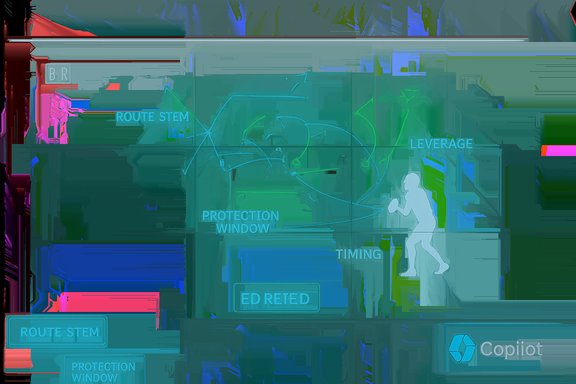
Ed Reed’s short, Copilot‑assisted film study of Drake Maye compresses high‑level defensive strategy, coaching pedagogy, and a real‑world product demonstration of Microsoft’s Copilot tooling into a neat, shareable clip — and it’s worth unpacking both for the football lessons and for what it reveals about AI in sports media production. The Yardbarker post hosting the clip points viewers to a Bleacher Report video in which Reed uses on‑screen callouts and tight narration to outline how he would game‑plan against the North Carolina‑developed quarterback; that page is explicitly branded with Microsoft Copilot as the enabling technology.
Background / Overview
Ed Reed’s credentials as a Hall of Fame safety give the clip immediate credibility: his instincts and tape reading are a teachable starting point for fans and coaches alike. What changes here is the tooling. Microsoft’s Copilot — and the visual overlay/production chain it enables — turns a verbal film room note into pixel‑level evidence on screen, synchronizing Reed’s narration with route stems, protection windows, and defensive leverage markers. That makes the micro‑mechanics visible to casual viewers and accelerates production workflows for publishers. The Yardbarker host page notes that the clip was originally posted to Bleacher Report and that Microsoft Copilot branding is present in the metadata. This article does three things: it summarizes what Reed’s segment teaches about defending a quarterback like Drake Maye; it explains the technical anatomy of the Copilot overlay and production workflow; and it critically assesses the risks — editorial, privacy, and procurement — that accompany fast, AI‑assisted sports film study. Where possible, technical and hardware claims are cross‑checked against vendor documentation and independent reporting so readers can separate marketing from verifiable capability.What the clip actually shows: Reed’s defensive thesis
The coaching spine (short, repeatable sequences)
Reed’s breakdown follows a time‑tested coaching template: use a precise timing throw or schematic pass to force defenders into conflict and widen pursuit angles, then finish with a compact, downhill run to exploit opened lanes. The clip combines slowed replays, synchronized callouts, and succinct narration to highlight:- Protection clarity — how simplified line/back rules create a 3–3.5 second window for the QB.
- Route engineering and stems — how receiver stems are designed to force linebacker hesitation or split reads.
- Leverage and tackle technique — why securing inside shoulder and gap integrity matter on short‑yardage finishes.
What Reed emphasizes about Drake Maye specifically
When Reed addresses a player like Drake Maye — a high‑ceiling, mobile, strong‑armed quarterback with known strengths and weaknesses from the college game — the emphasis is tactical realism rather than schematic novelty:- Make Maye operate in structure: simplify protection alignments and add stunt/blitz patterns that take advantage of processing delays under pressure.
- Force him to throw to narrow windows by eliminating the easy stem‑to‑YAC corridors; emphasize deep leverage and contested catch prep.
- Protect gap integrity and apply low‑center‑of‑gravity anchors on short‑yardage pushes to blunt quarterback runs and push‑style finishes.
The technical anatomy: how Microsoft Copilot is being used in the production
Visual alignment and on‑screen callouts
What makes Reed’s segment visually explicit is overlay technology that can trace receiver stems, identify blocking combos, and annotate defender leverage in exact frame sync with the audio. The result is a “see what I mean” moment — viewers can watch a tackle’s shoulder orientation and immediately understand Reed’s verbal key. Publishers label this capability in their metadata and sometimes in episode credits as Copilot‑assisted.Script drafting, captions, and SEO automation
Generative tools in the editorial pipeline compress long film‑room monologues into succinct voiceovers, auto‑generate captions for accessibility, and suggest SEO copy for CMS ingestion. Those automations reduce manual work and increase throughput for social‑first publishers that need many short explainers. But automation must be followed by human verification: generative assistants can introduce narrative drift or hallucinate specifics if outputs aren’t vetted.Hybrid runtime and on‑device spotting
Practical deployments use a hybrid model: light on‑device processing for latency‑sensitive spotting and overlay placement, with heavier cloud reasoning for script generation, metadata, and distribution packaging. Microsoft and OEM messaging around Copilot+ PCs emphasize on‑device acceleration for privacy and latency reasons, but vendor hardware numbers are claims that should be validated with OEM datasheets and independent benchmarks. Microsoft’s developer guidance requires NPUs capable of approximately 40+ TOPS for many Copilot+ experiences — a clear procurement threshold for vendors and IT buyers.Cross‑checking the technical claims (verification)
Any time a vendor advertises hardware or runtime advantages, independent verification matters. Two independent touchpoints confirm the basic Copilot+ story:- Microsoft’s Copilot+ PC developer documentation explicitly lists an NPU performance guidance of around 40+ TOPS for on‑device AI features and includes a list of Copilot+ devices and silicon families that meet the bar. That documentation is the canonical vendor statement for procurement and developer planning.
- Reporting from mainstream tech outlets (The Verge, Windows Central, Axios) confirms Microsoft’s Copilot+ PC positioning and the industry debate over on‑device vs. cloud processing, including specific discussions around features like Recall and the push to include Intel and AMD platforms beyond Qualcomm. Those outlets independently covered the Copilot+ rollout and the privacy questions that followed. Treat vendor TOPS numbers as vendor‑stated performance targets until independent benchmarks corroborate them for specific SKUs.
Editorial strengths — why this format works
- Accessibility to expert insight: A Hall of Famer’s voice paired with on‑screen annotations democratizes advanced film‑room literacy for casual fans and youth coaches.
- Pedagogical clarity: Visual callouts reduce ambiguity; complex timing and leverage concepts become visible rather than abstract.
- Production efficiency: Copilot assistance with captions, scripts, and social‑ready edits lets publishers scale short explainers without multiplying editorial headcount.
The risks and trade‑offs
Editorial selection bias and small‑sample inference
Short highlights are selection engines: editors intentionally choose the most persuasive clips to support a narrative. One Reed‑annotated vignette is instructive, not conclusive. Analysts and teams must pair clips with snap‑by‑snap metrics before making systematic claims about a player’s season‑long tendencies. The film‑room materials and producer notes repeatedly warn against extrapolating from a single highlight.Generative hallucination and narrative drift
When AI drafts voiceover scripts or captions, it can invent context or overstate causality. Human verification is necessary: verify yardage, play‑clock context, and player status (injury, substitution) against the official play‑by‑play before publishing definitive claims. The editorial workflow should treat Copilot outputs as first drafts, not final copy.Privacy, telemetry, and tracking on hosting pages
Highlight pages are ad‑funded telemetry endpoints — cookies, pixels, and measurement scripts collect audience signals. Publisher cookie preference centers help, but server‑side identifiers and fingerprinting can persist beyond client toggles. For privacy‑conscious viewers, the practical defenses include InPrivate/Incognito browsing, strict tracking prevention, and targeted blockers (bearing in mind some players disrupt playback when blockers are active). If producers are handling embargoed or sensitive footage, they should keep payloads in controlled environments and apply DLP and logging.Governance for production teams
If a studio uses Copilot Vision or agentic features in production, the integration must be covered by:- Data Loss Prevention (DLP) policies for creative assets.
- Audit trails and logging for agent actions and editorial changes.
- Role‑based access and revocable permissions for agents that can read, edit, or publish content.
- Contractual clarity on what processing runs locally vs. in the cloud.
Practical coaching takeaways for defending Drake Maye (actionable list)
- Prioritize simplified protections on scripted timing concepts to reduce quarterback processing time and deny Maye clean rhythm. Simple slide protections and consistent RB chip‑and‑release can preserve the timing windows for defenders to react.
- Engineer route coverage that attacks the intermediate stem lanes Maye favors; eliminate easy half‑field YAC alleys by squeezing leverage and applying bracket coverage on high‑value targets.
- Practice gap integrity and low‑center‑of‑gravity anchor points at interior positions to blunt push‑style short‑yardage finishes and designed QB sneaks or power QB runs.
- Use pre‑snap disguise and purposeful stunt packages to force Maye into quick decisions; when he’s forced off his mark or scrambling, his decision‑making and intermediate accuracy issues are likeliest to surface.
- Combine film‑room vignettes with objective snap‑by‑snap metrics before making personnel or schematic changes — treat Reed’s clip as a coaching starting point, not an instruction manual.
Verifying the football claims: cross‑reference with scouting reports
To place Reed’s tactical prescriptions in context, it’s useful to compare them against independent scouting reports about Drake Maye:- PFF’s scouting profile highlights Maye’s elite arm strength and playmaking while noting recurring issues with intermediate accuracy and performance under pressure. That matches Reed’s suggestion to force structure and pressure.
- Pro Football Network and other draft evaluators similarly document Maye’s mobility and arm talent, coupled with inconsistent footwork and occasional poor decisions when pressured — again supporting the idea that pressure and quick reads are key to containing him.
Recommendations for publishers, IT leaders, and fans
For publishers and content editors
- Use Copilot for draft overlays and captions, but require human sign‑off on every factual metric (yardage, time, player IDs).
- Publish a short methodology note on highlight pages when important numbers are cited (e.g., “Yardage per official play‑by‑play”).
- Log agent actions and maintain role‑based access for any production agent.
For IT administrators and rights holders
- Pilot Copilot Vision and agent features in controlled environments with DLP, Intune policies, and audit logging before broad rollout.
- Contractually require vendors to disclose what processing runs locally versus in the cloud and request OEM datasheets for NPU performance.
- Prefer private‑cloud or on‑prem handling of raw media for high‑value or embargoed assets.
For fans and privacy‑conscious viewers
- Watch annotated clips for teaching value, not as conclusive proof of season‑long phenomena.
- Use InPrivate mode or stricter tracking prevention settings when visiting highlight pages, and check the site’s cookie center to toggle off targeting cookies if you prefer less personalized advertising.
- If an embedded captioned yardage matters to your analysis, verify against the official gamebook or play‑by‑play before quoting numbers.
The broader implications for sports media and Windows users
Ed Reed’s Copilot‑assisted segment is a microcosm of two converging trends: expert voices becoming more accessible via short, teachable explainer formats, and AI tooling accelerating production and distribution. For readers who build content pipelines or purchase systems for creative teams, the episode underscores why vendor clarity matters: Copilot+ PCs and the promise of on‑device inferencing reduce latency and improve perceived privacy, but the claim set (NPUs at 40+ TOPS, inference distribution between device and cloud) must be validated against OEM hardware and independent benchmarks before procurement decisions are finalized. Microsoft’s own documentation and industry reporting make these expectations explicit, but they remain vendor‑anchored until device‑level validation. If governance and editorial checklists scale along with production capabilities, the industry benefits: higher‑quality explainers, wider access to expert knowledge, and improved accessibility through automated captions. If governance lags, the result will be accelerated distribution of persuasive but under‑verified narratives and an expanded telemetry surface for ad tech on highlight pages.Conclusion
Ed Reed’s Copilot‑augmented film study of how he would game‑plan against Drake Maye is a compact, high‑value example of modern sports production: expert analysis made visible, optimized for social distribution, and built with AI tools that speed production. It demonstrates the pedagogical power of synchronized overlays and focused narration while also surfacing substantive governance questions about editorial selection, AI‑generated copy, telemetry on hosting pages, and hardware procurement claims.For coaches and analysts, Reed’s tactical points are useful coaching starters: pressure, structure, leverage, and disciplined gap integrity are repeatable counters to a high‑upside, off‑structure quarterback. For publishers and IT leaders, the takeaway is operational: adopt Copilot‑enabled workflows, but do so with mandatory human verification, DLP, audit trails, and a demand for OEM performance data. For Windows users and fans, the segment is worth watching — both for football insight and as a case study in how Copilot is reshaping content creation — but watch with a critical eye and verify numerical claims against the official play‑by‑play when precision matters.
Source: Yardbarker Watch: Ed Reed breaks down how he'd gameplan against Drake Maye @Microsoft.Copilot
