

Cloudflare’s move to run LLM inference at the edge — powered by a Rust engine called Infire and integrated with its global Workers AI platform — is more than a technical curiosity: it is a deliberate attempt to rewire the cost economics of AI inference by shifting how and where GPUs, CPUs, and storage are used, and by squeezing more throughput from every dollar of infrastructure investment. The result is a new cost curve for latency-sensitive inference that challenges the default “centralized hyperscaler = cheapest at scale” assumption and forces a re-evaluation of how enterprises should architect and buy AI services going forward.
Cloudflare announced Infire in a detailed engineering blog post describing an LLM inference engine written in Rust and optimized for Cloudflare’s edge PoPs. The engine is built around three components — an OpenAI‑compatible HTTP server, a batcher, and the inference engine that runs kernels on NVIDIA Hopper-class GPUs — and it pulls model weights from Cloudflare’s R2 object storage, caching them on the edge node for subsequent cold-start avoidance. The company reports significantly reduced CPU overhead, fast model startup times (for some models under four seconds) and GPU utilization rates in the 80%+ range under production-like loads. That architecture and operational model directly target two issues that have emerged as the AI industry scales rapidly:
The critical next step for IT leaders is empirical: run representative pilots, instrument cost‑per‑use, and build an orchestration fabric that lets you pick the cheapest correct path for each inference call. If Infire’s early technical gains scale as Cloudflare claims, edge inference will be a durable and economically attractive option for a growing subset of AI workloads — and that alone will reshape the vendor conversations, procurement models, and architecture patterns enterprises adopt for the next phase of AI production.
Source: The Globe and Mail Can Cloudflare's Edge AI Inference Reshape Cost Economics?
 Background / Overview
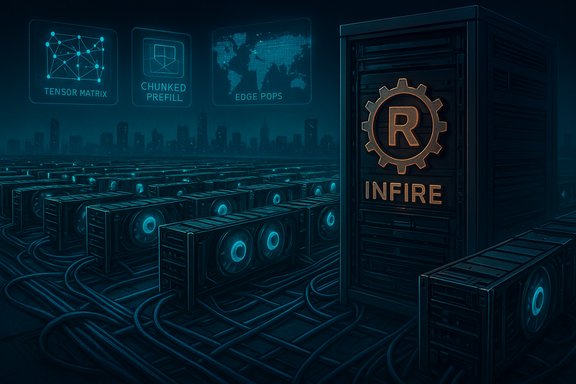
Cloudflare announced Infire in a detailed engineering blog post describing an LLM inference engine written in Rust and optimized for Cloudflare’s edge PoPs. The engine is built around three components — an OpenAI‑compatible HTTP server, a batcher, and the inference engine that runs kernels on NVIDIA Hopper-class GPUs — and it pulls model weights from Cloudflare’s R2 object storage, caching them on the edge node for subsequent cold-start avoidance. The company reports significantly reduced CPU overhead, fast model startup times (for some models under four seconds) and GPU utilization rates in the 80%+ range under production-like loads. That architecture and operational model directly target two issues that have emerged as the AI industry scales rapidly:- The rising share of recurring inference costs in AI product economics, which makes efficient per‑token serving crucial; and
- The mismatch between highly distributed user demand and centralized inference capacity, which creates latency, egress, and utilization inefficiencies when traffic must be backhauled to remote cloud regions.
Why inference economics matter now
- The per‑unit (per‑token or per‑call) cost of inference has improved dramatically over the last 24 months due to quantization, distillation, better runtimes and architectural advances — yet vendor pricing and customer bills have not necessarily fallen at the same pace. Cheaper tokens spur higher volumes and new embedded use cases, which can raise total spending even while unit costs fall.
- At scale, inference becomes a long‑lived, recurring operational cost that can exceed the one‑time training bill. Enterprises running hundreds of thousands or millions of prompts per month must therefore optimize the operational stack (CPU, GPU, memory, network, caching) to get predictable margins. Many vendors and analysts now frame the central engineering problem as reducing the cost per useful response rather than chasing raw model size.
- Finally, capacity constraints are not just about GPUs. Data center power, permitting, DRAM availability, and “warm shell” space to plug racks into matter — meaning that the ability to monetize hardware quickly and to maximize utilization matters as much as raw purchase price. Hyperscalers have responded with enormous capital programs, but that creates tension between capex commitments and short‑term revenue realization.
How Infire actually works (technical overview)
Three-engine architecture
Infire is intentionally compact and targeted:- OpenAI‑compatible HTTP server: built on a high-performance Rust HTTP crate (hyper) to handle many concurrent connections with low CPU cost.
- Batcher: schedules requests to maximize GEMM sizes on the GPU via continuous batching and chunked prefill, increasing effective throughput per kernel launch.
- Infire engine: JIT‑compiles CUDA kernels (PTX) tuned to the exact model and GPU, leverages fine‑grained CUDA graphs, and uses a paged KV cache for long contexts to avoid ballooning memory usage.
Key performance techniques
- Continuous batching + chunked prefill: mixes prefill tokens (all available up front) with live decode tokens to create larger matrix‑multiply (GEMM) workloads, improving Tensor Core utilization and memory bandwidth efficiency.
- Paged KV cache: avoids pre‑allocating full context KV buffers, enabling many concurrent prompts without exhausting GPU memory for the typical case where most prompts have much shorter contexts than the maximal window.
- JIT and CUDA graphs: kernels are compiled for the model’s parameters and GPU; CUDA graphs reduce per‑kernel-launch overhead and speed repeated execution paths.
- Parallel loading + JIT: model weight transfer from R2 to node-local storage and in‑process JIT combine to reduce startup time (Cloudflare reports under four seconds for Llama‑3‑8B in their test setup).
Storage + startup flow
Infire downloads model weights from R2 when a model is scheduled to run and caches them locally on the edge node for subsequent startups. Using page‑locked host memory and asynchronous CUDA copies, Infire parallelizes weight transfer with kernel compilation to shorten cold‑start latency — a crucial factor for edge nodes where spare capacity per location is limited.Measured gains
Cloudflare’s published internal benchmark (ShareGPT v3, 4,000 prompts, concurrency 200, H100 NVL) showed:- Infire: ~40.9 requests/s, ~17.2k tokens/s, ~25% CPU load
- vLLM (bare): ~38.4 req/s, ~16.1k tokens/s, ~140% CPU load
- vLLM under gVisor (edge sandbox): degraded throughput and far higher CPU usage
Cloudflare reports GPU utilization upward of 80% on their edge nodes running Infire, translating to fewer GPUs in service to hit the same throughput.
Why the edge can change cost math
There are three levers where an edge-first inference fabric can reshape economics:- Latency-driven revenue and product design
- Running models closer to users reduces round-trip time, enabling richer real‑time experiences (interactive agents, voice assistants, low-latency retrieval) that are hard to deliver from distant hyperscale regions.
- Lower latency also reduces the amount of engineering (retry logic, longer timeouts, additional caches) required in front-end stacks, which lowers operational overhead.
- Lower egress and data gravity costs
- Keeping inference (and sometimes retrieval/RAG) near the data avoids repeated egress of context data through the public cloud, lowering both latency and bills for bandwidth‑sensitive applications.
- Higher effective utilization per GPU
- By optimizing the host stack (Rust vs Python runtimes), reducing CPU overhead from sandboxing, and batching aggressively for the edge’s workload mix, an edge engine like Infire can achieve significantly higher utilization on the same GPU hardware — a direct capex amortization benefit. Cloudflare’s real-world tests show this effect.
How this differs from hyperscalers’ path
Hyperscalers (AWS, Microsoft, Google) pursue a partially opposite playbook:- Buy capacity and build centralized GPU farms and/or custom silicon, then monetize by renting those cycles at scale.
- Emphasize global, centralized services that integrate storage, identity, analytics and AI tools under one bill of materials.
- Offer hybrid/edge features to reduce latency (e.g., Lambda@Edge or Azure Arc/Azure Local), but the dominant economic model remains tied to regional/cloud data centers.
- Centralized GPUs can face the “GPU utilization paradox”: large investments are needed to guarantee capacity, but utilization can be low because of CPU bottlenecks, network tail latencies, and the challenge of matching highly variable, localized demand with centralized capacity. Cloudflare claims Infire reduces that mismatch by co‑locating compute and reducing CPU overhead.
- Hyperscalers counter with hybrid offerings:
- AWS: Lambda@Edge and CloudFront Functions let customers run logic closer to users to reduce latency and offload origin traffic; however, Lambda@Edge operates in regional edge caches and has runtime constraints vs a full GPU inference platform. Lambda@Edge is optimized for short‑lived functions and lacks the GPU inference footprint that a dedicated edge inference service would require.
- Microsoft: pushes a hybrid strategy with Azure Arc, Azure Local (formerly Stack HCI/Stack family) and Edge RAG — letting customers run Azure services (including ML and inference) on customer-owned hardware with Azure’s control plane. That approach preserves integration with Azure’s enterprise stack while allowing on‑prem/edge deployment for latency and data residency reasons. It’s a different trade: keep the cloud control plane, not necessarily the cloud economics.
Strengths of Cloudflare’s approach
- Engineering efficiency: Rewriting inference server code in Rust avoids Python interpreter overhead and sandboxing penalties that are significant at the edge. The resulting lower CPU load frees host cycles for other infrastructure tasks and increases GPU utilization. Cloudflare’s own benchmarks illustrate this point.
- Edge cache + R2 integration: Downloading weights from R2 and caching them on the node lets Cloudflare amortize cold-starts and start delivering inference quickly on repeated or geographically concentrated demand patterns.
- Distributed footprint: Cloudflare already operates PoPs in many metro areas and carrier hotels; placing inference there reduces latency for distributed user bases — a practical win for interactive applications and for regional compliance scenarios.
- Opportunistic capex conversion: Running faster revenue-generating workloads on rented or colocated hardware (or using existing edge racks) can shorten the interval between capacity deployment and monetization, reducing the financing drag on AI capex. This agility can be a competitive advantage in markets with immediate demand surges. (This specific claim about financing cadence is plausible and consistent with distributed colo economics, but it varies by contract and is not universally verifiable without vendor contract detail. Flag: the claim that Cloudflare can reliably “generate revenue before fully paying for hardware” depends on commercial terms (leasing vs purchase) and accounting treatment and should be validated in finance disclosures for contract-level confirmation.
Risks, limitations and caveats
- Model size and multi‑GPU limits: Infire’s initial focus is single‑GPU models and mid‑sized LLMs (e.g., 8B‑scale models). Larger models (100B+) and training or very large-context inference still favor centralized, multi‑GPU pods due to memory and interconnect requirements. Cloudflare has signalled multi‑GPU work is on the roadmap, but that’s a non‑trivial engineering lift.
- Workload fit: Edge inference is most compelling for latency‑sensitive, regionally distributed workloads, or for those where egress/privacy matters. Global, synchronous, high‑throughput batch inference (data processing at scale) still benefits from hyperscaler economies and TPU/pod-style aggregation in many cases. Choosing the right inference topology remains workload-dependent.
- Model governance and portability: Highly optimized inference stacks can introduce vendor‑specific runtimes and observability metadata that complicate migration. Buyers seeking portability should insist on standard formats, reproducible quantization flows, and exportable observability artifacts. This remains a procurement risk with specialist stacks.
- Capital and supply constraints at scale: While edge nodes can defer some capex timing and use off‑the‑shelf hardware, overall industry capacity limits (GPUs, power, DRAM, site permitting) persist. If every competitor adopts an edge strategy, the supply dynamics could tighten locally and globally.
- Unverified performance claims and benchmarking: Some performance claims — particularly comparative or “up to X%” numbers — are workload dependent. Independent pilots are essential. Published microbenchmarks are useful engineering signals but must be tested under representative, production traffic.
Practical procurement and architecture guidance (for WindowsForum readers and IT teams)
- Inventory the actual latency and data residency needs of each AI use case. Use edge inference when user experience or privacy materially benefits. Otherwise, favor centralized inference for scale and lower ops overhead.
- Design model orchestration layers so workloads can be routed to the most cost‑effective location (edge vs regional cloud). That means standard model formats, containerized runtimes, and a policy engine for routing.
- Run a short proof‑of‑concept:
- Build a production‑like traffic profile (token lengths, concurrency, tail events).
- Test both edge (Infire/Workers AI) and cloud endpoints, measuring P50/P95/P99 latency, cold‑start behavior and cost per useful reply.
- Validate startup time and model swap latency for rapid scaling events.
- Negotiate commercial terms that reflect reserved capacity and failover options. If inference is critical, insist on explicit P50/P95/P99 targets, and auditability (SOC2/ISO artifacts) for security and compliance claims.
- Instrument cost per inference as a first‑class metric. Track tokens, latency, egress, and downstream processing costs (vector DB lookups, retrievals) and use that to guide model selection and routing.
Competitive responses and where hyperscalers will press back
Hyperscalers possess three natural counters:- Hybrid offerings & local stacks (Azure Arc / Azure Local): Microsoft’s work to enable Azure services on customer-owned hardware — including Edge RAG and Azure Local — is specifically designed to satisfy low-latency, compliance, and sovereignty use cases while keeping enterprises inside Microsoft management and billing constructs. That reduces the switching incentive for customers who want edge-like behavior without changing cloud providers.
- Edge function services (AWS Lambda@Edge, CloudFront functions): AWS offers code‑at‑the‑edge for logic close to users, and will continue to evolve edge compute products; however these runtimes are not currently built for heavy GPU inference at each location — they are optimized for lightweight, event-driven compute. For full GPU‑backed inference, AWS would either evolve CloudFront/Local zones or offer integrated services pairing edge CPUs with nearby regional accelerators.
- Custom silicon and pod aggregation: Google (TPUs/Ironwood-style family) and hyperscalers’ custom accelerators will continue to chase price/performance on large models, especially for massive, centralized workloads and very large context inference. Those economics favor hyperscalers for the largest, most consolidated AI workloads.
- Edge players (Cloudflare, specialist neoclouds) win for latency‑sensitive, geographically distributed, or regulatory‑sensitive inference.
- Hyperscalers dominate heavy centralized training and some large‑context inference that benefit from pod‑scale aggregation and custom silicon.
- Most enterprises adopt hybrid architectures that balance both, using orchestration layers to pick the right runtime for each call.
Market signal: valuation and investor perspective
Cloudflare’s stock performance and forward valuations reflect investor enthusiasm about the company’s ability to monetize edge compute and AI features. Zacks and related analyst writeups in mid‑2025 show a forward price‑to‑sales ratio in the mid‑20s range and consensus estimates projecting revenue growth — signaling that market participants expect AI productization to raise ARPU and justify a multiple premium. That premium is conditional on durable unit economics and the ability to convert AI features into sticky enterprise contracts. These assumptions should be stress‑tested in buyer pilots and finance models. Investors should watch:- Capex cadence and the speed at which new edge GPU capacity converts into paying workloads.
- Evidence of improved gross margins on AI products (cost per token or cost per session).
- Customer wins that tie AI features to recurring enterprise contracts rather than one‑off trials.
Bottom line — when edge inference makes sense
- Use edge inference (Cloudflare/Infire style) when: low latency matters, data residency reduces egress or compliance risk, user distribution is wide and geographically dispersed, or when you can quantify the per‑prompt business value enough to offset any premium for running outside hyperscaler cores.
- Use centralized hyperscaler inference when: you require extremely large models (100B+), need the absolute best price/performance for batch or high‑volume centralized workloads, or want the operational simplicity of an integrated cloud management stack.
- For most enterprises the right answer is hybrid: fix the orchestration layer, standardize model artifacts, and route intelligently. That preserves choice and captures the best economics of both worlds while avoiding vendor lock‑in.
The critical next step for IT leaders is empirical: run representative pilots, instrument cost‑per‑use, and build an orchestration fabric that lets you pick the cheapest correct path for each inference call. If Infire’s early technical gains scale as Cloudflare claims, edge inference will be a durable and economically attractive option for a growing subset of AI workloads — and that alone will reshape the vendor conversations, procurement models, and architecture patterns enterprises adopt for the next phase of AI production.
Source: The Globe and Mail Can Cloudflare's Edge AI Inference Reshape Cost Economics?
