

The industry needs a clean, auditable, vendor‑neutral way to compare the real cost of running generative AI in production — not just raw token throughput or peak teraflops, but price/performance at system scale including power, amortized hardware cost, and usable, reproducible workloads — and the time to build that benchmark suite is now. This is the central argument of a recent NextPlatform piece calling for a modern equivalent of the database‑era TPC benchmarks to tame the chaos of AI inference purchasing, and it is a sensible, urgent call to action for enterprises, cloud providers, and vendors alike. rview
For three decades the database world used standard, auditable benchmarks to align buyers, sellers, and researchers on what “good performance” actually meant in the datacenter. The Transaction Processing Performance Council (TPC) — born from Jim Gray’s DebitCredit work in the 1980s and formalized into TPC‑A, TPC‑B, and the now‑classic TPC‑C tests — introduced an industry language for throughput, cost per transaction, and disclosure of tuning practices that transformed procurement and product engineering. Those efforts are documented in the TPC historical record and in Jim Gray’s early publications on transaction processing and price/performance measurement.
AI inference today is at the same inflection point the relational database market once was: a technology that has moved from research to mainstream adoption, fueled by massive spending and a widening field of hardware alternatives. But unlike the relational era — where a few well‑defined workload classes (transaction processing, decision support) could be captured by a manageable set of benchmarks — modern inference workloads are heterogeneous: short interactive prompts, long‑context multi‑agent streams, multimodal vision‑language workloads, recommendation engines with massive embedding tables, and large generative pipelines that mix RAG (retrieval‑augmented generation) and distilled models. The result is that vendors and cloud providers publish performance numbers that are difficult to compare, while buyers struggle to translate an MLPerf score or a vendor data‑sheet into a budget for a five‑ or ten‑year deployment.
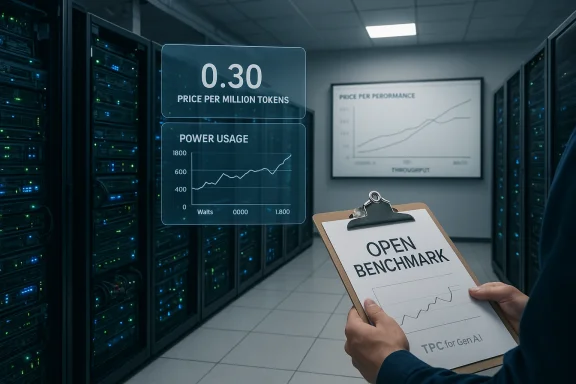
That friction matters. Enterprises want to buy and run inference systems for long periods, often amortizing hardware and running it at high utilization. Procurement decisions hinge not just on tokens/second but on dollars per million tokens, performance per watt, latency tail characteristics, and the ability to serve real, production traffic without exotic tuning. The industry needs a benchmark suite built for that reality.
But MLPerf purposely focuses on performance correctness and repeatability rather than procurement economics. While MLPerf includes optional power runs and tooling for power measurement in its power‑dev repo, it does not publish system price or amortized acquisition/rental cost as part of the canonical results table, and it does not provide a single, auditable “price/performance” metric that captures acquisition plus operating cost per useful unit of work (e.g., per million tokens or per 99th‑percentile interactive query). That omission leaves an enormous blind spot for buyers: you can know which machine runs a benchmark fastest, but not which one is most economical at your utilization and latency constraints.
A properly designed benchmark — one that marries the rigor of MLPerf’with the TPC era’s price/performance clarity and a modern emphasis on power and accuracy — would be transformational. It would give engineering teams realistic, reproducible measures to design against, and it would give procurement a defensible way to compare systems on total cost of ownership rather than on headline FLOPS.
This is not just an academic exercise. The stakes are commercial and systemic: lower token costs, more affordable access to inference at scale, and a healthier market with multiple economically viable accelerator choices. If done right, a benchmark authority — a Jim Gray for the GenAI age — will not only clarify the market but accelerate the innovation that makes large‑scale inference affordable for every organization, not just the hyperscalers. The time to start is now.
Source: The Next Platform We Need A Proper AI Inference Benchmark Test
For three decades the database world used standard, auditable benchmarks to align buyers, sellers, and researchers on what “good performance” actually meant in the datacenter. The Transaction Processing Performance Council (TPC) — born from Jim Gray’s DebitCredit work in the 1980s and formalized into TPC‑A, TPC‑B, and the now‑classic TPC‑C tests — introduced an industry language for throughput, cost per transaction, and disclosure of tuning practices that transformed procurement and product engineering. Those efforts are documented in the TPC historical record and in Jim Gray’s early publications on transaction processing and price/performance measurement.
AI inference today is at the same inflection point the relational database market once was: a technology that has moved from research to mainstream adoption, fueled by massive spending and a widening field of hardware alternatives. But unlike the relational era — where a few well‑defined workload classes (transaction processing, decision support) could be captured by a manageable set of benchmarks — modern inference workloads are heterogeneous: short interactive prompts, long‑context multi‑agent streams, multimodal vision‑language workloads, recommendation engines with massive embedding tables, and large generative pipelines that mix RAG (retrieval‑augmented generation) and distilled models. The result is that vendors and cloud providers publish performance numbers that are difficult to compare, while buyers struggle to translate an MLPerf score or a vendor data‑sheet into a budget for a five‑ or ten‑year deployment.
That friction matters. Enterprises want to buy and run inference systems for long periods, often amortizing hardware and running it at high utilization. Procurement decisions hinge not just on tokens/second but on dollars per million tokens, performance per watt, latency tail characteristics, and the ability to serve real, production traffic without exotic tuning. The industry needs a benchmark suite built for that reality.
 Why existing benchmarks fall short
MLPerf is necessary but not sufficient
MLPerf Inference has driven clarity by providing standardized workloads, test rules, and published results across vendors and clouds; the suite continues to evolve — v6.0 added new multimodal and recommendation workloads and had a submission window with a February 13, 2026 deadline. MLCommons’ MLPerf remains the de facto technical baseline for comparing raw throughput and latency across accelerators and systems.But MLPerf purposely focuses on performance correctness and repeatability rather than procurement economics. While MLPerf includes optional power runs and tooling for power measurement in its power‑dev repo, it does not publish system price or amortized acquisition/rental cost as part of the canonical results table, and it does not provide a single, auditable “price/performance” metric that captures acquisition plus operating cost per useful unit of work (e.g., per million tokens or per 99th‑percentile interactive query). That omission leaves an enormous blind spot for buyers: you can know which machine runs a benchmark fastest, but not which one is most economical at your utilization and latency constraints.
Vendor micro‑benchmarks and cloud token pricing are incomplete
Cloud price lists and vendor microbenchmarks — and specialized lab projects like SemiAnalysis’s InferenceMAX / InferenceX — are useful and insightful, but they typically test a narrower set of models, lack system‑level acquisition costs, or are run on rented instances rather than fully costed acquisitions. SemiAnalysis’s InferenceMAX (now sometimes referenced as InferenceX) includes estimated cost per million tokens and compares different GPU/accelerator families, which fills an important gap, yet its coverage is limited and often focused on the hottest box configurations rather than the full lifecycle costs and fleet economics enterprises need to evaluate.Hidden variables make apples‑to‑apples comparisons difficult
Real inference costs are a function of many non‑linear factors:- Model architecture and quantization (FP16, INT8, 4‑bit, FP4/FP8) change the compute profile.
- Context length and caching strategies (e.g., KV cache for attention layers) alter memory requirements drastically.
- Networking topology, scale‑up fabrics, and interconnects (NVLink, proprietary switch fabrics, or Ethernet scale‑up) alter multi‑chip scaling efficiency.
- Memory capacity per engine (HBM stacks) constrains what models you can host, especially for very large context windows.
- Power, cooling, and datacenter facility costs differ greatly between cloud regions and on‑prem deployments.
What a proper AI inference benchmark suite must measure
To be useful for enterprise procurement and to encourage healthy competition among vendors, a modern inference benchmark must do more than measure peak throughput. It must define a set of workload classes, measurement practices, and economic metrics that together answer the buyer’s real questions.Core workload classes (must include)
- Interactive conversational inference — short prompts, tight latency SLAs (P50, P95, P99).
- High‑throughput batch generation — long‑context token generation at maximum throughput (useful for offline content generation).
- Long‑context / persistent agent streams — multi‑agent sessions with 100k+ token contexts and RAG pipelines.
- Generative recommendation — embedding heavy workloads with billion‑scale item tables and heavy KV lookups (new in MLPerf v6.0; a real enterprise requirement).
- Multimodal inference — vision+text/video+text workloads (added to MLPerf v6.0 and increasingly important).
- Edge / cost‑constrained inference — resource‑limited, privacy‑sensitive on‑device scenarios.
Key metrics (must report)
- Tokens per second (throughput) — for both batch and streaming.
- Latency distribution — P50/P90/P95/P99 and cold‑start latency.
- Accuracy / utility — standard quality metrics for the target workload (per‑model).
- Power draw (Watts) — measured at the system PDU with standardized procedures (MLPerf has a power path but it’s optional; we must normalize it).
- Acquisition cost (CAPEX) and amortized cost — two views: purchase price amortized over useful life (e.g., 3‑ or 5‑year) and multi‑year rental equivalent.
- Operating cost (OPEX) — power cost at a normalized regional rate, cooling overhead, and maintenance.
- Price per useful unit — e.g., dollars per million tokens for a specified latency SLO and accuracy threshold.
- System footprint and utilization curve — how performance scales and where marginal cost jumps occur.
Test governance and reproducibility
- Open, auditable test harnesses — reference implementations and scripts that reproduce runs (public Git repos).
- Mandatory disclosure of tuning and software stacks — every result must include compiler/driver/runtime versions and tuning knobs used.
- Third‑party auditing — independent labs or audit agents verify runs and system pricing.
- Versioning and traceability — benchmark revisions, model/weights commits, and dataset commits are recorded.
A practical blueprint: how to build the benchmark (step‑by‑step)
- Form a neutral, multi‑stakeholder working group (cloud providers, OEMs, hyperscalers, enterprises, academia). Think “TPC for GenAI.” The TPC model shows the power of consensus standards combined with independent audits.
- Define an initial v1.0 benchmark that focuses on three representative workloads: conversational (short latency), long‑context streaming (large memory), and recommendation (embedding heavy). Base model references on widely adopted open and permissively licensed weights to avoid legal friction.
- Standardize measurement methods for power and cost: PDUs for power, regional electricity rates for operating cost, and a pricing disclosure template that vendors must fill out (purchase price, warranty, support, typical discounts).
- Publish an open reference implementation and a conformance test harness. Encourage community submissions from both vendors and independent labs.
- Require full disclosure and audit trails: system config, firmware, software stack, and the exact commands used. Audited results are published to a neutral ledger with traceability.
- Iterate rapidly: open the spec to periodic revision (6–12 month cadence) to add new models and workload classes as the field evolves.
The strengths of this approach
- Actionable procurement data: Buyers get a single, auditable comparison that translates directly into budgetary terms — dollars per million tokens at defined SLAs — enabling objective TCO comparisons across architectures.
- Encourages meaningful competition: Vendors compete on economics, not just peak FLOPS; this drives innovation in power efficiency, memory packaging, and system co‑design.
- Reduces vendor marketing noise: A standardized metric set and audit trail cuts through selective benchmarking and borderline apples‑to‑oranges claims.
- Fosters ecosystem alignment: Like TPC’s effect on databases, a shared benchmark creates a common engineering target for hardware and software vendors to optimize toward.
Potential risks and failure modes (be candid)
- Benchmark gaming: Vendors can tune specifically for the benchmark. The industry must design tests that are hard to overfit and require disclosure of tuning tricks — the same problem that prompted TPC to require vendor disclosures in the 1990s.
- Legal / IP friction: Proprietary model weights or closed toolchains can prevent full reproducibility. We should prioritize open or licensed reference models to minimize this.
- Economic complexity: System price varies by region, reseller discounts, and enterprise procurement deals. Defining a single price reporting template will be hard, but transparency (list price + typical discount bands) is better than no data.
- Rapid obsolescence: The AI stack moves fast. A benchmark that is too heavyweight to update will quickly become irrelevant. The governance body must iterate rapidly.
- Power measurement variance: Datacenter PUE, cooling designs, and measurement technique can distort comparisons. Standardized PDU‑level measurement and common assumptions about PUE and electricity rates are necessary.
- Resistance from incumbents: Dominant suppliers may be reluctant to expose price/performance that could enable buyers to negotiate or move away. Neutral governance and industry pressure from large buyers will be needed.
Why now — market evidence and signals
Several developments make this the right time:- MLPerf v6.0 has expanded to include multimodal and generative recommendation workloads, signaling recognition that inference benchmarks must evolve with real production use cases; its v6.0 round had a February 13, 2026 submission deadline, showing the community’s rapid cadence of updates.
- New hyperscaler in‑house accelerators (for example Microsoft’s Maia 200 and Google’s Ironwood TPU v7) and vendor architectures are changing the competitive landscape; while technical claims abound, public, auditable price/performance data remains scarce. Google’s Ironwood was introduced as a TPU family designed for inference; independent reporting has documented its memory and throughput claims but public MLPerf submissions are a mixed picture and illustrate the gap between PR claims and audited results.
- Independent labs and analyst projects (e.g., SemiAnalysis’s InferenceMAX/InferenceX) are beginning to attach cost estimates to throughput measurements, proving both the appetite and feasibility for price‑aware benchmarking — but their coverage is still narrow and not governed by a neutral body.
What success looks like — concrete outcomes
- A published set of benchmark results that includes both performance and standardized price/performance metrics (e.g., $ per million tokens at defined latency SLOs).
- A public repository containing the benchmark harness, model commits, dataset commits, and run scripts for reproducibility.
- An audit program where independent labs verify both performance and cost claims before a result is listed as “certified.”
- A regularly updated spec (v1.0, v2.0, etc.) that reflects new workloads like multimodal inference and large recommender systems.
- Widespread adoption by enterprise procurement teams who use the metrics as part of RFP evaluations and TCO modeling.
Getting started: a short roadmap
- Convene an initial steering group drawn from large buyers (hyperscalers, financial services, retail), neutral non‑profits (MLCommons, TPC-like organizations), and independent labs.
- Publish a v1.0 spec within 90 days that focuses on three core workloads and a standardized pricing disclosure form.
- Run the first public round using volunteer systems from major vendors and independent labs to exercise the harness and reveal practical measurement challenges.
- Iterate on governance, anti‑gaming rules, and auditing processes before v1.1.
- Promote adoption by integrating the benchmark into procurement playbooks and encouraging public cloud providers to publish certified results.
Final analysis: why a benchmark matters to WindowsForum readers and enterprise IT
Enterprises don’t buy chips; they buy capacity: the ability to serve customers, power products, and automate workflows at predictable cost. As inference becomes an embedded utility in business applications, procurement teams will need defensible, auditable metrics to justify spending and to avoid vendor lock‑in driven by marketing claims or fleeting performance peaks.A properly designed benchmark — one that marries the rigor of MLPerf’with the TPC era’s price/performance clarity and a modern emphasis on power and accuracy — would be transformational. It would give engineering teams realistic, reproducible measures to design against, and it would give procurement a defensible way to compare systems on total cost of ownership rather than on headline FLOPS.
This is not just an academic exercise. The stakes are commercial and systemic: lower token costs, more affordable access to inference at scale, and a healthier market with multiple economically viable accelerator choices. If done right, a benchmark authority — a Jim Gray for the GenAI age — will not only clarify the market but accelerate the innovation that makes large‑scale inference affordable for every organization, not just the hyperscalers. The time to start is now.
Source: The Next Platform We Need A Proper AI Inference Benchmark Test
