

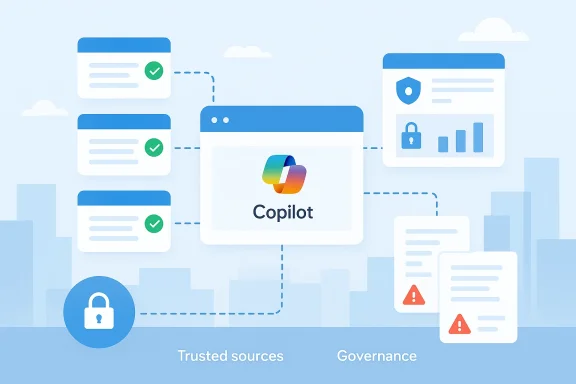
eGain’s latest Copilot-facing move is less about a flashy product debut and more about a familiar enterprise lesson: AI is only as useful as the knowledge it can trust. The company is positioning its AI-powered knowledge management approach as a way to help Global 2000 organizations get more from Microsoft Copilot by cleaning up the content layer beneath the assistant, not just adding another interface on top of it. That matters because Microsoft’s own guidance makes clear that Copilot can only reason over information users are already authorized to access, which means the quality, structure, and governance of enterprise knowledge are now central to AI value creation.
The announcement fits neatly into a broader market shift that has been building for more than a year. Enterprises spent the first wave of generative AI adoption experimenting with chatbots, drafting tools, and copilots, but many quickly discovered that impressive demos are not the same thing as reliable business outcomes. eGain has leaned hard into that distinction, arguing that the real bottleneck is not model capability but the underlying knowledge architecture that feeds those models. Its recent messaging around trusted knowledge, AI ROI, and hallucination risk shows that the company is selling governance as much as it is selling software.
That framing makes particular sense in Microsoft environments. Microsoft has been clear that Microsoft 365 Copilot works within existing permissions and tenant boundaries, and it has also published remediation guidance for oversharing, restricted content discoverability, and other controls that affect what Copilot can surface. In other words, organizations cannot treat Copilot like a magical search box; they have to treat it like a productivity layer sitting on top of a discipline problem. eGain is moving into that gap by pitching structured knowledge as the missing foundation.
There is also a commercial logic to the timing. The enterprise AI market is entering a phase where buyers are asking harder questions about return on investment, governance, and operational fit. The easy pitch is no longer enough. Vendors now need to show how AI reduces friction in real workflows, how it avoids hallucinated answers, and how it fits into the tools employees already use every day. eGain’s Copilot angle suggests it believes structured knowledge management can become a differentiator in exactly that environment.
For Microsoft, this kind of partner story is useful because it expands Copilot beyond generic productivity claims. The company has spent months reinforcing the idea that Copilot should become an embedded work layer across Microsoft 365, not just a standalone assistant. A partner like eGain helps make that narrative concrete by anchoring Copilot in knowledge operations, customer service, and other high-value enterprise use cases where trust and traceability matter. That is a much more defensible story than “AI for everything.”
The operational implication is that AI teams need to think like knowledge engineers, not just model integrators. They have to identify the authoritative answer, map it to the right process, and ensure the content is structured enough for both humans and machines. That is especially relevant in regulated or high-volume service environments where inconsistency is expensive. The more a company depends on broad AI rollout, the more it needs a single source of truth beneath the interface.
This also helps explain why eGain keeps emphasizing trusted knowledge rather than generic AI. In Microsoft terms, the problem is not just model output quality. It is the quality of the tenant data Copilot can surface, the consistency of the knowledge sources, and the ability to present answers that meet compliance and operational standards. A structured knowledge system is therefore not a nice-to-have; it is the thing that determines whether Copilot becomes a productivity tool or a liability.
eGain’s argument is that structured knowledge is the practical antidote. By organizing content around business questions, roles, and approved workflows, enterprises can reduce the chance that AI will improvise its way into bad advice. That is especially relevant in customer service, regulated industries, and HR-facing processes, where the cost of a wrong answer is higher than the cost of a slower answer. Speed without trust is a trap.
The ROI story becomes clearer when viewed through that lens. AI does not need to do everything to be valuable; it needs to remove enough friction to matter economically. If structured knowledge shortens resolution time, reduces escalation, and lowers training overhead, then it creates measurable value even before full automation arrives. That is one reason eGain continues to anchor its pitch in service and knowledge workflows rather than open-ended general intelligence.
The consumer market also tends to reward general-purpose assistants, while enterprise buyers want narrow competence. A proposal team, support desk, or HR operation does not need AI that can chat about anything; it needs AI that knows which answer is approved, which source is current, and which workflow step comes next. Structured knowledge is what makes that possible. Without it, AI becomes a fancy autocomplete layer.
This is why eGain’s Copilot strategy should be read as a workflow play rather than a branding play. The company is not trying to compete with the consumer experience of a mainstream chatbot. It is trying to sit beneath enterprise work and make that work safer, faster, and easier to standardize. That is a more durable value proposition, even if it is less glamorous.
Still, the market is not standing still. Microsoft itself continues to add more native capabilities, and a number of adjacent vendors are pushing data governance, search, and AI orchestration features that overlap with eGain’s pitch. That means eGain will need to keep proving that its knowledge method is better than a generic AI assistant plus a few governance tools bolted on the side. In enterprise software, good enough is rarely enough for long.
The upside for eGain is that knowledge quality is hard to fake. Vendors can market generative AI quickly, but they cannot easily manufacture trust, consistency, and content discipline. If eGain can demonstrate measurable reductions in handling time, training burden, or answer error rates, it can defend a premium story. That kind of evidence tends to carry more weight with CIOs and operations leaders than generic AI branding.
A second opportunity lies in helping enterprises rationalize their knowledge estates. Many organizations know they have too many versions of the truth, but they lack a practical route to consolidation. A Copilot-aligned knowledge layer gives them a reason to clean up content now, because the AI use case makes the business case immediate. That is a strong incentive structure.
Another concern is adoption complexity. Enterprises often agree in principle that they need better knowledge discipline, but operationalizing it can be slow and politically difficult. Content owners, security teams, business users, and IT all have different priorities, and AI projects can stall when those groups cannot agree on ownership. eGain will need to prove that its framework reduces complexity rather than adding another layer to manage.
Source: Traders Union EGain launches AI-powered knowledge management for Microsoft Copilot integration
 Overview
The announcement fits neatly into a broader market shift that has been building for more than a year. Enterprises spent the first wave of generative AI adoption experimenting with chatbots, drafting tools, and copilots, but many quickly discovered that impressive demos are not the same thing as reliable business outcomes. eGain has leaned hard into that distinction, arguing that the real bottleneck is not model capability but the underlying knowledge architecture that feeds those models. Its recent messaging around trusted knowledge, AI ROI, and hallucination risk shows that the company is selling governance as much as it is selling software.That framing makes particular sense in Microsoft environments. Microsoft has been clear that Microsoft 365 Copilot works within existing permissions and tenant boundaries, and it has also published remediation guidance for oversharing, restricted content discoverability, and other controls that affect what Copilot can surface. In other words, organizations cannot treat Copilot like a magical search box; they have to treat it like a productivity layer sitting on top of a discipline problem. eGain is moving into that gap by pitching structured knowledge as the missing foundation.
There is also a commercial logic to the timing. The enterprise AI market is entering a phase where buyers are asking harder questions about return on investment, governance, and operational fit. The easy pitch is no longer enough. Vendors now need to show how AI reduces friction in real workflows, how it avoids hallucinated answers, and how it fits into the tools employees already use every day. eGain’s Copilot angle suggests it believes structured knowledge management can become a differentiator in exactly that environment.
For Microsoft, this kind of partner story is useful because it expands Copilot beyond generic productivity claims. The company has spent months reinforcing the idea that Copilot should become an embedded work layer across Microsoft 365, not just a standalone assistant. A partner like eGain helps make that narrative concrete by anchoring Copilot in knowledge operations, customer service, and other high-value enterprise use cases where trust and traceability matter. That is a much more defensible story than “AI for everything.”
Why Structured Knowledge Matters Now
The core argument behind eGain’s pitch is simple: enterprise AI fails when the knowledge base is messy. That is not a new problem, but AI has made it more visible. When employees ask Copilot a question, they are not just looking for an answer; they are implicitly asking whether the answer can be trusted, traced, and reused. If the source material is fragmented, stale, or contradictory, the system can sound confident while still being wrong. That is the essence of the hallucination problem in enterprise settings.The hidden cost of content chaos
eGain’s own recent messaging has been unusually direct about the cost of poor knowledge hygiene. The company has described “content chaos” as a major drag on AI value, and it has argued that much of the ROI in knowledge work comes from a relatively small share of high-value content. That is a meaningful shift in perspective because it suggests organizations should stop trying to make every document AI-ready and instead focus on the material most likely to drive outcomes. That is a more realistic strategy for large enterprises than trying to sanitize everything at once.The operational implication is that AI teams need to think like knowledge engineers, not just model integrators. They have to identify the authoritative answer, map it to the right process, and ensure the content is structured enough for both humans and machines. That is especially relevant in regulated or high-volume service environments where inconsistency is expensive. The more a company depends on broad AI rollout, the more it needs a single source of truth beneath the interface.
- Better knowledge structure reduces rework.
- Fewer contradictory sources lower the risk of false answers.
- Governed content improves Copilot’s business utility.
- High-value articles deserve more attention than low-value archives.
- AI success increasingly depends on curation, not raw volume.
The Microsoft Copilot Angle
eGain’s decision to emphasize Microsoft Copilot is strategically smart because Copilot is where many enterprises have already started their AI journey. Microsoft has spent two years positioning Copilot as a work layer across Microsoft 365, Windows, Edge, and adjacent enterprise surfaces. That gives partners a broad distribution channel, but it also raises the bar: anything built around Copilot has to be trustworthy enough to live inside a production productivity stack.Copilot is not a shortcut around governance
Microsoft’s official documentation is explicit that Copilot operates within the user’s identity and access context, and that it only accesses data the user is authorized to view. Microsoft also recommends configuration steps such as restricted access control, restricted content discoverability, sensitivity labels, and permission remediation to reduce oversharing. That means partner solutions cannot assume Copilot will paper over bad data practices; they need to help enterprises fix them. eGain’s knowledge-centered strategy aligns with that reality.This also helps explain why eGain keeps emphasizing trusted knowledge rather than generic AI. In Microsoft terms, the problem is not just model output quality. It is the quality of the tenant data Copilot can surface, the consistency of the knowledge sources, and the ability to present answers that meet compliance and operational standards. A structured knowledge system is therefore not a nice-to-have; it is the thing that determines whether Copilot becomes a productivity tool or a liability.
- Copilot amplifies existing permissions.
- Copilot value rises when knowledge is curated.
- Governance tools matter as much as model performance.
- Microsoft’s ecosystem rewards partners that solve a concrete workflow problem.
- Structured content supports both humans and AI.
Hallucination Risk and AI ROI
The biggest strategic theme running through eGain’s recent messaging is that trust is the ROI gatekeeper. The company has highlighted survey findings that point to erroneous or inconsistent answers as a top concern for broad AI adoption, and it has tied that concern directly to the quality of the underlying content. This is important because it reframes hallucination from a model problem into an enterprise process problem.Why hallucinations are a business issue
In consumer AI, a hallucination may be annoying. In enterprise AI, it can create compliance exposure, customer dissatisfaction, or internal rework. That is why organizations buying Copilot-related solutions increasingly ask whether a system can distinguish between authoritative knowledge and merely plausible text. Microsoft’s own security documentation notes that users can review, modify, or reject AI-generated content, but that safeguard only works if the source material is solid in the first place.eGain’s argument is that structured knowledge is the practical antidote. By organizing content around business questions, roles, and approved workflows, enterprises can reduce the chance that AI will improvise its way into bad advice. That is especially relevant in customer service, regulated industries, and HR-facing processes, where the cost of a wrong answer is higher than the cost of a slower answer. Speed without trust is a trap.
The ROI story becomes clearer when viewed through that lens. AI does not need to do everything to be valuable; it needs to remove enough friction to matter economically. If structured knowledge shortens resolution time, reduces escalation, and lowers training overhead, then it creates measurable value even before full automation arrives. That is one reason eGain continues to anchor its pitch in service and knowledge workflows rather than open-ended general intelligence.
- Lower hallucination risk supports faster adoption.
- Trusted answers reduce downstream audit and remediation costs.
- Better knowledge design improves agent and employee productivity.
- ROI is easier to prove in repeatable workflows.
- Hallucination control is now a budget conversation, not just a technical one.
Enterprise Use Cases Versus Consumer Appeal
This announcement is overwhelmingly enterprise-focused, and that distinction matters. Consumer AI products win on novelty, fluency, and breadth of use cases. Enterprise AI wins on reliability, repeatability, and integration with existing systems. eGain’s messaging is aimed squarely at the second category, where the buyers care less about conversational polish and more about whether the assistant makes work faster without increasing risk.Different expectations, different economics
For consumer users, a bad answer is often a tolerable inconvenience. For enterprise users, it can be a process failure. That changes the economics of AI deployment because organizations have to account for compliance, knowledge curation, auditability, and training. Microsoft has made similar distinctions in its own Copilot guidance by emphasizing permissions, data boundaries, and remediation controls. eGain is building directly on that enterprise-first logic.The consumer market also tends to reward general-purpose assistants, while enterprise buyers want narrow competence. A proposal team, support desk, or HR operation does not need AI that can chat about anything; it needs AI that knows which answer is approved, which source is current, and which workflow step comes next. Structured knowledge is what makes that possible. Without it, AI becomes a fancy autocomplete layer.
This is why eGain’s Copilot strategy should be read as a workflow play rather than a branding play. The company is not trying to compete with the consumer experience of a mainstream chatbot. It is trying to sit beneath enterprise work and make that work safer, faster, and easier to standardize. That is a more durable value proposition, even if it is less glamorous.
- Enterprise buyers demand auditability.
- Consumer buyers reward breadth.
- Enterprise AI needs governance by design.
- Narrow workflow value can be more monetizable than broad novelty.
- Structured knowledge is the bridge between AI and policy.
Competitive Implications
The competitive significance of eGain’s move goes beyond one vendor announcement. The enterprise knowledge management market is crowded, and the rise of Copilot has effectively reset the rules. Vendors now need to prove that their systems can improve AI outcomes, not just manage documents or answer questions. That creates room for companies with strong knowledge discipline, but it also means the competition is shifting toward integration depth and governance credibility.Why integration is the new differentiator
Microsoft’s ecosystem is a major force multiplier here. Partners that can sit naturally inside Microsoft 365, SharePoint, Teams, and Copilot have a better story than standalone tools that require separate interfaces and separate governance models. That is especially true in Global 2000 environments, where procurement and deployment preferences often favor familiar platforms. eGain’s ability to position itself as a Copilot enabler rather than a replacement tool is a meaningful advantage.Still, the market is not standing still. Microsoft itself continues to add more native capabilities, and a number of adjacent vendors are pushing data governance, search, and AI orchestration features that overlap with eGain’s pitch. That means eGain will need to keep proving that its knowledge method is better than a generic AI assistant plus a few governance tools bolted on the side. In enterprise software, good enough is rarely enough for long.
The upside for eGain is that knowledge quality is hard to fake. Vendors can market generative AI quickly, but they cannot easily manufacture trust, consistency, and content discipline. If eGain can demonstrate measurable reductions in handling time, training burden, or answer error rates, it can defend a premium story. That kind of evidence tends to carry more weight with CIOs and operations leaders than generic AI branding.
- Microsoft-native positioning lowers adoption friction.
- Competition is moving from features to proof.
- Structured knowledge is harder to commoditize than a chat interface.
- Buyers want measurable workflow outcomes.
- Governance depth can become a moat.
Strengths and Opportunities
eGain’s strategy has several obvious strengths. It is aligned with Microsoft’s own security and permissions model, it addresses a genuine AI pain point, and it speaks to a budget owner’s obsession: measurable productivity. It also arrives at a moment when enterprises are trying to separate real AI value from speculative enthusiasm.- Trusted knowledge is a compelling answer to the hallucination problem.
- The approach fits Microsoft Copilot’s existing permissions model.
- Structured content can improve both human and AI performance.
- Knowledge governance is easier to justify than abstract AI experimentation.
- The value proposition is strongest in regulated and service-heavy industries.
- eGain can ride Microsoft’s enterprise distribution channel.
- The strategy supports repeatable ROI narratives for operations leaders.
A second opportunity lies in helping enterprises rationalize their knowledge estates. Many organizations know they have too many versions of the truth, but they lack a practical route to consolidation. A Copilot-aligned knowledge layer gives them a reason to clean up content now, because the AI use case makes the business case immediate. That is a strong incentive structure.
Risks and Concerns
The biggest risk is overpromising how much structure alone can fix. Better knowledge management is essential, but it is not a magic wand. If permissions are sloppy, if source content is outdated, or if the knowledge model is poorly governed, Copilot can still surface bad outcomes faster than before. Microsoft’s own guidance makes clear that organizations need remediation, labels, and access controls alongside any AI layer.Another concern is adoption complexity. Enterprises often agree in principle that they need better knowledge discipline, but operationalizing it can be slow and politically difficult. Content owners, security teams, business users, and IT all have different priorities, and AI projects can stall when those groups cannot agree on ownership. eGain will need to prove that its framework reduces complexity rather than adding another layer to manage.
- Implementation may be harder than the pitch suggests.
- Content governance still requires organizational buy-in.
- Permission hygiene remains a prerequisite.
- Buyers may expect Copilot to do more than it safely can.
- Competing vendors may narrow the differentiation gap.
- ROI could be delayed if knowledge cleanup takes too long.
Looking Ahead
The next phase of this story will be less about the announcement itself and more about execution. What matters now is whether eGain can show that its Copilot integration helps enterprises answer questions faster, reduce hallucinations, and simplify knowledge operations in measurable ways. If the company can back up its claims with real operational gains, it will have a strong case in a market that is increasingly allergic to vague AI promises.What to watch next
The most important signals will come from deployment depth, customer outcomes, and how tightly the solution maps to Microsoft’s evolving Copilot guidance. Enterprises will want to know whether the product can help them improve content governance without disrupting existing workflows. They will also want to see whether eGain can support broader use cases beyond customer service and knowledge search.- Whether eGain publishes concrete ROI metrics from Copilot-linked deployments.
- Whether Microsoft expands partner pathways around governed knowledge.
- Whether more enterprises treat knowledge cleanup as an AI prerequisite.
- Whether competitors answer with similar Microsoft-native offerings.
- Whether hallucination mitigation becomes a standard buying criterion.
Source: Traders Union EGain launches AI-powered knowledge management for Microsoft Copilot integration
