

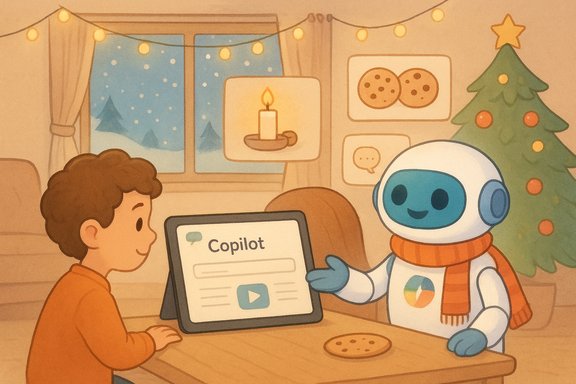
Microsoft Copilot’s holiday push — the playful “12 Days of Eggnog Mico” series — represents a subtle but significant shift in how big tech uses generative AI to connect with families and reshape seasonal marketing. Over the December run, Copilot published daily, kid-friendly explainer posts and short videos that simplify holiday traditions for children, leaning on a warm, persona-driven voice (Mico) and multimodal outputs. The campaign is notable not just for its cheer, but for what it reveals about product positioning, monetization strategy, regulatory pressure, and the technical plumbing required to run a safe, age-appropriate AI experience at scale.
Microsoft has been steadily embedding Copilot across its consumer and enterprise stack — from Windows and Edge to Microsoft 365 and specialized app copilots. Recent months brought a flurry of seasonal and persona-led efforts from major AI platforms; Microsoft’s Eggnog Mico joins a wave of holiday campaigns from other vendors aiming to make generative AI feel less intimidating and more human. These campaigns are part marketing, part product trial: they surface multimodal outputs, invite shareable social posts, and act as soft product demos for features behind paywalls or premium tiers like Copilot Pro.
The campaign’s explicit aim is obvious — humanize Copilot, build family engagement, and nudge adoption — but the implicit goals are equally important. Seasonal activations drive spikes in attention and social traffic, create low-friction touchpoints for product exploration, and supply marketing teams with testable creative assets for future personalization strategies.
As generative AI matures, the best executions will blend joyful, shareable content with careful governance — an approach that protects users while unlocking real value for brands and educators alike.
Source: Blockchain News Microsoft Copilot AI Enhances Family Engagement with Kid-Friendly Holiday Explanations | AI News Detail
 Background
Microsoft has been steadily embedding Copilot across its consumer and enterprise stack — from Windows and Edge to Microsoft 365 and specialized app copilots. Recent months brought a flurry of seasonal and persona-led efforts from major AI platforms; Microsoft’s Eggnog Mico joins a wave of holiday campaigns from other vendors aiming to make generative AI feel less intimidating and more human. These campaigns are part marketing, part product trial: they surface multimodal outputs, invite shareable social posts, and act as soft product demos for features behind paywalls or premium tiers like Copilot Pro.The campaign’s explicit aim is obvious — humanize Copilot, build family engagement, and nudge adoption — but the implicit goals are equally important. Seasonal activations drive spikes in attention and social traffic, create low-friction touchpoints for product exploration, and supply marketing teams with testable creative assets for future personalization strategies.
Overview of the Eggnog Mico Campaign
What the series did
- Daily posts across Copilot’s public social accounts presented kid-friendly explanations of holiday traditions, customs, and symbols, delivered in an approachable persona (“Mico”).
- Content mixed short-form text, illustrated frames, and lightweight video snippets designed to be easily shared by parents and educators.
- The series emphasized non-commercial, educational copy — quick explainer scripts, whimsical descriptions, and calls to “ask Copilot” for more family activities.
Why it matters
The campaign demonstrates how multimodal generative AI (text + images + short video) can be used for low-stakes education and seasonal engagement. It reframes Copilot away from pure productivity tooling and toward a companion role that families can trust for simple, safe explanations. That kind of emotional positioning can boost brand recall and create pathways to product experimentation among users who might otherwise avoid AI features.Verified facts and what we couldn’t independently confirm
- Verified: The campaign and persona posts were publicly visible during December and included kid-facing content that leaned on humor and simple explanations. The series was broadly reported and shared on social channels.
- Verified: Regulatory context has evolved — the U.S. Federal Trade Commission updated the COPPA rule in 2025 to strengthen protections for children’s personal information, and the EU’s AI Act has entered a phased application timeline with specific obligations rolling in during 2025 and beyond. Those regulatory shifts materially affect how vendors design child-directed AI interactions.
- Corroborated but not fully independently verified: Industry projections and market-sizing figures cited around the campaign (edtech market estimates, market valuations for AI assistants, and enterprise adoption forecasts) are consistent with the range of published forecasts from market analysts, but different research houses use varying methodologies. When a single numeric claim (for example, “Copilot recorded 1 billion interactions in H1 2025” or “Copilot Pro subscriptions grew 40% in Q4 2025”) appears in secondary writeups, those figures require direct confirmation from company filings or official press releases to be treated as definitive. These specific company-level numbers were reported in some outlets and briefings but were not universally replicated across public regulatory filings or audited disclosures at the time of review — flagging them as claims that should be checked against Microsoft’s official investor communications for exact wording and context.
Technical anatomy: how Copilot can produce kid-friendly holiday content
Multimodal foundations
The Eggnog Mico outputs rely on current-generation LLMs and multimodal models that combine text generation with image and short-video generation pipelines. In practical terms, this uses:- Large language models (LLMs) for script generation and conversational prompts.
- Image and visual-asset generation models for static frames and illustrated assets.
- Lightweight video compositing or generative-video tools for short clips suitable for social platforms.
- Integrated content moderation and age-safety filters (prompt constraints, classification layers, and human-in-the-loop review) to reduce unsafe or inappropriate outputs.
- Automated script generation from prompts tuned for clarity and age-appropriateness.
- Safety & policy checks via classification models (toxicity, bias, privacy).
- Visual generation and post-processing (illustration style, asset licensing).
- Human review and final approval before publication.
Production scale and latency
Delivering daily multimodal posts at scale requires low-latency inference, GPU-backed cloud capacity, and auto-scaling. The realistic engineering challenge is not model creativity alone — it’s ensuring throughput, predictable cost, and consistent moderation when a campaign generates higher-than-usual traffic.Age-appropriateness and prompt engineering
- Prompt engineering is used to steer tone, reading level, and vocabulary to match child comprehension.
- Prompts are paired with guard rails: must-avoid topics, simplified explanations, and content templates.
- Human editors are required for sensitive topics. Even with mature systems, automated models can hallucinate or include cultural inaccuracies; human review reduces harm and helps maintain brand trust.
Business implications and monetization opportunities
Marketing and user acquisition
Seasonal campaigns are low-cost, high-visibility tools for driving discovery. The Eggnog Mico effort:- Creates shareable content that can increase organic reach and social engagement during a peak period.
- Functions as a product demo funnel: curiosity about “how Copilot explains things to kids” can drive users to try Copilot features in search, Bing, or Microsoft 365.
- Helps reposition Copilot as a companion rather than a purely workplace utility — expanding potential user personas to parents, educators, and caregivers.
Upsell and premium conversion
Branded seasonal content that surfaces multimodal capabilities can showcase features behind premium tiers (e.g., faster responses, higher-quality image/video requests, or Copilot Pro experimentation pathways). The structural playbook is familiar:- Lower the barrier with free, entertaining content.
- Encourage trial of premium features for enhanced experiences.
- Convert a share of trial users into paying customers via time-limited offers or gated premium content.
B2B lessons
Retail, entertainment, and edtech companies can adapt this model by building AI-driven seasonal micro-campaigns to personalize product recommendations, create kid-safe educational content, or add interactive voice experiences tied to smart-home devices.Strengths of the approach
- Accessibility and personalization: Generative AI can adapt explanations to different ages and reading levels on demand, making cultural and linguistic tailoring easier.
- Shareability: Light, family-friendly content is naturally viral during holidays — potential for organic amplification.
- Brand humanization: A persona like “Mico” reduces perceived intimidation around AI and helps brands build emotional connections.
- Rapid iteration: AI enables fast creative A/B testing at scale, producing many copy variants and visual styles with minimal manual drafting.
- Cross-sell potential: Campaigns act as discovery moments feeding into desktop and app-based Copilot surfaces where conversion paths exist.
Risks and challenges
Content accuracy and hallucination
Even kid-friendly content must be factually correct. LLMs can hallucinate details or present oversimplified, misleading explanations. For child-directed educational material, verification loops (human reviewers or curated fact-check layers) are essential.Privacy and children’s data
Designing AI activations that target or appeal to children intersects directly with COPPA and other child-protection frameworks. Collecting, logging, or using data from minors introduces compliance obligations — conservative design should default to collecting minimal or no personal data for child-targeted interactions.Regulatory exposure
The EU AI Act’s phased enforcement and updated COPPA rule in the U.S. mean vendors must:- Apply transparency measures, e.g., clear labeling of AI-generated content.
- Document model risk assessments and safety testing for child-facing use cases.
- Implement data handling and retention policies aligned with evolving legal duties.
Ethical concerns and persuasion
There’s a fine line between friendly education and covert persuasion. Holiday content that subtly nudges purchasing behavior or steers family decisions risks ethical backlash — especially when aimed at children. Clear non-commercial framing and strict ad boundaries are prudent.Moderation scale and human effort
Automated pipelines reduce workload, but real safety requires human moderators for edge cases. Campaigns that scale rapidly must budget for editorial and moderation resources; automation alone is insufficient.Practical recommendations for businesses planning similar campaigns
- Prioritize safety-by-design:
- Build minimal data-collection flows for children.
- Apply COPPA-style consent models whenever interactions could reasonably be child-directed.
- Use hybrid workflows:
- Automate drafts, but retain human curation for factual checks and cultural sensitivity reviews.
- Label AI-generated content clearly:
- Transparency builds trust and helps regulators and users distinguish machine output from human-authored messaging.
- Localize thoughtfully:
- Holiday traditions vary widely — adapt content to cultural contexts rather than applying a one-size-fits-all script.
- Stress-test for scale:
- Confirm infrastructure can handle surges in social engagement and real-time requests without blocking or exposing user data.
- Include a clear non-commercial education mode:
- If the goal is trust-building, keep content non-promotional and focus on utility.
Ethical and regulatory checklist
- Confirm whether the content is child-directed under relevant statutes (COPPA and equivalent national rules).
- Maintain written data retention and deletion policies for any data collected.
- Preserve audit trails for how models were prompted and human checks performed.
- Run bias and safety audits on model outputs, especially for sensitive cultural or historical explanations.
- Implement an appeals or correction mechanism if factual errors are discovered post-publication.
Industry context: competition and market trends
Generative AI holiday campaigns are not unique to Microsoft. Several major players have experimented with seasonal personas, trivia series, and family-focused activations. The broader trend is twofold:- Platforms are moving from purely productivity or conversational interfaces toward persona-driven, multimodal experiences that are easily consumed on social channels.
- Enterprises are increasingly comfortable using generative AI for customer engagement and marketing, with analyst forecasts pointing to growing adoption across marketing functions and edtech markets expanding rapidly over the next several years.
Future outlook
Short-term, expect more holiday-style activations from AI platforms — a predictable cadence that aligns with seasonal attention cycles. Medium-term, the most effective campaigns will combine:- Robust safety and transparency practices,
- High-quality multimodal outputs,
- Integration into product surfaces that enable meaningful next steps (e.g., activities, local events, or educational content hubs).
FAQ
- What is the “12 Days of Eggnog Mico” campaign?
- It’s a seasonal Copilot series that used an AI persona to produce daily, kid-friendly explanations of holiday traditions and short multimodal posts for public social channels.
- Is it safe for kids to use?
- The concept is low-stakes if implemented with clear non-collection-of-personal-data policies, rigorous safety filters, and human editorial oversight. Any child-targeted AI content should follow COPPA-style protections and conservative privacy design.
- Does this change how businesses should market with AI?
- Yes. The campaign shows how AI can create approachable brand moments that drive discovery and upsell, but marketing teams must balance creativity with robust governance and legal compliance.
- Will regulators allow this kind of content?
- Regulators are actively updating rules. The COPPA rule in the U.S. has been strengthened, and the EU AI Act introduces phased obligations in 2025–2027. Companies must design with compliance in mind.
Conclusion
Microsoft’s Eggnog Mico series is a compact case study in modern AI marketing: it mixes creativity, technical capability, and product storytelling to make AI feel friendly and useful for families. The upside is clear — improved engagement, brand humanization, and new conversion touchpoints. But the campaign also highlights the operational and ethical work required to run child-facing AI at scale: accurate content, privacy-safe flows, human oversight, and regulatory alignment.As generative AI matures, the best executions will blend joyful, shareable content with careful governance — an approach that protects users while unlocking real value for brands and educators alike.
Source: Blockchain News Microsoft Copilot AI Enhances Family Engagement with Kid-Friendly Holiday Explanations | AI News Detail
