

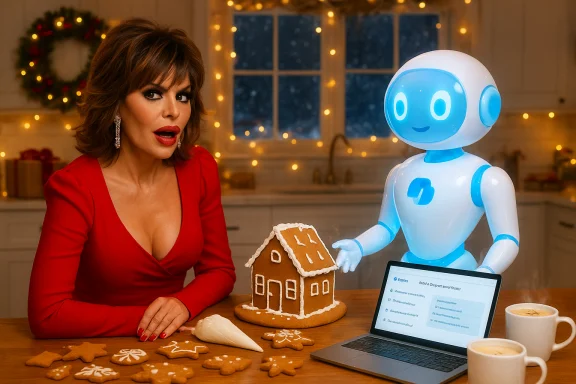
Lisa Rinna’s holiday cameo with Microsoft Copilot’s animated assistant Mico is a short, glossy piece of seasonal marketing that doubles as a case study in persona-first AI advertising: the spot leans into Rinna’s outsized, self-aware reality‑TV persona while the Copilot character — presented in a time‑limited “Eggnog Mode” — plays the friendly, capable foil who does the heavy lifting of holiday tasks. The ad’s cultural fallout was predictable and instructive: viewers laughed at Lisa’s baking attempts, riffed on the ongoing joke that her husband Harry Hamlin does the real cooking, and largely treated the AI as a stage prop rather than the star.
Microsoft’s Copilot platform has been evolving from a productivity add‑on into a broad, multimodal consumer assistant, and this holiday push is a textbook example of a time‑boxed persona activation. The Mico avatar and the so‑called Eggnog Mode are presentation‑layer overlays that change tone, visuals and short interaction templates without, reportedly, altering core model routing or data permissions. This design keeps the activation lightweight from an engineering and governance perspective while maximizing shareability.
Two broader facts worth confirming: Microsoft has publicly stated that its family of Copilot apps reached large user counts in recent quarters — figures cited by the company and echoed by earnings coverage reference 100 million monthly active users for the Copilot family and hundreds of millions of users interacting with AI features across Microsoft products. Those headline metrics are company‑reported and useful for understanding scale, but they are not interchangeable with paid‑seat counts or usage intensity; treat them as engagement metrics rather than hard revenue indicators.
Audience reaction largely followed the script, but with a twist: viewers didn’t debate whether Mico was technically impressive. Instead, they riffed on the Rinna/Hamlin household dynamic — a long‑running cultural meme that Harry Hamlin is the household chef. The reaction underscored a key creative trade‑off: celebrity‑led work often amplifies pre‑existing cultural narratives more than product features. Coverage and social chatter noted the ad’s entertainment value even as technical journalists questioned whether the clip overstates Copilot’s real‑world reliability.
Journalists and commentators also used the ad to revisit earlier Copilot ads and experiments where marketing promise outpaced product reliability. Critical pieces argued the ad showed an idealized scenario that doesn’t reflect day‑to‑day usage gaps people report. Those critiques are not trivial: when marketing sets unrealistic expectations, every subsequent failure is amplified.
Source: Celebrity Insider Lisa Rinna Teams Up With AI For A Fabulously Chaotic Holiday Campaign | Celebrity Insider
 Background / Overview
Microsoft’s Copilot platform has been evolving from a productivity add‑on into a broad, multimodal consumer assistant, and this holiday push is a textbook example of a time‑boxed persona activation. The Mico avatar and the so‑called Eggnog Mode are presentation‑layer overlays that change tone, visuals and short interaction templates without, reportedly, altering core model routing or data permissions. This design keeps the activation lightweight from an engineering and governance perspective while maximizing shareability.Two broader facts worth confirming: Microsoft has publicly stated that its family of Copilot apps reached large user counts in recent quarters — figures cited by the company and echoed by earnings coverage reference 100 million monthly active users for the Copilot family and hundreds of millions of users interacting with AI features across Microsoft products. Those headline metrics are company‑reported and useful for understanding scale, but they are not interchangeable with paid‑seat counts or usage intensity; treat them as engagement metrics rather than hard revenue indicators.
What the spot actually shows
The creative conceit is simple and intentionally self‑deprecating: Lisa Rinna is the combustible, theatrical every‑person struggling with holiday tasks — cakes, gift‑wrapping, a gingerbread house — while Copilot’s Mico calmly provides step‑by‑step guidance, cleanly solving the technical problems the human character cannot. The humor is at Rinna’s expense; the AI is benevolent and efficient. That balance — celebrity vulnerability + calm, personified AI — produces a shareable social clip designed for short‑form feeds and earned media.Audience reaction largely followed the script, but with a twist: viewers didn’t debate whether Mico was technically impressive. Instead, they riffed on the Rinna/Hamlin household dynamic — a long‑running cultural meme that Harry Hamlin is the household chef. The reaction underscored a key creative trade‑off: celebrity‑led work often amplifies pre‑existing cultural narratives more than product features. Coverage and social chatter noted the ad’s entertainment value even as technical journalists questioned whether the clip overstates Copilot’s real‑world reliability.
Why Microsoft chose this creative route
- Low governance risk: By keeping Mico as a cosmetic persona and Eggnog Mode as a toggle, product teams can test tone and engagement without touching core permissions or data flows.
- High‑reach amplification: Celebrity faces cut through social noise and seed memes and UGC quickly.
- Rapid telemetry: Short activations produce concentrated behavioral signals — how users respond to tone, which micro‑experiences drive repeat opens, and where moderation triggers occur.
The creative strengths — what the campaign does well
- Celebrity-as-accelerant: Lisa Rinna’s public persona is instantly legible to social audiences. Her willingness to be the butt of the joke made the spot eminently sharable and gave the campaign immediate cultural oxygen.
- Tight scope reduces risk: Positioning Eggnog Mode as a limited‑time, presentation‑only experience lowers privacy and regulatory exposure while still enabling large‑scale testing.
- Family‑safe defaults: The activation emphasized kid‑friendly interactions and simpler language, a sensible design choice when targeting seasonal family moments.
- Measurable signals: Short activations create concentrated telemetry, letting product teams detect moderation boundaries, favored prompts, and UGC potential.
The technical and reputational risks
- Hallucination risk: When a persona ventures into retrieval tasks (for example, converting or scaling recipes, or offering safety instructions), the model can produce incorrect or misleading content. Marketing clips that show pristine outcomes risk creating unrealistic expectations that labs and product teams then struggle to meet. Independent tests of similar Copilot adverts have surfaced failures where the system misidentified UI elements or produced incorrect step sequences. That gap between ad‑grade scenes and in‑field reliability can erode trust.
- Transparency and disclosure: Family‑facing activations must be clear about AI generation and data handling. Under the EU AI Act and emerging national guidance, platforms should document persona provenance, provide opt‑in toggles, and preserve auditable logs for outputs generated during campaign windows.
- Brand mismatch: Pairing a major platform with a polarizing celebrity can amplify both the upside and downside. The celebrity’s existing narrative — in this case, the Rinna/Hamlin household cooking trope — can overwhelm the product message and reframe the campaign as an entertainment stunt rather than a technical demonstration. That is not always bad, but it changes the metric of success from product adoption to cultural resonance.
- Measurement ambiguity: Company‑reported engagement metrics (for example, the Copilot family “100 million monthly users”) can conflate different product experiences and are not direct measures of feature reliability or paid adoption. Use such numbers for context, but avoid treating them as a single source of truth about product maturity.
Cultural dynamics: why viewers mocked the baking, not the AI
The spot intentionally caricatures Lisa Rinna as the hapless holiday mess‑maker; that dynamic invites viewers to lampoon the domestic role rather than the technology. Social media quickly turned the ad into fodder about who does the real cooking in the Rinna household — a recurring theme in coverage and comment sections that overshadowed the AI angle. This reaction demonstrates a predictable media truth: the celebrity will usually win the narrative.Journalists and commentators also used the ad to revisit earlier Copilot ads and experiments where marketing promise outpaced product reliability. Critical pieces argued the ad showed an idealized scenario that doesn’t reflect day‑to‑day usage gaps people report. Those critiques are not trivial: when marketing sets unrealistic expectations, every subsequent failure is amplified.
What the campaign signals for future AI marketing
- Persona layering will scale: Expect more time‑boxed, themed modes across assistants (holiday characters, sports modes, movie tie‑ins). They are cheap to produce and can be instrumented tightly.
- Governance will become mandatory: As episodic personas accumulate, regulators and enterprise customers will expect clear provenance, opt‑out controls, and auditing capabilities for persona outputs.
- Monetization avenues will appear: Platforms may test premium persona packs or creator partnerships that tie seasonal voices to paid features.
- Creators will own the culture: Celebrity partners and creators will increasingly dictate how an activation is interpreted; brands must decide whether they want product conversation or pop‑culture buzz.
A short checklist for product and marketing teams planning persona activations
- Define strict scope: persona overlays should be presentation‑only unless explicit consent is captured for expanded capabilities.
- Instrument everything: log prompts, responses and moderation flags with provenance metadata.
- Design conservative fallbacks: when retrieval fails or the model is uncertain, degrade to safe, non‑actionable guidance.
- Provide clear opt‑in toggles for families and enterprise admins to disable themed modes.
- Measure cultural outcomes separately from product outcomes: track shares, sentiment and UGC loops distinct from usage and retention metrics.
The Lisa Rinna factor — branding, self‑awareness, and narrative control
The spot is a lesson in celebrity brand hygiene. Rinna’s career has always been about performance and exaggerated persona; she embraces the jokes and controls the narrative by owning the self‑mockery. When pushed into a Copilot vignette, she amplifies her brand while granting the platform a friendly cultural entry point. That partnership works because the public already understands Rinna’s persona: she is an entertainer first, a domestic authority second — and that inversion is precisely what the ad trades on. Audience comments — many of them referencing Harry Hamlin’s cooking or calling for Rinna’s return to reality TV — show the campaign’s effect: it re‑energized the celebrity’s cultural footprint, even if it didn’t move the product needle in obvious ways.Verification and cautionary notes
- Company‑reported engagement numbers (for example, the claimed Copilot family “100 million monthly active users” and “hundreds of millions” of users across AI features) are real as reported during earnings and product announcements, but they should be read with nuance: they aggregate multiple surfaces, trials, and inclusion into bundled products and do not directly equate to paid seats or consistent, error‑free experiences. Verify any headline metric against the original earnings transcript or Microsoft blog when using it for business planning.
- Claims that the ad demonstrates technical parity with real‑world Copilot performance are not supported by independent tests. Reporting and hands‑on checks have shown that marketing clips sometimes compress interactions and omit failure modes; audiences and product teams should expect that live usage will reveal edge cases not visible in a scripted spot. Flag any advertising claims that imply perfect, frictionless performance as potentially misleading until cross‑checked by independent hands‑on reviews.
- Celebrity endorsement does not equal product advocacy: the presence of a star face should be treated as a cultural lever, not technical validation. The Rinna spot is as much about persona and social reach as it is about Copilot.
Final assessment — creative win, product lesson
Microsoft’s Lisa Rinna/Mico holiday spot accomplished what it likely set out to do: spark social conversation, generate short‑form shares, and test a constrained persona overlay at scale. It was a creative win for brand awareness and cultural resonance. But from a product credibility standpoint, the piece is a reminder that marketing narrative and technical reality can diverge. The most valuable outcome of campaigns like this is not immediate conversion but the telemetry and governance lessons product teams harvest afterward. If platforms and partners treat seasonal personas as experiments — instrumenting them thoroughly, setting conservative defaults, and being transparent about limitations — they can reap both delight and durable product insights.What WindowsForum readers should watch next
- Post‑campaign metrics: whether Microsoft publishes follow‑up numbers showing retention lifts, conversion to paid Copilot seats, or measurable behavior changes tied to Eggnog Mode.
- Governance updates: whether Microsoft adds clearer persona provenance metadata, admin controls, or audit logs for themed modes.
- Independent testing: hands‑on reviews that attempt to replicate ad scenarios and report on gaps between the pop‑clip and real‑world performance.
- Persona proliferation: whether seasonal toggles remain free acquisition funnels or evolve into paid persona packs and creator monetization.
Conclusion
The Lisa Rinna × Mico holiday spot is a smart, low‑risk marketing experiment: it humanizes Copilot using a highly shareable celebrity moment and gathers concentrated telemetry on persona interactions. The creative payoff — memes, social laughs, and renewed attention to Rinna’s public persona — came quickly. The product lesson arrived more quietly: marketing must be married to instrumentation and candid disclosure to convert episodic delight into sustained trust. When those pieces align — clever persona design, strong safety defaults, and transparent measurement — seasonal activations like Eggnog Mode can be both festive and formative for the future of consumer AI.Source: Celebrity Insider Lisa Rinna Teams Up With AI For A Fabulously Chaotic Holiday Campaign | Celebrity Insider
