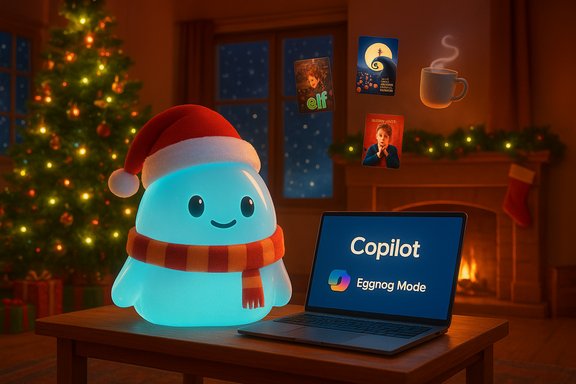
Microsoft’s Copilot has quietly evolved from a productivity aid into a seasonal entertainer: the recent “12 Days of Eggnog” push that dressed the new animated avatar Mico in holiday finery and used AI-powered recommendations to script a lighthearted, family‑friendly movie‑marathon experience illustrates how generative assistants are being repurposed as marketing and engagement channels across platforms.
Microsoft introduced the expressive Copilot avatar Mico as part of a broader Copilot Fall release that bundles voice-first experiences, long‑term memory, group sessions, and outreach into Windows, Edge and mobile. Mico is a deliberately non‑human, animated “blob” that reacts visually during voice interactions to signal listening, thinking and responding; it was rolled out as an optional UI layer designed to humanize voice sessions without recreating the intrusiveness of past assistants. Into that foundation Microsoft layered a time‑bounded persona overlay — Eggnog Mode — which toggles festive phrasing, light seasonal animations, and short “micro‑experiences” (trivia, jokes, toasts, and movie suggestions) for the holidays. The playbook is familiar: a temporary, low‑risk activation that aims to create social moments, collect behavioral signals, and test moderation and personalization workflows at scale. Blockchain.News’ coverage summarized this as a product‑marketing experiment with clear safety constraints for family audiences.
Why this matters now: personalization and recommendation systems are central to modern media distribution. Industry forecasts show the AI-in‑media market expanding rapidly, and platform owners can convert even small engagement uplifts into large, measurable outcomes because of their distribution scale. Market forecasts from multiple analysts converge on strong growth, though exact headline figures vary by publisher and methodology.
Source: Blockchain News AI-Powered Holiday Movie Recommendations: Microsoft Copilot Enhances User Engagement with Mico | AI News Detail
 Background / Overview
Microsoft introduced the expressive Copilot avatar Mico as part of a broader Copilot Fall release that bundles voice-first experiences, long‑term memory, group sessions, and outreach into Windows, Edge and mobile. Mico is a deliberately non‑human, animated “blob” that reacts visually during voice interactions to signal listening, thinking and responding; it was rolled out as an optional UI layer designed to humanize voice sessions without recreating the intrusiveness of past assistants. Into that foundation Microsoft layered a time‑bounded persona overlay — Eggnog Mode — which toggles festive phrasing, light seasonal animations, and short “micro‑experiences” (trivia, jokes, toasts, and movie suggestions) for the holidays. The playbook is familiar: a temporary, low‑risk activation that aims to create social moments, collect behavioral signals, and test moderation and personalization workflows at scale. Blockchain.News’ coverage summarized this as a product‑marketing experiment with clear safety constraints for family audiences.Why this matters now: personalization and recommendation systems are central to modern media distribution. Industry forecasts show the AI-in‑media market expanding rapidly, and platform owners can convert even small engagement uplifts into large, measurable outcomes because of their distribution scale. Market forecasts from multiple analysts converge on strong growth, though exact headline figures vary by publisher and methodology.
The Eggnog Mico campaign: what it was and what it tested
What users actually saw
- A togglable Eggnog Mode icon inside Copilot that applied a holiday voice/tone to responses and wrapped Mico in seasonal accessories (hat, scarf, fireplace backgrounds).
- Short, shareable prompts across a 12‑day cadence meant to encourage daily opens: movie picks, short carol humming, festive jokes, and family‑safe micro‑activities.
- Kid‑friendly defaults and safety filters designed to reduce risk for younger audiences while preserving playful interactions.
Product design and risk containment
Microsoft and independent hands‑on reporting emphasize Eggnog Mode as cosmetic — a persona and UX overlay rather than a change to Copilot’s data access or core model behavior. That distinction is crucial for compliance and privacy: the overlay softens tone and suggests activities but does not expand memory or connectors by default. The rollout pattern (social-first announcement, staged U.S. availability) also reflects a conservative, telemetry‑driven launch strategy.Why marketers and product teams run seasonal personas
- Boost short‑term engagement and daily active usage during high‑traffic windows.
- Create low‑cost social content and earned media without large ad buys.
- Serve as a controlled sandbox to test persona design, moderation, and personalization signals that can inform permanent product defaults.
How AI built the holiday movie marathon
Recommendation systems and the movie‑marathon prompt
Holiday movie recommendations are a familiar recommendation‑engine use case. Behind a simple conversational prompt ("Plan a holiday movie marathon with eggnog twists") sits a mix of classic and modern recommender techniques:- Collaborative filtering and behavioral signals (watch history, likes) to identify what similar users enjoyed.
- Content‑based ranking that surfaces titles sharing attributes (genre, mood, era).
- Hybrid models that blend neural ranking with popularity and freshness signals.
- LLMs and persona tuning to format the list, add themed copy (e.g., “eggnog toast” suggestions), and craft short micro‑activities.
Grounding and hallucination control
When Copilot offers “factual” details (ratings, availability on a streaming service), the system must avoid hallucination. Practically, this is handled via retrieval‑augmented generation (RAG): an LLM composes conversational text while retrieving up‑to‑date facts from curated indexes or partners. The campaign’s designers reportedly constrained Eggnog Mode to entertainment‑only outputs and combined automated filters with human review for edge cases.Multimodal recommendations
The most engaging playlists today combine text with thumbnails, trailer clips and sound cues. Future‑facing Copilot features are built on multimodal models—which can process text, images and audio—to produce rich lists (poster + one‑line logline + suggested snack). Microsoft’s Copilot roadmap is explicitly multimodal: Mico appears in voice flows while backend models handle ranking and retrieval.Market context: scale, growth and competitive stakes
Big picture numbers
- Industry forecasts indicate rapid growth in AI for media and entertainment with several analysts targeting a near‑triple‑digit billion‑dollar market by the end of the decade. Exact projections differ by publisher; widely circulated forecasts show the market climbing toward the high tens of billions by 2030. Treat headline figures as directional — methodology matters.
Why personalization matters commercially
Historic platform data demonstrates the power of recommendations:- Netflix researchers documented that the recommender system “influences choice for about 80% of hours streamed” on the service — an influential figure often cited to illustrate how personalization drives viewing behavior. That observation comes from Netflix’s technical literature and follow‑on analyses of its recommender system. Use it as a benchmark for the strategic value of recommendations, but not as a universal law across platforms.
- Amazon’s recommendation mechanics are widely credited with driving a sizable share of platform revenue (commonly reported around ~35% in industry summaries). Again, the magnitude varies by source and the definition of “driven by recommendations.” These case studies show how personalization can be monetized indirectly through reduced churn, higher conversion and better content ROI. Present these statistics as industry‑standard estimates rather than immutable facts.
The competitive landscape
Large platform owners (Microsoft, Google, Netflix, Amazon) compete on:- Model capability and grounding.
- Data access and integration across services (search, devices, streaming).
- UX experimentation (personas, avatars, voice modes).
Microsoft’s advantage is distribution across Windows, Edge and Microsoft 365 — enabling Copilot to be a persistent touchpoint across productivity and leisure.
Business implications and monetization strategies
Seasonal AI activations like Eggnog Mode open practical commercial levers for platforms and partners.- Direct monetization
- Affiliate links and rentals: Suggest a movie and link to a streaming rental or storefront; platforms can earn referral commissions.
- Sponsored suggestions: Brand partnerships where themed content or product placements appear as optional “premium” suggestions.
- Indirect value
- Retention and engagement: Micro‑experiences increase daily opens and session frequency, improving retention metrics that justify content spend.
- Data and signals: Behavioral telemetry from themed activations helps tune personalization models and A/B test creative recommendations.
- Creator and partner models
- Licensed persona skins: Creators or studios could license themed prompts or persona behaviors around IP (e.g., studio‑approved holiday modes).
- Affiliate commerce: Integrate storefronts so Copilot can bundle a movie list with snack or decor suggestions linked to e‑commerce partners.
Technical foundations: models, latency, and privacy
Models and pipelines
- Large language models (LLMs) handle conversational framing and persona tone.
- Ranking models (deep neural nets) score candidate titles.
- Collaborative filtering extracts cross‑user patterns.
- RAG pipelines ensure retrieved facts and availability are current and verifiable.
- Safety classifiers filter out unsafe or adult content when family modes are enabled.
Latency and edge compute
Real‑time conversational flows demand low latency. Hybrid architectures that blend cloud inference with on‑device or edge inference lower round‑trip time and can preserve privacy; industry reports show meaningful latency reductions when offloading inference closer to users, with several studies reporting latency reductions of 40–65% in edge deployments versus cloud‑only setups for specific workloads. Practical rollouts balance model size, privacy, and UX.Privacy, consent and data governance
- Keep persona overlays separate from data‑access changes: toggles that alter tone should not implicitly grant wider data permissions.
- Provide visible, easy controls for memory review and deletion.
- For features targeting minors, enforce conservative defaults and parental controls; treat “kid‑friendly” as a design constraint, not a marketing claim.
Regulatory and ethical considerations
Data privacy and GDPR
In jurisdictions under GDPR, platforms must be explicit about data collected, processing purposes, and deletion rights. Seasonal activations must not be a pretext to expand data collection without informed consent. Auditability is essential.Bias and echo chambers
Recommendation systems can narrow exposure if not explicitly diversified. Ethical best practice requires diversity constraints in ranking — intentionally surfacing a mix of titles to avoid reinforcing narrow consumption loops. Regular bias audits and transparent controls are recommended.Child safety and content moderation
Family‑facing persona modes must combine automated classification with human escalation for edge outputs. The recommended lifecycle: pre‑launch red teaming, staged pilot, live monitoring with human review, post‑mortem analysis and policy updates.Implementation playbook for product teams
- Define scope and success metrics:
- Engagement lift (daily opens, session length).
- Conversion attribution (click‑throughs to affiliated rentals/subscriptions).
- Safety metrics (false positive/negative rates for moderation).
- Build a sandboxed persona overlay:
- Tone templates and prompt libraries.
- Clear opt‑in UI and parental controls.
- Ground recommendations:
- Use RAG to source availability and ratings.
- Add provenance tags when facts are shown.
- Run a staged pilot:
- Small U.S. cohort → telemetry review → broader rollout.
- Include human reviewers for flagged outputs.
- Measure and iterate:
- A/B test persona variants.
- Tune diversity constraints to avoid echo chambers.
- Prepare governance artefacts:
- Retention and deletion policies.
- Audit logs and incident playbooks.
Risks and trade‑offs — balanced assessment
Strengths:- High engagement potential: Even small percentage changes scale when hundreds of millions use a product.
- Brand humanization: Seasonal personas make assistants feel friendly and shareable.
- Product R&D value: Seasonal activations provide a controlled environment to test persona mechanics and moderation.
- Default creep: Optional features can become pervasive if enabled by default in prominent flows.
- Anthropomorphism: Visual avatars and personified voices increase perceived trust, which can lead users to over‑rely on outputs that still require verification.
- Privacy surface growth: Memory and connector expansions increase attack surface and regulatory obligations.
- Attribution and measurement gaps: Without strong measurement, monetization bets may not pay off.
- Conservative UIDefaults, strong parental controls, continuous monitoring and robust provenance for factual claims.
Future outlook: where persona commerce and multimodal discovery meet
The Eggnog Mico experiment is a snapshot of several converging trends:- Persona commerce: Users may subscribe to persistent persona skins or pay for premium voices and modes.
- Multimodal discovery: Text, images and short clips will be combined to make richer suggestions; Copilot’s multimodal roadmap is aligned with this.
- Edutainment and micro‑lessons: Seasonal activations could evolve into episodic edutainment where personas deliver curriculum‑aligned micro‑lessons under parental controls.
- Immersive tie‑ins: As VR and spatial video mature, assistants that can sequence immersive experiences and suggest compatible content will gain share.
FAQ (concise, practical)
- What are the benefits of AI in movie recommendations?
- Faster discovery, higher relevance, and higher engagement. Personalization reduces search time and improves the chance viewers find content they enjoy.
- How does Microsoft Copilot contribute to AI trends?
- Copilot demonstrates conversational, multimodal personalization at scale. Mico and persona overlays show how assistants can be tuned for tone and occasion while preserving control features and governance.
Final assessment
Microsoft’s Mico Eggnog Mode is an instructive case study: it demonstrates how generative AI personas can be playful, culturally relevant and commercially useful — while also highlighting the persistent governance challenges that come with family‑facing AI. The activation’s conservative design (a cosmetic overlay, staged rollout, and kid‑friendly defaults) is a model of responsible experimentation. At the same time, the wider industry claims cited around market size, platform conversion rates, and user bases should be treated with caution: many headline figures are estimates or vendor‑reported metrics that vary by methodology. Cross‑platform lessons are clear, however: when persona design, safety, and measurement work in concert, seasonal activations can deliver both delight and durable product insights. Microsoft’s experiment with Eggnog Mode is small in scope but large in signal — it tells product teams, marketers and regulators alike that the next wave of consumer AI will be conversational, multimodal and episodic. The deciding factor for long‑term success will be whether companies can convert short‑term engagement into sustained trust through transparency, controls, and rigorous measurement.Source: Blockchain News AI-Powered Holiday Movie Recommendations: Microsoft Copilot Enhances User Engagement with Mico | AI News Detail