

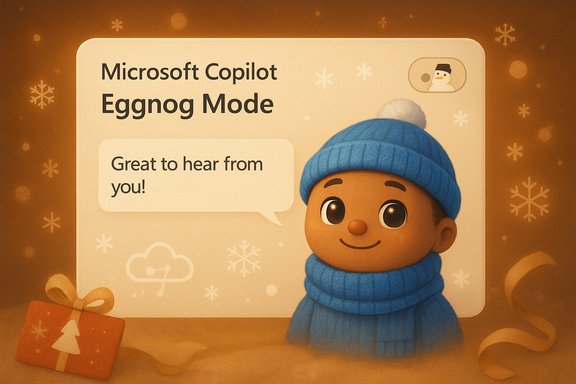
Microsoft Copilot’s holiday flourish arrived as a deliberately lightweight, deliberately viral experiment: “Eggnog Mode”, a time-limited persona overlay that dresses the Copilot voice experience (and its new animated avatar Mico) in seasonal visuals, warmer phrasing and short micro‑interactions designed to nudge engagement during the holidays. The rollout—announced primarily through Copilot’s social channels and quickly picked up by community posts and niche press—does not add new data pipelines or core model capabilities; instead it applies a presentation‑layer persona and tuned conversational prompts to create a festive user moment while Microsoft watches how people respond.
Microsoft’s Copilot product family has evolved rapidly since its first consumer rollouts in 2023. The company’s strategy shifted Copilot from a one‑off Q&A widget into a cross‑surface assistant embedded in Windows, Edge, Bing and Microsoft 365. The October 2025 “Copilot Fall Release” introduced a set of user-facing changes meant to make the assistant more persistent, more social and more expressive—among them a new animated avatar called Mico, a “Real Talk” conversational style, shared Copilot Groups, and long‑term memory and connector features. These changes set the UX foundation that Eggnog Mode now builds on. Eggnog Mode is therefore best read as a product‑marketing experiment with clear product‑engineering boundaries: it’s a persona toggle layered on top of existing Copilot flows rather than a separate model or new capability. That choice limits technical complexity and regulatory exposure while still delivering testable behavioral signals about tone, retention and shareability.
Independent reporting confirms Mico and the broader Fall Release as formal Microsoft updates; multiple outlets covered the avatar and the fall features, while the Eggnog Mode specifics circulated through social posts and community sites. Use those official Copilot channels and the Copilot app’s Labs or settings page for definitive availability checks. Caveat: where coverage is community‑led (social posts, Reddit clips), treat localized screenshots and demo videos as reliable signals of the feature’s existence, but verify administrative and enterprise‑level controls directly in the Copilot admin center before deploying broadly.
Eggnog Mode matters because it’s a compact, real‑time experiment in emotional design at platform scale: a Christmas card and a test lab rolled into one. Microsoft’s approach—keeping persona overlays presentation‑level, staged rollouts and conservative defaults—makes sense given the trust and compliance stakes. The real test will be whether these ephemeral moments translate into durable product value—improved task success, higher retention, or measurable movement into paid tiers—without widening privacy or regulatory exposure. If Microsoft can operationalize clear admin controls, telemetry transparency and cultural localization, seasonal personas can be a harmless delight; if not, the small charm of a snow‑capped Mico could become a governance headache.
Source: Blockchain News Microsoft Copilot Launches 'Eggnog Mode' Feature for Enhanced Productivity: Download Now | AI News Detail
 Background / Overview
Microsoft’s Copilot product family has evolved rapidly since its first consumer rollouts in 2023. The company’s strategy shifted Copilot from a one‑off Q&A widget into a cross‑surface assistant embedded in Windows, Edge, Bing and Microsoft 365. The October 2025 “Copilot Fall Release” introduced a set of user-facing changes meant to make the assistant more persistent, more social and more expressive—among them a new animated avatar called Mico, a “Real Talk” conversational style, shared Copilot Groups, and long‑term memory and connector features. These changes set the UX foundation that Eggnog Mode now builds on. Eggnog Mode is therefore best read as a product‑marketing experiment with clear product‑engineering boundaries: it’s a persona toggle layered on top of existing Copilot flows rather than a separate model or new capability. That choice limits technical complexity and regulatory exposure while still delivering testable behavioral signals about tone, retention and shareability.What Eggnog Mode Is — And What It Isn’t
The feature in practical terms
- Presentation-layer persona overlay: seasonal cosmetics for the Copilot interface—Mico wearing winter accessories, cozy background motifs, twinkling micro‑animations.
- Tone and micro‑interaction tuning: replies skew warmer and more convivial; Copilot suggests short, safe holiday interactions—recipes, trivia, carol prompts, a brief “take a breath and enjoy that eggnog” nudge.
- Easy activation: reports and community screenshots show a simple toggle (a snowman or ornament icon) exposed in the Copilot app for eligible users.
What Eggnog Mode deliberately avoids
- It does not swap in a new large model or change Copilot’s data‑access permissions. The engineering approach emphasizes prompt conditioning, UI assets and persona rules rather than altering model routing or storage. That boundary is central to Microsoft’s messaging and reduces immediate privacy/compliance surface area.
How Microsoft Built It — Technical Foundations
Eggnog Mode leverages the same multimodal, voice‑enabled Copilot stack introduced in the Fall Release. The practical engineering pattern is familiar:- Prompt conditioning and persona tuning: short, constrained prompt templates steer Copilot’s voice and phrasing toward festive wording without changing the underlying reasoning model.
- Visual assets and micro‑animations: the Mico avatar is styled with seasonal skins and small animated behaviors that sync to TTS or text replies.
- Safety and content filters: age‑appropriate defaults and classification layers screen for adult, unsafe or inappropriate suggestions when interactions are marked “family friendly.”
Announcement, Availability and Verification Status
Community timeline and signals point to a mid‑December 2025 social announcement and a U.S./U.K./Canada–first staged rollout. The initial public evidence came from Copilot social posts and short hands‑on clips shared by users and niche outlets rather than a detailed, formal entry in Microsoft’s long‑form Copilot release notes at the time of reporting. That means the feature was verifiable as a public experiment, but some distribution details—exact end date for the seasonal window, platform exceptions and enterprise admin controls—remained provisional until Microsoft publishes consolidated release notes.Independent reporting confirms Mico and the broader Fall Release as formal Microsoft updates; multiple outlets covered the avatar and the fall features, while the Eggnog Mode specifics circulated through social posts and community sites. Use those official Copilot channels and the Copilot app’s Labs or settings page for definitive availability checks. Caveat: where coverage is community‑led (social posts, Reddit clips), treat localized screenshots and demo videos as reliable signals of the feature’s existence, but verify administrative and enterprise‑level controls directly in the Copilot admin center before deploying broadly.
Business Rationale: Why Seasonal Modes Matter
Seasonal overlays are a classic product hook in consumer apps; for a platform-sized product like Copilot they serve several explicit business goals:- Low‑cost acquisition: a playful, ephemeral UI can attract non‑professional users and encourage trial of voice interactions.
- Rapid experimentation: persona overlays are a safe A/B lab for tone, moderation pipelines and retention signals, without touching core privacy settings.
- Earned media and social sharing: shareable moments (screenshots, short clips) generate organic visibility with minimal marketing spend.
Market Context and Verified Metrics (with caveats)
There are multiple, sometimes inconsistent metrics in public reporting; the most reliable approach is to cross‑reference and flag divergence.- Microsoft’s investor pages and annual materials describe strong growth in Copilot adoption and the expansion of Copilot integration across products. Microsoft’s FY25 investor resources cite broad adoption of Copilot across consumer and commercial surfaces.
- Third‑party trade press reporting has consolidated two different numbers used by Microsoft spokespeople: one figure for AI features across Microsoft products (reported at hundreds of millions to ~900 million monthly active users for AI‑enabled features) and another for first‑party Copilots (reported figures in many outlets around 100–150 million monthly active users). These differences come from how Microsoft segments “AI features” (a broad category across Bing, Edge, Windows, Xbox, etc. versus first‑party Copilot products. Treat headline MAU claims with caution and seek the exact metric definitions in Microsoft’s investor commentary before using them as contractual or marketing assumptions.
Privacy, Safety and Regulatory Considerations
Eggnog Mode is built to be presentation‑level and family‑friendly, but any persona that targets children, holidays or culture raises specific governance questions:- Transparency: apps should disclose that outputs are AI generated and explain the persona’s scope (cosmetic vs functional). This reduces consumer confusion and aligns with transparency obligations in many jurisdictions.
- Telemetry and retention: teams must list what persona telemetry is logged, retention windows and whether that data will be used to tune future models. Persona telemetry is legitimate R&D data, but it must be surfaced in privacy assessments used by teams and data protection officers.
- Age gating and family modes: the safest seasonal activations default to conservative content rules and a distinct “family” toggle; implementing explicit family defaults reduces the risk of adult humor or inappropriate surprises in kid‑facing interactions.
- Regulatory alignment: the EU AI Act and similar transparency and safety frameworks expect clear disclosures about AI behavior and scope—persona overlays should be documented in compliance artifacts for enterprise customers.
Risks and Failure Modes to Watch
- Scope creep — a cosmetic persona becomes an engagement lever: once users enjoy persona‑driven nudges, product teams may be tempted to tie persona behaviors to outbound recommendations or monetized content, increasing privacy and consent risk.
- Expectation mismatch — anthropomorphism raises user expectations: expressive avatars like Mico reduce friction but increase the chance users assume Copilot knows more than it does; that mismatch can degrade trust if not explicitly managed.
- Cultural insensitivity — holiday themes that work in one market can misfire in others; localize persona options and provide neutral alternatives (e.g., “winter mode”) to be inclusive.
- Monitoring blind spots — ephemeral persona experiments generate telemetry; failing to audit that data for bias or safety incidents can leave governance gaps. The safest programs bake red‑team checks and human‑in‑the‑loop review into the rollout.
Competitive and Industry Context
Seasonal theming is not unique to Microsoft: rivals are experimenting with persona and seasonal touches across assistant experiences. Google’s character/persona experiments in search and conversational AI, OpenAI’s custom GPTs and persona packs, and Amazon/Apple seasonal interactions in Alexa and Siri indicate a broader industry play: emotional design as discoverability. For platform owners, the question is whether these features drive durable retention or simply spike short‑term curiosity. Microsoft’s scale makes the decision consequential; even fractional engagement lifts can move large absolute numbers.Practical Guidance for Businesses and IT Teams
If you’re evaluating Eggnog Mode (or similar seasonal persona overlays) for internal rollouts, consider this checklist:- Verify the persona’s platform availability and admin controls in your tenant’s Copilot settings.
- Pilot with non‑sensitive groups for 7–14 days and collect telemetry on session length, content flags and user satisfaction.
- Confirm whether persona telemetry is used to retrain or tune base prompts and ensure it appears in your organization’s DPIA/Privacy Impact Assessment.
- Define escalation paths for content incidents (e.g., a family‑facing joke that inadvertently references adult content).
- Prepare opt‑out communications and a plan to suppress seasonal overlays for regulated teams.
Monetization Paths and Commercial Opportunities
Eggnog Mode also signals commercial thinking: persona packs or themed experiences are low‑friction ways to create ephemeral scarcity and spur engagement. Potential commercial models include:- Branded persona skins or partner packs for seasonal campaigns.
- Premium persona voices or asset packs behind subscription tiers (Microsoft’s consolidation into Microsoft 365 Premium demonstrates the packaging logic).
- White‑label persona overlays for enterprise customers who want branded internal assistants.
Future Outlook: What Eggnog Mode Signals
Eggnog Mode is small by design, but it is a clear signal about where conversational UX is headed:- Temporal and contextual theming will become a mainstream lever for engagement—expect assistant behavior to adapt to local events, user milestones and cultural moments.
- Enterprise persona governance will mature: admins will demand fine‑grained controls to enable, disable or white‑label persona overlays for internal users.
- Persona ecosystems may arise: partner persona packs, creator marketplaces and brand campaigns that ship temporary skins for mass events. That opens monetization but raises audit and bias risks.
Critical Takeaways and Final Assessment
- Design intent is conservative and pragmatic: Eggnog Mode is explicitly a presentation‑layer, time‑bounded persona overlay rather than a new capability. That keeps technical risk and regulatory exposure low while letting Microsoft test emotional design.
- Business logic is sound: seasonal personas are cheap experiments with high potential visibility and modest engineering cost—an efficient way to test new UX tropes at scale.
- Governance must follow product: even playful overlays require privacy assessments, telemetry reviews and admin controls—especially where child‑facing prompts are enabled.
- Verify headline metrics yourself: public MAU and engagement figures vary by reporting outlet and metric definition—confirm the exact definitions in Microsoft’s investor materials before using them in planning or procurement.
Quick FAQ (Verified & Cautioned)
- What is Eggnog Mode?
A seasonal persona overlay for Microsoft Copilot that applies festive visuals and tuned wording to voice and conversational flows; announced in mid‑December and distributed initially via social and staged rollouts. - Does it change Copilot’s data access or models?
No—public reporting and early hands‑on notes treat it as a cosmetic/persona overlay that does not alter core data access or model routing. Verify tenant settings if you manage a corporate Copilot deployment. - Who should pilot it internally?
Non‑sensitive user groups with an escalation plan and clear telemetry reviews—family‑facing or regulated teams should be excluded until governance checks are completed.
Eggnog Mode matters because it’s a compact, real‑time experiment in emotional design at platform scale: a Christmas card and a test lab rolled into one. Microsoft’s approach—keeping persona overlays presentation‑level, staged rollouts and conservative defaults—makes sense given the trust and compliance stakes. The real test will be whether these ephemeral moments translate into durable product value—improved task success, higher retention, or measurable movement into paid tiers—without widening privacy or regulatory exposure. If Microsoft can operationalize clear admin controls, telemetry transparency and cultural localization, seasonal personas can be a harmless delight; if not, the small charm of a snow‑capped Mico could become a governance headache.
Source: Blockchain News Microsoft Copilot Launches 'Eggnog Mode' Feature for Enhanced Productivity: Download Now | AI News Detail
