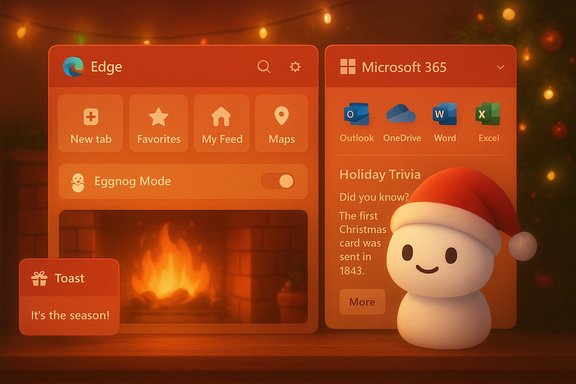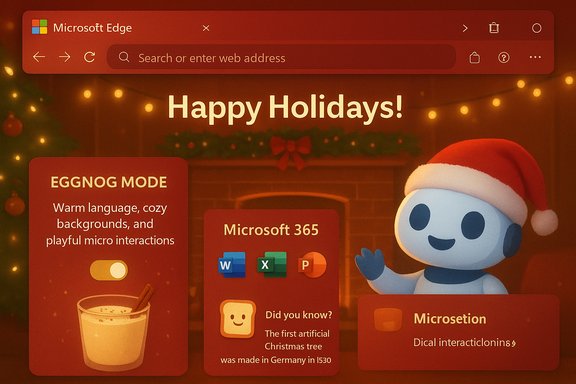
Microsoft’s Copilot has briefly traded its productivity blazer for a holiday sweater: the company rolled out a time‑limited “Eggnog Mode” that overlays festive visuals, warmer phrasing and short, shareable micro‑interactions onto the Copilot experience — a deliberately scoped experiment that illuminates how platform owners are using persona tuning and seasonal theming to drive engagement while keeping data and governance surfaces unchanged.
Background / Overview
Since its consumer debut in 2023, Copilot has evolved from a single chat box into a cross‑surface assistant embedded in Windows, Edge, Bing and Microsoft 365. The product’s breadth has enabled Microsoft to experiment with presentation, tone and persona as a way of broadening appeal beyond purely productivity use cases. A major inflection came with the Copilot Fall Release, which introduced an expressive avatar named Mico, long‑term memory and group sessions — all the building blocks that make a seasonal persona overlay both simple to deploy and easy to test at scale. Eggnog Mode itself is intentionally narrow: it is a presentation‑layer persona overlay rather than a model update or data‑policy change. Users who toggle the mode see Mico sport seasonal assets (hats, scarves, cozy backgrounds), hear warmer language or playful micro‑responses (toasts, quick recipes, trivia), and can engage with a short daily cadence of micro‑experiences designed for sharing and lighthearted interactions. Critically, Microsoft’s rollout messaging and hands‑on coverage emphasize that Eggnog Mode modifies tone and UI only — it does not expand Copilot’s data access or retrain the underlying models.What Eggnog Mode actually does — feature snapshot
- Festive visual cosmetics for Mico: seasonal skins, twinkling micro‑animations and cozy backgrounds.
- Themed phrasing and tone: replies assume a warmer, playful voice and surface holiday metaphors or “pep talk” style nudges.
- Micro‑activities: short, shareable bites such as a one‑line toast, a five‑second hum of a carol, a quick eggnog tweak or holiday trivia.
- Easy activation: a discoverable toggle (reported as a snowman or ornament icon) in the Copilot app.
- Kid‑friendly defaults: simplified language and safety filters when family mode is enabled.
Why Microsoft is running Eggnog Mode — product and business logic
Seasonal activations are a classic, low‑cost product‑marketing play, but in the context of large AI platforms they become useful R&D vehicles. Eggnog Mode serves three immediate purposes:- It drives short‑term engagement spikes and social sharing that widen Copilot’s reach without changing the product’s core capabilities. Because Microsoft reports very large user counts for AI features across its ecosystem, even small percentage lifts scale into meaningful absolute increases in usage.
- It provides a controlled environment to test persona design, moderation pipelines and family‑friendly defaults at scale before committing to any permanent UX or policy changes.
- It creates potential hooks for monetization or premium promotions — for example, themed asset packs, exclusive voice lines, or Copilot extensions for paying subscribers — while acting as a soft conversion funnel from casual usage to deeper product trials. The company’s consumer subscription experiments (Copilot Pro launched at $20/month in early 2024 before being folded into subsequent bundles) illustrate how Microsoft has been experimenting with paid tiers alongside free experiences.
Technical anatomy — how Eggnog Mode is built (and why that matters)
Eggnog Mode follows a pragmatic engineering pattern that prioritizes speed, safety and low operational cost.Persona tuning, not model surgery
Rather than retrain a foundation model, Microsoft uses prompt conditioning, constrained persona templates, and light adapter layers for TTS outputs to bias Copilot’s voice and behavior toward a festive persona. This approach produces consistent tone changes without touching model routing, storage or retrieval pipelines — which reduces regulatory and privacy exposure while keeping compute overhead low.Safety overlays and family filters
Because the campaign explicitly targets family‑facing interactions, it layers classification models and curated prompts to screen for adult or unsafe content. Kid‑safe defaults simplify language, block risky content and reduce the chance that seasonal playfulness results in inappropriate responses. Microsoft’s pattern of staged rollouts and telemetry monitoring allows rapid remediation if moderation flags spike.Hybrid delivery and latency management
Copilot uses a hybrid architecture: cloud inference for scale and optional on‑device fallbacks (on Copilot+ certified machines) for latency‑sensitive or privacy‑sensitive scenarios. This design helps Microsoft manage peak loads during holiday windows while maintaining responsive voice interactions.Observability and human‑in‑the‑loop
Robust telemetry, staged rollouts, and human review of flagged outputs are part of the production playbook. The technical choices are conservative by design: persona templates, retrieval‑augmented generation for grounded replies, and automated safety filters reduce the risk of hallucinations or offensive outputs during an ephemeral campaign.Cross‑checking the claims: what’s verified and what needs caution
The public narrative around Eggnog Mode and Copilot’s evolution contains a mix of company announcements, press coverage and community posts. Several claims are verifiable, while others merit caution:- Mico the avatar, and its introduction in the Oct 2025 Fall Release, is independently reported by mainstream outlets and Microsoft’s own channels. Reuters, Windows Central and multiple tech outlets documented Mico’s arrival and the broader Copilot feature set.
- The Eggnog Mode rollout in mid‑December with a social‑first tease is corroborated by social posts, short demo clips and local reporting in December 2025. Early clips and writeups align on a December 16–17 social tease followed by broader reporting. That social‑first pattern explains why timestamps vary across outlets.
- The assertion that Eggnog Mode does not change data access or model routing is consistent across Microsoft’s public framing and independent writeups: the feature is presented as cosmetic and tone‑based rather than a backend change. However, vendor framing should be treated as authoritative only where independently verifiable telemetry or engineering notes exist. In other words, the claim is credible and aligns with observable UI changes, but any organization that cares about precise data flows should validate via official Copilot release notes or privacy dashboards.
- Large‑scale usage numbers cited in public commentary (for example, a company‑reported figure of hundreds of millions of users interacting with AI features, or a “900 million monthly active users” aggregate) are vendor‑reported metrics and are commonly rounded or defined differently across reports. These figures are consistent with Microsoft’s public briefings, but readers should treat them as company statements rather than independently audited metrics.
- Predictions about retention uplift, monetization percentages and market sizing referenced in some industry summaries are model‑driven estimates (Gartner, Forrester, IDC and others). They are useful directional signals but vary by methodology. When using such numbers to make business decisions, require the underlying methodology and look for multiple independent confirmations.
Strengths: why Eggnog Mode is a smart experiment
- Low regulatory surface: Because Eggnog Mode is a cosmetic overlay rather than a new model or connector, it avoids immediate privacy and compliance complexity while still enabling high‑volume A/B testing.
- Rapid iteration: Persona overlays let product teams test tone, expressiveness and retention effects without large engineering cycles or expensive retraining.
- High signal‑to‑noise: With Copilot embedded across Microsoft surfaces and large reported user bases, even modest engagement shifts are easy to detect and analyze for behavioral signal.
- Family‑friendly testing ground: The holiday window provides a natural context to test simplified language, safety filters and content gating for younger users — valuable learnings for future education or family‑focused features.
- Marketing and earned media upside: Seasonal modes create social moments and shareable clips at low cost, extending organic reach and brand affinity among consumer audiences.
Risks and governance gaps
- Persona drift and brand risk: Even playful modes can produce outputs perceived as tone‑deaf or culturally insensitive if the persona templates are not well localized or audited. A holiday that’s benign in one market can be sensitive in another.
- False comfort on privacy: Users equating a “fun” mode with enhanced privacy controls is a real risk — presentation changes can mask unchanged telemetry and storage behaviors unless Microsoft explicitly communicates otherwise.
- Moderation edge cases: Short, playful prompts (jokes, toasts, sing‑alongs) still require robust content filtering. Edge cases exist: what’s family‑safe in one language or context may not be in another.
- Measurement and attribution: Engagement spikes tied to seasonal campaigns can look impressive on raw metrics but may not translate to long‑term retention. Without careful cohort analysis, teams can over‑index on short bursts rather than sustainable value.
- Regulatory scrutiny: The EU’s AI regulatory momentum and national privacy standards require transparency and auditability for interactive systems — seasonal overlays will be examined for fairness, age‑appropriate filtering and explainability. When governments ask for documentation, staged experiments without clear audit trails create friction.
Practical advice for IT and product teams (how to run a safe seasonal persona)
- Inventory: catalog the data flows and telemetry tied to the persona overlay before launch.
- Scoped templates: implement tightly constrained prompt templates and avoid free‑form persona conditioning that can escape safety rules.
- Staged rollout: deploy to a small region or percentage of users and monitor for moderation flags, sentiment and conversion lift.
- Localization and cultural review: ensure assets and phrasing are localized and vetted by native reviewers for each target market.
- Clear UX disclosure: tell users what the persona does and what it doesn’t do — explicitly call out that the overlay doesn’t change data collection or model routing.
- Audit log: retain an auditable log for moderation decisions during the activation window to speed investigations and regulatory responses.
Commercial implications and monetization pathways
Seasonal personas like Eggnog Mode provide multiple monetization or business opportunities:- Upsell hooks: convert casual users into paid tiers with premium seasonal assets, exclusive voices or extended micro‑experiences.
- Branded partnerships: allow limited, vetted co‑branding during seasonal windows (provided brand safety workflows are robust).
- Analytics products: sell anonymized engagement insights to advertisers or publisher partners around themed activations.
- Copilot Studio / no‑code persona tooling: empower enterprise customers to create their own seasonal overlays for internal communications, training or consumer promotions.
The larger trend: persona overlays as a new product primitive
Eggnog Mode is more than a holiday gimmick; it’s an instructive data point in a broader product strategy where personas, themes and temporal experiences become configurable layers on top of stable reasoning backends. This separation allows teams to:- Iterate on emotional design quickly.
- Test safety and moderation in bounded experiments.
- Monetize expressive assets without destabilizing core model governance.
What to watch next
- Will Microsoft publish post‑campaign metrics? Learnings on retention lift, moderation incidents and conversion will determine whether persona overlays become a recurring product lever or a one‑off seasonal stunt.
- How will regulators respond to persona‑based features aimed at children? Expect to see pressure for explainability and stronger parental controls if these features expand beyond entertainment.
- Will themed personas become configurable by enterprises via Copilot Studio or an admin console? Enabling safe, white‑label persona overlays could become a revenue stream if governance guardrails are robust.
- How will Microsoft reconcile fast‑moving consumer experiments with conservative enterprise customers who require strict data governance? The answer will shape Copilot’s adoption curve beyond novelty moments.
Final assessment
Eggnog Mode is small in scope but large in signal. It shows how modern AI platforms are treating persona, tone, and temporal theming as first‑class product primitives that can be rolled out quickly to test engagement and safety assumptions. Microsoft’s approach — persona overlays built on top of existing model routing, conservative safety defaults, staged rollouts and family‑safe templates — is a pragmatic path that balances novelty with governance. The risks are tangible: cultural missteps, misplaced privacy assumptions and measurement pitfalls remain real threats that can undercut the short‑term gains of a viral holiday activation.For product leaders, Eggnog Mode is a useful case study: seasonal personas can deliver cheap, fast learnings and marketing lift, but only if they are instrumented, localized and governed with the same rigor applied to more consequential AI features. The real test will be whether these ephemeral delights translate into durable improvements in retention, trust and real user value — or whether they remain charming distractions in an increasingly noisy AI landscape.
Eggnog Mode may have arrived wrapped in tinsel and animation, but its implications are practical and enduring: as AI assistants become more expressive, the lines between product, marketing and governance blur — and the companies that treat trust as a product requirement will be the ones that turn seasonal experiments into sustainable features.
Source: Blockchain News Microsoft Copilot Releases Eggnog Mode: AI Productivity Boost with New Features | AI News Detail