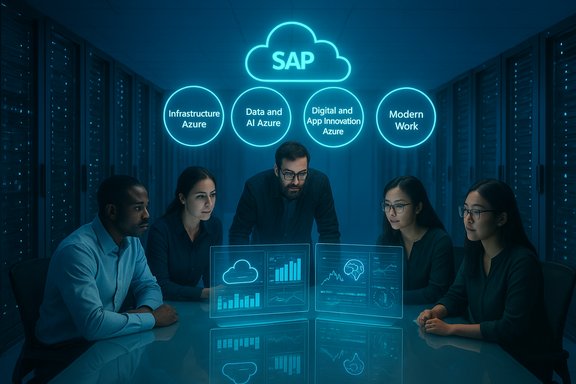
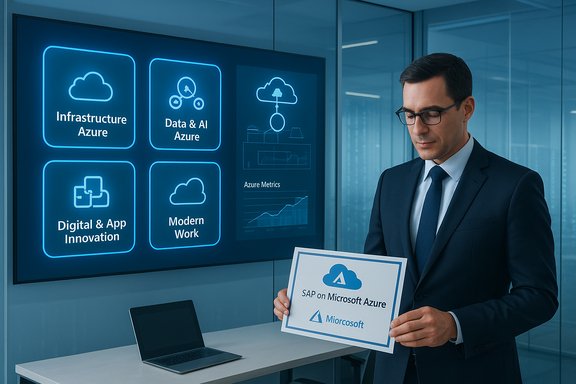
eMazzanti Technologies announced that it has earned four Microsoft Solutions Partner designations under the Microsoft AI Cloud Partner Program — Infrastructure (Azure), Data & AI (Azure), Digital & App Innovation (Azure), and Modern Work — and that it has met prerequisite requirements for the SAP on Microsoft Azure specialization, marking a significant credentials milestone for the Hoboken, N.J. managed services provider.
Microsoft’s partner ecosystem has been reorganized around the Microsoft AI Cloud Partner Program and the Solutions Partner designations, a structure that ties partner recognition to measurable outcomes in three pillars: Performance, Skilling, and Customer Success. Achieving a Solutions Partner designation requires partners to meet a partner capability score threshold and demonstrate activity across those three areas; Microsoft documents a minimum capability score of 70 points (out of 100) and points in each category as the baseline guardrail for award. These designations are no longer simple marketing badges. They are procedural achievements that unlock benefits including go‑to‑market resources, co‑sell eligibility, prioritized search discoverability in Partner Center, and access to specializations that require additional audit or skilling steps. The marketplace impact and sales motion advantages of solutions partner recognition have driven a wave of partner announcements in 2024–2025 as system integrators and MSPs align their GTM and technical investments to Microsoft’s cloud and AI priorities.
Key customer takeaways:
Microsoft’s partner program documentation explains the guardrails that make these designations meaningful — the partner capability score, documented skilling and customer success metrics, and workload specialization audits — but the program’s complexity and periodic rule changes require buyers to ask for Partner Center evidence and audit artifacts before assuming capability. For IT teams evaluating eMazzanti or any partner with recent Solutions Partner announcements, the most responsible path is straightforward: treat the badge as a positive filter, then convert that signal into operational proof. Ask for Partner Center screenshots, audit summaries for specializations, named references and SOC/ISO attestations, and require contractual protections that reflect the risk and criticality of the intended workload. When those elements line up, the combination of Solutions Partner designations and specialization evidence can materially reduce procurement friction and increase the chances of a successful Azure‑based transformation.
Source: WV News eMazzanti Technologies Achieves Four Microsoft Solutions Partner Designations in AI Cloud Partner Program
 Background
Microsoft’s partner ecosystem has been reorganized around the Microsoft AI Cloud Partner Program and the Solutions Partner designations, a structure that ties partner recognition to measurable outcomes in three pillars: Performance, Skilling, and Customer Success. Achieving a Solutions Partner designation requires partners to meet a partner capability score threshold and demonstrate activity across those three areas; Microsoft documents a minimum capability score of 70 points (out of 100) and points in each category as the baseline guardrail for award. These designations are no longer simple marketing badges. They are procedural achievements that unlock benefits including go‑to‑market resources, co‑sell eligibility, prioritized search discoverability in Partner Center, and access to specializations that require additional audit or skilling steps. The marketplace impact and sales motion advantages of solutions partner recognition have driven a wave of partner announcements in 2024–2025 as system integrators and MSPs align their GTM and technical investments to Microsoft’s cloud and AI priorities. What eMazzanti announced — concise summary
- The company secured Solutions Partner designations in:
- Infrastructure (Azure)
- Data & AI (Azure)
- Digital & App Innovation (Azure)
- Modern Work.
- Microsoft noted that eMazzanti has met prerequisite requirements for the SAP on Microsoft Azure Specialization, an additional validated specialization with its own audit and performance bars.
- The announcement includes a quote from Carl Mazzanti, eMazzanti’s president and co‑founder, framing the designations as validation of the company’s investments in Microsoft‑aligned skilling and managed‑service capabilities.
Why these specific designations matter
Infrastructure (Azure)
The Infrastructure Solutions Partner designation demonstrates a partner’s ability to migrate, run, and operate enterprise infrastructure on Azure: VMs, networking, storage, backup, site recovery, and hybrid scenarios. For customers with lift‑and‑shift, rehost, or platform migration needs, Infrastructure designation is a procurement shorthand that the partner can handle cloud operations at scale. Microsoft’s Solutions Partner framework ties this to measurable performance metrics and skilling credentials.Data & AI (Azure)
Data & AI signals capacity with Azure data platform services (Synapse, Fabric, Databricks integrations, AI platform services) and measured customer outcomes for analytics and AI. In practice this designation matters when organizations are moving from proofs‑of‑concept to production: customers expect governance, data lineage, and measured usage growth as part of customer success scoring. Achieving Data & AI is evidence of both technical skill and commercialized deployments.Digital & App Innovation (Azure)
Digital & App Innovation covers cloud‑native application modernization, developer productivity, Kubernetes and container platforms, DevOps toolchains, and low‑code/no‑code accelerators. For enterprises seeking to modernize legacy apps or build new cloud‑native services, a partner with this designation has demonstrated the combination of developer and cloud engineering skills Microsoft expects.Modern Work
The Modern Work designation ties to Microsoft 365, Windows management, Teams, Viva and the productivity stack. This signals capability in end‑user computing transformation, identity, device management, and collaboration—areas essential for hybrid work models and employee experience modernization. Historically, Modern Work was one of eMazzanti’s public strengths and is now reflected in the official Solutions Partner taxonomy.What the SAP on Microsoft Azure specialization means — and why to be cautious
eMazzanti’s statement that it has met prerequisite requirements for the SAP on Microsoft Azure Specialization is important because that specialization is a workload‑specific, audited recognition that requires:- An aligned Solutions Partner designation (Infrastructure).
- Performance thresholds expressed through Azure Consumed Revenue (ACR) aggregated across customers. Microsoft’s publicly posted figures for SAP on Azure prerequisites vary by page and timing: one Microsoft page references an average monthly ACR of USD 10,000 aggregated over the prior three months and at least three customers, while other Microsoft guidance documents show a higher aggregate ACR figure (for some specializations the page says USD 30,000 aggregated over three months). This inconsistency is a product of changing program rules and geography‑ or timeframe‑based updates; it should be validated in Partner Center before relying on it as fact.
- Skilling: certified individuals with SAP/Azure relevant certifications or completion of Microsoft’s “Run SAP on the Microsoft Cloud” learning path.
- A successful third‑party audit or documented customer references as part of the specialization workflow.
Verification: what the public record shows
- The company press release announcing the four solutions partner designations and the SAP prerequisite comes from a PR distribution (PR Newswire) published on November 25, 2025 and quotes company leadership and the specific solution areas awarded. This is the primary public record of the announcement.
- eMazzanti’s own site has historically published Modern Work recognition and partner credentials that align with the new Solutions Partner messaging; earlier Modern Work designation materials are available from eMazzanti’s site and show a sustained Microsoft alignment. Public company messaging supports the new announcement but is not an external audit.
- Microsoft documentation explains the mechanics, scoring, and specialization pathway for SAP on Microsoft Azure and the Solutions Partner model — offering authoritative details about the program rules and the partner capability score mechanics. These pages are the independent, program‑level verification of what the badges mean and what evidence Microsoft collects.
- Third‑party industry coverage of Microsoft partner milestones shows a broader pattern: multiple partners publishing Solutions Partner achievements and specializations across 2024–2025 as the program matured. This trend situates eMazzanti’s announcement inside normal partner‑ecosystem activity, but does not independently verify company claims beyond what Microsoft’s Partner Center and audit processes establish. Examples include public announcements from peers that have pursued all six Solutions Partner designations or specializations.
- Independent directories and market intelligence (for example, industry review sites listing eMazzanti among leading regional consultants) corroborate eMazzanti’s market presence but do not replace Partner Center evidence or audit artifacts. These sources are useful for context on capability and reputation, not for program validation.
Practical implications for customers, procurement teams, and channel partners
Achieving four Solutions Partner designations plus movement toward a workload specialization is strategically valuable — but it is neither a guarantee of project success nor a substitute for vendor due diligence.Key customer takeaways:
- Benefits
- Faster vendor shortlisting: Solutions Partner badges provide procurement teams with a searchable, program‑verified filter in Partner Center.
- Access to Microsoft resources: designation opens co‑sell pathways, deployment funding eligibility and partner‑level technical resources that can accelerate proof‑of‑value work.
- Signal of organized skilling: badges indicate a partner has invested in role‑based certifications and internal training programs to meet Microsoft’s skilling thresholds.
- Risks and caveats
- Maintenance risk: Partner designations depend on ongoing performance, skilling and customer success metrics. A badge today does not guarantee the same badge next quarter; partners must maintain or renew metrics and pass audits where applicable.
- Marketing vs. operational reality: A press release is promotional. It is legitimate to request direct evidence the partner’s program claims match Partner Center records and, where a specialization is involved, to ask for the audit summary or Microsoft verification letter.
- Specialization thresholds vary and change: numeric thresholds (ACR, certified personnel counts) can vary across program updates and regions; they must be checked in Partner Center. Multiple Microsoft pages sometimes show different numbers across updates—so confirm the current requirement rather than relying on a published press statement.
- Request an authenticated screenshot or exported view from Partner Center showing the partner capability score and the active Solutions Partner designations.
- For workload specializations (e.g., SAP on Azure), request the Microsoft specialization certification letter or Partner Center proof and ask for the third‑party audit executive summary (redacted if required).
- Ask for named references for recent, similar‑scope projects with contactable customer references and measurable outcomes (uptime, ACR, cost savings, timeline adherence).
- Obtain attestation of security posture: SOC 2 / ISO 27001 reports, vulnerability management evidence, and incident response playbooks if the partner operates production workloads.
- Confirm contractual protections: SLA definitions, escalation paths, migration warranties and rollback plans when the partner manages critical infrastructure or SAP workloads.
Critical analysis — strengths, commercial upside, and realistic risks
Strengths
- Strategic alignment with Microsoft’s cloud‑and‑AI priorities. The four designations map directly to the technical pillars most enterprise buyers now prioritize: infrastructure reliability, data & AI, cloud app modernization, and modern workplace transformation. This alignment improves relevance in Microsoft‑centric RFPs.
- Stronger GTM and co‑sell potential. Solutions Partner designation often increases discoverability and eligibility for Microsoft co‑sell motions, which can shorten procurement cycles for partner‑led pilots and proofs of concept.
- Indication of organized skilling and measurable customer outcomes. Success in these designations requires role‑based certifications and customer success evidence — an operational bar that many smaller providers do not meet. When genuine, that bar translates to more predictable delivery.
Risks and limitations
- Press release inflation is common. Many partners publish press releases when they hit program milestones. That publicity can blur the difference between achieved and maintained status, and messaging sometimes omits the nuance about whether a partner has fully completed audit steps required for a specialization. Buyers should always request Partner Center evidence and, for specializations, the audit letter.
- Program complexity and shifting thresholds. Microsoft’s partner program rules (ACR thresholds, skilling requirements, audit checklists) have changed during the AI Cloud Partner Program rollout. At times different Microsoft pages show different numeric thresholds for specializations; these inconsistencies create confusion for buyers and partners alike. This is especially relevant for SAP on Azure requirements, where public guidance includes differing ACR numbers on separate pages. Always verify in Partner Center.
- Operational scale vs. marketing signal. A Solutions Partner designation says the partner met certain program thresholds — but it doesn’t replace direct evidence of team capacity, documented runbooks, or sector experience for regulated industries. For large, mission‑critical projects, customers should demand named, production references and technical artifacts.
How partners convert badges into real customer value (practical advice for MSPs)
Partners that turn badges into sustained customer advantage follow a repeatable operating model:- Map badges to packaged offerings — e.g., Infrastructure: lift‑and‑shift migration package with defined timeframes, Data & AI: an analytics factory starter kit with governance checkpoints, Modern Work: device and identity lifecycle playbook.
- Publish measurable outcomes (ACR growth, time‑to‑value, customer satisfaction) and maintain a public dashboard or case library showing proof points.
- Operationalize Microsoft audit artifacts: archive audit summaries and make sanitized versions available for customers to review under NDA when necessary.
- Invest in internal enablement so the skilling threshold is sustained instead of a one‑time quota accomplishment.
Broader market context
A number of international systems integrators and managed service providers have used the Solutions Partner framework as a strategic milestone in 2024–2025. Examples include companies announcing full sets or multiple designations to signal capability across the Microsoft stack; this reflects a broader channel race to be visible for enterprise AI and cloud transformation work. The wave of announcements is consistent with partners pursuing increased co‑sell visibility and Microsoft alignment. At the same time, independent analysis and reporting about partner rebrands and capability signaling underscores a practical truth: badges are valuable, but they are an invitation to probe rather than proof of fit. Industry analysts regularly recommend that customers convert partner badges into vendor artifacts — Partner Center screenshots, audit reports, named references — before awarding critical contracts.Actionable checklist for Windows‑focused IT buyers (quick reference)
- Ask for Partner Center evidence of the four Solutions Partner designations and of any specialization audit completion.
- Request at least three named customer references for similar‑scale Azure/SAP/Data & AI/Modern Work projects and confirm contactability.
- Obtain redacted audit executive summaries for specializations or a copy of the Microsoft specialization letter.
- Validate security posture with SOC 2 / ISO 27001 evidence and review the partner’s incident response playbook.
- Insist on SLAs, migration warranties, and a staged cutover and rollback plan for infrastructure and SAP projects.
Conclusion
eMazzanti Technologies’ announcement that it has secured four Microsoft Solutions Partner designations and met prerequisites for the SAP on Microsoft Azure specialization is a credible market signal that the company is deepening its alignment with Microsoft’s cloud and AI strategy. The practical benefits for customers include faster shortlisting and potential access to Microsoft co‑sell resources, while the operational demands of these designations mean that the headline is only the start of procurement due diligence.Microsoft’s partner program documentation explains the guardrails that make these designations meaningful — the partner capability score, documented skilling and customer success metrics, and workload specialization audits — but the program’s complexity and periodic rule changes require buyers to ask for Partner Center evidence and audit artifacts before assuming capability. For IT teams evaluating eMazzanti or any partner with recent Solutions Partner announcements, the most responsible path is straightforward: treat the badge as a positive filter, then convert that signal into operational proof. Ask for Partner Center screenshots, audit summaries for specializations, named references and SOC/ISO attestations, and require contractual protections that reflect the risk and criticality of the intended workload. When those elements line up, the combination of Solutions Partner designations and specialization evidence can materially reduce procurement friction and increase the chances of a successful Azure‑based transformation.
Source: WV News eMazzanti Technologies Achieves Four Microsoft Solutions Partner Designations in AI Cloud Partner Program