

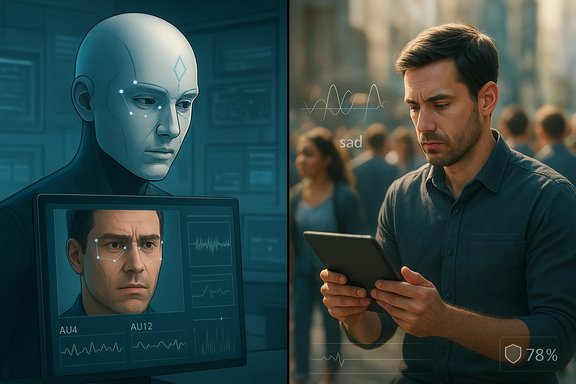
Emotion-sensing artificial intelligence is closing the gap on human ability to read facial expressions and vocal cues: multiple commercial systems and recent academic benchmarks report real-world accuracies in the mid‑70s to low‑80s percent range, while controlled laboratory tests and human benchmarking still show people generally outperform AI on nuanced, context‑rich emotion understanding.
Emotion-sensing AI — often called affective computing or emotional AI — refers to systems that infer a person’s internal affective state from observable signals. Those signals fall into four broad categories: facial expression, voice and prosody, textual content, and physiological signals (heart rate, skin conductance, EEG). Commercial implementations typically use one or more of these modalities and increasingly rely on multimodal fusion to boost robustness.
Research organized around open benchmarks and “in the wild” datasets has driven most recent progress. Historically, algorithms trained and evaluated on staged, lab‑collected databases performed very well; when moved to uncontrolled environments with varied lighting, occlusion, head pose, and cultural diversity, performance drops significantly. That difference — laboratory vs. real world — is the single most important technical constraint on practical emotion AI today.
Where that 75–80% figure breaks down in practice:
Systematic reviews of multimodal emotion recognition show that fusing facial, audio, text, and physiological signals reliably improves classification and robustness versus single‑modality pipelines. Conversely, single‑modality visual systems continue to suffer under varying illumination, pose, and real‑world distractions.
Modern AI systems sometimes match or exceed human performance on narrow benchmarks or specific tasks (for example, detecting prototypical expressions in short clips). However, humans still outperform AI when:
However, important limits remain. Human observers generally retain the advantage in interpreting nuance, context, and blended affect; AI systems are vulnerable to dataset bias, annotation subjectivity, and environmental variability. Ethical and legal risks are substantial and growing, and regulators are already constraining high‑risk uses. For technologists and product leaders, the imperative is clear: pursue emotion AI cautiously, prioritize privacy and fairness, verify performance across subgroups, and embed human oversight where outcomes matter. When those guardrails are in place, emotion‑sensing technology can be a valuable augmentation — but not a replacement — of human judgment.
Source: Analytics Insight Emotion-Sensing AI That Reads Your Mood Accurately
 Background
Emotion-sensing AI — often called affective computing or emotional AI — refers to systems that infer a person’s internal affective state from observable signals. Those signals fall into four broad categories: facial expression, voice and prosody, textual content, and physiological signals (heart rate, skin conductance, EEG). Commercial implementations typically use one or more of these modalities and increasingly rely on multimodal fusion to boost robustness.Research organized around open benchmarks and “in the wild” datasets has driven most recent progress. Historically, algorithms trained and evaluated on staged, lab‑collected databases performed very well; when moved to uncontrolled environments with varied lighting, occlusion, head pose, and cultural diversity, performance drops significantly. That difference — laboratory vs. real world — is the single most important technical constraint on practical emotion AI today.
How these systems work
Core architectural components
- Perception layer: image and audio preprocessing, face detection, voice activity detection, speaker diarization.
- Feature extraction: facial landmarks, facial action units (AUs), Mel‑spectrograms, pitch and energy contours, textual embeddings, and physiological feature vectors.
- Modeling: convolutional neural networks (CNNs), vision transformers (ViT), recurrent layers for temporal dynamics, and transformer‑based fusion networks.
- Decision layer: a classifier or regressor that maps features to emotion labels (happy, sad, angry, fearful, neutral, etc. or dimensional values (valence, arousal).
Modalities and their tradeoffs
- Facial expression: Widely used and often the first choice for real‑time emotion sensing. Relatively high signal density for basic emotions but sensitive to lighting, pose, occlusion, and skin‑tone representation in training data.
- Voice/prosody: Robust to visual occlusion and works across distance, but language, accent, and cultural norms influence how emotions map to vocal cues.
- Text: Useful for explicit sentiment and intent, but misses nonverbal context and subtext; best used with conversational AI.
- Physiological signals: Among the most reliable for internal states (stress, arousal) when available, but require wearables or dedicated sensors and raise additional privacy concerns.
What “75–80% accuracy” actually means
The widely circulated figure that emotion‑sensing AI achieves around 75–80% accuracy in real‑world use is a reasonable summary of multiple independent benchmarks and recent challenge results when systems are evaluated on in‑the‑wild datasets or privacy‑constrained, real‑world video collections. That performance band typically reflects:- Recognition of a limited set of basic emotions (anger, fear, disgust, happiness, sadness, surprise, neutral).
- Systems that have been fine‑tuned on large, diverse datasets or that employ multimodal fusion.
- Evaluations that use forced‑choice classification (select the single best emotion for each clip) rather than open, nuanced labeling.
Where that 75–80% figure breaks down in practice:
- Recognition of prototypical, high‑intensity expressions (e.g., a broad smile) approaches or exceeds this band more often than subtle or blended emotions.
- Cross‑cultural variation and in‑group/out‑group effects reduce accuracy in many deployments.
- Detection of complex social emotions (embarrassment, contempt, sarcasm) remains well below these figures.
Independent evidence and benchmarks
Recent academic and industry benchmarks focused on “in‑the‑wild” emotion recognition report results consistent with the mid‑70s to low‑80s percent accuracy range for state‑of‑the‑art systems that use multimodal data or privacy‑compliant feature sets. Large multimodal corpora and challenge tracks have pushed the frontier, but they also highlight the persistent gap between controlled and uncontrolled performance.Systematic reviews of multimodal emotion recognition show that fusing facial, audio, text, and physiological signals reliably improves classification and robustness versus single‑modality pipelines. Conversely, single‑modality visual systems continue to suffer under varying illumination, pose, and real‑world distractions.
Humans vs AI: who reads emotion better?
Laboratory psychology literature shows that human observers can achieve very high accuracy on prototypical expressions under carefully controlled conditions — often in the 80–90% range for a small set of basic emotions. In naturalistic settings, human accuracy falls as expressions become subtle, brief, or masked by context, but humans retain strong advantages in leveraging contextual cues, social knowledge, and world models.Modern AI systems sometimes match or exceed human performance on narrow benchmarks or specific tasks (for example, detecting prototypical expressions in short clips). However, humans still outperform AI when:
- The emotion expression is ambiguous, blended, or culturally specific.
- Contextual reasoning (situation, prior behavior, social cues) is essential to interpret the emotion correctly.
- Robustness and generalization across demographics, lighting, and occlusion are required.
Strengths and promising applications
Emotion‑sensing AI brings real technical and commercial benefits when used carefully and ethically. Notable strengths include:- Real‑time monitoring for safety: driver drowsiness detection, monitoring of operator alertness in industrial settings.
- Customer experience analytics: measuring aggregate reactions to content and advertisements at scale for product and UX teams.
- Augmented tools for healthcare and therapy: supporting clinicians with objective, continuous signals about arousal and affective change (used adjunctively, not as a sole diagnostic).
- Accessibility and assistive tech: helping people with social‑cognitive disorders by providing prompts about conversational partners’ likely affective state.
- Human–computer interaction: enabling adaptive interfaces that respond to frustration, boredom, or engagement.
Major risks, harms, and technical blind spots
Dataset bias and representational gaps
Training datasets remain skewed toward certain demographics and cultural backgrounds, producing systematic bias in recognition performance across skin tones, genders, ages, and cultural groups. These biases can lead to disparate outcomes when systems are applied to hiring, education, or law enforcement contexts.Label subjectivity and annotation problems
Ground truth for emotions is inherently noisy: human annotators disagree frequently, and annotations usually reflect perceived emotion rather than the expressor’s internal state. This creates a mismatch between model outputs and the underlying psychological construct.Context blindness
Facial expression or voice alone rarely encodes full meaning. AI that ignores situational context (what just happened, cultural norms, conversational history) risks mislabeling benign behavior as negative or vice versa.Privacy, surveillance, and consent
Emotion inference from biometric data touches the most sensitive forms of personal information. The risk of covert monitoring, function creep, and unauthorized profiling is high. Regulatory frameworks in some jurisdictions already restrict or ban certain uses of emotion recognition, especially in workplaces and education.Misuse and manipulation
Emotion AI can be repurposed for manipulation — tailoring persuasive content based on detected vulnerability or momentary emotional states. That capability raises serious ethical concerns about manipulation, coercion, and exploitation.Regulatory and legal landscape
Policymakers are reacting. High‑profile regulatory efforts treat some uses of emotion recognition as seriously risky or outright unacceptable in certain contexts. The evolving regulatory environment increasingly differentiates between:- Permissible, constrained uses (e.g., medical applications with patient consent and robust safeguards).
- High‑risk uses requiring strict oversight and transparency.
- Prohibited applications in sensitive settings such as workplace surveillance and education without explicit, freely given consent.
Best practices for engineers and decision makers
Deploying emotion‑sensing systems responsibly requires technical rigor and governance. Recommended practices include:- Start with a narrow use case and document why emotion sensing is necessary and how outcomes will be used.
- Prefer multimodal approaches (visual + audio + physiological where appropriate) and explicit uncertainty estimation to avoid overconfident predictions.
- Adopt privacy‑first data collection: minimize biometric retention, apply strong anonymization, and implement short retention cycles.
- Conduct demographic performance audits across age, gender, race/skin‑tone, and language. Publish summary metrics internally and to regulators as required.
- Integrate human‑in‑the‑loop controls for consequential decisions; use AI outputs as decision support, not final verdicts.
- Use calibrated confidence outputs and set conservative operating thresholds; allow systems to abstain when confidence is low.
- Provide transparency to end‑users: explain what the system measures, its limits, and how data will be stored and used.
- Perform continuous monitoring and revalidation as population, environment, or sensor characteristics change.
Technical recommendations for researchers
- Invest in diverse, high‑quality multimodal datasets collected with explicit consent and documented annotation protocols.
- Develop methods for uncertainty quantification (Bayesian approaches, selective prediction) so systems can defer to humans.
- Explore domain adaptation and continual learning to maintain performance as inputs shift.
- Prioritize explainability at the feature level (which facial regions, vocal features, or physiological markers drove the classification).
- Benchmark on both controlled and in‑the‑wild datasets; report per‑class and per‑subgroup metrics, not just average accuracy.
Strategic outlook for adopters
- Short term: expect incremental adoption in safety‑critical monitoring (driver monitoring), marketing analytics (aggregate, anonymized sentiment), and accessibility tools — provided robust governance is in place.
- Medium term: multimodal fusion and improved datasets will push accuracy higher for constrained problems, but contextual reasoning will remain the limiting factor for general emotion understanding.
- Long term: meaningful progress toward human‑level nuance will require systems that combine perceptual cues with situational context and richer cognitive models; this is as much a research problem in social cognition as it is a machine‑learning challenge.
When to say no: use cases that warrant refusal
- Automated hiring decisions or candidate screening based on inferred emotions.
- Covert surveillance or continuous monitoring of employees or students without explicit, revocable consent.
- Any decision that materially affects individuals (credit, parole, immigration) where predictions are used as determinative evidence.
- Manipulative advertising targeted to vulnerable states (e.g., targeting users in acute distress).
Conclusion
Emotion‑sensing AI has made measurable, practical progress: modern systems routinely achieve mid‑70s to low‑80s percent accuracy on realistic benchmarks when designed carefully and when they exploit multiple data streams. That progress unlocks useful, targeted applications — particularly where systems are used as assistive tools rather than decision authorities.However, important limits remain. Human observers generally retain the advantage in interpreting nuance, context, and blended affect; AI systems are vulnerable to dataset bias, annotation subjectivity, and environmental variability. Ethical and legal risks are substantial and growing, and regulators are already constraining high‑risk uses. For technologists and product leaders, the imperative is clear: pursue emotion AI cautiously, prioritize privacy and fairness, verify performance across subgroups, and embed human oversight where outcomes matter. When those guardrails are in place, emotion‑sensing technology can be a valuable augmentation — but not a replacement — of human judgment.
Source: Analytics Insight Emotion-Sensing AI That Reads Your Mood Accurately


