

The long-promised moment when laptops behave more like smartphones — automatically connecting to the best cellular network, enforcing corporate policies, and staying secure without user fiddling — has taken a major practical step forward today with a formal productization from Ericsson and Microsoft: the two companies announced an integrated 5G management solution built into Windows 11 that pairs Ericsson Enterprise 5G Connect with Microsoft Intune and Windows device features to deliver policy‑driven, zero‑touch 5G connectivity for enterprise PCs.
This new joint offering aims to make 5G‑connected Windows laptops “always connected” in a way enterprise IT can control at scale. The centerpiece is the integration of Ericsson’s cloud‑based connectivity orchestration (branded as Ericsson Enterprise 5G Connect, previously known in some trials as EVCN) with Windows 11 and Microsoft Intune, so that IT administrators can provision, enforce, and monitor cellular connectivity policies across entire device fleets. The companies position the product as an enterprise bundle — combining Surface Copilot+ PCs (as example hardware), Microsoft 365 and Intune, and Ericsson’s connectivity orchestration — to deliver automated eSIM provisioning, policy‑based network selection, and on‑device AI for connectivity decisions.
This announcement is the logical culmination of years of pilots and engineering work: Ericsson and Microsoft have been demonstrating network slicing and laptop connectivity capabilities with partners since at least 2023, and operators including T‑Mobile, SoftBank, Singtel and others have taken part in trials and early launches. The new package will be showcased at MWC Barcelona 2026 and is slated for broader availability beginning in the second quarter of 2026.
This staged carrier adoption reflects a practical reality: eSIM and managed 5G services require operator buy‑in for provisioning, roaming agreements, and commercial bundles. Enterprises evaluating this capability should confirm local carrier participation and commercial terms in their regions before planning large deployments.
Investors and market observers are already digesting the announcement in the context of Ericsson’s enterprise growth narrative; independent outlets reported the news alongside market commentary the same day. While product announcements don’t guarantee commercial success, they do show vendor execution on a multi‑year strategy to monetize enterprise 5G via software and orchestration.
Enterprises should treat this as a strategic capability worth piloting now: validate operator availability and costs, test real workloads under switching and roaming conditions, and insist on clear telemetry and contractual protections. If Ericsson and Microsoft deliver the operational reality they describe, the result could be a new class of enterprise device: a truly always‑connected PC that behaves like a smartphone for connectivity — yet remains under the control and governance of enterprise IT.
Source: Intellectia AI https://intellectia.ai/news/stock/ericsson-and-microsoft-launch-5g-solution-for-windows-11/
 Overview
This new joint offering aims to make 5G‑connected Windows laptops “always connected” in a way enterprise IT can control at scale. The centerpiece is the integration of Ericsson’s cloud‑based connectivity orchestration (branded as Ericsson Enterprise 5G Connect, previously known in some trials as EVCN) with Windows 11 and Microsoft Intune, so that IT administrators can provision, enforce, and monitor cellular connectivity policies across entire device fleets. The companies position the product as an enterprise bundle — combining Surface Copilot+ PCs (as example hardware), Microsoft 365 and Intune, and Ericsson’s connectivity orchestration — to deliver automated eSIM provisioning, policy‑based network selection, and on‑device AI for connectivity decisions.This announcement is the logical culmination of years of pilots and engineering work: Ericsson and Microsoft have been demonstrating network slicing and laptop connectivity capabilities with partners since at least 2023, and operators including T‑Mobile, SoftBank, Singtel and others have taken part in trials and early launches. The new package will be showcased at MWC Barcelona 2026 and is slated for broader availability beginning in the second quarter of 2026.
Background: why enterprise 5G for laptops matters
For almost a decade smartphones have enjoyed seamless connectivity and carrier‑managed provisioning. Laptops — despite being the backbone of enterprise productivity — have lagged because traditional corporate environments assume Wi‑Fi and VPNs. That creates friction for hybrid and remote workers, who either tether to phones, rely on insecure public Wi‑Fi, or carry separate hotspots.- Enterprise demands have changed. Cloud‑first apps, large AI models, and persistent real‑time collaboration increase the need for stable, secure connectivity outside the office.
- eSIMs and integrated modems exist, but management doesn’t. While many PCs now include eSIM‑capable 5G modems, provisioning and life‑cycle management of those SIMs is still largely manual or carrier‑centric.
- Enterprises want control. IT teams want predictable policies (which networks to prefer, what traffic to tunnel, which apps get priority) and zero‑touch provisioning so devices work securely out of the box.
What exactly did Ericsson and Microsoft announce?
Core capabilities (as described by the vendors)
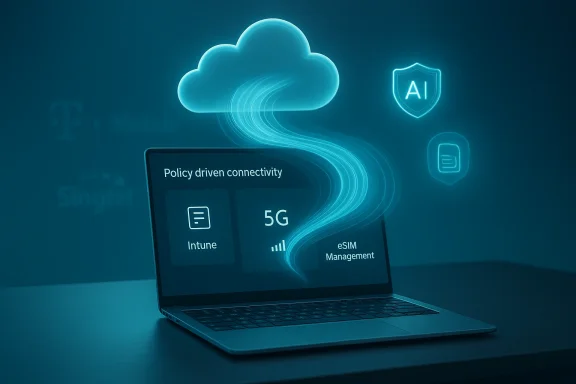
- Policy‑driven connectivity: IT admins can define enterprise policies in Microsoft Intune that determine how a device selects networks and prioritizes 5G for specific workflows. These policies are intended to be applied at scale across a fleet.
- Automated eSIM management and switching: Devices can automatically download, activate, and switch between multiple eSIM profiles without user intervention, allowing failover across carriers or access to private networks.
- Local AI agent for context‑aware decisions: An on‑device component monitors connection quality and makes real‑time choices (for example, when to switch eSIM profiles or throttle traffic) to optimize performance and security. The announcement highlights a “local AI agent” running on Surface 5G laptops as a differentiator.
- Zero‑touch provisioning and fleet roll‑out: Laptops shipped to users can receive connectivity profiles, apps and policies automatically through Intune and Ericsson’s backend orchestration, minimizing manual setup time for IT.
Technical deep dive
eSIM orchestration and zero‑touch provisioning
eSIM technology enables multiple carrier profiles on a single embedded SIM. Ericsson’s platform orchestrates the lifecycle:- Order and procure eSIMs centrally from an operator or a partner program.
- Push profiles during device production or immediately after enrollment via Intune.
- Activate/rotate profiles automatically when devices detect coverage or policy conditions.
Policy enforcement via Intune + Windows 11
Intune is extended to manage not only device software and security posture but also network policies that govern cellular behavior. Intune policies can indicate:- Which networks are permitted or preferred (public vs private vs specific CSP).
- When 5G should be prioritized (e.g., for low‑latency apps).
- Routing and tunneling requirements (e.g., force traffic through corporate VPN or selective split‑tunnel).
On‑device AI for connectivity intelligence
The press material describes a “local AI agent” that monitors connectivity signals, throughput, latency, and application context to make immediate decisions without always consulting the cloud. The rationale:- Reduce latency in switching decisions.
- Respect privacy by keeping transient telemetry local.
- Act on context (e.g., foreground apps needing high throughput get prioritized).
Carrier partners and availability
The initial launch targets specific markets and partners. Ericsson’s announcement names early launch commitments with several communications‑service providers, including:- T‑Mobile (United States)
- Telenor (Sweden)
- Singtel (Singapore)
- SoftBank Corp. (Japan)
This staged carrier adoption reflects a practical reality: eSIM and managed 5G services require operator buy‑in for provisioning, roaming agreements, and commercial bundles. Enterprises evaluating this capability should confirm local carrier participation and commercial terms in their regions before planning large deployments.
Real enterprise use cases
The announcement positions the solution for several distinct scenarios:- Field sales and remote knowledge workers: Laptops that connect automatically and securely for videoconferences and high‑bandwidth collaboration.
- First responders and mobile field teams: Devices that can switch to private or prioritized slices when entering critical zones.
- Hybrid branch scenarios: Offices with unreliable Wi‑Fi that rely on managed cellular as primary connectivity for certain devices.
- On‑site contractors and temporary deployments: Zero‑touch provisioning reduces the time to productivity for temporary workers and remote sites.
Security, privacy, and compliance considerations
5G connectivity brings new attack surfaces, but vendor design choices try to mitigate them:- Centralized policy and eSIM control reduces human error and risky user behavior (like manually adding plans or using insecure public Wi‑Fi).
- Network selection policies can prevent devices from attaching to untrusted public networks or force corporate VPN on certain connections.
- Local AI decisioning can limit telemetry sent to the cloud and perform transient decisions on the endpoint.
- Data flows and telemetry: Understand what device telemetry the Ericsson cloud collects versus what stays local in Windows. Vendors often collect telemetry for operational optimization, and enterprises must confirm retention and access policies for compliance. The public announcements do not publish full telemetry schemas, so require contractual clarity.
- Attack surface of remote provisioning: Automated eSIM provisioning centralizes control, but it also centralizes risk. Strong identity, certificate management, and secure attestation must protect the provisioning channel.
- Regulatory and export constraints: Cross‑border provisioning and private network access may trigger local regulatory or national security considerations in some markets. Ensure legal teams review cross‑border eSIM provisioning, especially for highly regulated industries.
Deployment checklist for IT teams
If you’re evaluating or preparing to pilot this capability, consider the following practical steps:- Inventory devices with 5G modem and eSIM support and identify which models are certified for the joint solution (Surface Copilot+ is mentioned as an early device example).
- Confirm regional carrier availability and commercial offers for managed eSIMs and roaming.
- Define Intune policies up front for network selection, tunneling, and data usage limits.
- Run a scoped pilot with representative users to test on‑device AI behavior, failover, and roaming—measure application SLAs.
- Verify telemetry, logging, and audit requirements with Ericsson and Microsoft; negotiate contractual terms for data handling.
- Train IT support for new operational flows (e.g., how to troubleshoot remote eSIM provisioning failures).
Competition and the broader market context
This announcement does not occur in a vacuum. Several dynamics matter:- Device OEMs: Intel, Qualcomm, and OEMs (HP, Lenovo, Dell) are shipping eSIM‑enabled Windows devices. Microsoft’s Surface examples are important for signaling capability, but enterprises will want broad OEM support.
- Operator programs: Operators are launching managed enterprise connectivity offerings (Singtel’s 5G+ and other operator‑led bundles), and their willingness to sell device + plan bundles will shape adoption.
- Alternative approaches: Some enterprises prefer private 5G/LTE or dedicated SD‑WAN + cellular failover solutions. Ericsson/Microsoft’s approach competes with those strategies by promising software‑defined policy at the device level rather than the network edge.
- Platform consolidation: Microsoft integrating connectivity control into Intune signals a shift where endpoint management and network orchestration converge, potentially reducing the need for separate mobile‑device management products for enterprise cellular cases.
Business implications and vendor motivations
For Ericsson, this extends their enterprise playbook: software and orchestration attached to operators’ 5G services is higher margin than hardware RAN sales. For Microsoft, embedding connectivity management into Windows and Intune strengthens the OS as the central management plane for hybrid work, encouraging more enterprises to standardize on their endpoint stack — and to buy Surface and Microsoft 365 bundles.Investors and market observers are already digesting the announcement in the context of Ericsson’s enterprise growth narrative; independent outlets reported the news alongside market commentary the same day. While product announcements don’t guarantee commercial success, they do show vendor execution on a multi‑year strategy to monetize enterprise 5G via software and orchestration.
Risks, unanswered questions, and things to validate in trials
No technology announcement is risk‑free. Below are the areas enterprises should scrutinize:- Operational resilience of automated switching: Frequent network switching, if not tuned, can degrade application performance. Tests should measure switching thresholds, hysteresis, and perceived UX.
- Cost control: Automatic switching or roaming may incur unexpected operator charges unless profiles and routing are carefully governed.
- Interoperability with existing VPN and security stacks: Confirm that Intune policies and local AI behavior do not conflict with custom VPN appliances or zero‑trust agents already deployed.
- Transparency and auditability: Enterprises must be able to audit which network a device used, when a switch occurred, and what policy triggered actions.
- Vendor lock‑in: Using Microsoft + Ericsson + specific carriers can be efficient, but enterprises should consider exit and migration scenarios.
Practical scenarios: a short hypothetical pilot
Imagine a mid‑sized professional‑services firm with 1,200 mobile consultants. A 12‑week pilot could proceed this way:- Weeks 0–2: Confirm hardware (Surface Copilot+ or equivalent), sign commercial terms with T‑Mobile (US) and Ericsson for managed eSIMs, and define Intune policies (preferred networks, forced VPN for confidential apps).
- Weeks 3–6: Enroll 100 users in a pilot. Devices ship zero‑touch with preprovisioned eSIMs and Intune policies.
- Weeks 7–9: Measure connectivity uptime for collaboration apps, test failover between Wi‑Fi and cellular, and monitor the local AI agent’s switching events.
- Weeks 10–12: Audit billing for cellular usage, evaluate helpdesk load reduction, and decide whether to scale fleet‑wide.
Final assessment: strengths, practical value, and what to watch
Strengths- Operational simplicity: The combination of Intune + Ericsson orchestration can drastically reduce device onboarding and configuration time for cellular connectivity.
- Enterprise control: Policy‑driven selection and centralized provisioning are strong answers to the long‑standing problem of inconsistent laptop connectivity.
- Realistic path to scale: Carrier commitments and prior pilots (e.g., Singtel, T‑Mobile, SoftBank) indicate commercial viability beyond labs.
- Transparency of AI and telemetry: The local AI agent is a promising concept, but enterprises must insist on clear telemetry, logging and explainability.
- Carrier coverage and cost: Availability and commercial terms will vary by region; universal global roaming and predictable billing remain non‑trivial.
- Interoperability: Enterprises with complex networking and security stacks should test end‑to‑end flows, not just connectivity in isolation.
- The technical sessions and demos at MWC Barcelona 2026 will likely provide additional detail on the on‑device AI, telemetry, and management UX.
- Broader OEM adoption beyond Surface devices will be crucial for mass enterprise uptake.
- Carrier pricing models for managed eSIMs and enterprise bundles will determine the economics for large deployments.
Conclusion
The Ericsson‑Microsoft announcement marks a meaningful shift in enterprise connectivity: software‑defined, policy‑driven 5G for Windows 11 laptops is moving from concept and pilots to a productized offering supported by major operators. For IT teams wrestling with hybrid work, the promise of zero‑touch provisioning, automated eSIM management, and policy enforcement via Intune is compelling and operationally transformative — if the commercial, security, and vendor‑integration pieces align in your region.Enterprises should treat this as a strategic capability worth piloting now: validate operator availability and costs, test real workloads under switching and roaming conditions, and insist on clear telemetry and contractual protections. If Ericsson and Microsoft deliver the operational reality they describe, the result could be a new class of enterprise device: a truly always‑connected PC that behaves like a smartphone for connectivity — yet remains under the control and governance of enterprise IT.
Source: Intellectia AI https://intellectia.ai/news/stock/ericsson-and-microsoft-launch-5g-solution-for-windows-11/
