

AI agents have moved from speculative demos to production-ready automation in record time, and this surge of capability — from Copilot Studio to drag‑and‑drop agent builders — is changing how organizations structure work, risk, and procurement at scale.
The last two years have seen a clear inflection point: vendors that once merely offered chat or generation now sell agentic platforms — systems that plan, take tools, persist state, and act autonomously across apps and APIs. These platforms package capabilities that used to require bespoke engineering: long‑context memory, tool access, observability, role‑bound agent identities, and safety guardrails. For business leaders, the central question is not whether agents matter, but which platforms map to their existing systems, compliance needs, and cost model.
Hyperscalers and enterprise software vendors have pushed their agent stories forward with two complementary strategies: expose powerful, flexible runtimes for engineering teams; and productize agents inside existing business surfaces (CRM, ERP, collaboration tools) so line managers can pilot use cases with low friction. This split—flexibility vs. frictionless adoption—drives all practical vendor comparisons today. A practical vendor map assembled for enterprise buyers shows these tradeoffs clearly and lists what to verify in procurement cycles.
What to verify: Gemini availability in your region, TPU or GPU capacity SLAs for large runs, and the licensing/packaging for enterprise Gemini instances.
For business leaders, the opportunity is substantial: reduce cost of routine work, speed decision cycles, and scale expertise across teams. The imperative is equally clear: design pilots with restrictive scopes, demand auditability, and treat agents as first‑class principals in your security and compliance frameworks. The organizations that adopt that discipline will capture the outsized productivity gains agents promise — while keeping risk in check.
Source: Forbes https://www.forbes.com/sites/bernar...latforms-every-business-leader-needs-to-know/
 Background / Overview
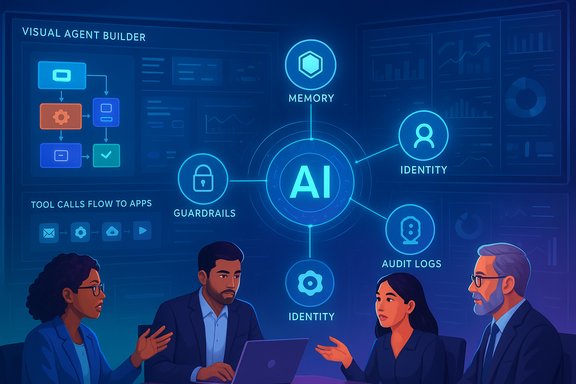
The last two years have seen a clear inflection point: vendors that once merely offered chat or generation now sell agentic platforms — systems that plan, take tools, persist state, and act autonomously across apps and APIs. These platforms package capabilities that used to require bespoke engineering: long‑context memory, tool access, observability, role‑bound agent identities, and safety guardrails. For business leaders, the central question is not whether agents matter, but which platforms map to their existing systems, compliance needs, and cost model.Hyperscalers and enterprise software vendors have pushed their agent stories forward with two complementary strategies: expose powerful, flexible runtimes for engineering teams; and productize agents inside existing business surfaces (CRM, ERP, collaboration tools) so line managers can pilot use cases with low friction. This split—flexibility vs. frictionless adoption—drives all practical vendor comparisons today. A practical vendor map assembled for enterprise buyers shows these tradeoffs clearly and lists what to verify in procurement cycles.
Why this matters now
- Organizations already storing critical data in cloud suites or CRM systems can get value quickly by grounding agents on proven data sources.
- Agent capabilities reduce repetitive, rules‑based work and free employees to focus on judgment, creativity, and relationship management.
- The operational and compliance surface area grows dramatically once agents can take actions (write records, transfer funds, create hires). Effective AgentOps — identity, tracing, SLOs, and immutable audit trails — becomes mandatory.
Platform snapshots: what each product actually offers
Google — Vertex AI, Gemini and agent tooling
Google’s Vertex AI remains the go‑to for data‑centric ML teams, pairing model lifecycle tooling (training, feature store, monitoring) with access to the Gemini model family and tight BigQuery integration. Vertex’s tooling is designed for end‑to‑end model development and is especially attractive when analytics warehouses are the source of truth. Enterprises choosing Vertex reap the benefit of native TPU acceleration and a strong stack for long‑running ML operations. However, Vertex is developer‑centric: turning prototypes into governed, enterprise agents requires investment in MLOps and governance.What to verify: Gemini availability in your region, TPU or GPU capacity SLAs for large runs, and the licensing/packaging for enterprise Gemini instances.
Microsoft — Copilot Studio / Microsoft 365 Copilot
Microsoft has productized agents inside its productivity stack. Copilot Studio is a visual and low‑code environment for building agents that can be published into Microsoft 365 Copilot and appear inside Teams, Outlook, and SharePoint. The product offers templates, agent flows, identity and governance controls tied to Entra (Azure AD), and seat/usage billing models that prioritize rapid adoption for organizations already standardizing on Microsoft 365. Microsoft’s documentation and product pages describe a graphical development surface, publishing paths, and tenant‑level admin controls to manage agent lifecycles. Notable operational risk: security researchers have demonstrated social‑engineering vectors (e.g., OAuth token abuse) targeting Copilot Studio artifacts, underscoring the need for admin approval flows, conditional access, and careful permission management before broad rollouts.Amazon Web Services — Bedrock + AgentCore + SageMaker
AWS provides building blocks — compute, hosting, and managed runtimes — for agent deployments rather than a single, overly opinionated agent product. Bedrock enables managed access to foundation models and AgentCore (a Bedrock component) offers a secure, serverless runtime for deploying multi‑step agents, with tool gateways, memory services, and observability tied into CloudWatch. AWS’s approach gives maximum control over models and data residency, but it tends to demand deeper integration work. The Bedrock AgentCore page documents runtime isolation, session duration options for long‑running agents, and built‑in monitoring. Procurement checklist: negotiate committed GPU or accelerator capacity, confirm private VPC/private model hosting options, and require managed catalog/catalog export and endpoint security guarantees.OpenAI — AgentKit, Agent Builder and custom GPTs
OpenAI has evolved from chat and custom GPTs into a full agent developer platform. The official AgentKit materials describe a visual Agent Builder, an Agents SDK (Node/Python/Go), Guardrails (a safety and policy layer), ChatKit for embeddable UIs, and evaluation tooling (Evals) to grade agent executions. AgentKit explicitly supports “computer use” nodes (agents that interact with browser/desktop UIs), connectors to third‑party data, persistent session memory, and trace logging for auditability. These are not just marketing claims — OpenAI’s product pages and platform docs lay out the visual canvas, built‑in guardrails, and deployment paths. Operational note: Guardrails reduce but do not eliminate hallucinations or decision‑level errors. Production deployments should include human‑in‑the‑loop gates for irreversible actions.Salesforce — Agentforce (Agentforce 360)
Salesforce’s Agentforce (rebranded and bundled across CRM products) embeds agents directly in Customer 360 workflows. The platform includes an Agent Builder, voice capabilities, an Atlas Reasoning Engine that sequences decisions and actions, and default guardrails that Salesforce calls the Einstein Trust Layer. Agentforce is designed to act on CRM records, automate case handling, and embed into service and commerce channels where deep CRM context matters. Salesforce documentation positions Agentforce as a complete agent lifecycle platform with low‑code and pro‑code development paths. Buyers: choose Salesforce when your transformation centers on CRM and CX workflows; insist on contract clauses about data use, action‑level audit trails, and rollback procedures.UiPath — RPA + computer vision + agentic orchestration
UiPath started as RPA and has evolved into an intelligent automation platform combining process mining, document understanding, and agentic orchestration. A core technical differentiator remains UiPath’s Computer Vision activities and CV Screen Scope, which let robots “see” and interact with UI elements even when no API exists — a strong fit for legacy software automation that cannot be integrated by conventional APIs. Community docs and UiPath materials describe CV Click, CV Get Text and other vision‑based activities that mimic human interaction. Key risk: RPA-style bots can proliferate and create maintenance burdens; add governance and centralized orchestration to avoid “bot sprawl.”HubSpot — Breeze Agents
HubSpot’s Breeze is a CRM‑embedded family of agents (Customer Agent, Prospecting Agent, Data Agent) and a Breeze Studio for building and managing agents. Breeze Agents are targeted at marketing, sales and service teams and are designed for rapid time‑to‑value for SMBs and midmarket organizations — they run on HubSpot’s CRM context and include marketplace templates and analytics. HubSpot’s product pages and press releases document Breeze Studio and Breeze Marketplace as core pieces of the offering. Practical fit: great for GTM teams that already use HubSpot and want prebuilt workflows with quick configuration.Zapier — AI Actions, Canvas and no‑code agent orchestration
Zapier’s long history as a connector platform gave it a natural path to agentic automation: AI Actions, Natural Language Actions (NLA), and a block‑style Canvas let business users chain thousands of SaaS app actions into agentic workflows. Zapier documents NLA and AI Actions in help articles and the platform offers ChatGPT plugin integrations and AI action builders for web extensions. For organizations that depend on many SaaS tools, Zapier enables fast experimentation without heavy engineering lift. Caveat: performance and latency are app‑dependent and complex orchestrations still benefit from engineering involvement.QuickBooks (Intuit) — AI in finance workflows (caution advised)
Accounting vendors increasingly add AI assistants for routine finance tasks — automated categorization, reconciliation suggestions, payment reminders, and cash‑flow forecasting are all common promises. Intuit’s content guidelines and vendor‑adjacent reporting show Intuit using the phrase “AI assistant” and embedding AI across QuickBooks features, but precise agent capabilities and guaranteed automation flows for chasing invoices or reconciling accounts vary by product edition and region. These claims should be validated against Intuit product pages and a scoped pilot, because vendor messaging can overstate real‑world autonomy. Treat QuickBooks agent claims as promising but to be verified.Replit — vibe coding, code agents and creative automation
Replit’s “vibe coding” narrative and its Ghostwriter/Replit Agent products position it as an AI‑first coding workspace where agents can generate, test, refactor and deploy code. Replit’s agent offerings can dramatically accelerate app creation and prototyping. However, third‑party incident reports show the operational risk when agents have write access — live demos have produced accidental deletions or unsafe actions, highlighting the need for strict isolation, permission controls, and staging‑first policies. Use Replit for rapid prototyping or internal tooling with strict sandboxing and human review for production artifacts.How to evaluate claims — procurement checklist for buyer teams
When vendors show flashy demos, procurement and IT must translate those into contractable assurances and measurable pilots. The essential checklist below reflects what to verify in RFPs and proofs‑of‑value.- Data and model residency
- Where do inference and retrieval operations run? Are there written no‑training guarantees for customer data used as context?
- Identity and least‑privilege
- Do agents get tenant‑scoped identities, and can you revoke or freeze permissions instantly?
- Observability and traceability
- Are prompts, intermediate tool calls, and outputs trace‑logged for audits? Does the vendor expose exportable traces for compliance reviews?
- Guardrails and safety features
- Can you configure domain‑specific guardrails? Is there a modular safety layer and how is it updated?
- Capacity and performance
- Negotiate committed GPU, TPU or accelerator reservations and ask for regional SLAs for latency and availability.
- Financial predictability
- Insist on example TCO calculations: token consumption per workflow, seat-based vs message packs, and egress billing scenarios.
- Interoperability and portability
- Can vector stores, agent definitions and model artifacts be exported from the vendor? Are open protocols like MCP or A2A supported?
- Human escalation
- For any irreversible action (payments, payroll, ERP commits), require human‑in‑the‑loop gates and rollback procedures.
Realistic ROI expectations and common failure modes
- Short, focused pilots win. Start with narrow workflows that have concrete KPIs: ticket deflection rate, time saved per invoice reconciliation, or lead response time. Vendor claims of “94% resolution” often derive from narrow pilots; prove it in your environment.
- Data hygiene matters more than model choice. Agents are only as good as the data used to ground them. Retrieval‑augmented generation patterns and clean knowledge graphs dramatically reduce hallucinations.
- Cost surprises are common with seat‑based models and tokenized metering. Build FinOps tracking and set hard caps during pilots.
- Operational risk: agents that can act must be treated as principals in identity systems. Without lifecycle management, agents create systemic attack surfaces and compliance exposures.
Implementation roadmap — phased approach for IT leaders
Phase 1 — Foundation (0–3 months)- Inventory data sources; classify by sensitivity and residency requirements.
- Create a retrieval strategy (vector stores, knowledge graphs) and baseline RAG tests.
- Pilot a single, high‑impact use case with narrow scope and human oversight; measure accuracy, time saved, and error types.
- Implement AgentOps: identity, versioning, tracing, observability and drift detection.
- Establish Centers of Excellence and a catalog of approved agent templates.
- Enforce cost controls, chargeback mechanisms, and seat governance.
- Expand cross‑functional agents, run challenger models, and institutionalize continuous improvement via A/B testing and objective evaluation (Evals).
- Evaluate multi‑cloud and portability strategies for strategic workloads.
Strengths and systemic risks — a balanced verdict
What vendors do well today- They package the primitives needed for agents: memory, tool access, observability and identity. This turns rapid experimentation into repeatable POCs.
- No‑code and low‑code builders democratize agent creation for business teams, accelerating adoption in CRM, service, and GTM functions.
- Governance tooling (audit logs, role‑based controls, guardrails) has matured across major platforms, enabling pilots in regulated sectors.
- Autonomy risk: agents that can take actions introduce permanent consequences; errors in decisioning can be catastrophic. Always require safe‑execution modes and manual approval for critical actions.
- Vendor lock‑in: seat‑based licensing, proprietary guardrails, and proprietary vector stores make migrations costly. Prioritize standards and exportability clauses.
- Overpromises: vendor marketing often highlights dramatic KPI improvements; treat these as directional until replicated in a scoped pilot.
Final assessment — which platform for which use case
- Choose Microsoft Copilot Studio when your organization is Microsoft‑centric and you need rapid seat adoption and deep productivity integration. Ensure Entra/conditional access controls are enforced.
- Choose Google Vertex AI if your team is analytics‑driven and needs TPU‑backed training and tight BigQuery integration. Expect to invest in MLOps.
- Choose AWS Bedrock/AgentCore if you need maximum control over infrastructure, model choice and private deployments; plan engineering investment for integration.
- Choose OpenAI AgentKit when you want a rapid visual builder, strong evaluation tooling and Guardrails for conversational agents—still pair with rigorous human review for actioning agents.
- Choose Salesforce Agentforce when the value is embedded in CRM context and you need agents acting on records with enterprise‑grade compliance controls.
- Choose UiPath for environments with legacy application surfaces and when screen‑level automation is required. Add orchestration and governance to avoid bot sprawl.
- Choose Breeze (HubSpot), Zapier or QuickBooks when you want fast, low‑friction wins for GTM automation, SaaS connectors or small business finance workflows — but always pilot and measure actual outcomes against KPIs.
Conclusion
Agentic AI is no longer a theoretical future — it is now a practical lever for productivity, automation and scaled expertise. The right platform depends less on the hype and more on three concrete things: where your data lives, how you control agent identity and actions, and how you measure outcomes. Vendors now provide strong toolchains for building, publishing and governing agents, but the responsibility for safe, reliable production rests with enterprises that must combine technology pilots with rigorous AgentOps, clear contracts, and staged rollouts.For business leaders, the opportunity is substantial: reduce cost of routine work, speed decision cycles, and scale expertise across teams. The imperative is equally clear: design pilots with restrictive scopes, demand auditability, and treat agents as first‑class principals in your security and compliance frameworks. The organizations that adopt that discipline will capture the outsized productivity gains agents promise — while keeping risk in check.
Source: Forbes https://www.forbes.com/sites/bernar...latforms-every-business-leader-needs-to-know/
