
AI has quietly remade the data that matters most inside regulated businesses: everyday conversations with clients and partners have become structured, searchable, and actionable — and that transformation is forcing organisations to choose between innovation and oversight unless they adopt new governance models for messaging intelligence.
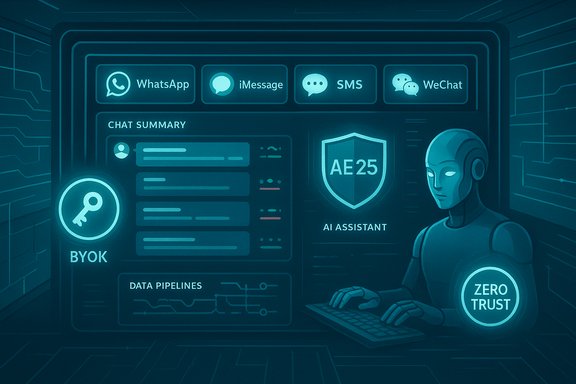
LeapXpert has positioned itself at the intersection of that choice. The company’s communications platform — now extended with an AI module called Maxen — promises to collect, normalise and analyse external client messaging (WhatsApp, iMessage, SMS, WeChat and others) alongside internal collaboration channels, converting raw chat streams into a governed, auditable dataset the firm calls Communication Data Intelligence. Built on what LeapXpert describes as a security-first, zero‑trust architecture with customer-controlled encryption, the platform aims to give relationship managers, compliance teams and legal officers a single pane of glass to monitor conversations, detect anomalies, and speed audit and supervisory workflows.
This shift is not coming a moment too soon. Across 2024–2025, multiple industry studies and vendor reports documented a rapid proliferation of “shadow AI” and unsanctioned generative assistants inside enterprises, plus a parallel rise in the embedding of AI summarisation and drafting features into mainstream collaboration tools. That trend turns ephemeral chat threads into high‑value — and high‑risk — corporate records. LeapXpert’s proposition is to keep the productivity gains of modern messaging while restoring visibility, governance, and legal defensibility.
The rest of this feature parses what LeapXpert claims to deliver, checks those claims against available evidence, and provides a practical, technical critique for IT leaders who must balance adoption with control.
LeapXpert’s materials assert mechanisms designed to preserve privacy and consent, but any organisation adopting such a solution must audit the data flow, retention windows, deletion guarantees and contractual commitments to ensure personal content does not remain accessible beyond what is necessary for compliance.
Organisations should demand transparency around model performance metrics, error rates, and retraining cadences for any AI used for surveillance or compliance.
From a practical standpoint, firms should align their messaging governance to three pillars:
However, technology alone is not a panacea. The successful adoption of communication‑governance platforms depends as much on contractual, legal and operational safeguards as it does on feature checklists. AI summarisation and automated detection can materially reduce compliance overhead, but they introduce new governance vectors — primarily around runtime decryption, model accuracy and privacy exposure — that organisations must manage proactively.
Organisations assessing solutions like LeapXpert should insist on independent security attestation, documented runtime protections for AI processing, robust retention and deletion guarantees, and transparent model governance. Vendor‑provided efficiency numbers are useful, but they must be backed by audited customer references or third‑party validation before being treated as baseline expectations.
If managed conscientiously, the payoff is significant: the same AI that complicates oversight can, when placed inside a governed architecture, become a source of business intelligence, faster regulatory response times, and — crucially — the trust regulators require for continued innovation.
Yet the transition demands sceptical, informed procurement and rigorous operational practices. The technical choices made in key management, runtime processing, and model governance will determine whether AI‑enhanced communication becomes a controlled asset or a new source of regulatory exposure. For IT and compliance leaders, the imperative is clear: accept the productivity benefits of modern messaging, but only after you have the governance control to explain, justify and audit every decision an AI makes on your behalf.
Source: AI News https://www.artificialintelligence-...ng-order-and-oversight-to-business-messaging/
 Background / Overview
LeapXpert has positioned itself at the intersection of that choice. The company’s communications platform — now extended with an AI module called Maxen — promises to collect, normalise and analyse external client messaging (WhatsApp, iMessage, SMS, WeChat and others) alongside internal collaboration channels, converting raw chat streams into a governed, auditable dataset the firm calls Communication Data Intelligence. Built on what LeapXpert describes as a security-first, zero‑trust architecture with customer-controlled encryption, the platform aims to give relationship managers, compliance teams and legal officers a single pane of glass to monitor conversations, detect anomalies, and speed audit and supervisory workflows.This shift is not coming a moment too soon. Across 2024–2025, multiple industry studies and vendor reports documented a rapid proliferation of “shadow AI” and unsanctioned generative assistants inside enterprises, plus a parallel rise in the embedding of AI summarisation and drafting features into mainstream collaboration tools. That trend turns ephemeral chat threads into high‑value — and high‑risk — corporate records. LeapXpert’s proposition is to keep the productivity gains of modern messaging while restoring visibility, governance, and legal defensibility.
The rest of this feature parses what LeapXpert claims to deliver, checks those claims against available evidence, and provides a practical, technical critique for IT leaders who must balance adoption with control.
Why messaging became the enterprise’s blind spot
The forces that made chat mission‑critical
- Consumer messaging apps became the client-preferred channel for rapid, informal interactions. In finance, professional services, and many B2B sectors, clients increasingly expect to transact and get updates via WhatsApp, iMessage, SMS and similar services.
- AI features are now built directly into collaboration platforms. Assistants that summarise threads, extract action items or suggest replies are no longer exotic; they’re a basic part of modern productivity stacks.
- The combination of personal-device usage, encrypted channels and cloud‑hosted assistants created an asymmetry: communication is efficient and intelligent, but visibility and retention frequently are not.
The security and compliance gap
Multiple enterprise surveys in 2024–2025 documented the problem: large majorities of organisations report limited technical controls over employee use of consumer AI tools, and many workers use unapproved AI services. The practical result is that sensitive client data can flow into third‑party models or remain scattered across channels without retention, supervision, or audit trails — a regulatory and reputational risk for firms operating under rules from agencies such as financial conduct authorities, securities regulators, or data‑privacy regimes.What LeapXpert is selling: Communication Data Intelligence and Maxen
Core capabilities (as described by the vendor)
LeapXpert’s platform aims to deliver the following set of core functions:- Channel consolidation — capture and normalise conversations across multiple external messaging channels and internal collaboration systems into one governed environment.
- AI-driven analysis (Maxen) — automated extraction of sentiment, intent, compliance signals and anomaly detection; generation of human‑readable summaries for faster review.
- Auditability and retention — tamper‑proof archiving of message content and metadata so compliance and legal teams can reconstruct conversations.
- Security-first architecture — zero‑trust controls, TLS for transit, AES‑256 data encryption, bring‑your‑own‑key (BYOK) options so customers maintain cryptographic control.
- Integrations and export — connections to archiving, surveillance, e‑discovery and SIEM systems to support existing compliance pipelines.
- User experience — features designed for relationship managers (summaries, suggested topics), while preserving client channel preferences.
How the AI layer is positioned
Maxen is presented as a generative/large language model‑powered layer that does three things:- Enrich — fuses message content, metadata and enterprise knowledge to provide context-aware suggestions.
- Detect — flags potential policy violations, insider trading signals, biased or risky phrasing, or anomalous patterns that might indicate impersonation or fraud.
- Summarise — creates condensed, readable summaries for compliance reviews and for relationship managers to catch up quickly.
Independent checks and verification
- LeapXpert publicly announced Maxen and described it as an AI-driven module designed to deliver communication intelligence. The company’s product pages and PR materials describe BYOK support, a zero‑trust approach, and native integrations with consumer messaging platforms.
- Industry reporting and vendor documentation confirm that mainstream collaboration tools now include embedded summarisation and assistant features (for example, Copilot in Microsoft Teams and Zoom’s AI Companion both provide thread and meeting summarisation capabilities).
- Multiple enterprise surveys highlight the lack of technical controls for employee AI use and widespread shadow AI behaviour, creating the same governance blind spots LeapXpert aims to address.
What LeapXpert gets right: notable strengths
1) Centralising external client channels is necessary
For firms that must retain and supervise client communications, capturing chats from consumer platforms and normalising them into a single governance model is a logical and necessary evolution. A central record reduces the need for brittle manual sampling and preserves context that fragmented archives often lose.2) Official integrations beat wrapper hacks
LeapXpert’s emphasis on official API integrations and server‑side capture addresses several practical risks posed by client‑side “wrapper” solutions — those that instrument user devices or require sideloaded clients. Official integrations are typically more resilient to app updates and avoid invasive device modifications that create user friction and potential security holes.3) BYOK and zero‑trust address key enterprise concerns
Allowing customers to control encryption keys and enforce zero‑trust access enables enterprises to keep legal ownership and reduce third‑party exposure. For highly regulated firms, BYOK plus strict RBAC and comprehensive logging are table stakes.4) AI can materially speed compliance workflows
When configured correctly, AI summarisation and risk detection can triage the volume of conversations compliance officers must review. This shifts the highest‑value human work away from repetitive sampling toward investigation and remediation.5) Security and compliance are now a differentiator
Vendors that combine governance with strong security controls — encryption, DLP, malware scanning, information barriers and auditable retention — make a credible case to regulated customers that messaging convenience need not mean regulatory exposure.What to watch out for: risks, limitations and hidden costs
1) Privacy and “selective capture” pitfalls
A recurring privacy concern with messaging compliance solutions is how capture is implemented. Solutions that promise to capture only “work‑relevant” chats may still route entire message streams through vendor systems for filtering or classification before any content is discarded. Even transient exposure of personal messages to third‑party systems can create legal and trust problems, particularly in regions with strict data‑privacy laws or where consent and purpose limitation are required.LeapXpert’s materials assert mechanisms designed to preserve privacy and consent, but any organisation adopting such a solution must audit the data flow, retention windows, deletion guarantees and contractual commitments to ensure personal content does not remain accessible beyond what is necessary for compliance.
2) Encryption in use remains a tough technical problem
BYOK secures data at rest and can strengthen control over stored content. However, when AI models must analyse message content, the platform inevitably needs to decrypt messages in controlled environments. That places a premium on:- the security of the processing environment,
- clear operational controls for key access,
- detailed logging of who or what accessed decrypted material,
- and — if applicable — the use of confidential computing or hardware enclaves to reduce exposure.
3) False positives, model drift and regulatory sensitivity
Automated detection of “compliance signals” relies on classifiers that are inevitably probabilistic. False positives (innocuous messages flagged as suspicious) create operational noise and staff time overhead; false negatives (missed policy violations) create regulatory risk. Over time, models will need retraining and governance to prevent drift, to account for domain‑specific terminology, and to align to regulatory rules (for example, what constitutes “investment advice” in one jurisdiction might differ in another).Organisations should demand transparency around model performance metrics, error rates, and retraining cadences for any AI used for surveillance or compliance.
4) Legal and cross‑border data transfer complexity
Messaging capture often involves data that originated on devices or servers located in multiple jurisdictions. The combination of cross‑border retention, potential access by different business units, and regulator demands for e‑discovery can create contradictory obligations. Contracts, data processing agreements and information flow mappings are essential. Vendors must be able to demonstrate geographic deployment options and clear policies on international access.5) Vendor lock‑in and data portability costs
Moving communications archives from one vendor to another can be costly. Enterprises should insist on standard export formats, transparent retention/archiving policies and legal assurances that data will be provided on demand in an auditable format.Operational advice for IT, compliance and security teams
- Treat communication data as privileged enterprise assets. Classify message streams the same way you classify structured databases or document repositories.
- Map the data flow end‑to‑end. Identify where messages are captured, how they are stored, where decryption occurs, which services have access to keys, and exactly what metadata is preserved.
- Require BYOK and strict key‑access controls. If a vendor offers BYOK, confirm the operational procedures for key rotation, emergency key escrow and forensic access. Insist on proof that keys cannot be exfiltrated.
- Demand runtime protections for decrypted processing. If AI processes require decrypted text, ask for evidence of confidential computing, hardware roots of trust, or strong isolation controls coupled with transparent logging.
- Audit AI model governance. Obtain details on model training data sources (to the extent permissible), update schedules, validation sets for compliance classification models, and mechanisms to handle false positives and appeals.
- Start human‑in‑the‑loop workflows early. Use AI to triage, not to adjudicate. Compliance officers should be able to inspect, annotate and override AI flags; those actions must be audited.
- Define minimisation and retention policy. Keep only what’s necessary for compliance and legal obligations; document deletion processes and proof of removal.
- Integrate with existing e‑discovery and SIEM tooling. Central archives without enterprise integrations will only create new siloes.
- Contractual protections matter. Include SLAs for responsiveness to regulator requests, audit rights over vendor security controls, indemnities for data exfiltration and clear terms on data portability.
- Train users and leaders on acceptable AI usage. Technical controls are necessary but insufficient; user education reduces shadow AI risk.
Governance frameworks and regulatory expectations
Regulators are watching communication governance more closely. The move by mainstream collaboration vendors to bake summarisation and generative features into core products accelerated the regulatory focus. Firms should expect regulators to view disappearing messages, unrecorded client interactions, and unsanctioned AI uploads as potential breaches of recordkeeping obligations.From a practical standpoint, firms should align their messaging governance to three pillars:
- Transparency: Clear audit trails and supervisor access to explain why a message was flagged or summarised.
- Accountability: Role‑based access controls and logged reviewer decisions that can be produced to regulators.
- Proportionality: Policies that reflect the sensitivity of the client relationship and the regulatory regime; not every chat requires the same retention posture.
How to evaluate a vendor like LeapXpert
When assessing a vendor promising to govern and analyse communications, buyers should use a checklist covering security, AI governance, integration and ROI:- Security & cryptography: Does the vendor support BYOK? What runtime protections exist when messages are decrypted for analysis?
- Integration fidelity: Are integrations official and server‑side (not device wrappers)? Can the vendor capture full metadata and message edits/retains?
- Compliance completeness: Can the archiving meet your regulator’s retention, e‑discovery and legal hold requirements?
- AI transparency: Can the vendor show model performance, audit logs of decisions, and mechanisms for human review and contestation?
- Operational resilience: How does the vendor handle app updates from channel providers? What uptime and retention SLAs are provided?
- Privacy controls: How does the vendor segregate personal content, implement minimisation, and document consent for client communications?
- Customer success evidence: Ask for anonymised case studies, references, and measurable metrics (time saved, reduced audit response times) — then verify those claims independently where possible.
The bottom line: a pragmatic verdict
LeapXpert addresses a real and growing problem: the need to capture, govern and extract value from the new communication data layer that AI has created. The combination of channel consolidation, official API integrations, BYOK and zero‑trust architecture is exactly the type of product profile regulated enterprises should be evaluating.However, technology alone is not a panacea. The successful adoption of communication‑governance platforms depends as much on contractual, legal and operational safeguards as it does on feature checklists. AI summarisation and automated detection can materially reduce compliance overhead, but they introduce new governance vectors — primarily around runtime decryption, model accuracy and privacy exposure — that organisations must manage proactively.
Organisations assessing solutions like LeapXpert should insist on independent security attestation, documented runtime protections for AI processing, robust retention and deletion guarantees, and transparent model governance. Vendor‑provided efficiency numbers are useful, but they must be backed by audited customer references or third‑party validation before being treated as baseline expectations.
If managed conscientiously, the payoff is significant: the same AI that complicates oversight can, when placed inside a governed architecture, become a source of business intelligence, faster regulatory response times, and — crucially — the trust regulators require for continued innovation.
Conclusion
The enterprise messaging landscape has evolved from ephemeral chat into a structured intelligence layer that can drive client service and compliance alike. LeapXpert’s framing of that problem — consolidating scattered channels, applying AI to surface risk and insight, and packaging the whole thing inside a security‑focused, auditable platform — aligns with the direction regulated organisations must take.Yet the transition demands sceptical, informed procurement and rigorous operational practices. The technical choices made in key management, runtime processing, and model governance will determine whether AI‑enhanced communication becomes a controlled asset or a new source of regulatory exposure. For IT and compliance leaders, the imperative is clear: accept the productivity benefits of modern messaging, but only after you have the governance control to explain, justify and audit every decision an AI makes on your behalf.
Source: AI News https://www.artificialintelligence-...ng-order-and-oversight-to-business-messaging/
