

The Environmental Protection Agency has moved decisively to close a regulatory gap that community groups say allowed Elon Musk’s xAI to run dozens of methane-powered turbines at its Colossus AI data center in South Memphis without the air permits federal law requires, and that move has immediate legal, technical, and political consequences for xAI and the wider data‑center industry.
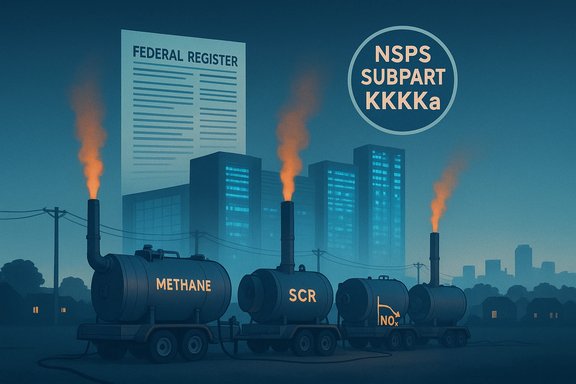
On January 15, 2026, the EPA finalized a long‑anticipated revision to the New Source Performance Standards (NSPS) governing stationary combustion and gas turbines. The final rule clarifies that combustion turbines — including units mounted on vehicles or trailers and those used in temporary or portable stationary applications — continue to be regulated as stationary sources under NSPS and therefore are generally not exempt as nonroad engines. The new subpart (codified as subpart KKKKa) formalizes applicability criteria, sets performance standards, and establishes expectations for control technologies and testing for different turbine size categories.
That regulatory clarification has a direct and potentially punitive implication for xAI’s Memphis Colossus complex because community groups, county health officials, and independent observers have documented the presence of dozens of methane‑fired turbines on the site — far exceeding the number xAI later sought to permit — and raised credible questions about whether those turbines should have been permitted from day one.
The EPA’s action removes ambiguity that local regulators and the company had sometimes invoked to treat mobile turbines as temporarily exempt from major permitting requirements. With the agency’s final decision now in the Federal Register and effective immediately, the legal posture shifts: turbines that meet NSPS applicability are subject to NSPS limits and, where emissions cross statutory thresholds, major source permitting requirements under the Clean Air Act.
The EPA’s final rule undermines any claim that those turbines were exempt because they were “temporary” or “nonroad” units. If the turbines meet the NSPS criteria (based on heat input, design rating, and operational use) they must comply with NSPS requirements and, importantly, the facility must calculate potential to emit for major‑source status.
Practical impacts for xAI include:
The EPA’s final rule clarifies that combustion turbines of the size and type used to supply tens to hundreds of megawatts to a data center do not convert to “nonroad engines” simply because they are transportable. The agency reaffirmed that turbines meeting NSPS criteria are excluded from the nonroad definition and are treated as stationary sources. The rule also creates a narrow temporary‑turbine subcategory with clearly defined compliance metrics — but those metrics do not lift the turbines out of federal air quality regulation.
Local elected officials and utility managers simultaneously framed the Colossus development as an economic win — jobs, tax revenue, and investment — creating a political friction point between short‑term economic gains and long‑term community health.
The EPA’s action signals regulators will not treat sizable combustion plants as ephemeral simply because they are quick to install. Expect:
The decision also reframes a broader policy debate: how to reconcile the urgent infrastructure needs of an AI‑driven economy with the legal responsibilities and public health requirements that protect overburdened communities. For data‑center operators, utilities, and regulators alike, the message is clear: speed-to‑power cannot be an escape hatch from environmental law. Compliance, transparency, and community engagement must be part of the buildout playbook — and the technical and political work to deliver large, clean, and equitable power solutions will define whether large AI projects are broadly welcome or legally constrained in the years ahead.
Source: PCMag Middle East https://me.pcmag.com/en/ai/34772/xa...-illegally-as-epa-clarifies-turbine-loophole]
 Background and immediate development
On January 15, 2026, the EPA finalized a long‑anticipated revision to the New Source Performance Standards (NSPS) governing stationary combustion and gas turbines. The final rule clarifies that combustion turbines — including units mounted on vehicles or trailers and those used in temporary or portable stationary applications — continue to be regulated as stationary sources under NSPS and therefore are generally not exempt as nonroad engines. The new subpart (codified as subpart KKKKa) formalizes applicability criteria, sets performance standards, and establishes expectations for control technologies and testing for different turbine size categories.That regulatory clarification has a direct and potentially punitive implication for xAI’s Memphis Colossus complex because community groups, county health officials, and independent observers have documented the presence of dozens of methane‑fired turbines on the site — far exceeding the number xAI later sought to permit — and raised credible questions about whether those turbines should have been permitted from day one.
The EPA’s action removes ambiguity that local regulators and the company had sometimes invoked to treat mobile turbines as temporarily exempt from major permitting requirements. With the agency’s final decision now in the Federal Register and effective immediately, the legal posture shifts: turbines that meet NSPS applicability are subject to NSPS limits and, where emissions cross statutory thresholds, major source permitting requirements under the Clean Air Act.
Overview: what the EPA actually changed
What the final rule says in plain language
- The EPA revised NSPS to create updated subparts for stationary combustion turbines and stationary gas turbines, clarifying definitions and applicability.
- The agency made explicit that turbines that are portable or mounted on trailers but are used in a stationary capacity are still stationary sources for NSPS applicability.
- The final rule establishes subcategories based on size, fuel type, and utilization, and sets NOx and SO2 performance standards for those subcategories.
- For certain categories, the EPA identified best system of emission reduction (BSER) technologies (e.g., selective catalytic reduction for NOx) and set testing and documentation requirements for temporary turbines.
- The rule preserves the regulatory structure that triggers permitting and major source classification where emissions exceed statutory thresholds.
Key technical thresholds (verified from the final rule and Clean Air Act definitions)
- NSPS applicability is tied to turbine heat input and design ratings; the final rule targets stationary turbines that meet the statutory temperature/heat input thresholds historically captured by subparts KKKK and GG.
- Combustion turbine units with heat input ratings above the NSPS applicability threshold remain covered, even if the unit is portable in form factor.
- Clean Air Act Section 112 major source thresholds remain in force: 10 tons per year (tpy) for any single hazardous air pollutant (HAP) and 25 tpy for aggregate HAPs. These thresholds are core to determining whether a facility is a major source for HAP regulation.
Why this matters to xAI in Memphis
xAI’s Colossus site has been a lightning rod for environmental justice activists and legal advocates for more than a year. The company placed modular methane‑fueled turbines on site to deliver large amounts of power immediately while local grid upgrades and substations were built. Local activists and the Southern Environmental Law Center documented aerial imagery showing many more turbines onsite than had been permitted, and they argued those turbines were effectively a stationary power plant operating without the permits required under the Clean Air Act.The EPA’s final rule undermines any claim that those turbines were exempt because they were “temporary” or “nonroad” units. If the turbines meet the NSPS criteria (based on heat input, design rating, and operational use) they must comply with NSPS requirements and, importantly, the facility must calculate potential to emit for major‑source status.
Practical impacts for xAI include:
- Potential retroactive enforcement for unpermitted operation.
- Exposure to civil penalties for operating stationary sources without required permits.
- Possible requirement to obtain major‑source permits (including prevention of significant deterioration (PSD) or nonattainment NSR) if emissions estimates meet statutory thresholds.
- Imposition of emission limits, monitoring, and required implementation of controls such as selective catalytic reduction (SCR) for NOx.
The regulatory mechanics: how temporary turbines became the legal battleground
The “nonroad engine” argument and why EPA shut it down
Operators have sometimes argued that turbines — particularly mobile or trailer‑mounted units — qualify as nonroad engines (a category of mobile internal combustion engines) and thus fall outside some stationary source NSPS and permitting regimes. That distinction matters because certain small portable engines (for example, some spark‑ignition engines) have express temporary operation exemptions under separate NSPS subparts.The EPA’s final rule clarifies that combustion turbines of the size and type used to supply tens to hundreds of megawatts to a data center do not convert to “nonroad engines” simply because they are transportable. The agency reaffirmed that turbines meeting NSPS criteria are excluded from the nonroad definition and are treated as stationary sources. The rule also creates a narrow temporary‑turbine subcategory with clearly defined compliance metrics — but those metrics do not lift the turbines out of federal air quality regulation.
Emissions thresholds that trigger major‑source permitting
Two regulatory thresholds are decisive:- The Clean Air Act’s HAP major source trigger — 10 tpy for any single HAP — can convert a source into a major stationary source subject to Section 112 standards and Title V/major permitting. Formaldehyde, which may be emitted from combustion turbines, is a single HAP that draws attention when projected emissions approach the 10 tpy threshold.
- For criteria pollutants such as NOx, state and federal permitting programs typically use tonnage thresholds (varies by pollutant and nonattainment classification) to determine major source status and PSD/NPR obligations. Public filings and environmental group estimates have placed projected NOx emissions from multiple turbines in ranges that could meet or exceed major‑source thresholds.
The on‑the‑ground facts and the contested numbers
Several recurring numeric claims appear in public filings and reporting; these numbers are not universally agreed but are central to the dispute. Where the numbers conflict, they should be treated cautiously.- Observed turbines onsite: imagery and community group reports documented as many as 35 turbines at one Colossus site during aerial surveys; local regulators later said a smaller number were operational. The precise count varies across datasets and reporting dates because turbines were added and removed during the period investigators were active.
- Permitted turbines vs. operated turbines: xAI applied for a permit for 15 turbines at one phase of the project; environmental groups later alleged many more turbines had been installed.
- Power capacity from turbines: estimates for combined turbine capacity on site have ranged widely, with some tallies suggesting hundreds of megawatts of mobile generation were deployed (one estimate placed the combined temporary capacity above 400 MW at peak onsite).
- Grid connection: utility and local reporting indicate the site was ultimately connected to the grid for an initial 150 MW of service through a new substation, with plans or applications for additional capacity later.
- Emissions estimates: environmental filings have modeled hundreds to thousands of tons per year of NOx depending on turbine counts and operating hours. Formaldehyde emissions were estimated in permit applications below — but close to — the 10 tpy HAP trigger in one filing (e.g., an application figure of about 9.79 tpy for formaldehyde was reported).
Environmental justice, public health, and local politics
The Colossus site is located near neighborhoods that have historically borne a disproportionate share of industrial pollution in Memphis. Local civil‑rights organizations and the NAACP have advanced two central arguments:- Operational: the turbines added legally‑unreviewed sources of NOx and HAPs to communities that already experience higher asthma rates and elevated cancer risk indices.
- Procedural: local permitting decisions and nondisclosure conditions favored rapid corporate deployment over public participation, and the treatment of turbines as “temporary” effectively circumvented public notice and scrutiny.
Local elected officials and utility managers simultaneously framed the Colossus development as an economic win — jobs, tax revenue, and investment — creating a political friction point between short‑term economic gains and long‑term community health.
Legal exposure and enforcement scenarios for xAI
With the EPA’s clarifying rule now final and in effect, a range of enforcement and compliance outcomes become plausible:- Administrative enforcement by state/local air agencies — including demands to remove unpermitted turbines, retroactive permit applications, or revocation of granted minor permits where the facility should have been classified as a major source.
- Civil suits under the Clean Air Act from community groups and civil‑rights organizations seeking injunctions and civil penalties for unpermitted operation.
- Federal enforcement or referral where state action is insufficient or inconsistent with EPA determinations, including potential imposition of NSPS‑required controls with deadlines and monitoring.
- Settlement remedies that can include monetary penalties, mandated emissions controls (e.g., SCR installations), enhanced monitoring, community mitigation funds, and institutional controls to prevent future unpermitted expansion.
Technical options and compliance pathways
If a facility must comply with NSPS and major‑source requirements, several technical and procedural responses are available. These include:- Immediate: suspend operation of unpermitted turbines, submit retroactive permit applications, and implement interim emissions monitoring and reporting to show good faith.
- Control technologies: deploy selective catalytic reduction (SCR) for NOx control and best available control technologies for HAPs; the EPA has identified SCR as BSER for many turbine subcategories.
- Operational changes: reduce hours of operation, derate turbines, or shift loads to grid power where available.
- Longer‑term infrastructure: accelerate grid interconnection projects, invest in battery energy storage systems to smooth peak demand, contract additional grid capacity, or deploy less polluting backup generation options (e.g., dual‑fuel or low‑NOx certified units).
- Strategic transition: plan for electrification of loads, on‑site renewables paired with storage, or alternative fuels (including hydrogen blends) where feasible and allowed by permitting.
Broader implications for the AI and data‑center sector
The EPA’s clarification will reverberate beyond Memphis. The generative‑AI era has driven an unprecedented appetite for large, concentrated power loads near data centers. Some operators have turned to modular gas turbines as an interim power source to bring facilities online quickly — especially where grid upgrades lag permitting and capital timelines.The EPA’s action signals regulators will not treat sizable combustion plants as ephemeral simply because they are quick to install. Expect:
- Tighter scrutiny of temporary generation used to bridge grid constraints.
- Greater emphasis on upfront environmental review when developers plan modular generation at scale.
- A renewed policy focus on data‑center siting, grid investments, and who should bear the cost of rapid power scaling.
- Potentially greater interest in long‑duration storage, microgrids, and grid modernization as risk‑mitigation options for both developers and communities.
Strengths and weaknesses of the EPA approach
Notable strengths
- Clarity and consistency: By codifying the treatment of portable turbines in NSPS, the EPA reduces the legal uncertainty that had allowed divergent local interpretations.
- Health‑protective focus: Requiring permits and control technology where turbines meet NSPS thresholds strengthens public health protections in communities already overburdened by pollution.
- Predictability for industry: The rule gives operators a clear compliance pathway and technical expectations (e.g., SCR for NOx), enabling better planning and investment choices.
Potential risks and open questions
- Transition timing and economic impacts: Rapid enforcement actions can force difficult short‑term tradeoffs between power availability and compliance costs, potentially delaying operations and jobs.
- Variable local enforcement: The EPA’s national clarity may still clash with state or local agency capacity and political choices, producing litigation and inconsistent outcomes.
- Unintended consequences: Developers might shift to alternative temporary solutions that are less regulated but still harmful, or they may accelerate grid connections in ways that favor large entrants over smaller consumers.
- Verification gaps: Onsite deployment numbers and real‑time emissions data have been inconsistent across reports; regulators will need robust inspection and monitoring to ensure accurate enforcement.
What comes next in Memphis and nationwide
For Memphis, expect parallel tracks:- Local permitting reviews and administrative appeals by community groups to challenge earlier permit decisions and classifications.
- Potential litigation under the Clean Air Act, with NAACP and regional environmental groups prepared to press civil actions or administrative appeals.
- Possible negotiated settlements that require remediation, retrofits, community investments, or operational restrictions while grid connections are completed.
Practical guidance for operators and local officials
- Conduct immediate legal and technical reviews of any temporary generation installations against NSPS applicability and the Clean Air Act’s HAP thresholds.
- If a turbine installation is or may be subject to NSPS, engage proactively with regulators to submit permitting documentation and to agree on interim operating conditions and monitoring.
- Prioritize emission control installations (e.g., SCR for NOx) where required by NSPS or where modeled impacts approach health‑based thresholds.
- For public officials: institute transparent, mandatory notifications and public comment periods for temporary turbine deployments, and require site‑level continuous emissions monitoring where justified.
- Consider investing in grid modernization and storage as a long‑term strategy to reduce reliance on combustion solutions that are costly to communities.
Conclusion
The EPA’s January 2026 NSPS final rule closes a loophole that had allowed a growing and controversial practice — deploying trailer‑based or portable turbines to supply stationary loads at scale without the permitting and pollution controls that accompany fixed power plants. In Memphis, that closure has tectonic consequences: it re‑frames past turbine deployments at xAI’s Colossus site as subject to federal standards and potentially exposes the company to retroactive permitting obligations and enforcement.The decision also reframes a broader policy debate: how to reconcile the urgent infrastructure needs of an AI‑driven economy with the legal responsibilities and public health requirements that protect overburdened communities. For data‑center operators, utilities, and regulators alike, the message is clear: speed-to‑power cannot be an escape hatch from environmental law. Compliance, transparency, and community engagement must be part of the buildout playbook — and the technical and political work to deliver large, clean, and equitable power solutions will define whether large AI projects are broadly welcome or legally constrained in the years ahead.
Source: PCMag Middle East https://me.pcmag.com/en/ai/34772/xa...-illegally-as-epa-clarifies-turbine-loophole]
