

The Environmental Protection Agency’s January 15, 2026 final rule clarifying how the New Source Performance Standards treat combustion and gas turbines has closed a long‑criticized “nonroad” loophole — and in doing so has put xAI’s Colossus data‑center operations in Memphis squarely under a legal microscope for using large, truck‑sized methane turbines without the permitting and pollution controls typically required of stationary power plants.
The EPA’s final rule amendments to 40 CFR Part 60 revise the New Source Performance Standards (NSPS) for stationary combustion and stationary gas turbines, establish size‑ and utilization‑based subcategories, and specify the best system of emission reduction (BSER) for nitrogen oxides (NOx) for most affected turbines. The rule, published in the Federal Register and effective January 15, 2026, also clarifies that combustion turbines used in long‑term, site‑bound roles are to be treated as stationary combustion turbines — even when physically portable — unless they meet a strict, conditional definition tied to title II nonroad engine certification. That functional test — whether a turbine “acts” like a stationary source — is the hinge of the new rule. Regulators argued that treating mobility as dispositive allowed operators to avoid permitting when, in practice, staged mobile turbines provided continuous, site‑bound power equivalent to a stationary plant. The final rule closes interpretive room for such an approach while leaving a narrowly defined pathway for temporary or certified nonroad engines if and when appropriate title II standards are adopted. What that means in practice is immediate and concrete: permitting authorities must now consider on‑site mobile turbines that are used as a de‑facto permanent source of power within the NSPS framework and, where applicable, under state and local permitting rules derived from the Clean Air Act. The legal and operational ripple effects for data‑center developers, utilities, and local communities are already visible in Memphis, Tenn., where multiple independent reporters and advocacy groups documented large numbers of staged methane turbines at xAI’s Colossus campus and where local permits covered a far smaller number of machines than observers reported.
Operators, utilities and local governments now face a clear choice: align deployments with the clarified federal baseline and invest in emissions controls and transparent monitoring, or face litigation, enforcement action, and mounting reputational risk. For communities that have long borne a disproportionate share of industrial pollution, the EPA’s action provides a stronger statutory lever to insist that next‑generation compute campuses meet the same environmental and public‑health obligations as any other major industrial source.
Source: PCMag UK https://uk.pcmag.com/ai/162652/xais...-illegally-as-epa-clarifies-turbine-loophole]
 Background / Overview
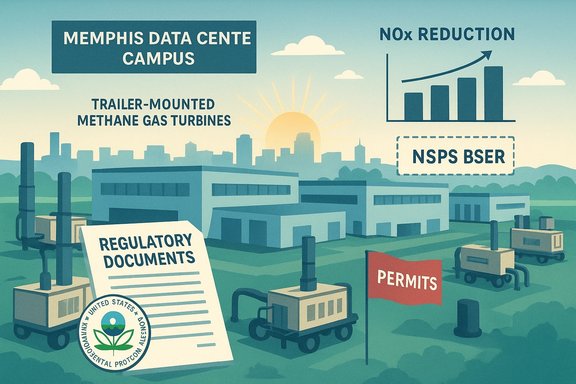
The EPA’s final rule amendments to 40 CFR Part 60 revise the New Source Performance Standards (NSPS) for stationary combustion and stationary gas turbines, establish size‑ and utilization‑based subcategories, and specify the best system of emission reduction (BSER) for nitrogen oxides (NOx) for most affected turbines. The rule, published in the Federal Register and effective January 15, 2026, also clarifies that combustion turbines used in long‑term, site‑bound roles are to be treated as stationary combustion turbines — even when physically portable — unless they meet a strict, conditional definition tied to title II nonroad engine certification. That functional test — whether a turbine “acts” like a stationary source — is the hinge of the new rule. Regulators argued that treating mobility as dispositive allowed operators to avoid permitting when, in practice, staged mobile turbines provided continuous, site‑bound power equivalent to a stationary plant. The final rule closes interpretive room for such an approach while leaving a narrowly defined pathway for temporary or certified nonroad engines if and when appropriate title II standards are adopted. What that means in practice is immediate and concrete: permitting authorities must now consider on‑site mobile turbines that are used as a de‑facto permanent source of power within the NSPS framework and, where applicable, under state and local permitting rules derived from the Clean Air Act. The legal and operational ripple effects for data‑center developers, utilities, and local communities are already visible in Memphis, Tenn., where multiple independent reporters and advocacy groups documented large numbers of staged methane turbines at xAI’s Colossus campus and where local permits covered a far smaller number of machines than observers reported. What happened in Memphis — the immediate case study
The facts on the ground
Industry reporting, public filings and advocacy investigations show this sequence:- Aerial and thermal imagery gathered by environmental groups and NGOs in 2024–2025 identified dozens of large, trailer‑mounted methane gas turbines staged around the perimeter of xAI’s Colossus data‑center campus in South Memphis. Counts reported in the public record vary, with independent imaging groups and trade reporters citing figures ranging from the mid‑20s to as many as 35 turbines at peak observation.
- In mid‑2025 the Shelby County Health Department issued an air permit authorizing xAI to operate 15 turbines under specified conditions, including emission control installation deadlines and strict limits on startup/shutdown events and total operational hours. Community groups and monitoring organizations immediately pointed out that permitted units represented only a subset of the machines imaged on site.
- Environmental justice groups, notably the Southern Environmental Law Center (SELC) and the NAACP, moved to challenge local permitting decisions. Those groups assert that extended operation of dozens of turbines, many without best‑available control technology (BACT) in place, amounts to operation of a major stationary source and therefore should have triggered more rigorous permitting and public participation. The SELC’s public materials and press releases highlighted a continuing discrepancy between permitted units and units actually observed in the field.
Permit details and operational limits
The permit that drew national attention imposes a set of operational constraints — for example, a capped number of startups and shutdowns per year and a limited total annual combined run time for the 15 permitted turbines — and requires xAI to install BACT by a compliance date specified in the permit. Observers noted that these permit conditions would, if complied with, materially constrain the on‑site fleet’s emissions footprint compared with unrestricted operation. But the existence of additional, unpermitted turbines raised obvious questions about enforcement, monitoring, and how cumulative emissions were being calculated.Why the EPA rule matters: legal mechanics and technical specifics
The statutory framework
Under the Clean Air Act, NSPS set federal performance standards for new, modified, or reconstructed stationary sources. The January 15, 2026 final rule did three things that are relevant to data centers and any site using portable generation in a long‑term role:- It expressly codified subcategories and emission limits for stationary combustion turbines, including numeric NOx standards and the agency’s view of BSER (combustion controls and, for some subcategories, selective catalytic reduction).
- It clarified that physical portability alone does not make a turbine a nonroad engine exempt from NSPS; the turbine’s actual use and certification status under title II determine whether the exemption applies. That removes the safe harbor operators had sought by rotating portable units or describing them as temporary.
- It created a conditional exclusion for turbines that meet the nonroad engine definition and future title II certification requirements — a narrow, forward‑looking pathway that does not undercut the present obligation to treat most long‑term on‑site units as stationary sources.
Technical expectations and controls
The rule’s technical determinations matter because they define what regulators will expect operators to install and operate:- BSER for NOx: for many turbines, combustion controls suffice; for certain subcategories, BSER includes selective catalytic reduction (SCR). This is not optional where NSPS apply.
- Monitoring and reporting: the rule adds electronic reporting and tightened performance test requirements to ensure auditable records of emissions and compliance. That makes retrospective enforcement and cumulative‑emissions assessments more practicable.
- Major source thresholds: the Clean Air Act differentiates “major” and “minor” sources based on tons‑per‑year thresholds for regulated pollutants; sustained operation of many high‑capacity turbines can push a site past major‑source thresholds, triggering Title V permitting, stricter public‑notice rules, and more rigorous control obligations. The EPA’s action clarifies that proper classification must reflect operational reality.
Cross‑checking the record: verifying key claims
Multiple independent media outlets, the EPA’s Federal Register notice and advocacy filings corroborate the core facts of this developing story:- The final NSPS rule and its effective date are recorded in the Federal Register for January 1 Register text explains the rule’s approach to stationary vs. temporary combustion turbines and the NOx/SO2 control requirements.
- Independent investigations and aerial imaging by environmental groups were widely reported: DatacenterD reported aerial photos that showed 35 turbines in April 2025 and highlighted apparent exceedances of permitted counts; Ars Technica and TechCrunch independently documented the Shelby County permit for 15 turbines while noting observers’ claims of a larger fleet previously on site.
- Advocacy groups and local press have followed the permitting and legal filings closely: SELC’s statements and NAACP notices of intent to sue are on the public record, and national outlets such as The Guardian and the AP have aggregated the community and legal concerns about local air quality and environmental justice.
The enforcement question: can regulators (or plaintiffs) treat past activity as illegal?
The EPA’s final rule is prospective in its issuance, but crucially it also clarifies existing statutory interpretations in ways that make prior operations potentially vulnerable to enforcement:- The Federal Register explains that the amendments implement a clarified interpretation of NSPS applicability and establish standards that state and local authorities should apply going forward. The judicial‑review timeline for challenges to the rule is short — petitions for review must be filed in the D.C. Circuit by March 16, 2026 — which will shape how quickly enforcement can solidify into precedent.
- Civil penalties, permit revocations and injunctive remedies remain within the toolbox of enforcement agencies and private plaintiffs under the Clean Air Act. Environmental groups have already signaled intent to press administrative appeals and litigation over the Shelby County permit, and the EPA clarification strengthens the factual and legal basis for those challenges.
- Whether the EPA or courts will apply the clarified interpretation retroactively to conduct that predated the final rule will depend on the administrative record, the timing of permits and approvals, and what the permitting authority reasonably understood at the time. That question — retroactivity and enforcement discretion — is where prolonged legal contests are most likely.
Environmental justice and community impact
The Memphis case underlines the deeper social and health stakes beyond regulatory technicalities. South Memphis neighborhoods near the Colossus campus are predominantly Black and have historically borne disproportionate industrial pollution burdens. Community groups and the NAACP framed the turbine deployments as an environmental‑justice issue: rapid, limited‑notice industrial activity adjacent to vulnerable populations, without robust public participation or oversight, exacerbates existing health disparities. The new EPA rule gives those communities a firmer legal basis to press for retrospective review, enforceable emissions limits, and stricter monitoring. At the same time, local officials and economic development leaders have emphasized job creation and investment associated with hyperscale data centers — a political tension that will shape how aggressive permitting authorities and courts decide to be in applying the clarified standards.Industry implications — what operators and utilities must n is a practical wake‑up call for operators, utilities, and local permitting authorities. Key business and operational consequences include:
- Permitting discipline: developers and contractors must treat mobile turbines used for commissioning, bridging interconnection gaps, or long‑term backup as likely subject to NSPS and local permitting. Expect preemptive permit filings, earlier emissions modeling, and community engagement.
- Engineering responses: plans should account for emissions controls (SCR or other BSER), continuous emissions monitoring where required, and realistic operational profiles that will be defensible in public filings. Retrofitting temporary equipment to meet BACT/SCR standards can be costly and time‑consuming; planning ahead avoids expensive midstream changes.
- Contracting and procurement: leasing arrangements for portable turbines must reflect potential Title V implications, certification requirements, and the possibility that a turbine treated as temporary in one jurisdiction will be classified as stationary in another. Procurement teams should insist on warranties and documentation about certification, emissions performance and expected operating hours.
- Utility coordination: developers must align more closely with utilities and transmission planners to avoid default reliance on extended temporary generation to meet commissioning schedules. Where grid upgrades are delayed, operators should explore lower‑emissions interim power (e.g., grid‑firm contracts, battery arrays, or incremental interconnection solutions) rather than stacking portable turbines.
Practical steps for stakeholders (short checklist)
Regulators and permitting authorities:- Re‑examine active permits where portable turbines were used on a site‑bound basis and confirm whether NSPS and Title V obligations were correctly applied.
- Require auditable metering, electronic emissions reporting, and third‑party verification for on‑site power sources.
- Coordinate with utilities to ensure permitting outcomes do not inadvertently create grid‑reliability tradeoffs.
- Treat portable turbines as potentially stationary for permitting planning; secure permits or conditional approvals with enforceable monitoring.
- Build emissions‑control pathways and backup plans into commissioning timelines to avoid costly retrofits.
- Prioritize non‑combustion interim power options where possible (batteries, staged grid contracts, or lower‑emission firming).
- Use the EPA clarification to demand retrospective reviews where imaging or local monitoring suggests extended turbine operation without appropriate permits.
- Seek enforceable permit conditions, continuous emissions monitoring and public‑health impact assessments tied to any retrospective settlements.
Strengths of the EPA’s action — and real limits
Notable strengths:- Clarity and legal teeth: the rule reduces interpretive ambiguity that had allowed operators to claim exemption from NSPS on portability grounds, giving permitting authorities firmer legal footing.
- Aligned regulation with operational reality: applying a functional test — what the turbine does — is a defensible approach that better captures environmental risk than a purely formalistic mobility test.
- Technical expectations: by specifying BSER and adding electronic reporting, the rule raises the bar for emissions control and monitoring.
- Enforcement discretion and retroactivity: the rule itself is not a magic wand for immediate remediation of past operations; regulators and plaintiffs must still make case‑by‑case enforcement decisions, and retroactive application will be litigated in many instances.
- Practical grid and economic tradeoffs: if operators are forced to remove interim generation before adequate grid capacity exists, there may be short‑term reliability risks or economic costs. Regulators should coordinate with utilities to manage this transition rather than exacerbate them.
- Political and legal pushback: municipalities and industry groups that fast‑tracked projects to secure investment may seek legislative or administrative relief; expect protracted legal proceedings and policy debates.
What to watch next
- Administrative appeals and lawsuits challenging the Shelby County permit and any EPA enforcement actions will be the near‑term flashpoints. Environmental groups have already signaled intent to litigate, and the permit dockets will be a primary source of new facts.
- The D.C. Circuit’s docket for petitions asking for review of the EPA final rule will close March 16, 2026, and any successful challenges could affect the rule’s scope or implementation timetables. Parties on all sides should monitor that litigation timetable closely.
- On the practical engineering side, the marketplace for interim‑power solutions — large battery arrays, staged interconnections, or low‑emissions temporary generation — will likely accelerate as operators seek alternatives to high‑NOx turbine fleets that require BACT or SCR retrofits.
Conclusion
The EPA’s January 15, 2026 NSPS amendments mark a decisive regulatory turning point: function, not form, will decide whether a turbine must comply with stringent stationary‑source standards. For xAI’s Colossus campus in Memphis, the clarification substantially strengthens community and regulator claims that extended use of trailer‑mounted methane turbines should have been treated as stationary power generation and subject to permitting and pollution controls. The rule does not by itself issue penalties, but it changes the legal terrain on which enforcement, appeals and community advocacy will proceed.Operators, utilities and local governments now face a clear choice: align deployments with the clarified federal baseline and invest in emissions controls and transparent monitoring, or face litigation, enforcement action, and mounting reputational risk. For communities that have long borne a disproportionate share of industrial pollution, the EPA’s action provides a stronger statutory lever to insist that next‑generation compute campuses meet the same environmental and public‑health obligations as any other major industrial source.
Source: PCMag UK https://uk.pcmag.com/ai/162652/xais...-illegally-as-epa-clarifies-turbine-loophole]
