

EPAM’s decision to embed Microsoft Applied Skills into its global skilling pipeline signals a pragmatic shift from classroom certification to project‑ready validation, and the early results—faster onboarding, stronger delivery alignment, and nearer‑term business impact—illustrate why skills portfolios that test real tasks are becoming a strategic asset for large consulting firms.
EPAM Systems is a major global engineering and consulting firm with a multi‑national delivery footprint; public records and market reports list the company at roughly 60k+ employees operating across more than 50 countries, making its approach to workforce readiness consequential for many enterprise customers. Microsoft’s Applied Skills program is a portfolio of scenario‑based, lab‑driven credentials designed to validate job‑level capabilities through interactive assessments rather than multiple‑choice exams. The program sits alongside Microsoft’s role‑based Certifications and was explicitly designed to bridge the gap between learning and on‑the‑job performance. EPAM’s customer story—published by Microsoft—details how EPAM integrated Applied Skills inside onboarding labs and role‑based skilling tracks in order to shorten ramp time and ensure engineers assigned to projects are evaluated against the actual tasks they will perform. The company reports that Applied Skills replaced significant amounts of custom training content and helped cut onboarding for early‑career engineers from about 3.5 months to roughly 2 months when those engineers complete the Applied Skills pathway.
This is not a fatal flaw—many enterprises standardize on a primary cloud provider—but it does raise questions about multi‑vendor flexibility and vendor lock‑in at the skills layer. Broader partner evidence suggests Microsoft’s skilling programs are intentionally designed to create platform familiarity that can translate into commercial consumption of Azure and Copilot offerings.
For organizations that choose this path, the recommended approach is deliberate: align scenario credentials to discrete delivery tasks, preserve remediation pathways, and maintain a set of vendor‑neutral competencies to protect architectural flexibility. When executed with governance and measurement, applied scenario credentials—like those EPAM adopted—can materially shorten the time between hiring and delivering real client value, while providing a repeatable, audit‑friendly way to demonstrate project readiness.
EPAM’s case is an early, visible example of a broader industry shift: the credential that signals readiness is no longer merely theoretical knowledge, but the ability to complete production tasks under validated conditions. That change reshapes how talent pipelines are built, how projects are staffed, and how vendors and partners compete to be the platform that powers modern AI and cloud transformations.
Source: Microsoft EPAM fast-tracks AI readiness and project outcomes with Microsoft Applied Skills | Microsoft Customer Stories
 Background
EPAM Systems is a major global engineering and consulting firm with a multi‑national delivery footprint; public records and market reports list the company at roughly 60k+ employees operating across more than 50 countries, making its approach to workforce readiness consequential for many enterprise customers. Microsoft’s Applied Skills program is a portfolio of scenario‑based, lab‑driven credentials designed to validate job‑level capabilities through interactive assessments rather than multiple‑choice exams. The program sits alongside Microsoft’s role‑based Certifications and was explicitly designed to bridge the gap between learning and on‑the‑job performance. EPAM’s customer story—published by Microsoft—details how EPAM integrated Applied Skills inside onboarding labs and role‑based skilling tracks in order to shorten ramp time and ensure engineers assigned to projects are evaluated against the actual tasks they will perform. The company reports that Applied Skills replaced significant amounts of custom training content and helped cut onboarding for early‑career engineers from about 3.5 months to roughly 2 months when those engineers complete the Applied Skills pathway. Overview: What EPAM did and why it matters
EPAM built a layered approach to skills: traditional Microsoft certifications provide role‑level foundations while Applied Skills injects scenario validation into the delivery lifecycle. The company then maps these credentials to staffing decisions and project roles, effectively making certification status part of its bench‑to‑bill matching algorithm. The result is twofold:- Engineers enter projects with proven, scenario‑tested capabilities rather than only textbook knowledge.
- Project teams spend less time remediating gaps, leaving senior talent available for higher‑value work.
Why Applied Skills is an attractive fit for system integrators
Applied Skills emphasizes small, actionable scenarios:- Short, role‑aligned labs that mirror production tasks.
- Immediate, shareable credentials that are visible to hiring and staffing teams.
- On‑demand assessments that can be integrated into learning platforms and company onboarding flows.
Technical and operational details
How EPAM integrated Applied Skills into delivery workflows
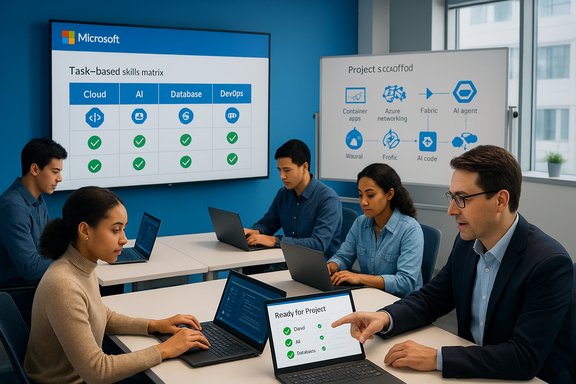
EPAM’s approach is structured and reproducible:- Map project roles to the Microsoft credentialing matrix and EPAM’s internal competency model.
- Use Applied Skills labs as a standard onboarding block inside cloud and AI tracks.
- Treat Applied Skills results as staffing signals—engineers who hold scenario credentials are prioritized for projects requiring those tasks.
- Feed assessment outcomes back into training loops to close persistent skill gaps.
Tools and tech: what skills were prioritized
EPAM named several modern technologies and workflows tied to Applied Skills scenarios:- GitHub Copilot was listed as a mainstream productivity tool used by engineers; EPAM executives claimed that roughly 30% of code is already written using Copilot internally—an internal adoption statistic that should be treated as a company metric rather than an industry benchmark.
- AI agent development and Copilot Studio scenarios were part of Applied Skills mappings, reflecting the push to operationalize AI agents and integrate them with Fabric and Azure services.
- Microsoft Fabric scenarios and real‑time intelligence tasks featured in practical assessments, aligning skilling with EPAM’s delivery stack.
Measured outcomes and business impact
EPAM reported several near‑term outcomes from its Applied Skills adoption:- Reduction in early‑career onboarding from ~3.5 months to ~2 months for those completing Applied Skills.
- Better alignment between staffing and project requirements, leading to less rework and fewer backfills.
- Faster time from training to billing, enabling senior engineers to spend more time on high‑value design and oversight tasks.
What makes this approach credible
There are several technical and logistical factors that increase the credibility and sustainability of EPAM’s program:- Vendor‑maintained scenario content reduces content staleness: Microsoft updates Applied Skills scenarios as platform features evolve, so EPAM can rely on current lab flows rather than maintaining them entirely in‑house.
- Project alignment: scenario credentials map directly to tasks customers request (migration scripts, container orchestration, agent building), making credentialing defensible in conversations with procurement and technical leads.
- Scalability: online, on‑demand assessment labs are inherently easier to scale than instructor‑led bespoke programs; they also provide consistent evaluation across locations.
Critical analysis — strengths and implications
Strength: speed of delivery and operational predictability
Applied Skills reduces ambiguity in staffing: delivering a standardized assessment gives hiring managers a clear pass/fail signal for specific tasks, which reduces project risk. The EPAM case shows how standardizing that signal improves time‑to‑productivity and client confidence. This is especially valuable for clients who measure supplier performance by milestone delivery and quality, not simply headcount.Strength: lower maintenance cost and faster content refresh
By adopting vendor‑maintained labs EPAM avoided creating and constantly updating a large body of training assets. That reduces both direct costs (instructional design, lab maintenance) and indirect costs (time trainers spend debugging lab environments vs. coaching engineers on real projects).Strength: employer signals and talent market positioning
Micro‑credentials that demonstrate applied capabilities are persuasive in RFPs and client evaluations. APPLIED, visible credentials can be embedded in candidate profiles and staffing dashboards, which is valuable when customers request certified teams for compliance or auditable delivery.Potential risk: vendor alignment and platform dependency
Relying on vendor‑provided scenario assessments increases dependency on that vendor’s platform and curriculum. While Microsoft Applied Skills maps cleanly to Azure, GitHub, and Fabric, that same alignment could complicate multi‑cloud staffing strategies: engineers credentialed on Applied Skills may still need re‑training to work across non‑Microsoft stacks.This is not a fatal flaw—many enterprises standardize on a primary cloud provider—but it does raise questions about multi‑vendor flexibility and vendor lock‑in at the skills layer. Broader partner evidence suggests Microsoft’s skilling programs are intentionally designed to create platform familiarity that can translate into commercial consumption of Azure and Copilot offerings.
Potential risk: internal claims that need external verification
Several metrics in the Microsoft‑published case are internal EPAM claims (for example, the “30% of code written with GitHub Copilot” figure and the precise onboarding reduction numbers). These are legitimate company outcomes but should be treated as self‑reported until verified by independent operational audits or longitudinal studies across multiple customers. Where possible, buyers should request measurable KPIs and sample staffing outcomes tied to specific projects rather than accepting headline percentages alone.Operational risk: assessment gating and developer morale
Turning scenario assessments into hard gating criteria for project staffing has tradeoffs. While it raises quality, it can also create bottlenecks or morale issues if engineers perceive assessments as punitive rather than developmental. Successful programs balance gating with supportive remediation pathways—micro‑learning, coaching, and sandboxed opportunities to retake labs—so talent mobility is preserved rather than penalized. Industry guidance on role‑based skilling emphasizes pairing assessments with short, applied remediation modules to retain positive learning momentum.Broader industry context and Microsoft’s skilling playbook
Microsoft has been consolidating skilling, credentialing, and partner programs to accelerate adoption of Azure, Copilot, and adjacent AI services. Applied Skills is one visible instrument in a broader strategy to convert learning into platform familiarity and enterprise consumption. Public Microsoft materials describe Applied Skills as complementary to role‑based Certifications while also being tailored for scenario proficiency. Large learning partners and training integrators have built services around Applied Skills, offering prep courses and instructor‑led programs that feed into the in‑lab assessment model. That ecosystem simplifies adoption for firms like EPAM because external training partners can help scale prep classes and remediation cohorts. At a strategic level, Microsoft’s skilling programs—when paired with partner incentives, marketplace reach, and funded deployment programs—create a multi‑layer pathway from training to purchase to deployment. That makes corporate skilling both a social investment and a commercial lever for platform adoption. For partners, the upside is faster client modernization cycles; the downside is the need to manage multi‑vendor client preferences while operating within a vendor‑aligned skilling framework.Practical guidance for IT leaders and learning teams
If you’re evaluating Applied Skills or a similar vendor‑backed applied credentialing program, treat EPAM’s approach as a tested recipe but adapt it to your context.- Map skills to roles, not titles. Define the exact tasks that need validation and pick Applied Skills scenarios that match those tasks.
- Use credentials as signals, not as sole gating. Pair assessments with remediation and coaching so they become development milestones rather than exclusionary barriers.
- Track outcome metrics that matter: time‑to‑first‑billable, defect rates in first release, time in rework, and trainee retention. These are more telling than completion rates alone.
- Maintain platform flexibility: supplement platform‑specific credentials with vendor‑neutral fundamentals where your architecture requires multi‑cloud or heterogeneous stacks.
- Validate self‑reported vendor stats: when vendors or partners cite adoption percentages or ramp‑time reductions, request underlying measurement definitions and samples.
Governance, ethics and security considerations
Embedding scenario labs that use tenant data or cloud sandboxes requires careful governance:- Tenant controls must be configured to prevent accidental data exfiltration or model training exposure when Copilot or Azure OpenAI endpoints are used in lab environments.
- Assessment data should be treated with privacy and retention policies in mind—especially if labs capture code snippets, configuration artifacts, or customer‑simulated content.
- Skill‑based audit trails help stakeholders explain staffing decisions (which credentials an engineer held at the time of a deliverable). This is useful in regulated industries where demonstrable competencies are required.
Where caution is warranted
- Treat internal adoption numbers (e.g., percentage of code authored by Copilot) as company‑reported metrics that illustrate directionality, not universal norms. Seek corroboration when using such figures to benchmark your own programs.
- Beware of over‑standardizing on a single vendor’s credential set if your organization depends on multi‑cloud flexibility or vendor neutrality for competitive reasons. Balanced skilling strategies mitigate this risk by combining platform credentials with vendor‑agnostic fundamentals.
- Ensure that scenario assessments are updated with product changes; while vendor‑maintained labs reduce maintenance, they also require vigilance: deleted or revised scenarios can temporarily interrupt internal learning flows. Historical community experience shows these assets can be altered, removed, or localized on Microsoft’s cadence. Design skilling timelines to accommodate such changes.
Final assessment and strategic takeaway
EPAM’s integration of Microsoft Applied Skills is a pragmatic, defensible move for large systems integrators and consultancies that must convert training budgets into predictable delivery outcomes. The key advantages are faster ramp times, clearer staffing signals, and reduced internal content maintenance. The primary tradeoffs are increased alignment to a vendor ecosystem and the need to validate self‑reported metrics.For organizations that choose this path, the recommended approach is deliberate: align scenario credentials to discrete delivery tasks, preserve remediation pathways, and maintain a set of vendor‑neutral competencies to protect architectural flexibility. When executed with governance and measurement, applied scenario credentials—like those EPAM adopted—can materially shorten the time between hiring and delivering real client value, while providing a repeatable, audit‑friendly way to demonstrate project readiness.
EPAM’s case is an early, visible example of a broader industry shift: the credential that signals readiness is no longer merely theoretical knowledge, but the ability to complete production tasks under validated conditions. That change reshapes how talent pipelines are built, how projects are staffed, and how vendors and partners compete to be the platform that powers modern AI and cloud transformations.
Source: Microsoft EPAM fast-tracks AI readiness and project outcomes with Microsoft Applied Skills | Microsoft Customer Stories
