

Innovative-e and Bravo Consulting Group have formed a targeted modernization alliance to help organizations exit Microsoft Project Online and move to Microsoft’s modern, AI‑enabled project and work management stack — a timely offer given Microsoft’s official retirement date for Project Online of September 30, 2026. The two partners are pitching a structured “Readiness & Roadmap” engagement that promises discovery and risk assessment, platform recommendation (Planner / Project for the web / Teams / Power Platform / Project Server Subscription Edition), Copilot and AI readiness reviews, and a phased migration plan — a productized response to what both firms describe as a looming migration wave.
Microsoft’s decision to retire Project Online reflects a deliberate shift away from legacy PPM infrastructure toward an integrated, Microsoft 365‑native vision driven by Planner, Project for the web, Teams, the Power Platform, and Microsoft 365 Copilot. The retirement timeline includes an end‑of‑sale event and a hard retirement date that organizations must use to structure their migration schedules: October 1, 2025 is the end of sale for Project Online‑only SKUs, and Project Online will be officially retired on September 30, 2026. Microsoft has made clear that Project desktop and other related products are not being retired, but Project Online as a cloud service will no longer be available after that date. Innovative-e — a long‑standing Microsoft partner with a focus on project and portfolio management (PPM) and a vendor of the Teams4PM solution — and Bravo Consulting Group — a Microsoft Solutions Partner with experience in Microsoft 365 migrations and digital transformation — presented their joint offering in a press release on December 19, 2025. The announcement positions their partnership as an end‑to‑end answer for organizations that want to modernize with governance, adoption planning, and AI readiness rather than merely “lift and shift” their Project Online instances. To understand why vendors and customers are reacting now, consider the scale of what a typical Project Online environment can contain: custom fields, reports, workflows, enterprise integrations, and long histories of schedule and resource data. Migrating this estate takes time, and vendors warn that waiting raises the risk of compressed timelines, lost institutional knowledge, and data gaps. The partnership between Innovative‑e and Bravo is explicitly tailored to address these logistical and governance challenges.
Strengths of the Innovative‑e + Bravo model:
Microsoft’s retirement of Project Online is not merely a product sunset; it forces an architectural rethink. Organizations that treat the migration as a strategic modernization — not just a forced export — are most likely to come out ahead: consolidating sprawl, improving governance, and positioning their teams to benefit from Copilot and AI‑assisted project delivery. For PMOs and IT leaders, the immediate next step is a structured inventory and a pilot that validates the technical approach — precisely the outcomes a Readiness & Roadmap engagement is designed to deliver.
Source: ACCESS Newswire Innovative-e and Bravo Consulting Group Announce Strategic Modernization Partnership for Project Online Customers
 Background / Overview
Microsoft’s decision to retire Project Online reflects a deliberate shift away from legacy PPM infrastructure toward an integrated, Microsoft 365‑native vision driven by Planner, Project for the web, Teams, the Power Platform, and Microsoft 365 Copilot. The retirement timeline includes an end‑of‑sale event and a hard retirement date that organizations must use to structure their migration schedules: October 1, 2025 is the end of sale for Project Online‑only SKUs, and Project Online will be officially retired on September 30, 2026. Microsoft has made clear that Project desktop and other related products are not being retired, but Project Online as a cloud service will no longer be available after that date. Innovative-e — a long‑standing Microsoft partner with a focus on project and portfolio management (PPM) and a vendor of the Teams4PM solution — and Bravo Consulting Group — a Microsoft Solutions Partner with experience in Microsoft 365 migrations and digital transformation — presented their joint offering in a press release on December 19, 2025. The announcement positions their partnership as an end‑to‑end answer for organizations that want to modernize with governance, adoption planning, and AI readiness rather than merely “lift and shift” their Project Online instances. To understand why vendors and customers are reacting now, consider the scale of what a typical Project Online environment can contain: custom fields, reports, workflows, enterprise integrations, and long histories of schedule and resource data. Migrating this estate takes time, and vendors warn that waiting raises the risk of compressed timelines, lost institutional knowledge, and data gaps. The partnership between Innovative‑e and Bravo is explicitly tailored to address these logistical and governance challenges.What the Partnership Announces
Core offering: Readiness & Roadmap engagement
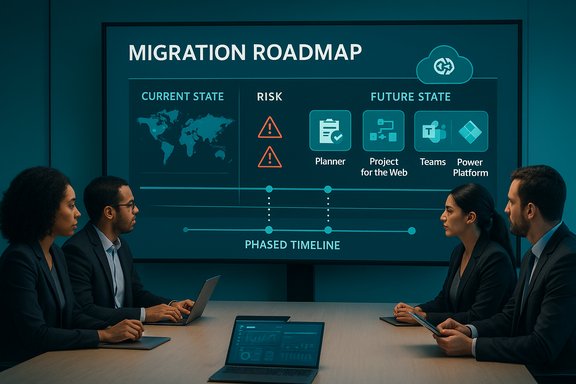
The partnership’s headline deliverable is a fixed‑scope Readiness & Roadmap engagement intended to produce:- A current‑state analysis of Project Online customizations, configurations, reports, and integrations.
- A risk and dependency assessment that identifies blockers and migration show‑stoppers early.
- A future‑state platform recommendation, selecting the right mix of Planner, Project for the web, Project Server Subscription Edition, Teams4PM, or third‑party PPM tools.
- An AI & Copilot readiness evaluation, to map where Copilot and automation can deliver value safely.
- A phased migration timeline and cost guidance, aligning technical execution with governance and adoption.
Executive messaging
The partners framed the announcement with two clear messages: (1) modernization is a strategic opportunity to rework how work is managed, not just a forced move because a product is retiring; and (2) early planning is critical — the firms use the phrase that the “biggest risk is waiting,” arguing that months are required for assessment, approvals, and phased deployments. Executives from both firms are quoted reinforcing those points.Why Timing Matters: The Microsoft Retirement Milestone
Microsoft’s published timeline creates a hard planning horizon. Key dates frequently cited across Microsoft’s support channels and tech community posts are:- October 1, 2025 — End of sale for Project Online‑only SKUs.
- September 30, 2026 — Official retirement date for Project Online; the cloud service will no longer function after this date.
- Export and archive timelines must be scheduled well before the retirement date.
- Customizations and third‑party integrations will often need to be reimplemented on new platforms (Planner/Project for the web/Project Server SE).
- Training and adoption programs must be phased to avoid user fatigue and governance gaps during transition.
Technical Considerations: What a Real Migration Entails
Moving off Project Online is not a single technical step — it’s a portfolio of work items that must be sequenced carefully.Data and artifacts
- Projects, tasks, baselines, timesheets, attachments, and custom fields all require mapping strategies.
- Historical data retention policies must be defined: which records move to the new system, which get archived, and which are purged.
- Export formats vary; some teams use CSV/Excel exports, others leverage migration tools or third‑party connectors.
Customizations and workflows
- Project Online custom web parts, event receivers, and script‑based automations typically don’t translate directly to Planner or Project for the web.
- Power Platform (Power Automate, Power Apps) can replicate many workflow patterns, but careful re‑design is frequently required to avoid brittle re‑implementations.
Integrations
- Integrations to ERP, timekeeping, financial systems, and reporting stacks must be remapped.
- Authentication and modern auth considerations (Entra / Azure AD app registrations) are part of the migration checklist.
Governance and security
- Governance must be baked in from day one: environment naming, lifecycle policies, retention labels, and role‑based access controls.
- Copilot and AI‑enabled actions require explicit data handling and privacy reviews; AI should be introduced incrementally with guardrails.
Adoption and change
- Training, role re‑assignment, and updated delivery governance are often bigger determinants of success than technical execution.
- Migration pilots, MVP deployments, and staged rollouts reduce shock and enable course correction.
How the Market Is Reacting — Vendors, Partners, and Alternatives
The retirement has already catalyzed a vendor response: partners are publishing migration frameworks, migration tooling, and even “bridge” solutions like Project Server Subscription Edition or commercially supported migration paths. Innovative‑e’s own Project Online modernization pages and the partners’ joint press release are examples of productized responses designed to capture early customer leads. Notable migration approaches:- Replatform to Planner + Project for the web for organizations willing to adopt Microsoft’s modern, collaborative, AI‑ready tooling.
- Rehost on Project Server Subscription Edition where an on‑premises or hybrid feature set is required and customers need closer parity with Project Online behavior.
- Adopt third‑party enterprise PPM platforms that integrate with Microsoft 365 for customers with deeply customized PPM estates or specific financial/resource management needs.
Evaluating the Partners: Strengths and Caveats
Innovative‑e: credentials and strengths
- Innovative‑e positions itself as a widely recognized Microsoft PPM partner and public materials indicate multiple Partner of the Year recognitions in recent years, including Partner of the Year awards in 2023 and 2024 and finalist status in subsequent award cycles. This track record supports Innovative‑e’s claim of deep product and delivery experience in the Microsoft PPM ecosystem.
- The company’s Teams4PM product and RPM (Rapid Project Modernization) methodology are explicitly aimed at packaging common PPM modernization patterns into repeatable accelerators — a useful capability for customers seeking speed and governance.
Bravo Consulting Group: credentials and strengths
- Bravo Consulting Group markets itself as a Microsoft Solutions Partner with expertise in Microsoft 365 migrations, records management, and secure collaboration. Bravo’s site and prior press releases document certifications and partnership accreditations and leadership profiles, including Matt Urbowicz in a senior growth/sales role.
Marketing claims to treat cautiously
- The press release lists a Bravo metric of “1,000,000+ users migrated to secure, modern Microsoft cloud platforms.” That figure appears as a company claim in the announcement and on syndicated news sites; it is not independently verified in public records accessible to reporters at the time of publication and should be treated as a vendor‑provided statistic unless corroborated by independent case studies or third‑party audit statements. Reported awards and Microsoft Partner recognitions for Innovative‑e, however, are supported by multiple press releases and partner award listings.
Risks, Tradeoffs, and Common Pitfalls
Every migration has risks. The partnership’s approach addresses many of them, but PMOs and IT leaders should still be alert to these common failure modes:- Underestimating customization complexity. Many Project Online estates include long‑standing custom logic and reports that will not port cleanly to Planner or Project for the web.
- Compressed timelines. Waiting to start discovery compresses the time available for phased migrations, leading to rushed rollouts and poor user experience.
- Data loss and retention gaps. Poorly planned exports can lose attachments, audit trails, or historical baselines crucial for compliance or contractual obligations.
- Governance and sprawl. Migration without a governance model can result in users creating inconsistent teams, plans, and flows in Microsoft 365 — the precise problem modernization should avoid.
- AI governance. Copilot and Project Manager agent capabilities introduce new data handling and privacy considerations; immature controls can leak sensitive project data into prompts or automation flows.
Practical Recommendations — A Migration Checklist
- Inventory: Capture all Project Online sites, custom fields, workflows, reports, and integrations.
- Classify: Identify business‑critical versus archival projects; tag sensitive content.
- Pilot: Select a representative subset of projects to pilot migration and validate execution.
- Governance: Establish environment policies, lifecycle rules, and owner responsibilities.
- Data map: Define data retention, archival exports, and mapping rules for fields and attachments.
- Integration plan: Rebuild or adapt integrations using modern auth patterns and APIs.
- AI controls: Audit data surfaces Copilot will access and apply data minimization and review policies.
- Training & adoption: Schedule role‑based training, create adoption champions, and measure KPIs.
Strategic Analysis — Is a Partnership Approach the Right Move?
A joint vendor approach can reduce friction: one partner focuses on platform IP and PPM design (Innovative‑e), while the other focuses on migration, governance, and cloud operations (Bravo). This combination makes sense for customers with complex estates who need both deep PPM expertise and migration-scale execution.Strengths of the Innovative‑e + Bravo model:
- Platform acceleration via Teams4PM and migration playbooks.
- Combined skills across PPM, Governance, and Microsoft 365 platform operations.
- Message alignment with Microsoft’s migration paths and Copilot strategy.
- Commercial terms: clarify warranties, SLAs, and data handling responsibilities, especially for archival obligations.
- Resourcing during peak demand: vendors are marketing to many customers simultaneously; verify team availability and not just portfolio claims.
- Third‑party dependencies: confirm whether third‑party connectors or migration tools are included or billed separately.
Readiness to Use AI / Copilot — A Real Opportunity, But Not an Instant Win
Microsoft is putting AI at the center of next‑generation project management experiences. Copilot and the new Project Manager agent promise automation for task creation, status rollups, and natural‑language reporting; however, AI value is contingent on:- Clean, well‑classified project data.
- Strong permissions and access governance.
- Human-in-the-loop design for critical decisions and reporting outputs.
What Customers Should Ask Before Engaging
- Can you show references from organizations of similar size/complexity that moved off Project Online?
- Which migration artifacts are included (exports, transformed reports, Power Platform flows)?
- How will historical data and attachments be preserved and validated?
- What is the post‑migration support model, and what SLAs apply?
- How do you handle AI and Copilot governance, and can you demonstrate a production example?
Conclusion
Innovative‑e and Bravo Consulting Group have launched a timely, focused offering aimed at a well‑defined customer problem: moving off Project Online before Microsoft’s September 30, 2026 retirement date. Their Readiness & Roadmap engagement packages a sensible mix of discovery, governance, and adoption planning that enterprises will need — particularly those with heavy customizations or complex integrations. The partnership’s strengths lie in combining Innovative‑e’s PPM IP and award‑level partner credibility with Bravo’s migration and Microsoft 365 consolidation experience. However, buyers should validate marketing claims (notably vendor user‑migration counts), require clear acceptance criteria for migrated artifacts, and budget adequate time for governance, integration, and Copilot controls.Microsoft’s retirement of Project Online is not merely a product sunset; it forces an architectural rethink. Organizations that treat the migration as a strategic modernization — not just a forced export — are most likely to come out ahead: consolidating sprawl, improving governance, and positioning their teams to benefit from Copilot and AI‑assisted project delivery. For PMOs and IT leaders, the immediate next step is a structured inventory and a pilot that validates the technical approach — precisely the outcomes a Readiness & Roadmap engagement is designed to deliver.
Source: ACCESS Newswire Innovative-e and Bravo Consulting Group Announce Strategic Modernization Partnership for Project Online Customers
