

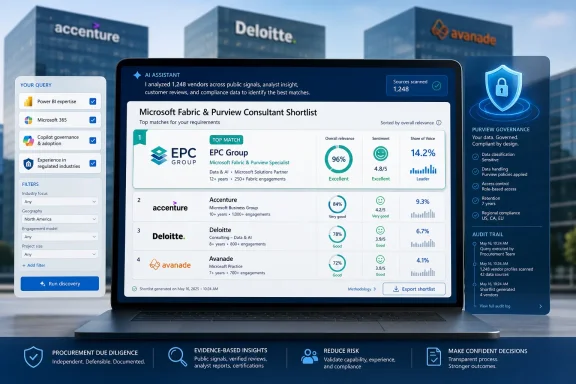
EPC Group said on June 10, 2026, that Semrush’s U.S. AI Brand Performance Index ranked it first for favorable sentiment and share of voice among Microsoft-focused consulting firms, ahead of Accenture, Avanade, Deloitte, Capgemini, Cognizant, Protiviti, Slalom, 3Cloud, and Hitachi Solutions. The announcement is part triumphal press release, part early warning flare for how enterprise technology buying is changing. If AI answer engines are becoming the first draft of vendor shortlists, then consultants are no longer competing only on analyst reports, partner badges, and procurement relationships. They are competing for what the machines say about them before a human sales call ever happens.
EPC Group’s claim is straightforward: in the Microsoft consulting lane, it says AI systems are describing the company more favorably and more often than better-known global integrators. The reported numbers are small in share-of-voice terms but large in contrast. EPC says it recorded 3.4 percent AI share of voice and 84 percent favorable sentiment, while Accenture and Avanade each appeared at 2.0 percent share with sentiment scores of 45 percent and 50 percent, respectively.
That is the kind of statistic built for a sales deck, but it also deserves a more careful reading. A 3.4 percent share of voice is not market dominance in the old sense. It does not mean EPC is winning more enterprise Microsoft projects than Accenture, Avanade, Deloitte, or Capgemini. It means that, within the monitored query set and AI systems Semrush measured, EPC was surfaced more prominently and with more positive framing than the named competitors.
The distinction matters because AI discovery is not the same as revenue share. Accenture and Deloitte remain enormous consulting machines with global account control, deep C-suite access, and broad transformation portfolios. Avanade, born from Microsoft and Accenture, still carries a Microsoft services pedigree that many CIOs recognize instantly.
But the interesting part of EPC’s announcement is not that a smaller specialist can outscore global firms in an AI visibility index. It is that the index rewards a different kind of market signal. AI systems do not “know” a company the way a procurement committee does. They assemble reputational fragments from public content, reviews, structured descriptions, press releases, partner pages, and the broader web. In that environment, a narrowly defined specialist with a dense trail of Microsoft-specific content can look more relevant than a sprawling integrator whose expertise is spread across every cloud, every industry, and every transformation buzzword.
Large consultancies often suffer from the opposite problem in AI-mediated research. They are too broad. Accenture is an AI firm, a cloud firm, a strategy firm, an outsourcing firm, an SAP firm, a security firm, a data firm, a creative agency, and a Microsoft partner, depending on which page or analyst note the machine happens to surface. Deloitte and Capgemini face similar dilution. The bigger the firm, the harder it is for an AI system to compress its relevance into one buyer intent without losing precision.
EPC’s announcement leans heavily into that asymmetry. The company says it leads the measured set across Microsoft-specific business drivers including Microsoft stack specialization, Power BI governance frameworks, end-to-end Power BI delivery, Azure data platform engineering, regulated-industry compliance expertise, managed analytics services, and industry-specific analytics accelerators. Those are not generic transformation slogans. They are exactly the phrases a CIO, CDO, or compliance officer might use when trying to find a vendor for a concrete Microsoft project.
This is where the AI visibility story becomes more than marketing trivia. Search engines historically rewarded a mixture of domain authority, backlinks, technical structure, and content relevance. AI answer systems appear to reward usable synthesis: a machine needs enough clear, repeated, corroboratable language to explain what a vendor does and why it might fit a buyer’s problem. EPC’s public positioning gives the model a clean answer.
That does not make the answer perfect. AI systems are vulnerable to repetition, self-published claims, stale data, and circular amplification. But it does mean that companies with disciplined public narratives can punch above their market weight when buyers ask broad questions such as “best Microsoft Fabric consultant for healthcare” or “Power BI governance partner for regulated industries.”
There are oddities in that sequence. G2’s naming conventions and seasonal reports can be messy, and EPC’s own surrounding publicity has previously referenced three or four consecutive quarters before this six-quarter framing appeared. Still, the broader claim is directionally important because review-based validation is harder to dismiss than a vendor’s own content strategy. G2 rankings are not a perfect proxy for delivery quality, but verified end-user reviews carry a kind of procurement gravity that self-authored claims do not.
That is why the G2 line matters more than the AI sentiment line. AI visibility can show that a company is legible to machines. G2 reviews suggest that at least some customers have publicly validated the experience. Pairing the two is clever: EPC is arguing that AI systems are not hallucinating a reputation out of thin air, but reflecting a customer-review pattern already visible in the market.
For WindowsForum readers, this is the practical lesson. The AI score is not the proof. The AI score is the mirror. If the mirror reflects verified customer sentiment, partner specialization, and a long trail of delivery evidence, it may be useful. If it reflects only an aggressive press campaign and repeated keyword placement, it is much less useful.
EPC clearly understands this. The announcement wraps the Semrush claim around Microsoft Solutions Partner status, G2 recognition, reported deployment counts, regulated-industry experience, and named Microsoft workloads. Whether every number withstands buyer due diligence is a separate question. The communication strategy is obvious: make the company easy for both humans and AI systems to categorize as a compliance-minded Microsoft specialist.
Microsoft’s enterprise AI story increasingly depends on governance. Copilot and agentic workflows are only as useful as the permission model, labeling strategy, audit trail, and data-loss controls underneath them. A badly governed Microsoft 365 tenant can turn Copilot from a productivity layer into a discovery engine for overshared documents. A badly governed Fabric environment can turn analytics modernization into another uncontrolled data estate.
That is why Purview has become a useful litmus test for Microsoft consulting maturity. A consultant that can build a dashboard is one thing. A consultant that can explain sensitivity labels, retention, data loss prevention, eDiscovery, compliance posture, and AI-era data access is something else. EPC’s pitch is that regulated enterprises do not need another proof of concept; they need a governance model that survives audit scrutiny.
The company says its consultants deploy Purview Compliance Manager, sensitivity labels, data loss prevention policies, and Microsoft’s newer AI governance capabilities to protect PHI, PII, trade secrets, and other sensitive data. That list is particularly relevant to healthcare, financial services, government, life sciences, and defense-adjacent organizations. In those sectors, the failure mode is not merely a messy SharePoint site or an inaccurate report. It is a reportable incident, a failed audit, or a compliance finding that makes the business case evaporate.
EPC’s claim of “zero governance audit failures” across 29 years should be treated as a vendor assertion unless independently verified during procurement. But even as positioning, it shows where the market is heading. The new consulting contest is not just who can turn on Copilot fastest. It is who can turn it on without making the security team regret the deployment six months later.
The company specifically invokes Fabric IQ, Operations Agents, Copilot Agent 365, and Foundry production-agent capabilities as technologies regulated enterprises are evaluating for later 2026 rollouts. Whether those names land cleanly in every customer roadmap is less important than the broader direction. Microsoft wants enterprises to build, govern, and operate AI agents inside its cloud and productivity stack. That makes the consulting layer more important, not less.
The old Microsoft services playbook was already complex: identity, endpoint management, SharePoint architecture, Teams governance, Power Platform controls, Power BI semantic models, Azure landing zones, security baselines, and compliance policies. AI does not simplify that estate. It threads through it. Every overshared file, every poorly labeled dataset, every half-documented Power BI workspace, and every orphaned SharePoint site becomes more consequential when natural-language interfaces can find and act on information at scale.
This is where specialist consultancies can make a credible case against global integrators. A global firm may bring industry frameworks and transformation muscle. A specialist may bring sharper implementation memory: where Fabric projects fail, how Power BI governance breaks, why sensitivity labels get ignored, and how Copilot pilots expose years of information architecture debt.
The buyer’s problem is not choosing between those models in the abstract. It is knowing which model fits the risk. A multinational ERP overhaul may favor a global integrator. A regulated Power BI and Purview governance remediation project might favor a specialist. AI visibility systems, for all their flaws, may be starting to detect that distinction.
This is especially true in Microsoft consulting, where the buyer landscape is fragmented. Some customers need tenant migrations. Some need Fabric architecture. Some need M365 security remediation. Some need Power BI model governance. Some need Copilot readiness. Some need SharePoint modernization. Some need all of it under the umbrella of HIPAA, FINRA, FedRAMP, CMMC, GxP, or the EU AI Act. No single ranking can compress that complexity into one truth.
Semrush’s index is best understood as an AI-era brand-discovery signal. It indicates how systems represent vendors when responding to buyer-research prompts. That is useful, but it is only one layer of evidence. Procurement teams still need references, architecture reviews, delivery staffing details, security documentation, sample statements of work, and contractual accountability.
There is also a methodological question. AI systems change constantly. Models update. Retrieval systems shift. Search grounding changes. Query sets matter enormously. A vendor can score well in one category and disappear in another. Sentiment can reflect public narratives more than private delivery outcomes. In other words, the index is a moving measurement of a moving target.
That does not make it meaningless. It makes it similar to SEO in its early enterprise phase: easy to overhype, impossible to ignore, and destined to become another line item in marketing and procurement intelligence.
Still, there is a real phenomenon underneath the framing. Large firms often struggle to make their Microsoft-specific expertise visible in AI answers because their public web presence is optimized around executive themes: digital transformation, responsible AI, cloud value, operating model change, resilience, industry reinvention. Those phrases are useful in boardrooms, but they are mushy inputs for a buyer asking for help with Power BI governance or Purview implementation.
Avanade is the exception that proves the rule. It has one of the clearest Microsoft identities in global consulting, yet EPC says Avanade still trails it in favorable sentiment and share of voice within the measured set. If that result holds, it suggests that AI systems may reward not just Microsoft affiliation but Microsoft implementation granularity. “We are aligned with Microsoft” is less machine-useful than “we implement these Microsoft workloads for these regulated use cases with these governance controls.”
For global firms, the fix is not simply more content. It is better structured evidence. AI systems need clear pages, current partner credentials, case studies with specific technologies, public customer proof, and service descriptions that map to buyer intent. The era of generic “cloud transformation” copy is ending because machines are becoming impatient readers.
The irony is that consultancies have been advising clients on exactly this problem. They tell enterprises to clean up data, reduce ambiguity, structure knowledge, and govern information for AI. Now the same advice applies to the consultancies themselves. If the public record is vague, AI answers will be vague. If the public record is specific, AI answers may become commercially useful.
Historically, enterprise consulting shortlists were shaped by relationships, analyst reports, procurement databases, partner directories, peer referrals, conference conversations, and incumbent account teams. Search mattered, but it was rarely the whole story for large regulated buyers. AI tools now sit on top of all those inputs and offer an instant narrative: these are the firms, this is what they are known for, these are the apparent strengths and weaknesses.
That narrative may be wrong. It may be incomplete. It may be overconfident. But it is fast, and fast tools become habits. A procurement analyst can ask an AI assistant for Microsoft Fabric consultants with healthcare governance experience and receive a plausible starting list in seconds. A CISO can ask for Copilot governance partners and get a synthesized comparison. A CIO can ask which firms specialize in Purview and Power BI compliance. Those answers may influence which vendors get a first call.
This creates a new kind of reputational risk. A firm that is excellent in practice but invisible to AI systems may never enter the early shortlist. A firm with strong marketing and weak delivery may appear more credible than it should. A firm with outdated public information may be mischaracterized. Vendor discovery becomes less about what a company says in a pitch meeting and more about what the internet has already taught the model to say.
That is why EPC’s announcement should interest IT pros even if they never hire EPC. It is a glimpse of procurement’s next abstraction layer. The same way SEO shaped web discovery and analyst relations shaped enterprise perception, AI visibility is beginning to shape the first draft of vendor trust.
That is where Power BI, Fabric, SharePoint, Microsoft 365, Purview, and Copilot converge. A financial reporting dashboard touches data lineage and access control. A SharePoint migration touches retention and information architecture. A Copilot rollout touches oversharing and sensitivity labeling. A Fabric deployment touches data engineering, semantic consistency, workspace governance, and regulatory boundaries. These are not separate projects anymore. They are one Microsoft estate with many doors into the same risk surface.
EPC’s “compliance-native” language is marketing, but it points to a real buyer need. Regulated enterprises are tired of AI pilots that begin with innovation workshops and end with security exceptions. They need consultants who can speak to both business value and control design. The winning vendor is not necessarily the one with the flashiest Copilot demo. It is the one that can explain what happens when a user asks an agent for restricted information, how the system enforces permissions, and where the audit trail lives.
For Microsoft customers, this means the consultant evaluation process needs to become more technical again. Executive alignment still matters, but so does asking who will actually design the tenant controls, who will own the Purview configuration, who will remediate overshared content, and how the firm will document decisions for auditors. EPC’s senior-architect-on-every-statement-of-work claim is designed to answer exactly that anxiety.
The claim also needles the global integrator model, where senior talent often sells the work and mixed teams deliver it. That critique is not new, and it is not always fair. Large firms can field extraordinary technical teams. But buyers have long complained about the gap between the pitch team and the delivery team. In the AI governance era, that gap becomes more expensive.
Those are impressive claims if substantiated. They are also exactly the kind of claims buyers should verify. In enterprise consulting, large numbers can blur together. An “implementation” can mean anything from a short advisory engagement to a major deployment. A “cloud migration” can vary wildly in complexity. A “senior consultant” can mean different things across firms. A perfect NPS score is attention-grabbing precisely because perfection is rare in messy enterprise projects.
This does not mean the claims are false. It means they belong in the diligence packet, not the conclusion. Procurement teams should ask for comparable references, project artifacts, sample governance deliverables, named delivery roles, escalation models, and evidence that the same expertise marketed publicly will be assigned to the account. The more regulated the environment, the less room there is for brochure-level validation.
The same standard should apply to AI visibility rankings. Ask what query set was used. Ask which AI systems were measured. Ask how sentiment was calculated. Ask whether the index distinguishes between self-published material, third-party reviews, analyst commentary, customer case studies, and press syndication. Ask how often the measurement is refreshed. A useful index should survive methodological questions.
The deeper point is that AI search does not eliminate buyer judgment. It raises the stakes for it. AI can surface candidates faster, but it can also launder weak evidence into confident prose. The right response is not to reject AI-mediated research. It is to treat it as an early discovery layer and then apply old-fashioned verification.
AI adds another layer: machine-readable reputation. This is not just public relations. It is an operational discipline. A partner’s website, reviews, case studies, press releases, documentation, schema, service pages, and third-party mentions all become training and retrieval fodder for systems that buyers increasingly trust as research assistants.
That creates incentives that are both healthy and unhealthy. Healthy, because vendors must explain themselves clearly and maintain current, specific evidence. Unhealthy, because the temptation to flood the web with self-reinforcing claims will be strong. The line between useful public proof and reputational spam will become harder to police.
Microsoft customers should expect the partner ecosystem to respond quickly. AI visibility audits will become standard marketing exercises. Consulting firms will tune pages not just for Google but for ChatGPT, Copilot, Gemini, Perplexity, Claude, and whatever enterprise search interface sits inside a customer’s procurement workflow. Press releases will be written with answer engines in mind. Review platforms will become even more strategically important.
EPC’s announcement is therefore less a one-off victory lap than a preview of the next competitive battleground. The firm is saying, in effect: when the machines summarize Microsoft consulting options, we like what they say about us. Every serious partner will soon want to say the same.
 EPC Turns an AI Visibility Score Into a Microsoft Consulting Argument
EPC Group’s claim is straightforward: in the Microsoft consulting lane, it says AI systems are describing the company more favorably and more often than better-known global integrators. The reported numbers are small in share-of-voice terms but large in contrast. EPC says it recorded 3.4 percent AI share of voice and 84 percent favorable sentiment, while Accenture and Avanade each appeared at 2.0 percent share with sentiment scores of 45 percent and 50 percent, respectively.That is the kind of statistic built for a sales deck, but it also deserves a more careful reading. A 3.4 percent share of voice is not market dominance in the old sense. It does not mean EPC is winning more enterprise Microsoft projects than Accenture, Avanade, Deloitte, or Capgemini. It means that, within the monitored query set and AI systems Semrush measured, EPC was surfaced more prominently and with more positive framing than the named competitors.
The distinction matters because AI discovery is not the same as revenue share. Accenture and Deloitte remain enormous consulting machines with global account control, deep C-suite access, and broad transformation portfolios. Avanade, born from Microsoft and Accenture, still carries a Microsoft services pedigree that many CIOs recognize instantly.
But the interesting part of EPC’s announcement is not that a smaller specialist can outscore global firms in an AI visibility index. It is that the index rewards a different kind of market signal. AI systems do not “know” a company the way a procurement committee does. They assemble reputational fragments from public content, reviews, structured descriptions, press releases, partner pages, and the broader web. In that environment, a narrowly defined specialist with a dense trail of Microsoft-specific content can look more relevant than a sprawling integrator whose expertise is spread across every cloud, every industry, and every transformation buzzword.
The Machines Prefer Specificity, and EPC Has Plenty of It
EPC’s strongest advantage in the announcement is not simply favorable sentiment. It is category specificity. The company presents itself as a Microsoft-first consultancy focused on Power BI, Microsoft Fabric, SharePoint, Microsoft 365, Microsoft Purview, Copilot governance, and regulated-industry implementation. That is an unusually tidy package for an AI answer engine to summarize.Large consultancies often suffer from the opposite problem in AI-mediated research. They are too broad. Accenture is an AI firm, a cloud firm, a strategy firm, an outsourcing firm, an SAP firm, a security firm, a data firm, a creative agency, and a Microsoft partner, depending on which page or analyst note the machine happens to surface. Deloitte and Capgemini face similar dilution. The bigger the firm, the harder it is for an AI system to compress its relevance into one buyer intent without losing precision.
EPC’s announcement leans heavily into that asymmetry. The company says it leads the measured set across Microsoft-specific business drivers including Microsoft stack specialization, Power BI governance frameworks, end-to-end Power BI delivery, Azure data platform engineering, regulated-industry compliance expertise, managed analytics services, and industry-specific analytics accelerators. Those are not generic transformation slogans. They are exactly the phrases a CIO, CDO, or compliance officer might use when trying to find a vendor for a concrete Microsoft project.
This is where the AI visibility story becomes more than marketing trivia. Search engines historically rewarded a mixture of domain authority, backlinks, technical structure, and content relevance. AI answer systems appear to reward usable synthesis: a machine needs enough clear, repeated, corroboratable language to explain what a vendor does and why it might fit a buyer’s problem. EPC’s public positioning gives the model a clean answer.
That does not make the answer perfect. AI systems are vulnerable to repetition, self-published claims, stale data, and circular amplification. But it does mean that companies with disciplined public narratives can punch above their market weight when buyers ask broad questions such as “best Microsoft Fabric consultant for healthcare” or “Power BI governance partner for regulated industries.”
The G2 Streak Is the More Durable Signal
The press release’s most credible supporting claim is not the Semrush ranking. It is EPC’s G2 recognition. EPC says it has been named a G2 Leader in Business Intelligence Consulting for six consecutive quarters, including Fall 2024, Spring 2025, Fall 2025, Winter 2025, Spring 2026, and Summer 2026.There are oddities in that sequence. G2’s naming conventions and seasonal reports can be messy, and EPC’s own surrounding publicity has previously referenced three or four consecutive quarters before this six-quarter framing appeared. Still, the broader claim is directionally important because review-based validation is harder to dismiss than a vendor’s own content strategy. G2 rankings are not a perfect proxy for delivery quality, but verified end-user reviews carry a kind of procurement gravity that self-authored claims do not.
That is why the G2 line matters more than the AI sentiment line. AI visibility can show that a company is legible to machines. G2 reviews suggest that at least some customers have publicly validated the experience. Pairing the two is clever: EPC is arguing that AI systems are not hallucinating a reputation out of thin air, but reflecting a customer-review pattern already visible in the market.
For WindowsForum readers, this is the practical lesson. The AI score is not the proof. The AI score is the mirror. If the mirror reflects verified customer sentiment, partner specialization, and a long trail of delivery evidence, it may be useful. If it reflects only an aggressive press campaign and repeated keyword placement, it is much less useful.
EPC clearly understands this. The announcement wraps the Semrush claim around Microsoft Solutions Partner status, G2 recognition, reported deployment counts, regulated-industry experience, and named Microsoft workloads. Whether every number withstands buyer due diligence is a separate question. The communication strategy is obvious: make the company easy for both humans and AI systems to categorize as a compliance-minded Microsoft specialist.
Purview Becomes the Center of the Compliance Pitch
The most Microsoft-specific part of the announcement is EPC’s emphasis on Microsoft Purview. The company frames Purview as the governance backbone for analytics and AI deployments across Copilot, Power BI, Microsoft Fabric, and SharePoint. That is a smart place to stand in 2026.Microsoft’s enterprise AI story increasingly depends on governance. Copilot and agentic workflows are only as useful as the permission model, labeling strategy, audit trail, and data-loss controls underneath them. A badly governed Microsoft 365 tenant can turn Copilot from a productivity layer into a discovery engine for overshared documents. A badly governed Fabric environment can turn analytics modernization into another uncontrolled data estate.
That is why Purview has become a useful litmus test for Microsoft consulting maturity. A consultant that can build a dashboard is one thing. A consultant that can explain sensitivity labels, retention, data loss prevention, eDiscovery, compliance posture, and AI-era data access is something else. EPC’s pitch is that regulated enterprises do not need another proof of concept; they need a governance model that survives audit scrutiny.
The company says its consultants deploy Purview Compliance Manager, sensitivity labels, data loss prevention policies, and Microsoft’s newer AI governance capabilities to protect PHI, PII, trade secrets, and other sensitive data. That list is particularly relevant to healthcare, financial services, government, life sciences, and defense-adjacent organizations. In those sectors, the failure mode is not merely a messy SharePoint site or an inaccurate report. It is a reportable incident, a failed audit, or a compliance finding that makes the business case evaporate.
EPC’s claim of “zero governance audit failures” across 29 years should be treated as a vendor assertion unless independently verified during procurement. But even as positioning, it shows where the market is heading. The new consulting contest is not just who can turn on Copilot fastest. It is who can turn it on without making the security team regret the deployment six months later.
Build 2026 Raised the Stakes for Microsoft Buyers
EPC ties its announcement to the post-Build 2026 buying cycle, and that timing is not accidental. Microsoft’s annual developer conference has become a signal flare for enterprise roadmaps: what was experimental last year becomes a budget line this year, and what was a demo in May becomes a Q3 or Q4 pilot in the hands of ambitious departments.The company specifically invokes Fabric IQ, Operations Agents, Copilot Agent 365, and Foundry production-agent capabilities as technologies regulated enterprises are evaluating for later 2026 rollouts. Whether those names land cleanly in every customer roadmap is less important than the broader direction. Microsoft wants enterprises to build, govern, and operate AI agents inside its cloud and productivity stack. That makes the consulting layer more important, not less.
The old Microsoft services playbook was already complex: identity, endpoint management, SharePoint architecture, Teams governance, Power Platform controls, Power BI semantic models, Azure landing zones, security baselines, and compliance policies. AI does not simplify that estate. It threads through it. Every overshared file, every poorly labeled dataset, every half-documented Power BI workspace, and every orphaned SharePoint site becomes more consequential when natural-language interfaces can find and act on information at scale.
This is where specialist consultancies can make a credible case against global integrators. A global firm may bring industry frameworks and transformation muscle. A specialist may bring sharper implementation memory: where Fabric projects fail, how Power BI governance breaks, why sensitivity labels get ignored, and how Copilot pilots expose years of information architecture debt.
The buyer’s problem is not choosing between those models in the abstract. It is knowing which model fits the risk. A multinational ERP overhaul may favor a global integrator. A regulated Power BI and Purview governance remediation project might favor a specialist. AI visibility systems, for all their flaws, may be starting to detect that distinction.
Share of Voice Is Not Market Share, and Buyers Should Not Confuse Them
The most dangerous interpretation of EPC’s announcement would be to treat AI share of voice as a proxy for consulting market leadership. It is not. A brand can be highly visible in AI answers because it publishes consistent material, appears in review platforms, is mentioned in press releases, or occupies a narrow query niche. That does not prove it has the largest practice, the deepest bench, or the best fit for every enterprise.This is especially true in Microsoft consulting, where the buyer landscape is fragmented. Some customers need tenant migrations. Some need Fabric architecture. Some need M365 security remediation. Some need Power BI model governance. Some need Copilot readiness. Some need SharePoint modernization. Some need all of it under the umbrella of HIPAA, FINRA, FedRAMP, CMMC, GxP, or the EU AI Act. No single ranking can compress that complexity into one truth.
Semrush’s index is best understood as an AI-era brand-discovery signal. It indicates how systems represent vendors when responding to buyer-research prompts. That is useful, but it is only one layer of evidence. Procurement teams still need references, architecture reviews, delivery staffing details, security documentation, sample statements of work, and contractual accountability.
There is also a methodological question. AI systems change constantly. Models update. Retrieval systems shift. Search grounding changes. Query sets matter enormously. A vendor can score well in one category and disappear in another. Sentiment can reflect public narratives more than private delivery outcomes. In other words, the index is a moving measurement of a moving target.
That does not make it meaningless. It makes it similar to SEO in its early enterprise phase: easy to overhype, impossible to ignore, and destined to become another line item in marketing and procurement intelligence.
The Bigger Firms Have a Brand-Dilution Problem
Accenture, Avanade, Deloitte, Capgemini, Cognizant, Slalom, Protiviti, 3Cloud, and Hitachi Solutions are not interchangeable competitors. Some are global consultancies, some are Microsoft specialists, some are regional or industry-focused players, and some have very different service mixes. EPC’s announcement bundles them into a “Microsoft consulting” competitive set because that is the frame most favorable to EPC’s argument.Still, there is a real phenomenon underneath the framing. Large firms often struggle to make their Microsoft-specific expertise visible in AI answers because their public web presence is optimized around executive themes: digital transformation, responsible AI, cloud value, operating model change, resilience, industry reinvention. Those phrases are useful in boardrooms, but they are mushy inputs for a buyer asking for help with Power BI governance or Purview implementation.
Avanade is the exception that proves the rule. It has one of the clearest Microsoft identities in global consulting, yet EPC says Avanade still trails it in favorable sentiment and share of voice within the measured set. If that result holds, it suggests that AI systems may reward not just Microsoft affiliation but Microsoft implementation granularity. “We are aligned with Microsoft” is less machine-useful than “we implement these Microsoft workloads for these regulated use cases with these governance controls.”
For global firms, the fix is not simply more content. It is better structured evidence. AI systems need clear pages, current partner credentials, case studies with specific technologies, public customer proof, and service descriptions that map to buyer intent. The era of generic “cloud transformation” copy is ending because machines are becoming impatient readers.
The irony is that consultancies have been advising clients on exactly this problem. They tell enterprises to clean up data, reduce ambiguity, structure knowledge, and govern information for AI. Now the same advice applies to the consultancies themselves. If the public record is vague, AI answers will be vague. If the public record is specific, AI answers may become commercially useful.
The AI Shortlist Is Becoming a Procurement Shadow System
The most consequential line in EPC’s announcement is not about sentiment. It is the claim that CIOs, CISOs, and procurement teams increasingly use AI-mediated research to assemble vendor shortlists. That is plausible, and it changes the buying funnel in ways many enterprise vendors have not fully absorbed.Historically, enterprise consulting shortlists were shaped by relationships, analyst reports, procurement databases, partner directories, peer referrals, conference conversations, and incumbent account teams. Search mattered, but it was rarely the whole story for large regulated buyers. AI tools now sit on top of all those inputs and offer an instant narrative: these are the firms, this is what they are known for, these are the apparent strengths and weaknesses.
That narrative may be wrong. It may be incomplete. It may be overconfident. But it is fast, and fast tools become habits. A procurement analyst can ask an AI assistant for Microsoft Fabric consultants with healthcare governance experience and receive a plausible starting list in seconds. A CISO can ask for Copilot governance partners and get a synthesized comparison. A CIO can ask which firms specialize in Purview and Power BI compliance. Those answers may influence which vendors get a first call.
This creates a new kind of reputational risk. A firm that is excellent in practice but invisible to AI systems may never enter the early shortlist. A firm with strong marketing and weak delivery may appear more credible than it should. A firm with outdated public information may be mischaracterized. Vendor discovery becomes less about what a company says in a pitch meeting and more about what the internet has already taught the model to say.
That is why EPC’s announcement should interest IT pros even if they never hire EPC. It is a glimpse of procurement’s next abstraction layer. The same way SEO shaped web discovery and analyst relations shaped enterprise perception, AI visibility is beginning to shape the first draft of vendor trust.
Regulated Industries Will Be the Test Case
EPC’s strongest market argument is aimed at regulated buyers. Healthcare, financial services, government, life sciences, and defense supply chain organizations do not buy Microsoft consulting the same way a lightly regulated startup does. They care about implementation speed, but they care more about evidence, documentation, control inheritance, auditability, and defensible governance.That is where Power BI, Fabric, SharePoint, Microsoft 365, Purview, and Copilot converge. A financial reporting dashboard touches data lineage and access control. A SharePoint migration touches retention and information architecture. A Copilot rollout touches oversharing and sensitivity labeling. A Fabric deployment touches data engineering, semantic consistency, workspace governance, and regulatory boundaries. These are not separate projects anymore. They are one Microsoft estate with many doors into the same risk surface.
EPC’s “compliance-native” language is marketing, but it points to a real buyer need. Regulated enterprises are tired of AI pilots that begin with innovation workshops and end with security exceptions. They need consultants who can speak to both business value and control design. The winning vendor is not necessarily the one with the flashiest Copilot demo. It is the one that can explain what happens when a user asks an agent for restricted information, how the system enforces permissions, and where the audit trail lives.
For Microsoft customers, this means the consultant evaluation process needs to become more technical again. Executive alignment still matters, but so does asking who will actually design the tenant controls, who will own the Purview configuration, who will remediate overshared content, and how the firm will document decisions for auditors. EPC’s senior-architect-on-every-statement-of-work claim is designed to answer exactly that anxiety.
The claim also needles the global integrator model, where senior talent often sells the work and mixed teams deliver it. That critique is not new, and it is not always fair. Large firms can field extraordinary technical teams. But buyers have long complained about the gap between the pitch team and the delivery team. In the AI governance era, that gap becomes more expensive.
The Numbers Invite Due Diligence, Not Blind Trust
EPC’s announcement includes a long list of enterprise milestones: 11,000-plus enterprise engagements, 1,500-plus Power BI implementations, 6,500-plus SharePoint deployments, 625-plus cloud migrations, 500-plus Microsoft Fabric implementations, 200-plus senior Microsoft consultants, a perfect Net Promoter Score of 100, and client outcomes such as 85 percent reporting-time reductions and zero downtime for 50,000-user tenant migrations.Those are impressive claims if substantiated. They are also exactly the kind of claims buyers should verify. In enterprise consulting, large numbers can blur together. An “implementation” can mean anything from a short advisory engagement to a major deployment. A “cloud migration” can vary wildly in complexity. A “senior consultant” can mean different things across firms. A perfect NPS score is attention-grabbing precisely because perfection is rare in messy enterprise projects.
This does not mean the claims are false. It means they belong in the diligence packet, not the conclusion. Procurement teams should ask for comparable references, project artifacts, sample governance deliverables, named delivery roles, escalation models, and evidence that the same expertise marketed publicly will be assigned to the account. The more regulated the environment, the less room there is for brochure-level validation.
The same standard should apply to AI visibility rankings. Ask what query set was used. Ask which AI systems were measured. Ask how sentiment was calculated. Ask whether the index distinguishes between self-published material, third-party reviews, analyst commentary, customer case studies, and press syndication. Ask how often the measurement is refreshed. A useful index should survive methodological questions.
The deeper point is that AI search does not eliminate buyer judgment. It raises the stakes for it. AI can surface candidates faster, but it can also launder weak evidence into confident prose. The right response is not to reject AI-mediated research. It is to treat it as an early discovery layer and then apply old-fashioned verification.
Microsoft Partners Are Entering the Reputation-Engineering Era
Microsoft’s partner ecosystem has always had layers of reputation. There were Gold competencies, now retired. There are Solutions Partner designations. There are specializations, marketplace listings, customer references, FastTrack relationships, field co-selling motions, and industry clouds. There are also informal reputations: the partner that fixes failed migrations, the partner that understands government tenants, the partner that can untangle a Power BI mess without breaking the business.AI adds another layer: machine-readable reputation. This is not just public relations. It is an operational discipline. A partner’s website, reviews, case studies, press releases, documentation, schema, service pages, and third-party mentions all become training and retrieval fodder for systems that buyers increasingly trust as research assistants.
That creates incentives that are both healthy and unhealthy. Healthy, because vendors must explain themselves clearly and maintain current, specific evidence. Unhealthy, because the temptation to flood the web with self-reinforcing claims will be strong. The line between useful public proof and reputational spam will become harder to police.
Microsoft customers should expect the partner ecosystem to respond quickly. AI visibility audits will become standard marketing exercises. Consulting firms will tune pages not just for Google but for ChatGPT, Copilot, Gemini, Perplexity, Claude, and whatever enterprise search interface sits inside a customer’s procurement workflow. Press releases will be written with answer engines in mind. Review platforms will become even more strategically important.
EPC’s announcement is therefore less a one-off victory lap than a preview of the next competitive battleground. The firm is saying, in effect: when the machines summarize Microsoft consulting options, we like what they say about us. Every serious partner will soon want to say the same.
EPC’s Win Is Really a Warning About the New Buyer Journey
The concrete lesson from EPC’s Semrush ranking is not that every enterprise should hire EPC. It is that every enterprise should understand how AI-generated vendor narratives are entering the buying process before governance policies have caught up.- EPC’s reported lead in Semrush’s AI Brand Performance Index suggests that narrow Microsoft specialization can outperform global brand recognition in AI-mediated discovery.
- The G2 recognition claim is the stronger validation point because verified customer reviews carry more procurement weight than AI sentiment alone.
- Microsoft Purview, Power BI, Fabric, SharePoint, and Copilot governance are increasingly one connected risk surface for regulated enterprises.
- AI share of voice should be treated as an early discovery signal, not as proof of delivery capacity or market leadership.
- Buyers should ask vendors to explain the methodology behind AI visibility claims and then validate those claims with references, artifacts, and named delivery teams.
- Microsoft partners that cannot make their expertise legible to AI systems may find themselves excluded from shortlists before a human evaluator ever compares proposals.
References
- Primary source: AiThority
Published: 2026-06-10T09:50:08.150240
Loading…
aithority.com - Related coverage: epcgroup.net

EPC Group Earns Triple G2 Leader Recognition for Business Intelligence
EPC Group achieves unprecedented triple G2 Leader designation for BI Consulting with 9.8/10 satisfaction rating. 1,500+ Power BI implementations.www.epcgroup.net
- Related coverage: weeklyvoice.com

EPC Group Named G2 Leader in BI Consulting for 6th Consecutive Quarter
EPC Group Power BI Consulting and Microsoft Fabric Consulting Practice Experts Top G2 Rated in North America EPC Group - Governed AI on Microsoft Framework Consulting Services - EPC Group AI Consul… weeklyvoice.com
- Related coverage: semrush.com
Loading…
www.semrush.com - Related coverage: investors.semrush.com
Loading…
investors.semrush.com - Related coverage: natlawreview.com
Loading…
natlawreview.com
- Related coverage: ai-visibility-index.semrush.com
Loading…
ai-visibility-index.semrush.com - Related coverage: 0e190a550a8c4c8c4b93-fcd009c875a5577fd4fe2f5b7e3bf4eb.ssl.cf2.rackcdn.com
Loading…
0e190a550a8c4c8c4b93-fcd009c875a5577fd4fe2f5b7e3bf4eb.ssl.cf2.rackcdn.com - Related coverage: digitalasset.avanade.com
Loading…
digitalasset.avanade.com - Related coverage: accenture.com
Loading…
www.accenture.com