

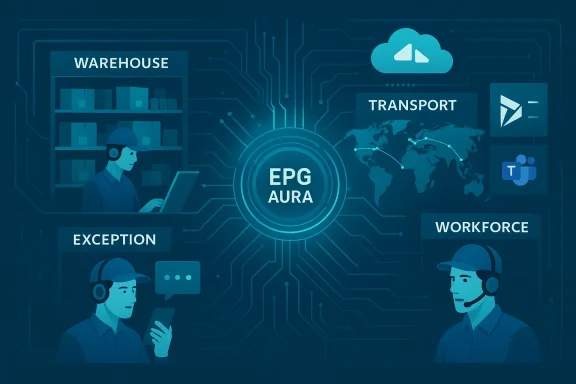
Microsoft’s newly spotlighted collaboration with Ehrhardt Partner Group (EPG) is more than another channel-partner announcement. It signals how quickly supply chain execution software is moving toward an AI-native, cloud-first model, with EPG AURA set to run globally on Microsoft Azure and tie more tightly into Dynamics 365, Microsoft 365, and emerging MCP-based integration patterns. The practical message for customers is clear: faster deployment, broader scale, and a more unified operating layer for warehouse, transport, voice, and workforce workflows. The strategic message is even bigger: the next wave of logistics software is being built around agentic AI, not just automation.
The EPG-Microsoft partnership lands at a moment when supply chain technology is being redefined by three forces at once: cloud migration, AI adoption, and the rising expectation that enterprise software should act more like an intelligent operator than a passive system of record. EPG’s own positioning around EPG AURA makes that evolution explicit, describing it as an AI-powered environment that transforms the EPG ONE suite into a more agentic, unified, and resilient execution platform. Microsoft, meanwhile, has spent the past year pushing hard on agentic ERP and AI-connected business operations, including dynamics around Dynamics 365 and Model Context Protocol.
That matters because supply chain execution software sits closer to the operational nerve center than many other business applications. If AI can improve picking accuracy, routing, labor orchestration, exception handling, and planning collaboration, then it stops being a nice-to-have and becomes a direct driver of throughput, service quality, and cost discipline. EPG has long sold itself as a specialist in exactly these areas, with more than 35 years of logistics experience and a broad EPG ONE suite spanning warehouse, transport, and workforce management.
Microsoft’s side of the story is equally important. Azure provides the kind of scale, security architecture, and geographic reach that global logistics software vendors increasingly need, while Microsoft’s newer work around MCP and Dynamics 365 shows the company is building a broader agentic fabric for enterprise applications. In that context, EPG is not simply “hosted on Azure.” It is plugging into a larger Microsoft ecosystem that is becoming more structured around AI interoperability and governed data access.
The timing also reflects a wider competitive race. Warehouse and supply chain vendors are under pressure to prove that AI can do more than summarize dashboards or answer questions in natural language. They need to show that AI can participate in work execution itself, with guardrails, integration depth, and measurable business outcomes. EPG’s announcement suggests that the company wants to be seen as an early mover in that shift, not a late adopter.
AURA is especially noteworthy because it is framed as both a platform and an enabling environment. That makes it more ambitious than a simple copilot or chatbot overlay. In practical terms, EPG appears to be positioning AURA as the intelligence layer that can sit above execution systems and interpret context across warehouse, transport, and labor operations.
EPG’s framing also hints at a move from static automation toward situational decisioning. In the warehouse, that could mean recommending the right task sequence, identifying bottlenecks before they become disruptions, or dynamically adapting labor flow. The more context-rich the system becomes, the more value AI can create beyond simple prediction.
The key question, of course, is how much of that promise will show up as operationally useful behavior versus marketing-language ambition. But the architectural direction is important: EPG is signaling that future product development will be shaped around AI as a core design principle, not an add-on feature. That is a meaningful distinction in a market where many vendors still treat AI as a wrapper around legacy workflows. That difference is strategic, not cosmetic.
For EPG, this is also a market-access play. Some customers will continue to prefer private hosting or a controlled deployment environment, and the company says its EPX hosting remains part of the portfolio. But Azure adds an alternative SaaS delivery path that can reduce friction for customers already invested in Microsoft infrastructure.
There is also a practical implementation benefit. When a software vendor can anchor its SaaS strategy in a hyperscale cloud with mature security and operational tooling, it can more easily support multi-country rollouts and standardized deployments. For global logistics organizations, that consistency often matters more than raw feature breadth.
Still, cloud migration always carries a trade-off. Customers may gain scalability and lower deployment complexity, but they also become more dependent on the cloud provider’s commercial and technical roadmap. In this case, that dependency cuts both ways: EPG gets reach, while customers get convenience, yet both are tied more closely to Microsoft’s ecosystem choices. That is the hidden cost of scale.
For EPG, this could substantially reduce integration friction. Preconfigured interfaces can shorten implementation cycles, reduce custom-code requirements, and make it easier to connect ERP workflows with execution events in the EPG ONE suite. That matters because integration is often the hidden tax in logistics transformation projects.
By linking EPG to this ecosystem, the partnership gives customers a more coherent route from ERP event to logistics action. In theory, that could support use cases such as automated replenishment triggers, exception handling, approval workflows, and cross-system task orchestration. The exact value will depend on how deep the implementation goes, but the architectural signal is strong.
The most important implication is that the old boundary between ERP and execution software is thinning. If AI agents can see both the business intent and the operational state, then supply chain software can begin to behave less like a silo and more like a continuously adapting system. That is the kind of shift that could redefine implementation priorities over the next few years.
What changes here is the promise of tighter system alignment. Instead of voice tools operating as a standalone layer, they can be linked more directly to the enterprise systems that manage orders, inventory, and workflows. That should reduce data duplication and improve the speed at which operational instructions are issued and confirmed.
Microsoft’s broader supply chain messaging also reinforces this reality. Dynamics 365 Supply Chain Management explicitly emphasizes collaboration and planning across departments in the flow of work, which makes sense when logistics decisions need to be visible to multiple stakeholders at once. Voice is one interface; collaborative orchestration is the larger goal.
There is a sensible balance emerging here. The best supply chain systems will not replace human workers, but they will give them better context and more immediate feedback. The EPG-Microsoft partnership seems designed to push exactly in that direction, where AI and voice support the worker instead of distracting from the task. That is where the productivity upside becomes real.
That is more consequential than it first appears. In logistics, delays often happen not because data does not exist, but because the right people do not see it quickly enough. Bringing operational context into the collaboration layer can help planners, supervisors, customer service teams, and executives act sooner.
This also helps explain why Microsoft has been investing in agents across business applications. The company is trying to make collaboration, context, and action feel more continuous. EPG benefits from that direction because its customers do not just need data movement; they need work movement.
There is, however, an important design challenge. If Teams becomes the place where too many operational issues surface, users may face information overload unless the AI layer does an excellent job filtering and prioritizing. The success of this integration will depend on relevance, not just visibility. Noise is the enemy of operational intelligence.
For the broader market, the message is that supply chain execution is becoming a platform contest. Vendors are no longer competing only on WMS feature checklists; they are competing on integration depth, AI readiness, deployment flexibility, and the ability to participate in a larger cloud ecosystem. EPG’s Microsoft move is a bid to stay relevant in that broader contest.
The deal may also influence buying behavior among enterprises that already standardize on Microsoft. Procurement teams often favor vendors that fit naturally into existing identity, security, and collaboration environments. That is a quiet but powerful advantage in a market where platform familiarity can shorten sales cycles.
Still, competitive advantage will depend on execution, not announcement value. A partnership is only meaningful if it produces tangible deployment speed, lower total cost of ownership, and stronger operational outcomes. The market has seen enough “AI transformation” rhetoric to demand proof. Customers will not buy the story twice.
Microsoft’s comment, which describes EPG as one of the companies that not only use AI but actively shape the next stage of AI-driven logistics solutions, reinforces that narrative. In other words, this is not being framed as a passive hosting arrangement. It is being presented as a joint innovation effort.
For EPG, this means its product story can move beyond efficiency and into decision support. That is where AI becomes commercially interesting, because it can influence how exceptions are resolved, how labor is allocated, and how supply chain teams respond to volatility. Those are the moments where software has the greatest strategic value.
Whether EPG can truly claim frontier status will depend on the depth of adoption and the quality of measurable outcomes. But the narrative is aligned with where the market is going: intelligent execution, governed agents, and cloud-native interoperability. That makes the partnership more than plausible; it makes it timely.
It also creates room for faster product modernization. By anchoring AURA in Azure and connecting it to Microsoft’s broader AI stack, EPG can potentially accelerate release cycles and deliver more standardized customer deployments. That can be especially valuable in complex multi-country rollouts.
There is also the challenge of integration complexity. Even with MCP and preconfigured interfaces, enterprise environments are messy, and any cross-system rollout can hit data-quality, governance, and customization issues. A standardized protocol helps, but it does not magically remove the hard parts of implementation.
It will also be worth tracking how deeply EPG adopts Microsoft’s broader agentic stack. If MCP-based connectivity and Dynamics integrations become a repeated pattern rather than a one-off feature, the partnership could become a template for other logistics software vendors. That would be a meaningful signal for the broader market.
Microsoft and EPG are betting that the future of supply chain execution will be defined by intelligence embedded directly into the operational fabric of the business. That is a defensible bet, and it fits the direction of the broader Microsoft platform strategy. Whether it becomes a breakout success will depend on proof, not rhetoric, but the strategic logic is clear: supply chain software is moving from hosted execution to adaptive decision-making, and EPG wants to be one of the companies leading that transition.
Source: Logistics Business Microsoft Joins Push for Supply Chain of The Future
 Overview
The EPG-Microsoft partnership lands at a moment when supply chain technology is being redefined by three forces at once: cloud migration, AI adoption, and the rising expectation that enterprise software should act more like an intelligent operator than a passive system of record. EPG’s own positioning around EPG AURA makes that evolution explicit, describing it as an AI-powered environment that transforms the EPG ONE suite into a more agentic, unified, and resilient execution platform. Microsoft, meanwhile, has spent the past year pushing hard on agentic ERP and AI-connected business operations, including dynamics around Dynamics 365 and Model Context Protocol.That matters because supply chain execution software sits closer to the operational nerve center than many other business applications. If AI can improve picking accuracy, routing, labor orchestration, exception handling, and planning collaboration, then it stops being a nice-to-have and becomes a direct driver of throughput, service quality, and cost discipline. EPG has long sold itself as a specialist in exactly these areas, with more than 35 years of logistics experience and a broad EPG ONE suite spanning warehouse, transport, and workforce management.
Microsoft’s side of the story is equally important. Azure provides the kind of scale, security architecture, and geographic reach that global logistics software vendors increasingly need, while Microsoft’s newer work around MCP and Dynamics 365 shows the company is building a broader agentic fabric for enterprise applications. In that context, EPG is not simply “hosted on Azure.” It is plugging into a larger Microsoft ecosystem that is becoming more structured around AI interoperability and governed data access.
The timing also reflects a wider competitive race. Warehouse and supply chain vendors are under pressure to prove that AI can do more than summarize dashboards or answer questions in natural language. They need to show that AI can participate in work execution itself, with guardrails, integration depth, and measurable business outcomes. EPG’s announcement suggests that the company wants to be seen as an early mover in that shift, not a late adopter.
What EPG AURA Changes
At the center of this story is EPG AURA, which EPG describes as an AI environment that reshapes the EPG ONE suite into a more adaptive and resilient supply chain execution platform. That is not just branding language. It signals a transition from conventional software modules toward a layered operating model where AI helps mediate workflows, recommendations, and exceptions across logistics processes.AURA is especially noteworthy because it is framed as both a platform and an enabling environment. That makes it more ambitious than a simple copilot or chatbot overlay. In practical terms, EPG appears to be positioning AURA as the intelligence layer that can sit above execution systems and interpret context across warehouse, transport, and labor operations.
Why “AI-native” Matters
The phrase AI-native is doing a lot of work here. In enterprise software, AI-native usually implies that AI is not bolted on after the fact, but built into the architecture, data model, and workflow design from the start. That should matter to logistics buyers because retrofitted AI often struggles with fragmented data, brittle integrations, and inconsistent operational context.EPG’s framing also hints at a move from static automation toward situational decisioning. In the warehouse, that could mean recommending the right task sequence, identifying bottlenecks before they become disruptions, or dynamically adapting labor flow. The more context-rich the system becomes, the more value AI can create beyond simple prediction.
The key question, of course, is how much of that promise will show up as operationally useful behavior versus marketing-language ambition. But the architectural direction is important: EPG is signaling that future product development will be shaped around AI as a core design principle, not an add-on feature. That is a meaningful distinction in a market where many vendors still treat AI as a wrapper around legacy workflows. That difference is strategic, not cosmetic.
Why Azure Is a Big Deal
Moving EPG AURA to Microsoft Azure gives the product global distribution muscle that is difficult for a mid-sized specialist vendor to replicate alone. Azure also brings established enterprise trust signals: scale, compliance tooling, region options, and backup/recovery capabilities that matter when supply chain operations cannot tolerate long outages. Microsoft’s own Azure backup and resilience material emphasizes geo-redundant storage and paired-region recovery options, which are exactly the kinds of features enterprise buyers expect for mission-critical workloads.For EPG, this is also a market-access play. Some customers will continue to prefer private hosting or a controlled deployment environment, and the company says its EPX hosting remains part of the portfolio. But Azure adds an alternative SaaS delivery path that can reduce friction for customers already invested in Microsoft infrastructure.
Enterprise Buyers Care About More Than Speed
Enterprise supply chain buyers rarely choose infrastructure solely because it is fashionable. They care about availability, auditability, recovery, regional support, and the ability to fit into an existing identity and governance stack. Azure’s enterprise positioning helps EPG speak to those concerns in a more familiar language.There is also a practical implementation benefit. When a software vendor can anchor its SaaS strategy in a hyperscale cloud with mature security and operational tooling, it can more easily support multi-country rollouts and standardized deployments. For global logistics organizations, that consistency often matters more than raw feature breadth.
Still, cloud migration always carries a trade-off. Customers may gain scalability and lower deployment complexity, but they also become more dependent on the cloud provider’s commercial and technical roadmap. In this case, that dependency cuts both ways: EPG gets reach, while customers get convenience, yet both are tied more closely to Microsoft’s ecosystem choices. That is the hidden cost of scale.
Integration With Dynamics and MCP
One of the most interesting parts of the announcement is the reference to a standardized interface to Microsoft Dynamics, including MCP, or Model Context Protocol. That puts the partnership squarely inside a broader industry shift toward more governed, interoperable AI systems. Microsoft’s recent documentation and blog material show MCP becoming a structural way to connect agents with ERP actions and business logic across Dynamics 365 Finance and Supply Chain Management.For EPG, this could substantially reduce integration friction. Preconfigured interfaces can shorten implementation cycles, reduce custom-code requirements, and make it easier to connect ERP workflows with execution events in the EPG ONE suite. That matters because integration is often the hidden tax in logistics transformation projects.
The Significance of Standardized Connectivity
MCP is not just another connector specification. In Microsoft’s framing, it is part of a larger push to let agents access trusted business logic and operations in a consistent, governed way. That is especially important for supply chain scenarios, where permissions, approvals, and audit trails are non-negotiable.By linking EPG to this ecosystem, the partnership gives customers a more coherent route from ERP event to logistics action. In theory, that could support use cases such as automated replenishment triggers, exception handling, approval workflows, and cross-system task orchestration. The exact value will depend on how deep the implementation goes, but the architectural signal is strong.
The most important implication is that the old boundary between ERP and execution software is thinning. If AI agents can see both the business intent and the operational state, then supply chain software can begin to behave less like a silo and more like a continuously adapting system. That is the kind of shift that could redefine implementation priorities over the next few years.
Voice, Teams, and the Frontline Workflow
EPG’s announcement also highlights LYDIA Voice and the Communicator, with connections to Microsoft Dynamics solutions. That may sound like a narrow feature-level integration, but voice remains one of the most practical interfaces in warehouse operations because it keeps workers hands-free and focused on physical tasks. Voice-guided workflows have long been a productivity lever in picking, replenishment, and task confirmation.What changes here is the promise of tighter system alignment. Instead of voice tools operating as a standalone layer, they can be linked more directly to the enterprise systems that manage orders, inventory, and workflows. That should reduce data duplication and improve the speed at which operational instructions are issued and confirmed.
Why Frontline UX Still Matters
The industry often talks about AI as if it only lives in dashboards, but warehouses are won or lost on front-line execution. If a worker can receive clearer instructions, respond faster, and make fewer errors, the business case is concrete. That is why voice, though less glamorous than generative AI, remains an essential part of intelligent logistics.Microsoft’s broader supply chain messaging also reinforces this reality. Dynamics 365 Supply Chain Management explicitly emphasizes collaboration and planning across departments in the flow of work, which makes sense when logistics decisions need to be visible to multiple stakeholders at once. Voice is one interface; collaborative orchestration is the larger goal.
There is a sensible balance emerging here. The best supply chain systems will not replace human workers, but they will give them better context and more immediate feedback. The EPG-Microsoft partnership seems designed to push exactly in that direction, where AI and voice support the worker instead of distracting from the task. That is where the productivity upside becomes real.
Microsoft 365 and the Collaboration Layer
The reference to Microsoft 365, especially Teams, is another telling detail. Supply chain software has often struggled to escape the confines of specialized back-office tools, but the real work of operations involves cross-functional communication. Embedding supply chain-relevant information into Teams can shorten decision cycles and reduce the need for people to jump between systems.That is more consequential than it first appears. In logistics, delays often happen not because data does not exist, but because the right people do not see it quickly enough. Bringing operational context into the collaboration layer can help planners, supervisors, customer service teams, and executives act sooner.
From Alerts to Decisions
The real value of collaboration software in supply chains is not notification volume. It is whether the alert reaches the person who can actually decide what happens next. When integrated properly, Teams becomes less of a chat client and more of a decision surface for exceptions, approvals, and operational coordination.This also helps explain why Microsoft has been investing in agents across business applications. The company is trying to make collaboration, context, and action feel more continuous. EPG benefits from that direction because its customers do not just need data movement; they need work movement.
There is, however, an important design challenge. If Teams becomes the place where too many operational issues surface, users may face information overload unless the AI layer does an excellent job filtering and prioritizing. The success of this integration will depend on relevance, not just visibility. Noise is the enemy of operational intelligence.
Competitive Positioning in Supply Chain Execution
This partnership also says something about EPG’s competitive strategy. By aligning itself closely with Microsoft, EPG gains credibility in accounts where Microsoft is already a trusted enterprise platform. It also gives the company a stronger answer to larger rivals that can sell both software and ecosystem scale.For the broader market, the message is that supply chain execution is becoming a platform contest. Vendors are no longer competing only on WMS feature checklists; they are competing on integration depth, AI readiness, deployment flexibility, and the ability to participate in a larger cloud ecosystem. EPG’s Microsoft move is a bid to stay relevant in that broader contest.
What Rivals Will Notice
Competitors will likely pay close attention to whether EPG can translate this announcement into repeatable customer outcomes. If the Azure-hosted version of AURA can materially shorten deployments, improve usability, and accelerate AI adoption, it could put pressure on other specialist vendors to deepen their own hyperscaler partnerships.The deal may also influence buying behavior among enterprises that already standardize on Microsoft. Procurement teams often favor vendors that fit naturally into existing identity, security, and collaboration environments. That is a quiet but powerful advantage in a market where platform familiarity can shorten sales cycles.
Still, competitive advantage will depend on execution, not announcement value. A partnership is only meaningful if it produces tangible deployment speed, lower total cost of ownership, and stronger operational outcomes. The market has seen enough “AI transformation” rhetoric to demand proof. Customers will not buy the story twice.
The Meaning of “AI Frontier Company”
EPG’s use of the phrase AI frontier company is carefully chosen. It suggests not only early adoption, but also the ambition to shape how AI is used in supply chain execution. That is a higher bar than simply offering AI features; it implies product leadership, ecosystem influence, and perhaps even category creation.Microsoft’s comment, which describes EPG as one of the companies that not only use AI but actively shape the next stage of AI-driven logistics solutions, reinforces that narrative. In other words, this is not being framed as a passive hosting arrangement. It is being presented as a joint innovation effort.
From Automation to Agentic Operations
The important transition here is from automation to agentic operations. Automation typically follows rules. Agentic systems aim to act with more context, more autonomy, and more adaptability, while still respecting governance and human oversight. That is the direction Microsoft has been signaling in Dynamics 365 and related AI work.For EPG, this means its product story can move beyond efficiency and into decision support. That is where AI becomes commercially interesting, because it can influence how exceptions are resolved, how labor is allocated, and how supply chain teams respond to volatility. Those are the moments where software has the greatest strategic value.
Whether EPG can truly claim frontier status will depend on the depth of adoption and the quality of measurable outcomes. But the narrative is aligned with where the market is going: intelligent execution, governed agents, and cloud-native interoperability. That makes the partnership more than plausible; it makes it timely.
Strengths and Opportunities
The EPG-Microsoft collaboration has several obvious strengths, starting with the combination of domain specialization and hyperscale infrastructure. EPG brings deep logistics know-how, while Microsoft brings cloud reach, AI tooling, and enterprise trust. Together, they can offer a compelling value proposition for global supply chain customers.It also creates room for faster product modernization. By anchoring AURA in Azure and connecting it to Microsoft’s broader AI stack, EPG can potentially accelerate release cycles and deliver more standardized customer deployments. That can be especially valuable in complex multi-country rollouts.
- Global scalability through Azure-hosted delivery.
- Stronger integration with Microsoft Dynamics and Teams.
- Improved deployment speed via standardized interfaces and cloud patterns.
- Greater operational flexibility with both private cloud and SaaS options.
- Better frontline usability through voice and workflow integration.
- AI-readiness via an agentic, context-aware architecture.
- Enterprise credibility from Microsoft’s security and platform ecosystem.
Risks and Concerns
The biggest risk is that the announcement raises expectations faster than the product reality can support. Supply chain buyers are cautious, and they will want to see proof that AURA delivers measurable gains rather than just a more modern architecture and polished AI language. Execution is the real test.There is also the challenge of integration complexity. Even with MCP and preconfigured interfaces, enterprise environments are messy, and any cross-system rollout can hit data-quality, governance, and customization issues. A standardized protocol helps, but it does not magically remove the hard parts of implementation.
- Overpromising on AI outcomes before field results are proven.
- Cloud dependency on Microsoft’s platform and roadmap.
- Integration complexity in heterogeneous enterprise IT estates.
- Data governance risks if agentic workflows are not tightly controlled.
- User adoption challenges if frontline teams find the new stack intrusive.
- Competitive response from rival vendors and cloud ecosystems.
- Security and compliance scrutiny in regulated or multinational deployments.
What to Watch Next
The most important thing to watch is whether EPG and Microsoft can turn this collaboration into referenceable deployments with measurable business outcomes. In supply chain technology, the difference between a promising partnership and a market-moving platform is often a handful of successful enterprise rollouts. The market will want evidence of faster implementations, fewer errors, and better operational visibility.It will also be worth tracking how deeply EPG adopts Microsoft’s broader agentic stack. If MCP-based connectivity and Dynamics integrations become a repeated pattern rather than a one-off feature, the partnership could become a template for other logistics software vendors. That would be a meaningful signal for the broader market.
Key Signals Ahead
- Customer case studies showing concrete productivity or quality gains.
- The scope of global Azure availability for AURA.
- Expansion of MCP-based integrations beyond the initial Dynamics interface.
- Deeper Teams-based workflow participation for logistics users.
- Whether EPG uses Microsoft’s ecosystem to speed up AI feature releases.
- Competitive responses from other supply chain execution vendors.
Microsoft and EPG are betting that the future of supply chain execution will be defined by intelligence embedded directly into the operational fabric of the business. That is a defensible bet, and it fits the direction of the broader Microsoft platform strategy. Whether it becomes a breakout success will depend on proof, not rhetoric, but the strategic logic is clear: supply chain software is moving from hosted execution to adaptive decision-making, and EPG wants to be one of the companies leading that transition.
Source: Logistics Business Microsoft Joins Push for Supply Chain of The Future
