

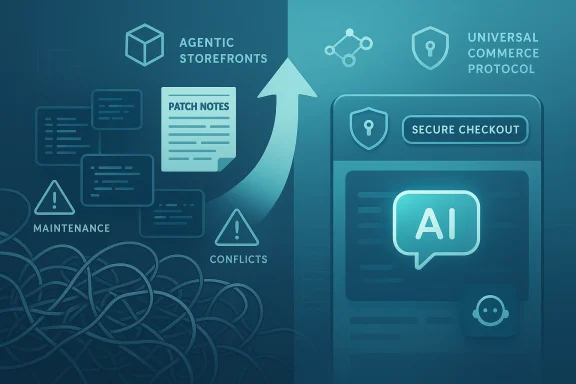
When your engineering team is spending half its time wrestling with plugin conflicts, security patches, and checkout regressions, the business you hoped to build quietly turns into a maintenance company with a storefront.
For a generation of brands the default path to online selling began with WordPress, bolted-on commerce plugins, and an army of small, specialized integrations. That approach made sense when budgets were tight and the priority was simply to launch. But commerce today runs at a different cadence: new discovery channels, instant personalization, and agentic AI experiences are raising customer expectations every quarter. When your roadmap is clogged with upkeep, you lose not only developer hours but strategic runway—the experiments, optimizations, and growth plays that produce real revenue.
Shopify’s recent enterprise materials frame this problem around a single, practical pivot: reduce platform maintenance and recapture developer time for features that directly move the business forward. Shopify has formalized that argument with product investments like Agentic Storefronts—tools that let merchants appear and accept checkout inside AI chat experiences—and a merchant assistant called Sidekick that automates many day-to-day tasks inside the admin. These product moves aren’t theoretical: Shopify now publishes platform-level compliance artifacts (PCI, SOC), channel primitives, and migration research that aim to quantify the trade-off between custom stacks and built-for-commerce platforms.
Shopify’s enterprise messaging highlights concrete migration research commissioned and published by a major consulting firm showing measurable time- and cost-to-value advantages when brands move to a modern commerce platform. The headline numbers vary by page, but the underlying pattern is consistent: many migrations finish faster, with lower budgeted costs and higher on-time delivery rates compared to comparable custom implementations. Treat these vendor‑commissioned findings as directional evidence rather than gospel—your mileage will depend on scope, integrations, and complexity.
Why that matters: when developer cycles are consumed by maintenance, features that directly increase revenue or reduce CAC simply don’t get built. The opportunity cost compounds: one quarter becomes two, and the competitor who can run fast experiments wins the customer experience war.
Recent industry moves show the channel is real and accelerating. Google’s work to enable shopping inside Gemini and Microsoft’s Copilot embedded checkout experiments indicate major tech players are layering commerce into conversational surfaces—exactly the scenario where platform-level channel primitives reduce duplication and maintenance. Merchants that are prepared to appear in AI agents will have a discovery advantage; those who need bespoke engineering for each agent will pay a steep friction tax.
Put simply: if an AI prompt can create a promotion, generate catalog copy, or scaffold a small admin app in minutes, a merchant no longer needs to queue these items for a developer sprint. That turns months of backlog into immediate, testable actions, and changes how development capacity is allocated.
When you evaluate those numbers for your business, ask three practical questions:
The research and case studies that vendors publish are directional and useful, but they should be treated as the beginning of due diligence, not its end. Map your integration surface, choose a realistic pilot, and measure the reclaimed developer capacity in months and dollars. If your backlog contains experiments that would materially lower CAC, raise retention, or expand channels—those are the features you’ll finally be able to build once maintenance is out of the way.
Platform migration is not a silver bullet, but for many brands it converts maintenance drag into growth velocity. If your team is maintaining rather than building, the real question isn't whether a platform can do more—it's whether you can afford not to.
Source: Shopify WordPress Was Built for Blogs. You Need a Platform Built for Commerce. (2026) - Shopify Philippines
 Background: why the "maintenance tax" matters right now
For a generation of brands the default path to online selling began with WordPress, bolted-on commerce plugins, and an army of small, specialized integrations. That approach made sense when budgets were tight and the priority was simply to launch. But commerce today runs at a different cadence: new discovery channels, instant personalization, and agentic AI experiences are raising customer expectations every quarter. When your roadmap is clogged with upkeep, you lose not only developer hours but strategic runway—the experiments, optimizations, and growth plays that produce real revenue.Shopify’s recent enterprise materials frame this problem around a single, practical pivot: reduce platform maintenance and recapture developer time for features that directly move the business forward. Shopify has formalized that argument with product investments like Agentic Storefronts—tools that let merchants appear and accept checkout inside AI chat experiences—and a merchant assistant called Sidekick that automates many day-to-day tasks inside the admin. These product moves aren’t theoretical: Shopify now publishes platform-level compliance artifacts (PCI, SOC), channel primitives, and migration research that aim to quantify the trade-off between custom stacks and built-for-commerce platforms.
Overview: what "built for commerce" actually buys you
Moving from a custom stack to a commerce platform like Shopify is a package deal, not a single feature. The typical benefits fall into three categories:- Operational defense — platform-managed infrastructure, security, and compliance that reduce audit and patching workload.
- Execution velocity — prebuilt integrations, curated apps, and admin automation that shrink delivery times for common features.
- Channel readiness — turnkey connections to new sales and discovery surfaces (mobile wallets, marketplaces, and now AI agents).
The math of the backlog: what maintenance is costing you
Maintenance costs are both visible and invisible. Visible costs show up in developer hours, contractor retainers, and cloud spend. Invisible costs appear as features that never leave the backlog—checkout optimizations, conversion experiments, personalization, and new channel integrations.Shopify’s enterprise messaging highlights concrete migration research commissioned and published by a major consulting firm showing measurable time- and cost-to-value advantages when brands move to a modern commerce platform. The headline numbers vary by page, but the underlying pattern is consistent: many migrations finish faster, with lower budgeted costs and higher on-time delivery rates compared to comparable custom implementations. Treat these vendor‑commissioned findings as directional evidence rather than gospel—your mileage will depend on scope, integrations, and complexity.
Why that matters: when developer cycles are consumed by maintenance, features that directly increase revenue or reduce CAC simply don’t get built. The opportunity cost compounds: one quarter becomes two, and the competitor who can run fast experiments wins the customer experience war.
What Shopify builds into the platform (and why it matters)
Built-in security and compliance: not optional for enterprise commerce
PCI, SOC, vulnerability scanning, SSL termination, DDoS protections—these are baseline expectations for modern commerce. On custom stacks each of these requires engineering time, vendor management, and audit cycles. Shopify publishes PCI attestations and SOC reports that demonstrate the platform’s controls and audit cadence; for many merchants this materially reduces the internal burden of compliance and quarterly scanning. That doesn’t remove merchant responsibility—access control, app vetting and internal policies remain critical—but it centralizes the most expensive, expertise-heavy pieces of compliance.Curated ecosystem vs. plugin sprawl
Third-party marketplaces can be double-edged swords. On WordPress, plugins are often released in isolation, resulting in fragile dependency graphs and frequent conflicts. Shopify’s app ecosystem is curated, reviewed, and sandboxed in ways that reduce the most common causes of platform instability. The practical result: merchants can often adopt well-maintained third-party solutions without months of custom integration and the associated long-term maintenance overhead.Platform primitives: reusable features that compound
When a platform provides a secure, tokenized checkout, Shop Pay, or a catalog format optimized for AI agents, every merchant—big or small—benefits from that investment. For example, Shopify’s Agentic Storefronts and Universal Commerce Protocol (UCP) are explicitly designed to make merchants discoverable and purchasable inside AI conversations like ChatGPT, Google AI Mode, and Microsoft Copilot, without each brand engineering a bespoke agent or checkout. That reduces per-channel engineering multiplied across dozens of AI surfaces.Case evidence: what brands actually built when maintenance became someone else’s problem
Vendor case studies are not neutral evidence, but they do illuminate practical outcomes when companies stop re-implementing what a platform already provides.- Lull moved a decade of custom infrastructure to Shopify in about six months and reported a 25% reduction in infrastructure costs and a 25% decrease in payment processing fees, while dramatically shortening rollout times for promotions and product launches. That jump in operational speed freed the team to run experiments and scale.
- MakerFlo says a loyalty program that used to take five to ten months to implement on their custom stack now takes hours or days on Shopify—an estimated $120,000 annual saving in developer time redirected to product and growth work.
- Peter Sheppard Footwear and Arhaus are among broader enterprise examples cited where conversion and merchandising autonomy improved after migrations, allowing developers to focus on strategic changes instead of routine operations. These stories illustrate a common pattern: centralized platform capabilities + curated apps = faster iteration.
Agentic commerce and the AI opportunity: a new discovery layer
The next big shift in commerce is agentic: customers now discover and purchase within AI conversations. Major platform work—Shopify’s Agentic Storefronts and the Universal Commerce Protocol—are designed so merchants can be discoverable and sell directly through AI agents without building and operating separate integrations for each assistant. That’s operationally significant: building a reliable agent-led checkout and agent-safe product knowledge base for each partner would otherwise be months of work per channel, plus ongoing maintenance as agent APIs and expectations change.Recent industry moves show the channel is real and accelerating. Google’s work to enable shopping inside Gemini and Microsoft’s Copilot embedded checkout experiments indicate major tech players are layering commerce into conversational surfaces—exactly the scenario where platform-level channel primitives reduce duplication and maintenance. Merchants that are prepared to appear in AI agents will have a discovery advantage; those who need bespoke engineering for each agent will pay a steep friction tax.
The Sidekick proposition: automation as leverage
Sidekick is Shopify’s internal AI assistant for merchants: query your store, generate copy, run basic analytics, set up automations, or scaffold admin apps through natural language. Shopify reports rapid adoption—hundreds of thousands of shops using Sidekick and nearly 100 million cumulative merchant conversations since January 2025, according to company materials and syndicated press coverage. Those are vendor-provided adoption metrics but they reflect a clear trend: AI is being embedded into the admin to automate recurring tasks that previously required developer time or dedicated specialists.Put simply: if an AI prompt can create a promotion, generate catalog copy, or scaffold a small admin app in minutes, a merchant no longer needs to queue these items for a developer sprint. That turns months of backlog into immediate, testable actions, and changes how development capacity is allocated.
Trade-offs and risks: what you give up when you standardize
No migration is free of trade-offs. The platform approach introduces a different set of risks that every buyer should evaluate:- Vendor lock-in — migrating away later has cost. A platform can accelerate growth, but it can also create migration friction if a brand later demands a capability the platform cannot support.
- Perceived loss of creative control — full pixel-level control is still possible with headless or customized storefronts on many platforms, but achieving "100% custom" sometimes requires additional investment and architecture choices (headless, Hydrogen-style frameworks, or bespoke storefronts).
- App vetting and compatibility — Shopify’s app ecosystem is curated, but apps still introduce dependencies. Merchants must maintain governance, least-privilege access, and app reviews.
- Vendor-reported metrics — be cautious with headline statistics. Vendor-commissioned research and internal usage figures are useful directional signals but should be validated against your own migration planning and total cost of ownership modeling.
- Hidden integration cost — back-office systems like ERP, PIM, and complex tax/fulfillment flows can still be expensive to integrate. Platform advantage often applies most directly to customer-facing and checkout flows; integrations to legacy systems may still require bespoke engineering.
How to evaluate the claim that migrations are faster, cheaper, and more likely to finish on time
Shopify cites research (commissioned and published by EY in October 2025) showing material migration advantages across a variety of metrics—faster implementation timelines, lower budgeted costs, and higher on-time delivery rates versus both competing platforms and custom builds. Those numbers are useful as benchmarks but they’re not substitutes for an honest assessment of your own project scope, integration surface area, and risk profile.When you evaluate those numbers for your business, ask three practical questions:
- What level of integration is required with my ERP, OMS, or custom OMS workflows?
- Which customer experiences are truly differentiating and require bespoke engineering?
- What is the realistic migration timeline and budget if we keep business-as-usual operations running during cutover?
A recommended migration playbook (practical, sequential, pragmatic)
- Inventory and prioritize
- Catalog every integration, plugin, and in-house service. Rank them by business impact and maintenance cost.
- Classify differentiation
- Tag features as "core differentiator" (must be bespoke), "operational" (platform-fit), or "experimental" (iterative).
- Pilot a single site or region
- Validate key integrations (payments, fulfillment, ERP sync) under production load.
- Reuse platform primitives
- Adopt built-in checkout, tokenization, and channel connectors where possible.
- Measure and reallocate
- Track developer hours freed, feature velocity, and conversion change. Reinvest reclaimed capacity into prioritized experiments.
- Govern and harden
- Define app approval processes, least-privilege access, and disaster recovery objectives on the new platform.
Realistic outcomes: what you can expect if you reclaim developer time
If you succeed at moving maintenance off your core team, what does that freed capacity actually enable? Based on case examples and platform claims, outcomes include:- Faster feature delivery: days or weeks for loyalty programs, promotions, or new payment methods instead of months.
- Lower operational overhead: measurable reductions in infrastructure and payment processing costs for some merchants.
- Improved conversion and retention: unified checkout and native express pay options can raise transactional conversion by meaningful percentages.
- New channel reach without bespoke builds: being present inside AI chats, marketplaces, and social commerce surfaces without engineering separate, fragile integrations.
Practical red flags to watch for before you decide
- If your business depends on custom checkout logic that implements pricing or compliance rules unique to your industry, validate that a platform’s extension model can support that logic without compromise.
- If your back office is deeply coupled (custom ERP with brittle connectors), create a migration plan for connective tissue first—data model changes are where many migrations stumble.
- If your product roadmap is defined by relentless pixel-level novelty (every microinteraction being unique), evaluate whether a hybrid approach (platform core + bespoke front-end) preserves speed without losing identity.
- If vendor-reported metrics are the only evidence you’ve seen, demand reproducible case studies and scoped proofs-of-concept with your integrations and traffic patterns.
Conclusion: platform decisions are strategy decisions
This isn’t a WordPress-versus-Shopify morality play. It’s a choice about opportunity cost, technical debt, and where growth happens. Platforms like Shopify are explicitly optimized to remove the recurring, expensive burdens of maintenance—compliance, patching, payment security, and multi-channel plumbing—so merchants can reallocate developer effort to experiments and product features that matter to customers.The research and case studies that vendors publish are directional and useful, but they should be treated as the beginning of due diligence, not its end. Map your integration surface, choose a realistic pilot, and measure the reclaimed developer capacity in months and dollars. If your backlog contains experiments that would materially lower CAC, raise retention, or expand channels—those are the features you’ll finally be able to build once maintenance is out of the way.
Platform migration is not a silver bullet, but for many brands it converts maintenance drag into growth velocity. If your team is maintaining rather than building, the real question isn't whether a platform can do more—it's whether you can afford not to.
Source: Shopify WordPress Was Built for Blogs. You Need a Platform Built for Commerce. (2026) - Shopify Philippines
