

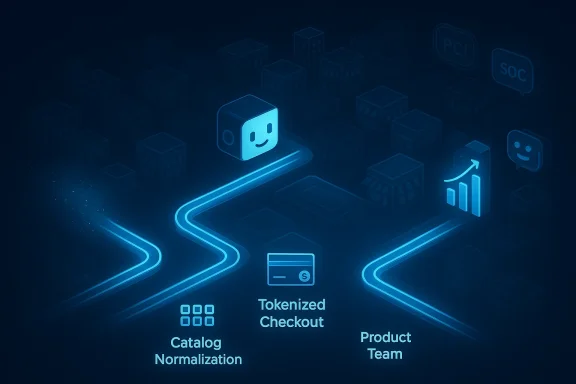
Shopify’s argument is blunt and familiar: if your development team is spending months on plugin updates, security patches, and checkout regressions, you didn’t hire them to maintain plumbing—you hired them to build growth. That framing sits at the center of a broader pitch: move off bespoke or WordPress-based commerce stacks and onto a commerce platform that handles infrastructure, security, and common features so your engineers can spend their time on experiments, conversions, and product-led growth. Shopify frames that shift with concrete performance claims—faster migrations, lower costs, and measurable developer capacity gains—and a new set of product plays that aim to make brands discoverable inside AI assistants. The result is less maintenance and more runway to build the features that actually move KPIs.
Background / Overview
The problem Shopify surfaces is operational drag: teams on custom stacks or plugin-heavy WordPress sites spend an outsized share of development cycles on upkeep—resolving plugin conflicts, testing security updates, and triaging checkout issues after third-party changes. The consequence is simple: maintenance crowds out innovation. Executives and heads of commerce frequently describe a “maintenance tax” that siphons 30–50% of engineering capacity away from new features. The promotional literature and merchant conversations quoted by Shopify place that cost in stark relief: the time not spent building checkout optimizations, personalization, new sales channels (including agentic/AI channels), or conversion experiments is opportunity cost.Shopify’s positioning combines three threads:
- Platform-managed security, compliance, and uptime so merchants don’t run audits and maintain patch cycles themselves.
- A vetted app and p reduces “plugin sprawl” and the conflicts that come with it.
- New rails—catalog normalization, tokenized checkout, and agent-friendly storefronts—that aim to put merchants into conversational discovery channels (ChatGPT, Microsoft Copithout bespoke engineering integrations.
What maintenance actually costs you
If an engineering team spends 40% of its time on maintenance—as a VP of e‑commerce from a high-profile brand described—what does that look like in practice? The real cost shows up in three measurable forms.- Direct developer hours: critical fixes, security testing, and platform upgrades that don’t mov senior engineers.
- Slower experiments: A/B tests, checkout experiments, and personalization that would have increased conversion are delayed or
- Opportunity cost of lost channels: integrations with new discovery surfaces (agentic assistants, shopping in AI) require engineering resource and time to maintain; without platform support these are multi‑month projects per channel.
- Checkout optimizations that reduce CAC but are deprioritized while teams fight bugs.
- Personalization explaunched last quarter that never left the backlog.
- Integrations for emerging channels (AI aeckout) that would be months of bespoke work for a single platform but are offered as “switch-on” experiences on modern commerce rails.
Verifying the technical and compliance claims
Shopify’s pitch depends on a fel assertions. I verified the core, load‑bearing points below and noted where claims are vendor‑reported and should be treated as directional.Platform compliance and security posture
Shopify publishes compliance reports (PCI attestations, SOC reporting) and states that stores powered by Shopify benefit from platform-level PCI compliance obligations. Shopify’s compliance portal lists PCI Attestations of Compliance and SOC reports, with periodic ASV scan attestations and SOC 3 reporting publicly referenced. This is verifiable: Shopify makes compliance artifacts available to merchants and posts regular attestations. For merchants, the practical implication is that baseline payment-security responsibilities are handled by the platform rather than by custom hosting stacks.What this does not do is absolve individual merchant responsibilities. Merchants still must follow best practices (secure apps, least-privilege access, vendor‑contract review) and supply their own evidence where required by partners or enterprise buyers. But the heavy lifting—network-level hardening, PCI controls for hosted checkout rails, quarterly scans—is a platform responsibility on Shopify.
Migration speed and cost claims (EY study)
Shopify points to independent research commissioned to EY (October 2025) to quantify migration advantages—faster implementations, lower costs, and higher on‑time delivery. Shopify’s marketing pages and enterprise blog reproduce the EY numbers (percentages for “faster,” “lower budgeted costs,” and “likelier to finish on time”) and include methodology notes (sample size, merchant GMV bands, time window). Those claim pages are explicit about the commission source: the analysis was commissioned by Shopify and published by EY. The underlying report is the primary citation Shopify references; I could not locate a public PDF from EY in the open web search results at the time of reporting, which suggests the detailed report may be behind access controls or available to clients. The Shopify page and enterprise blog summarize the findings and provide methodology notes. Treat the percentages as study results reported by Shopify and EY, and ask for the EY report or methodology appendices if you need independent auditability.Sidekick, merchant productivity, and platform telemetry
Shopify describes Sidekick—its embedded merchant assistant—as a productivity engine. Shopify and multiple reporting outlets cite adoption figures (hundreds of thousands of merchants newly using Sidekick in a quarter) and aggregate interaction counts that approach “nearly 100 million merchant conversations” since January 2025. Those figures appear repeatedly in product posts and event recaps, and are consistent across Shopify materials and industry reporting. They are powerful adoption signals, but again they are platform-reported metrics; merchants and procurement teams should ask Shopify for definitions (what counts as a “conversation,” sampling windows, measurement of deep engagements vs. trivial queries) when relying on these stats for business planning.How Shopify reduces maintenance (and where it matters)
Shopify’s practical reductions in maintenance come from three design choices that matter operationally:- Platform-managed rails: security, PCI, and platform-level patching reduce the need for merchant-level infra work. This frees SRE and platform engineers from routine compliance and patch cycles.
- Curated app ecosystem: apps in Shopify’s marketplace go through review and are sandboxed; they are not the asellers often maintain on WordPress, reducing conflict and upgrade friction. That ecosystem effect means you often solve a problem by adopting a maintained third‑party app rather than building a custom integration.
- Prebuilt new channels and AI primitives: Agentic Storefronts, Catalog normalization, Checkout Kit (tokenized rails) and Sidekick convert months of bespoke engineon and opt‑in toggles. For merchants that want presence inside agentic assistants, the platform approach converts heavy build and maintenance work into operational choices and consent toggles.
- Faster experiments and feature cycles: teams can run more A/B tests, push localized merchandising, or trial new checkout UX faster because low‑level reliability and security are already handled.
- Lower TCO on shared capabilities: payments,experiences (Shop Pay), and catalog normalization are costly to build and maintain; when offered by the platform, the incremental operational cost for merchants is lower.
- Access to shared security improvements: DDoS protection, vulnerability scanning, and enterprise-grade compliance are maintained centrally and rolled out across the merchant base.
Critical analysis — strengths, trade-offs, and real risks
Shopify’s platform story is convincing in many ways—but it is not a universal panacea. Below I unpack the most important trade-offs.Strengths (when the platform approach wins)
- Speed and predictability: Platform-managed components and a mature partner network materially reduce time-to-market for common commerce features and channels. EY-commissioned findings, and Shopify’s own reported implementation case studies, point to measurable time and cost advantages for many migrations—especially for merchants whose differentiation is product and marketing rather than completely bespoke checkout flows.
- Security and compliance baseline: centralized compliance artifacts (PCI/AoC, SOC reporting) and quarterly ASV attestations reduce audit burden and the engineering cost of maintaining certifications. This is verifiable in Shopify’s compliance portal.
- Product velocity at ecosystem scale: when thousands of merchantsm, independent app makers and Shopify’s product team can iterate on features (payments, checkout, agentic storefronts) that benefit many merchants simultaneously—raising the baseline feature set without every merchant funding that R&D individually.
Trade-offs and operational risks
- Vendor-reported metrics need scrutiny: Sidekick interactions, migration percened order multipliers are company-reported. They are directional and useful for evaluating momentum, but procurement teams should request measurement definitions and raw baselines before embedding these figures into ROI models.
- Loss of some control: a fully custom stack gives you control over every pixel and bespoke flow; a platformcontrol for maintainability. Many merchants land in the middle—using platform rails for core commerce while investing selectively in distinct differentiators. That hybrid model is often the most pragmatic.
- Channel economics and gatekeepers: agentic commerce—where assistants discover and initiate checkout—may change the economics of discovery. Agents or assistant platforms could introduce placement economics (paid placement, preferential ranking, lter merchant margins. Merchants should safeguard attribution and insist on opt‑out windows, transparent placement rules, and contractual clarity when enabling new assistant channels.
- Operational readiness is non‑negotiable: agentic storefronts and instant checkout rely on canonical product data (GTINs, accurate SKUs, real-time inventory). Poor catalog hygiene in an agentic context amplifies risk—wrong sizes, oud return rates can spike, costing margin and trust. The vendor may provide tooling to help, but the human and process work remains the merchant’s responsibility.
Security and liability nuances
Tokenized or delegated checkout flows—where an assistant hands a single-use payment token to the merchant or PSP—reduce exposure on the assistant side but move complexity to settlement, dispute attribution, and PSP SLAs. Merchants must validate PSP settlement windows, dispute handling, and reconciliation in agentic flows before full rollout. Shopify’s compliance artifacts show the platform maintains PCI attestations, but each merchant must still ensure downstream settlement and chargeback processes align with their finance and operations systems.A practical checklist for teams considering migration or hybrid models
If your roadmap is clogged by maintenance and you're evaluating a move, here are the pragmatic steps to evaluate the trade:- Audit what’s truly differentiating: list e code is a competitive advantage (product composition, unique checkout flows, complex subscription logic). Prioritize investing there; everything else is a candidate for platf. Measure current maintenance tax: quantify the % of developer time on maintenance vs. feature work. Use this to model potential gain if maintenance moves to the platform.
- Catalog hygiene KUs, ensure GTINs where applicable, normalize images and variant metadata—this is preparatory work that pays off once you enable agentic storefronts.
- Run a pilot migration: choose a representative product set and route it through the platform’s catalog/checkout stack; measure time-to-value, integration effort, and reconciliation gaps.
- Clarify commercial terms for emerging channels: ask partners for fee schedules, opt‑out mechanilosure for in‑assistant placements or instant-checkout programs. Negotiate audit and attribution access.
- Preserve first‑party relationships: capture emails, loyalty sign‑ups, and LTV signals even when the pan assistant; treat third‑party channels as distribution, not owned relationships.
Case outcomes: what merchants actually built when maintenance was reduced
Shopify and partners publish a set of merchant case studies that show the potential outcomes when platform-managed maintenance frees engineering cycles. These range from time-to-market acceleration to margin improvements:- Loyalty program rollout: what previously took 5–10 months now deploys in days, saving an estimated six-figure sum in annual developer time according to vendor case materials. This is emblematic of the differen feature on a custom stack vs. composing platform components.
- Infrastructure repatriation: a brand rebuilt a decade of custom commerce infrastructure in ~6 months with meaningful operational cost savings and faster product launches—again, vendor-cior what’s possible with high discipline.
- Conversion and merchandising autonomy: one merchant tripled conversion by giving non-technical business users the tools to manage merchandising independently, freeing developers for strategic initiatives. That dynamic—developer time moving from ohe core ROI thesis.
The larger strategic wager: agentic commerce and platform competition
Beyond maintenance and migrations, Shopify’s product bets reveal the company’s strategic posture: standardize catalog and checkout primitives and become the neutral plumbing merchants use to show up inside many assistants. Agentic Storefronts, Catalog normalization, and Checkout Kit are the primitives Shopify argues will let merchants appear in conversations without bespoke engineering for every assistant. That bet aims to reduce N×M integration complexity (every merchant × every assistant) and funnel discovery into auditable, tokenized checkouts that keep merchants as The upside for merchants is reach and reduced engineering friction. The risks are macro and legal: who sets placement economics inside assistants? How does attribution evolve? Will agents introduce commissions or prioritized placements that change merchant economics? Those are open questions—platforms and regulators are still figuring out governance and disclosure. Merchants should treat agentic channels as an experimental distribution layer, instrument them carefully, and insist on contractual clarity.pragmatic verdict for WindowsForum readers
If your team spends meaningful time on plugin upgrades, patching, and merchant support instead of shipping conversion lifts, moving to a platform that takes on maintenance and provides ready rails for modern channels is a powerful option. Shopify’s documented compliance posture and platform artifacts back up the “less maintenance” portion of the promise; vendor-commissioned research and merchant case studies illustrate the kind of speed and TCO improvements many merchants realize in practice.
But buyer beware: many of the high-impact numbers—migration percentages, Sidekick interaction counts, AI traffic multipliers—are vendor‑reported or come from commissioned research. They are useful directional signals, not immutable truths. Ask for the underlying methodology, trial a representative pilot, and measure absolute (not just relative) improvements in GMV, conversion, and developer productivity before making long-term platform decisions.
The practical path most organizations land on is a hybrid one: reclaim the runway by moving standard commerce rails to a platform, preserve bespoke investment for truly differentiating customer experiences, and treat emerging channels (agentic assistants, in‑chat checkout) as carefully instrumented experiments. Do that, and the maintenance tax becomes the wind at your back rather than the hand on your throat.
Source: Shopify WordPress Was Built for Blogs. You Need a Platform Built for Commerce. (2026) - Shopify Malaysia
