

ZeniMax Online Studios released ESO update 2.86 on June 29, 2026, for PlayStation and Xbox consoles, with matching PC fixes noted by patch trackers, targeting Shattered Path Signet balance, Werewolf bugs, Vengeance equipment rules, broken quests, reward delivery, UI errors, and Windows 10 launch crashes. The patch is not a headline-grabbing expansion, but it is the kind of corrective update that tells players what Update 50 actually broke once it hit live servers. Its real story is not the item nerf alone; it is the speed with which ESO’s newest systems needed guardrails. For a game that increasingly sells itself on build freedom, this patch is a reminder that freedom becomes chaos when the numbers outrun the rules.
The most visible change in update 2.86 is the rebalance of Shattered Path Signet, the Mythic item that had quickly become the symbol of Update 50’s power spike. Its status-effect damage bonus now applies only to monsters, its maximum bonus has been reduced from 170 percent to 133 percent, and its Ultimate threshold has been brought down to match that new ceiling. The cooldown at maximum Ultimate has also been shortened from four seconds to two seconds, which complicates the easy complaint that the item was simply gutted.
This is a classic live-service compromise. ZeniMax did not remove the Signet’s PvE identity; it narrowed the item’s battlefield. By making the damage bonus monster-only, the studio effectively pulled the emergency brake in PvP while still allowing damage-focused PvE players to experiment with the revised cadence.
That distinction matters because ESO’s itemization is built around discovery, abuse, correction, and rediscovery. Mythics are supposed to be weird. They are also supposed to be bounded, and Shattered Path Signet appears to have crossed the line from interesting optimization into a pressure point that distorted combat expectations.
The Ultimate scaling change is especially telling. Lowering both the maximum bonus and the Ultimate required to reach it makes the item less explosive at the top end but potentially smoother in practical play. That is not a random number tweak; it is a design attempt to reduce the ceiling without making the item feel dead between burst windows.
For PvP players, though, the monster-only limitation is the part that will define the patch. In one stroke, ZeniMax has said that some interactions are acceptable against scripted enemies but not against human opponents. That is sensible balancing, but it also makes ESO’s long-running PvE/PvP split more visible than ever.
The patch fixes several Werewolf-specific issues that range from mechanical edge cases to animation and audio polish. Slot passives should no longer remain active in Werewolf form after a respec when the relevant ability sits on an inactive bar. Missing audio for Claw Fury damage impacts has been restored, NPC death animations should behave properly when enemies are killed by Slaughter, and tattoo effects should now fade more cleanly around Rampage availability.
That list sounds modest until you remember how much of Werewolf’s appeal depends on responsiveness. A transformation build lives or dies on feedback: the sound of impact, the clarity of a proc, the visible cue that a window has opened or closed. When those pieces misfire, players do not merely notice a bug; they lose trust in the form’s rhythm.
The passive issue is the more serious fix because it touches build integrity. If inactive-bar passives persisted after a respec, players could end up with benefits they were not meant to have, creating unreliable comparisons between builds and possibly skewing balance perception. In a patch already dominated by Shattered Path Signet, that kind of hidden advantage is exactly the sort of thing that makes community theorycrafting noisy.
ESO’s combat system is old enough and layered enough that small state bugs can become folklore. Players test, retest, parse, and argue, often without knowing whether they are evaluating design intent or a leftover flag. Update 2.86 is valuable because it removes a few of those ghosts from the machine.
Vengeance is meant to be a controlled PvP environment, and controlled environments collapse when their equipment rules leak. If players can equip or receive gear that does not belong in that mode, balance discussions become impossible. Every match becomes suspect, and every loss invites the question of whether the opponent was playing the intended game.
The Battle Medic fixes point in the same direction. Battle Shield and Splinters of Chaos were affecting more targets than intended, which is exactly the kind of bug that changes group combat in ways that are hard to spot from the outside. In small-scale encounters, one extra protected or affected target can turn a fight. In organized play, it can become a repeatable exploit path.
These fixes are not just about fairness; they are about legibility. PvP players will tolerate punishing systems if they understand the rules. They are much less forgiving when the system itself appears to be handing out exceptions.
That is why this patch feels more consequential than its size suggests. ZeniMax is not merely trimming numbers; it is making sure new PvP infrastructure does not immediately become another case study in unintended interactions. In a game with ESO’s long combat history, that work is never optional.
That is the unglamorous maintenance burden of an MMO with a decade of accumulated content. When a major systems update lands, the blast radius is not limited to new features. It can reach old questgivers, legacy hubs, interactable cabinets, and zone entrances that many veteran players assume are permanent pieces of the world.
For new or returning players, these bugs are not minor. If Quen is missing from the expected place, the player does not experience a “known issue.” They experience a broken game. If an oasis cannot be accessed or a cabinet cannot be opened, the fiction stops and the troubleshooting begins.
ESO has always benefited from being unusually solo-friendly for an MMO. Its questing layer is not a side dish; it is one of the reasons people keep the client installed between dungeons, trials, battlegrounds, and events. That makes quest regressions more damaging than they might appear on a balance-focused patch note page.
The fix list also underscores why live-service games age unevenly. The newest systems get the marketing push, but the older content gets the support burden. Update 2.86 is a reminder that the health of Tamriel depends as much on functioning decade-old quest chains as it does on a freshly reworked combat form.
Players will forgive a balance adjustment if they understand the reason. They will grumble about a crash fix and move on. But when a system says “do these tasks and receive these rewards,” it has to deliver with absolute reliability. Anything else turns routine progression into a support-ticket generator.
The same logic applies to Challenges. The Weekly Challenge for defeating Bogdan the Nightflame or Lord Warden Dusk should now complete consistently, and the “Complete Incursions” Weekly Challenge has been clarified so players know World Events count. These are small wording and tracking fixes, but they address a larger problem: players should not have to reverse-engineer whether the game recognizes their time.
In modern ESO, reward paths are layered on top of reward paths. There are dailies, weeklies, events, Seals, Golden Pursuits, collections, campaigns, and seasonal incentives. When one layer miscounts, the whole stack feels more fragile.
That fragility is not unique to ESO, but ESO is especially exposed because its player base spans casual questers, housing collectors, PvPers, achievement hunters, and endgame parse chasers. A reward bug in one corner may not affect everyone, but it affects someone’s main reason to log in.
The wording matters because “older versions of Windows 10” sits in an awkward place in 2026. Windows 10 is no longer the forward-looking Windows platform, yet it remains common enough that MMOs cannot casually abandon it without cutting off paying players. ESO’s audience includes users on older hardware, living-room PCs, handheld-adjacent setups, and machines that have been upgraded piecemeal for years.
For WindowsForum.com readers, this is the practical note hiding inside a fantasy MMO patch. Game updates are software deployments, and software deployments expose dependencies. A game client that worked yesterday can fail today because a runtime, driver path, OS build, overlay, or launcher behavior changed beneath it.
The fix also illustrates why “PC” is never one platform in the same way a console is. A PS4 patch lands against a known hardware target. An Xbox One patch does the same. A PC patch lands against an ecosystem of drivers, security tools, background services, store clients, and aging Windows builds.
That does not excuse breakage, but it explains why a single line in a patch note can represent days of triage. For players still on Windows 10, update 2.86 is a reminder to keep backups, drivers, and OS servicing in mind even when the problem appears to be “just ESO.”
None of those issues changes a damage parse, but each one affects confidence. A transaction message that falsely implies failure is not just annoying; it risks making players question whether their purchase completed correctly. In a game with a cash shop, subscriptions, DLC, and platform-specific storefront plumbing, that uncertainty is toxic.
The Gamepad UI fixes are equally important because ESO’s console heritage is not a secondary concern. This is a game that must feel coherent on controller, mouse, Steam, PlayStation, Xbox, and various living-room setups. When one interface path points to the wrong menu or previews the wrong variation, the experience feels less like a unified product and more like several clients stitched together.
That is one of the hidden costs of long-term MMO success. Every new event panel, pursuit system, challenge category, reward preview, and store transaction state becomes another place where the UI can desynchronize from the underlying game. Players see a button. Developers see a matrix.
The patch’s UI fixes are therefore not trivial polish. They are maintenance on the trust layer between the player and the game’s increasingly elaborate economy of objectives. If the interface cannot explain what the game is doing, the player eventually stops believing the game knows either.
ESO’s account-wide culture has made cosmetics, housing, achievements, and collectibles central to the game’s identity. For many players, a new armor visual or furnishing interaction is not a throwaway reward; it is the point of the session. The game has spent years teaching players that completion matters, so completion systems have to be precise.
Achievement tracking failures are especially frustrating because they often become visible only after the player has already done the work. A combat bug can be tested in a few minutes. A progression bug may cost an evening. Once players suspect a tracker is unreliable, they delay content, wait for confirmation, or avoid the activity entirely.
The collectible description changes are another small but healthy correction. If a five-piece outfit visual effect exists, the game should explain it clearly. Players should not have to rely on Discord screenshots and community spreadsheets to understand what their own collection menu is trying to say.
Housing audio is a tiny detail, but tiny details are the point of housing. A furnishing that looks right but sounds wrong is still unfinished. In a game where players build museums, taverns, libraries, shrines, and elaborate guild halls, interaction feedback is part of the object’s value.
The danger for ZeniMax is perception. If a major update launches with ambitious systems and then immediately needs balance reductions, reward corrections, and quest restorations, some players will read that as insufficient testing. Others will see it as normal MMO iteration. Both reactions can be true.
Live games are not shipped once. They are negotiated week by week between developer intent and player behavior. Players find edge cases faster than internal QA because players arrive in greater numbers, with stranger builds, more extreme incentives, and fewer assumptions about how the game is “supposed” to be played.
The question is not whether update 2.86 proves Update 50 was flawed. Every major MMO update is flawed in some way. The better question is whether the fixes are pointed at the right failures, and here the answer is mostly yes: the patch targets problems that directly affect fairness, access, progression, and client stability.
Still, the Shattered Path Signet change will sting because it touches the emotional center of buildcraft. Players like feeling clever, and a nerf can feel like punishment for finding the fun too quickly. ZeniMax’s challenge is to keep that cleverness alive without letting one item become mandatory, oppressive, or absurd.
Console players, meanwhile, should not treat this as a mere maintenance download. The Vengeance equipment restrictions, Werewolf fixes, Path to Adventure corrections, and quest restorations all affect how the game feels after Update 50. For anyone who bounced off a broken quest or confusing reward panel, this patch may remove the friction point.
The patch also shows how console certification and PC iteration continue to shape MMO communication. PC players often expect rapid hotfixes and forum clarification. Console players expect larger packaged updates that arrive through platform pipelines. ESO has to satisfy both rhythms while keeping the community aligned on what actually changed.
That is why patch note clarity matters. A console player seeing version 2.86 needs to understand whether this is a stability patch, a balance pass, a content fix, or all of the above. In this case, it is all of the above, and that breadth is precisely the story.
For sysadmins and technically minded readers, the lesson is familiar: broad updates create broad regression surfaces. The more systems touched by Update 50, the more places update 2.86 had to revisit. Games are entertainment, but their maintenance pattern looks a lot like enterprise software after a major release train lands.
That is why small patches deserve serious reading. They reveal where the game is actually under stress. A studio can announce features in polished language, but patch notes show where real players collided with those features at scale.
In ESO’s case, the collision points are predictable but important. Combat balance remains volatile when new items and reworked forms interact. PvP requires stricter rule separation than PvE. Reward systems have to be exact. Old quests are never as isolated from new systems as developers would like.
The good news is that update 2.86 appears focused rather than scattershot. It does not try to relitigate Update 50 wholesale. It addresses the places where broken behavior, bad incentives, or blocked progression were most likely to damage the live game.
The less comfortable news is that ESO’s growing system density makes these patches more necessary, not less. Every new layer increases the chance that a future update will produce similar cleanup lists. That is the price of keeping a long-running MMO alive instead of freezing it in amber.
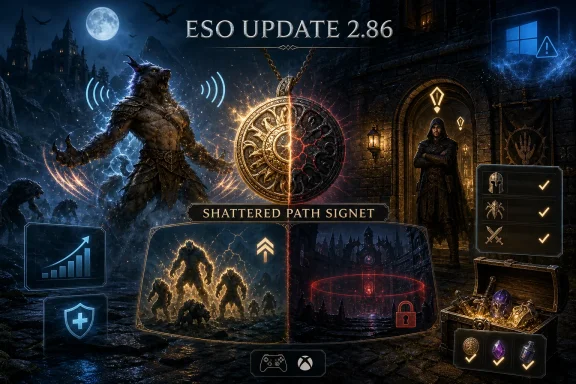 The Mythic Nerf Is the Patch’s Loudest Signal
The most visible change in update 2.86 is the rebalance of Shattered Path Signet, the Mythic item that had quickly become the symbol of Update 50’s power spike. Its status-effect damage bonus now applies only to monsters, its maximum bonus has been reduced from 170 percent to 133 percent, and its Ultimate threshold has been brought down to match that new ceiling. The cooldown at maximum Ultimate has also been shortened from four seconds to two seconds, which complicates the easy complaint that the item was simply gutted.This is a classic live-service compromise. ZeniMax did not remove the Signet’s PvE identity; it narrowed the item’s battlefield. By making the damage bonus monster-only, the studio effectively pulled the emergency brake in PvP while still allowing damage-focused PvE players to experiment with the revised cadence.
That distinction matters because ESO’s itemization is built around discovery, abuse, correction, and rediscovery. Mythics are supposed to be weird. They are also supposed to be bounded, and Shattered Path Signet appears to have crossed the line from interesting optimization into a pressure point that distorted combat expectations.
The Ultimate scaling change is especially telling. Lowering both the maximum bonus and the Ultimate required to reach it makes the item less explosive at the top end but potentially smoother in practical play. That is not a random number tweak; it is a design attempt to reduce the ceiling without making the item feel dead between burst windows.
For PvP players, though, the monster-only limitation is the part that will define the patch. In one stroke, ZeniMax has said that some interactions are acceptable against scripted enemies but not against human opponents. That is sensible balancing, but it also makes ESO’s long-running PvE/PvP split more visible than ever.
Update 50’s Werewolf Fantasy Meets Live-Server Reality
Update 50’s Werewolf overhaul was one of the game’s flashiest recent promises: a long-neglected playstyle pulled back into relevance with new mechanics, better presentation, and renewed build interest. Update 2.86 is what happens after the honeymoon. The fantasy survived, but the implementation needed cleanup.The patch fixes several Werewolf-specific issues that range from mechanical edge cases to animation and audio polish. Slot passives should no longer remain active in Werewolf form after a respec when the relevant ability sits on an inactive bar. Missing audio for Claw Fury damage impacts has been restored, NPC death animations should behave properly when enemies are killed by Slaughter, and tattoo effects should now fade more cleanly around Rampage availability.
That list sounds modest until you remember how much of Werewolf’s appeal depends on responsiveness. A transformation build lives or dies on feedback: the sound of impact, the clarity of a proc, the visible cue that a window has opened or closed. When those pieces misfire, players do not merely notice a bug; they lose trust in the form’s rhythm.
The passive issue is the more serious fix because it touches build integrity. If inactive-bar passives persisted after a respec, players could end up with benefits they were not meant to have, creating unreliable comparisons between builds and possibly skewing balance perception. In a patch already dominated by Shattered Path Signet, that kind of hidden advantage is exactly the sort of thing that makes community theorycrafting noisy.
ESO’s combat system is old enough and layered enough that small state bugs can become folklore. Players test, retest, parse, and argue, often without knowing whether they are evaluating design intent or a leftover flag. Update 2.86 is valuable because it removes a few of those ghosts from the machine.
Vengeance Needed Rules Before It Became a Loophole
The Vengeance changes are less glamorous than the Mythic nerf, but they reveal the same pattern: Update 50 introduced ambitious systems, and update 2.86 is cleaning up the permissions around them. Players in Vengeance can no longer equip the Vengeance Yew Shield or the Ebon Axe, Mace, and Sword, and players entering Vengeance should no longer receive those items. That is not flavor text; it is a boundary being redrawn.Vengeance is meant to be a controlled PvP environment, and controlled environments collapse when their equipment rules leak. If players can equip or receive gear that does not belong in that mode, balance discussions become impossible. Every match becomes suspect, and every loss invites the question of whether the opponent was playing the intended game.
The Battle Medic fixes point in the same direction. Battle Shield and Splinters of Chaos were affecting more targets than intended, which is exactly the kind of bug that changes group combat in ways that are hard to spot from the outside. In small-scale encounters, one extra protected or affected target can turn a fight. In organized play, it can become a repeatable exploit path.
These fixes are not just about fairness; they are about legibility. PvP players will tolerate punishing systems if they understand the rules. They are much less forgiving when the system itself appears to be handing out exceptions.
That is why this patch feels more consequential than its size suggests. ZeniMax is not merely trimming numbers; it is making sure new PvP infrastructure does not immediately become another case study in unintended interactions. In a game with ESO’s long combat history, that work is never optional.
The Quest Fixes Matter Because Trust Is Built in Old Content
The restored quests and NPCs are easy to skim past, but they may be the most important part of the update for everyday players. Quen once again offers the original Thieves Guild questline in all Outlaws Refuges, Fa’ren-dar has returned to the Hew’s Bane guild hideout, and several blocked or missing quest steps have been repaired. The Cursed Treasure quest, The Green Aegis, White Mask of Merien, and Gone Missing all receive specific fixes.That is the unglamorous maintenance burden of an MMO with a decade of accumulated content. When a major systems update lands, the blast radius is not limited to new features. It can reach old questgivers, legacy hubs, interactable cabinets, and zone entrances that many veteran players assume are permanent pieces of the world.
For new or returning players, these bugs are not minor. If Quen is missing from the expected place, the player does not experience a “known issue.” They experience a broken game. If an oasis cannot be accessed or a cabinet cannot be opened, the fiction stops and the troubleshooting begins.
ESO has always benefited from being unusually solo-friendly for an MMO. Its questing layer is not a side dish; it is one of the reasons people keep the client installed between dungeons, trials, battlegrounds, and events. That makes quest regressions more damaging than they might appear on a balance-focused patch note page.
The fix list also underscores why live-service games age unevenly. The newest systems get the marketing push, but the older content gets the support burden. Update 2.86 is a reminder that the health of Tamriel depends as much on functioning decade-old quest chains as it does on a freshly reworked combat form.
Rewards Had to Be Correct Before the Grind Could Feel Fair
Path to Adventure also receives a meaningful correction: it now grants the correct number of Seals and awards all eligible rewards. That is not a cosmetic adjustment. Reward errors are among the fastest ways to sour a player base because they strike at the implied contract behind repeatable play.Players will forgive a balance adjustment if they understand the reason. They will grumble about a crash fix and move on. But when a system says “do these tasks and receive these rewards,” it has to deliver with absolute reliability. Anything else turns routine progression into a support-ticket generator.
The same logic applies to Challenges. The Weekly Challenge for defeating Bogdan the Nightflame or Lord Warden Dusk should now complete consistently, and the “Complete Incursions” Weekly Challenge has been clarified so players know World Events count. These are small wording and tracking fixes, but they address a larger problem: players should not have to reverse-engineer whether the game recognizes their time.
In modern ESO, reward paths are layered on top of reward paths. There are dailies, weeklies, events, Seals, Golden Pursuits, collections, campaigns, and seasonal incentives. When one layer miscounts, the whole stack feels more fragile.
That fragility is not unique to ESO, but ESO is especially exposed because its player base spans casual questers, housing collectors, PvPers, achievement hunters, and endgame parse chasers. A reward bug in one corner may not affect everyone, but it affects someone’s main reason to log in.
The Windows 10 Crash Fix Is Small Only If It Wasn’t Your PC
The patch also addresses a launch crash affecting some PCs running older versions of Windows 10. That line is short, but for affected players it is the difference between a balance debate and no game at all. Stability fixes rarely dominate community conversation unless they fail.The wording matters because “older versions of Windows 10” sits in an awkward place in 2026. Windows 10 is no longer the forward-looking Windows platform, yet it remains common enough that MMOs cannot casually abandon it without cutting off paying players. ESO’s audience includes users on older hardware, living-room PCs, handheld-adjacent setups, and machines that have been upgraded piecemeal for years.
For WindowsForum.com readers, this is the practical note hiding inside a fantasy MMO patch. Game updates are software deployments, and software deployments expose dependencies. A game client that worked yesterday can fail today because a runtime, driver path, OS build, overlay, or launcher behavior changed beneath it.
The fix also illustrates why “PC” is never one platform in the same way a console is. A PS4 patch lands against a known hardware target. An Xbox One patch does the same. A PC patch lands against an ecosystem of drivers, security tools, background services, store clients, and aging Windows builds.
That does not excuse breakage, but it explains why a single line in a patch note can represent days of triage. For players still on Windows 10, update 2.86 is a reminder to keep backups, drivers, and OS servicing in mind even when the problem appears to be “just ESO.”
The UI Fixes Reveal How Many Storefronts ESO Has to Serve
The user-interface fixes in update 2.86 read like housekeeping, but they expose the complexity of maintaining a game across input modes and storefront layers. A Steam issue that left a “Transaction Cancelled” message on screen after a successful purchase has been fixed. A UI error tied to newly added Challenges has been addressed. Gamepad UI now displays reward preview variations correctly in full-screen preview, and the Path to Adventure announcement panel now opens the Golden Pursuits menu as expected.None of those issues changes a damage parse, but each one affects confidence. A transaction message that falsely implies failure is not just annoying; it risks making players question whether their purchase completed correctly. In a game with a cash shop, subscriptions, DLC, and platform-specific storefront plumbing, that uncertainty is toxic.
The Gamepad UI fixes are equally important because ESO’s console heritage is not a secondary concern. This is a game that must feel coherent on controller, mouse, Steam, PlayStation, Xbox, and various living-room setups. When one interface path points to the wrong menu or previews the wrong variation, the experience feels less like a unified product and more like several clients stitched together.
That is one of the hidden costs of long-term MMO success. Every new event panel, pursuit system, challenge category, reward preview, and store transaction state becomes another place where the UI can desynchronize from the underlying game. Players see a button. Developers see a matrix.
The patch’s UI fixes are therefore not trivial polish. They are maintenance on the trust layer between the player and the game’s increasingly elaborate economy of objectives. If the interface cannot explain what the game is doing, the player eventually stops believing the game knows either.
Achievements and Collectibles Are Not Side Content Anymore
Update 2.86 also fixes the “Give No Quarter” achievement so progress is tracked correctly, updates collectible descriptions for the Chosen of Anu and Chosen of Padomay armor visuals, and corrects the Chevalier’s Honor Body Tattoo icon. The Valenwood Skull Blocks furnishing now plays its interaction audio properly. These are the kinds of changes that some players dismiss until their own collection breaks.ESO’s account-wide culture has made cosmetics, housing, achievements, and collectibles central to the game’s identity. For many players, a new armor visual or furnishing interaction is not a throwaway reward; it is the point of the session. The game has spent years teaching players that completion matters, so completion systems have to be precise.
Achievement tracking failures are especially frustrating because they often become visible only after the player has already done the work. A combat bug can be tested in a few minutes. A progression bug may cost an evening. Once players suspect a tracker is unreliable, they delay content, wait for confirmation, or avoid the activity entirely.
The collectible description changes are another small but healthy correction. If a five-piece outfit visual effect exists, the game should explain it clearly. Players should not have to rely on Discord screenshots and community spreadsheets to understand what their own collection menu is trying to say.
Housing audio is a tiny detail, but tiny details are the point of housing. A furnishing that looks right but sounds wrong is still unfinished. In a game where players build museums, taverns, libraries, shrines, and elaborate guild halls, interaction feedback is part of the object’s value.
This Is What a Post-Expansion Triage Patch Looks Like
The broader pattern is unmistakable: Update 50 changed a lot, and update 2.86 is the first visible round of triage. It reins in a Mythic, repairs a revamped skill line, tightens a PvP mode, restores broken quest flow, corrects rewards, and patches interface and stability problems. That is not an accidental collection of fixes; it is the footprint of a large release settling into reality.The danger for ZeniMax is perception. If a major update launches with ambitious systems and then immediately needs balance reductions, reward corrections, and quest restorations, some players will read that as insufficient testing. Others will see it as normal MMO iteration. Both reactions can be true.
Live games are not shipped once. They are negotiated week by week between developer intent and player behavior. Players find edge cases faster than internal QA because players arrive in greater numbers, with stranger builds, more extreme incentives, and fewer assumptions about how the game is “supposed” to be played.
The question is not whether update 2.86 proves Update 50 was flawed. Every major MMO update is flawed in some way. The better question is whether the fixes are pointed at the right failures, and here the answer is mostly yes: the patch targets problems that directly affect fairness, access, progression, and client stability.
Still, the Shattered Path Signet change will sting because it touches the emotional center of buildcraft. Players like feeling clever, and a nerf can feel like punishment for finding the fun too quickly. ZeniMax’s challenge is to keep that cleverness alive without letting one item become mandatory, oppressive, or absurd.
Console Players Get the Patch, but PC Players Should Read It Too
Although update 2.86 is framed around PlayStation and Xbox availability, PC players have reasons to pay attention. The Windows 10 launch crash fix is explicitly PC-facing, and many of the underlying systems affected by the patch are shared across platforms. ESO may have platform-specific version numbers, but its design problems are cross-platform.Console players, meanwhile, should not treat this as a mere maintenance download. The Vengeance equipment restrictions, Werewolf fixes, Path to Adventure corrections, and quest restorations all affect how the game feels after Update 50. For anyone who bounced off a broken quest or confusing reward panel, this patch may remove the friction point.
The patch also shows how console certification and PC iteration continue to shape MMO communication. PC players often expect rapid hotfixes and forum clarification. Console players expect larger packaged updates that arrive through platform pipelines. ESO has to satisfy both rhythms while keeping the community aligned on what actually changed.
That is why patch note clarity matters. A console player seeing version 2.86 needs to understand whether this is a stability patch, a balance pass, a content fix, or all of the above. In this case, it is all of the above, and that breadth is precisely the story.
For sysadmins and technically minded readers, the lesson is familiar: broad updates create broad regression surfaces. The more systems touched by Update 50, the more places update 2.86 had to revisit. Games are entertainment, but their maintenance pattern looks a lot like enterprise software after a major release train lands.
The Patch Notes Say More Than the Marketing Did
The marketing story of Update 50 was renewal: Werewolves revitalized, PvP refreshed, challenges expanded, rewards added, old systems modernized. Update 2.86 tells the operational story: the new Mythic overshot, the Werewolf rework had edge cases, the Vengeance rules needed enforcement, and some legacy content buckled under the changes. Both stories are true, but only one arrives with glamour.That is why small patches deserve serious reading. They reveal where the game is actually under stress. A studio can announce features in polished language, but patch notes show where real players collided with those features at scale.
In ESO’s case, the collision points are predictable but important. Combat balance remains volatile when new items and reworked forms interact. PvP requires stricter rule separation than PvE. Reward systems have to be exact. Old quests are never as isolated from new systems as developers would like.
The good news is that update 2.86 appears focused rather than scattershot. It does not try to relitigate Update 50 wholesale. It addresses the places where broken behavior, bad incentives, or blocked progression were most likely to damage the live game.
The less comfortable news is that ESO’s growing system density makes these patches more necessary, not less. Every new layer increases the chance that a future update will produce similar cleanup lists. That is the price of keeping a long-running MMO alive instead of freezing it in amber.
The Moonlit Patch Leaves a Clear Trail
Update 2.86 is not the kind of patch that will bring lapsed players back by itself, but it is the kind of patch that determines whether returning players stay after a major update. Its most concrete lessons are less about one item or one quest and more about how ESO now has to manage ambition under live pressure.- Shattered Path Signet remains relevant in PvE, but its monster-only bonus sharply reduces its role as a PvP damage amplifier.
- Werewolf players should see cleaner ability behavior, better audiovisual feedback, and fewer lingering passive-state oddities after respecs.
- Vengeance now has tighter equipment restrictions, which should reduce unintended loadouts and improve confidence in the mode’s rules.
- Path to Adventure and Weekly Challenge fixes matter because reward systems lose credibility quickly when tracking or payout is wrong.
- Restored Thieves Guild and quest interactions are a reminder that old content can still be destabilized by modern updates.
- Windows 10 users affected by launch crashes should treat this patch as more than routine maintenance.