

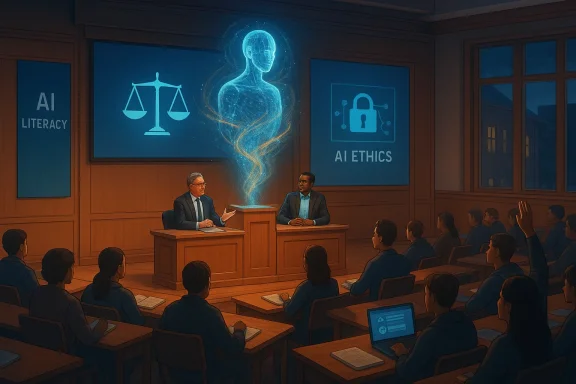
Oglethorpe University’s upcoming On Mutual Ground conversation, “Ethics and the Future of AI,” is a timely microcosm of a national reckoning: students and campus leaders are trying to translate the abstract ethics debates about generative AI into classroom practice, institutional policy, and career readiness. The Feb. 26, 2026 event will bring together Dr. Edward L. Queen of Emory University and Avoilan Bingham of Drive Capital and Atlanta Tech Week to speak directly with students about the practical and moral questions now shaping higher education.
But the path is narrow and full of trade-offs. Robust teacher training, transparent vendor contracts, equitable access, and assessment redesign are not optional extras; they are prerequisites for any responsible campus strategy. The conversation must continue beyond single events: the future of AI in education will be decided in classrooms, faculty meetings, contracts, and student clubs—not just on stages. Oglethorpe’s forum is a welcome step in that ongoing, messy, and essential civic work.
Source: Evrim Ağacı Oglethorpe Event Sparks Debate On AI Ethics In Education
 Background
Why a campus conversation matters now
Generative AI and large language models have moved from niche developer tools to mass-adopted utilities in three short years. Higher education campuses are both laboratories and battlegrounds for this shift: students use AI for drafting and coding, faculty face new academic-integrity challenges, and administrators must decide whether to ban, guide, or integrate these tools. The Oglethorpe event is one node in a broader story of institutions attempting to teach AI literacy while preserving foundational human skills such as critical thinking and ethical reasoning.The speakers and the forum
The On Mutual Ground event will feature two distinct but complementary voices. Dr. Edward L. Queen directs the D. Abbott Turner Program in Ethics and Servant Leadership at Emory and advises on AI ethics for organizations, bringing a governance- and values-first lens to the discussion. Avoilan Bingham, Atlanta Seed General Manager at Drive Capital and president of Atlanta Tech Week, represents the regional tech ecosystem and community-building around AI practice, including organizing the AI Tinkerers Atlanta chapter. Their presence underscores the hybrid nature of the debate: ethics and pedagogy must meet the realities of industry adoption and technical literacy.What campuses are doing: three dominant approaches
Across the country, colleges and schools are experimenting with different responses to generative AI. Broadly, strategies fall into three categories: permissive integration with guided literacy; restricted or course-level bans; and institution-wide governance experiments that mix training, tool access, and enforcement.1) Literacy-first, guided integration
Some institutions are choosing to teach responsible use rather than prohibit tools outright. These programs emphasize AI literacy—how to ask critical questions of models, how to document AI-assisted work, and how to preserve learning goals while using new tools. This approach often pairs access to enterprise tools with curricular changes and teacher professional development. Evidence from districts and higher-education pilots suggests constructive, supervised access tends to produce better outcomes than bans alone.2) Course-level bans where reasoning is the core goal
Other instructors and departments have adopted targeted bans in courses where the learning objective is explicit reasoning or formal skill-building—proofs, theoretical problem solving, or raw design thinking. These “no-AI” zones are defensive pedagogies: the goal is not to deny the tool’s existence but to protect the cognitive practices essential to certain fields. Reports from multiple computer science and mathematics programs indicate that students who delegate core cognitive tasks to AI can suffer measurable learning deficits when assessed later.3) Governance and policy labs
Large systems—districts, state agencies, and some universities—are setting up AI policy labs and pilot programs to develop context-sensitive guidance. These efforts aim to balance innovation with protections for equity and privacy, acknowledging that full-scale rollouts carry data governance and bias risks if left unchecked. Frameworks emerging from policy groups emphasize teacher training, principled model design for pedagogy, and auditing mechanisms.Case studies on the ground
Oglethorpe University: a student-centered dialogue
Oglethorpe’s On Mutual Ground series is explicitly designed to foster open, inclusive campus conversations. The Feb. 26 session will center student-facing concerns: how should students use AI ethically, how should academic standards adapt, and how do universities prepare graduates who will use AI in the workplace? The event frames ethics not as abstract admonishment but as a practical skill set students must learn to deploy responsibly.Michigan State University: club culture and practical pedagogy
At Michigan State University, the AI Club has become a locus for both enthusiasm and ethical reflection. Recent reporting shows MSU providing students with access to Microsoft Copilot while student groups run workshops—like “vibe-coding”—that demonstrate the speed and power of generative AI in creative coding tasks. Club activities deliberately pair hands-on practice with discussions about the pitfalls of overreliance, emphasizing that models are tools and not replacements for technical fundamentals. These grassroots efforts have real educational value: they build community, expose students to tooling, and surface ethical trade-offs in real projects.What educators and students are saying
- Faculty: Many instructors report a sharp decline in office-hour attendance as students gravitate toward instant AI answers. Instructors warn that the convenience of polished AI outputs can mask shallow learning and poor retention unless assignments are redesigned to reward process and verification.
- Students: For many undergraduates, AI is a productivity booster and a skill employers ask about. But students involved in clubs and workshops also describe a tension: vibe-coding and similar practices accelerate prototyping but can lead to brittle, opaque code if foundational knowledge is insufficient.
- Alumni and employers: Employers increasingly expect candidates to describe how they use AI tools responsibly, making ethical tool use a marketable skill in hiring conversations. This shifts the pedagogical calculus: refusing AI entirely can become a career disadvantage in some fields.
The pedagogical problem: preserving learning while adopting tools
The cognitive trade-offs
Research and campus pilots suggest several consistent cognitive risks when AI becomes a shortcut rather than a scaffold:- Reduced retrieval practice and effortful processing, which are crucial for long-term retention.
- Normalization of authoritative-sounding but incorrect outputs, especially when models generate fluent text without transparent sourcing.
- Behavioral lock-in where students prefer quick AI answers over slower, more diagnostic human guidance—undermining metacognitive development.
Practical classroom strategies that work
Successful approaches emerge where faculty reframe assignments and assessments to make reasoning visible and to require students to critique AI outputs. Examples include:- Require documentation of AI prompts and a written critique of the model’s answers.
- Use staged submissions that show incremental development rather than a final artifact only.
- Create hybrid assignments where students must generate a plan, attempt a solution unaided, then use AI to refine and reflect.
- Train TAs and instructors in AI pedagogy—how to integrate retrieval practice and formative feedback around AI-assisted tasks.
Equity, access, and governance: the larger policy stakes
Who benefits and who is left behind
If AI adoption is uneven—high-quality, human-centered instruction for the privileged and AI-heavy, minimally staffed instruction for under-resourced populations—educational inequality could widen. National and international pilot programs show the temptation to scale quickly without solving connectivity, localization, and data governance challenges. Several recent initiatives—from municipal AI policy labs to multinational partnerships—underscore the scale of the policy problem: vendor contracts, data access, and auditability matter as much as the models themselves.Data privacy and vendor risk
Large-scale deployments raise thorny contract questions: how will student data be stored, shared, or re-used? Are models auditable for bias and safety? Some reported national pilots still lack clear implementation details on offline capacity, device distribution, and data protections—areas where advocates urge caution and stronger contractual guardrails.The ethics curriculum: what should a responsible syllabus include?
If universities are serious about producing ethically literate graduates, coursework and co-curricular programs should combine three pillars:- Technical comprehension: understanding what models can and cannot do, and what data they are trained on.
- Practical fluency: being able to use AI tools safely and productively—prompt design, verification, and integration into workflows.
- Ethical reasoning: structured deliberation on fairness, accountability, privacy, and long-term societal consequences.
- Model mechanics and failure modes
- Case studies in biased outcomes and audit techniques
- Assignments that require students to surface assumptions and trade-offs
- Guest sessions with ethicists, practitioners, and regulators (the format Oglethorpe is using) to bridge academic and industry perspectives.
Industry engagement: opportunities and tensions
Why invite venture and community leaders to campus?
Industry practitioners—like Avoilan Bingham—bring concrete tool knowledge, hiring expectations, and real-world trade-offs that enrich academic debates. Community groups such as AI Tinkerers offer pragmatic, hands-on exposure to the state of the art and create talent pipelines into regional tech ecosystems. Their involvement can help students understand how to shape digital transformation responsibly, not just adapt to it.Why industry engagement requires guardrails
Yet this engagement must be structured. Industry partnerships that provide access to tools or data should come with academic independence guarantees, transparent terms about data use, and faculty control over curricular outcomes. Without those protections, campus adoption cr-driven solutions that prioritize scalability or metrics over learning quality.Risks that deserve spotlight attention
- Overreliance and skill erosion: A generation that uses AI as a crutch risks lills unless curricula adapt intentionally.
- Unequal access and the two-tiered system: Rapid rollouts without equity planning risk widening achievement gaps.
- Privacy and commercial reuse of studeat don’t explicitly forbid repurposing of student submissions can expose learners and institutions to misuse.
- The “authenticity” problem: Assessment design needs overhaul—traditional exams and essays reward polished outputs, not processes. Enforcement or detection-only approaches are brittle and easy to circumvent.
What success looks like: a pragmatic checklist for campuses
- AI literacy requirements baked into orientation and core curricula.
- Clear, public AI-use policies that distinguish between course goals, permitted tools, and required disclosures.
- Faculty development programs focused on AI pedagogy and assessment redesign.
- Equity audits to ensure under-resourced students get the same access to high-quality instructional support.
- Contract templates that protect student data and require auditability and transparency from vendors.
- Student-facing events and co-curricular options (clubs, hackathons, speaker series) that expose learners to both the power and limits of AI.
How Oglethorpe’s event fits into the broader playbook
Oglethorpe’s On Mutual Ground session is not a silver bullet, but it exemplifies a healthy move: bringing ethics, industry, and student voices into a single forum. When ethics-talk is paired with practical workshops—like MSU’s vibe-coding series—and governance experiments at the institutional level, campuses can create ecosystems where AI is a pedagogical tool rather than a shortcut or a punitive bogeyman. The presence of both a university ethics director and a regional industry leader on the same stage models the cross-sector conversation required to align values, pedagogy, and marketplace realities.Recommendations for students, faculty, and administrators
- Students: Treat AI as a professional skill—document your use, interrogate outputs, and learn the fundamentals behind tools you rely on.
- Faculty: Redesign assessments to reward process and verification; embed AI literacy in rubrics and assignment scaffolds.
- Administrators: Invest in teacher training and clear governance that protects student data, ensures equity, and maintains academic standards.
Conclusion
The Oglethorpe event on Feb. 26 is a snapshot of a much larger institutional pivot: higher education is moving from reactive gatekeeping to proactive pedagogy around AI. That shift is overdue and necessary. If universities can build AI literacy into the core of learning—combining technical comprehension, hands-on practice, and ethical reasoning—students will be better equipped to use, critique, and shape the tools that increasingly govern work and civic life.But the path is narrow and full of trade-offs. Robust teacher training, transparent vendor contracts, equitable access, and assessment redesign are not optional extras; they are prerequisites for any responsible campus strategy. The conversation must continue beyond single events: the future of AI in education will be decided in classrooms, faculty meetings, contracts, and student clubs—not just on stages. Oglethorpe’s forum is a welcome step in that ongoing, messy, and essential civic work.
Source: Evrim Ağacı Oglethorpe Event Sparks Debate On AI Ethics In Education
