

The European Commission on June 3, 2026 proposed a technology-sovereignty package that would force sensitive EU public-sector cloud and AI contracts through new jurisdictional risk tests, putting Amazon Web Services, Microsoft Azure, and Google Cloud outside the highest assurance tiers. The move is not a conventional antitrust strike against Big Tech. It is a legal and industrial bet that Europe can no longer treat server location as the same thing as control. For Windows administrators and enterprise buyers, the message is blunt: the cloud procurement question is shifting from “where is the data?” to “who can be compelled to touch it?”
For years, the compromise between American hyperscale cloud and European data protection has been built around geography. Put the data in an EU region, wrap it in contractual safeguards, certify the environment, and call the result compliant enough for most workloads. The Commission’s Cloud and AI Development Act attacks that compromise at its weakest point: a European data center owned by a US company is still operated by a company subject to US law.
That is why the 2018 US CLOUD Act looms so large over the new proposal. The law allows US authorities, with legal process, to require US-incorporated providers to produce data they control, even when that data is stored abroad. European policymakers have been circling that problem since the Schrems II ruling, but CADA gives the concern a procurement shape: some workloads are now deemed too sensitive for contractual promises alone.
The Commission’s framing is deliberately broader than privacy. It is about continuity of government, resilience of hospitals, stability of energy grids, and the operational control of services that cannot be interrupted without political consequences. Henna Virkkunen, the Commission executive vice-president overseeing the portfolio, described the goal as ensuring Europe can control critical services and data inside Europe.
That language matters because it treats cloud dependency as infrastructure dependency. The hyperscaler is no longer just a vendor; it is a potential point of geopolitical leverage. Europe’s new package is built around the idea that a dependency can be lawful, efficient, and technically secure while still being strategically unacceptable.
Microsoft has already been dragged into this debate in unusually concrete terms. In French proceedings, the company’s representatives reportedly acknowledged that it could not absolutely rule out disclosure of European-stored data if compelled under US legal orders. That is the sort of lawyerly answer any global cloud provider would give, but it is also precisely the answer European sovereignty advocates were waiting for.
The International Criminal Court episode sharpened the political mood. After the Trump administration sanctioned the court’s chief prosecutor, Microsoft reportedly disabled his email account, a small operational act with outsized symbolic value. To Brussels, it looked like a demonstration that dependence on foreign platforms can become a service-denial risk at political speed.
For American providers, the obvious rebuttal is that this is an overcorrection. The US cloud giants have spent years building compliance programs, local regions, sovereign-cloud variants, encryption controls, customer-managed keys, and European partnerships. But the Commission’s proposal asks a harsher question: can any of that defeat the legal obligations of the corporate parent?
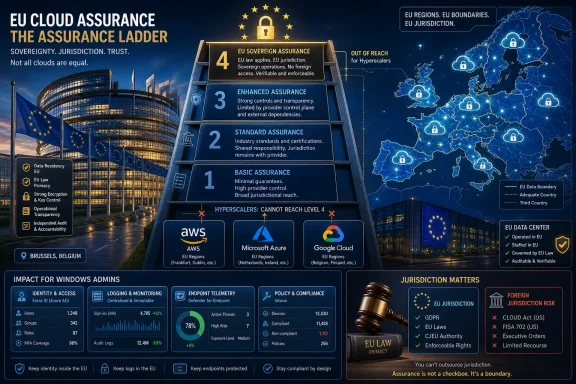
The answer, at least for the most sensitive tiers, appears to be no. That is why the package is less a technical certification exercise than a jurisdictional screen. It creates a formal ladder on which the US hyperscalers can occupy the lower rungs but struggle, by design, to reach the top.
Level 1 is essentially the old data-residency bargain: data must be processed and stored on infrastructure physically located in the EU. That is a requirement the American hyperscalers can already meet, thanks to their extensive European data center footprints. For many public-sector workloads, this may remain enough.
Level 2 adds independence from third-country governments and transparency over the software supply chain. This is where the ambiguity starts. A provider can be technically mature, transparent, and deeply invested in European operations while still being legally exposed to a foreign court order. The Commission will have to define how much legal exposure is too much.
Level 3 moves from location to ownership and control. Providers must be owned and controlled from within the EU, with additional requirements that reportedly include criteria around personnel and governance. The Commission may reserve some discretion to recognize selected third-country providers, but the direction of travel is plain: sensitive government work should not depend on foreign-controlled cloud infrastructure.
Level 4 is the hardest version of the sovereignty claim. It demands full transparency and control over the entire software supply chain, with no interference from any third country. That requirement is aimed not only at American legal reach, but at the broader reality of modern cloud: hardware, firmware, orchestration layers, identity systems, support processes, and software dependencies are all potential channels of control.
For WindowsForum readers, the practical consequence is that “Azure in Europe” and “European-controlled cloud” are no longer interchangeable phrases. A Microsoft tenant in an EU region may satisfy plenty of compliance and performance needs. It may not satisfy a future procurement officer handling justice, defense, health, or critical infrastructure workloads under the highest CADA tiers.
Qwant is not going to topple Google because parliamentary staff now see it first in Microsoft Edge and Mozilla Firefox. But the symbolism is unusually clean: an EU institution has moved a routine digital dependency from a US provider to a European alternative, and it has done so in the name of privacy and sovereignty. That is exactly the sort of action officials have long urged private and public buyers to consider, but rarely implemented themselves.
The move also demonstrates the difference between substitution and parity. Replacing a default search engine is comparatively easy. Replacing a hyperscale cloud platform underneath identity, analytics, storage, application hosting, AI services, security monitoring, developer tooling, and disaster recovery is another matter entirely.
Still, defaults shape habits. The Parliament’s Qwant decision is a reminder that digital sovereignty will not only arrive through giant procurement frameworks and industrial subsidies. It will also arrive through boring settings, approved-vendor lists, browser policies, endpoint configurations, and the small administrative choices that IT departments make at scale.
For Microsoft customers, the irony is hard to miss. Parliament’s Qwant rollout applies to browsers that include Microsoft Edge, even as Microsoft Azure sits at the center of the cloud-sovereignty fight. Europe is not rejecting American technology wholesale. It is trying to decide which dependencies are tolerable, which are strategically risky, and which can be replaced without breaking the machine.
European providers such as OVHcloud, Scaleway, StackIT, Post Telecom, and Proximus can carry important workloads. Some are strong in infrastructure-as-a-service, data hosting, or regionally focused public-sector contracts. But hyperscale cloud is not just rented compute. It is a sprawling catalog of managed databases, security services, AI accelerators, identity integrations, data platforms, observability tools, and automation layers that customers have built into their architecture over a decade.
That explains the controversy around the Commission’s own April 2026 sovereign-cloud contract. The €180 million award went to European provider groups, but one winning consortium involved Proximus working with S3NS, a venture controlled by Thales while using Google Cloud technology underneath. Critics called this sovereignty washing, arguing that it gave a European wrapper to a non-European technology stack.
The Commission’s defense is that governance matters. If non-European technology is operated under strict European control, it may meet certain sovereignty thresholds. That position is pragmatic, but it also exposes the problem CADA is trying to solve: Europe wants independence, yet still needs the capabilities of the platforms from which it seeks independence.
This is the uncomfortable middle period. Europe can write procurement rules faster than it can build a cloud ecosystem. The danger is that the rules become either too loose to change anything or too strict to be operationally usable.
What changes is the ceiling. For the most sensitive government workloads, especially those touching critical infrastructure and high-risk public data, the Commission is trying to make foreign legal control a procurement defect. That is a profound shift because it tells buyers that technical excellence is not enough.
The US providers will argue that such rules fragment the market and punish companies for the nationality of their incorporation. Industry groups representing American technology firms have already warned that the upper-tier requirements amount to closed-market thresholds dressed as risk management. That complaint will resonate in Washington, particularly amid an already tense trade environment.
But Europe’s answer is that sovereignty rules are not protectionism when applied to essential state functions. Governments have always treated defense, intelligence, and critical infrastructure differently from normal commercial procurement. CADA extends that logic into cloud and AI, where the infrastructure is privately operated but the consequences of failure are public.
The result is not a clean decoupling. It is a tiered dependency model. American cloud remains acceptable for many things, questionable for some things, and structurally disfavored for the most sensitive things.
The first Chips Act mobilized more than €52 billion in public and private investment, but Europe remains far from its ambition of producing 20 percent of the world’s semiconductors by 2030. Global capacity expanded, Asian and American subsidy programs accelerated, and the EU’s share remained stubbornly low. Brussels now appears to be shifting from “build fabs and hope demand follows” to “create demand and force the supply chain to respond.”
That means faster permitting for fabrication plants, extended state aid for first-of-a-kind facilities, and pressure on key sectors such as automotive to diversify away from heavily subsidized Chinese suppliers. The automotive angle is especially important because Europe’s car industry is both economically central and highly exposed to chip shortages. The pandemic-era semiconductor crunch made that vulnerability painfully visible.
The most aggressive piece is emergency power. During a declared supply crisis, the Commission could compel chipmakers to prioritize EU crisis-critical orders over existing commercial commitments. That is a remarkable intervention in private contracting, and it shows how far the sovereignty debate has moved from competition policy into industrial command.
Industry skepticism is warranted. Europe cannot become a semiconductor leader by decree, and emergency powers do not create advanced lithography capacity overnight. But the Commission is trying to ensure that the next supply crisis does not leave Brussels pleading from the back of the queue.
This is where Europe’s sovereignty agenda intersects with something Windows administrators already understand: vendor lock-in is not only a pricing problem. It is an operational constraint. If a public agency cannot inspect, modify, reuse, or migrate software without a proprietary vendor’s permission, then sovereignty is limited even when the servers are local.
Open-source advocates see this as a landmark moment because it treats shared code as public infrastructure. If taxpayers fund software for one ministry, the argument goes, another agency should not have to buy the same functionality again from scratch. That is not anti-commercial by itself; companies can still provide support, integration, security hardening, and managed services.
Proprietary vendors see the danger differently. A “Free Software First” posture can become a procurement bias that disadvantages closed-source products even when they are mature, secure, or cheaper to operate. That argument will gain traction wherever public-sector IT teams are already stretched thin and wary of replacing working systems with ideologically preferred alternatives.
The best version of the policy would use open source to increase bargaining power and interoperability, not to create a new checkbox bureaucracy. The worst version would confuse source-code availability with maintainability, security, or actual independence. Europe has enough abandoned public-sector software projects to know the difference.
That is not an accident. The American hyperscalers benefited from enormous domestic demand, capital markets willing to fund vast infrastructure bets, deep developer ecosystems, and early leadership in cloud-native tooling. European providers, by contrast, often grew in more fragmented national markets with smaller procurement pools and less appetite for moonshot infrastructure spending.
CADA tries to reverse the demand side of that equation. If public-sector buyers are required to classify sensitive workloads and steer some of them toward sovereign providers, European cloud firms get predictable demand. Predictable demand makes financing easier. Financing makes capacity expansion plausible.
But the timeline is brutal. The Commission estimates that around €120 billion in combined public and private investment may be needed by 2035 to make European cloud and AI infrastructure competitive. It also wants to triple data center capacity within five to seven years, a target that runs straight into grid constraints, permitting fights, water use, land availability, and local resistance to large data center projects.
The sovereignty agenda therefore depends on infrastructure that does not yet exist at sufficient scale. Europe can mandate risk assessments now. Building enough cloud, compute, power, cooling, network capacity, and skills to make those assessments painless will take years.
The sovereignty criteria are likely to be the fiercest battleground. Countries with large US cloud investments, major data-center footprints, or strong transatlantic trade interests will push for flexibility. More sovereignty-minded states will demand bright lines, especially for defense, justice, health, energy, and core administrative systems.
The Commission has already limited the blast radius by focusing the strictest cloud rules on sensitive public-sector workloads rather than the entire private economy. That is politically sensible. A broad attack on private-sector cloud choice would trigger commercial chaos and near-certain backlash from European businesses that depend on hyperscaler services.
Even within government, implementation will be messy. Public agencies rarely run neatly separated workloads. Identity systems touch many applications. Analytics platforms ingest mixed datasets. Backup, logging, monitoring, and incident-response tooling can contain sensitive metadata even when the main application does not.
That is where Windows and Microsoft 365 administrators should pay attention. The sovereignty debate will not stop at virtual machines and object storage. It will move into identity, endpoint telemetry, productivity suites, email, collaboration, audit logs, security operations, and AI assistants embedded into office workflows.
From the US perspective, the upper tiers of the sovereignty framework look like nationality-based exclusion. If AWS, Microsoft, and Google cannot qualify because of US incorporation and US legal obligations, Washington can argue that the policy is protectionist even if Brussels calls it risk-based. The fact that European cloud providers stand to benefit will strengthen that case.
From the EU perspective, the distinction is equally clear. A public authority procuring critical cloud infrastructure is entitled to consider whether a foreign government can compel the provider. If the answer is yes, the risk is not imaginary. It is built into the legal environment.
Both arguments can be true. CADA may be a rational response to real jurisdictional risk and a market intervention that disadvantages US companies. Modern industrial policy often lives in that overlap, and the next phase of transatlantic tech politics will be fought there.
The larger question is whether the US and EU can create a trusted framework for government access to data that lowers the temperature. Without one, cloud providers will be trapped between legal systems, customers will be trapped between compliance regimes, and procurement officers will increasingly choose nationality as a proxy for trust.
For public-sector buyers, the immediate task is inventory. Agencies will need to understand which workloads are genuinely sensitive, which providers control which layers, which support paths cross borders, which encryption models are meaningful, and which contracts assume that data residency equals sovereignty. Many will discover that the harder problem is not the main cloud region, but the surrounding ecosystem.
For vendors, the next year will be a scramble to shape definitions. US hyperscalers will push sovereign-cloud partnerships, local operating models, encryption boundaries, and legal challenge mechanisms. European providers will push procurement reservations, anti-lock-in rules, and stricter ownership tests. Systems integrators will sell migration roadmaps, hybrid architectures, and compliance assessments.
For enterprises outside government, CADA is still relevant. Regulation aimed at public procurement often becomes a de facto standard for risk committees, regulated industries, and large customers. Banks, healthcare providers, energy firms, and defense suppliers should assume that sovereignty questionnaires will become more common even where the law does not directly apply.
The biggest mistake would be to treat this as an EU-only story. Every major government is rethinking the strategic consequences of cloud concentration, AI infrastructure, chip supply, and foreign legal reach. Europe is simply turning that anxiety into a legislative package with unusually sharp procurement teeth.
 Brussels Turns Data Residency Into a Jurisdiction Fight
For years, the compromise between American hyperscale cloud and European data protection has been built around geography. Put the data in an EU region, wrap it in contractual safeguards, certify the environment, and call the result compliant enough for most workloads. The Commission’s Cloud and AI Development Act attacks that compromise at its weakest point: a European data center owned by a US company is still operated by a company subject to US law.That is why the 2018 US CLOUD Act looms so large over the new proposal. The law allows US authorities, with legal process, to require US-incorporated providers to produce data they control, even when that data is stored abroad. European policymakers have been circling that problem since the Schrems II ruling, but CADA gives the concern a procurement shape: some workloads are now deemed too sensitive for contractual promises alone.
The Commission’s framing is deliberately broader than privacy. It is about continuity of government, resilience of hospitals, stability of energy grids, and the operational control of services that cannot be interrupted without political consequences. Henna Virkkunen, the Commission executive vice-president overseeing the portfolio, described the goal as ensuring Europe can control critical services and data inside Europe.
That language matters because it treats cloud dependency as infrastructure dependency. The hyperscaler is no longer just a vendor; it is a potential point of geopolitical leverage. Europe’s new package is built around the idea that a dependency can be lawful, efficient, and technically secure while still being strategically unacceptable.
The CLOUD Act Becomes Europe’s Procurement Wall
The awkward part for AWS, Microsoft, and Google is that they do not have to do anything wrong to fail the Commission’s highest sovereignty tests. The disqualifying fact is structural: they are American companies. Their European regions, European support teams, encryption promises, and local partnerships do not erase the jurisdiction of the country in which the corporate parent sits.Microsoft has already been dragged into this debate in unusually concrete terms. In French proceedings, the company’s representatives reportedly acknowledged that it could not absolutely rule out disclosure of European-stored data if compelled under US legal orders. That is the sort of lawyerly answer any global cloud provider would give, but it is also precisely the answer European sovereignty advocates were waiting for.
The International Criminal Court episode sharpened the political mood. After the Trump administration sanctioned the court’s chief prosecutor, Microsoft reportedly disabled his email account, a small operational act with outsized symbolic value. To Brussels, it looked like a demonstration that dependence on foreign platforms can become a service-denial risk at political speed.
For American providers, the obvious rebuttal is that this is an overcorrection. The US cloud giants have spent years building compliance programs, local regions, sovereign-cloud variants, encryption controls, customer-managed keys, and European partnerships. But the Commission’s proposal asks a harsher question: can any of that defeat the legal obligations of the corporate parent?
The answer, at least for the most sensitive tiers, appears to be no. That is why the package is less a technical certification exercise than a jurisdictional screen. It creates a formal ladder on which the US hyperscalers can occupy the lower rungs but struggle, by design, to reach the top.
Four Assurance Levels Draw the New Map of Trust
CADA’s central mechanism is the EU Cloud Sovereignty Framework, a four-level model that public-sector bodies would use when buying cloud and AI services. The lower levels look familiar. The upper levels are where the politics live.Level 1 is essentially the old data-residency bargain: data must be processed and stored on infrastructure physically located in the EU. That is a requirement the American hyperscalers can already meet, thanks to their extensive European data center footprints. For many public-sector workloads, this may remain enough.
Level 2 adds independence from third-country governments and transparency over the software supply chain. This is where the ambiguity starts. A provider can be technically mature, transparent, and deeply invested in European operations while still being legally exposed to a foreign court order. The Commission will have to define how much legal exposure is too much.
Level 3 moves from location to ownership and control. Providers must be owned and controlled from within the EU, with additional requirements that reportedly include criteria around personnel and governance. The Commission may reserve some discretion to recognize selected third-country providers, but the direction of travel is plain: sensitive government work should not depend on foreign-controlled cloud infrastructure.
Level 4 is the hardest version of the sovereignty claim. It demands full transparency and control over the entire software supply chain, with no interference from any third country. That requirement is aimed not only at American legal reach, but at the broader reality of modern cloud: hardware, firmware, orchestration layers, identity systems, support processes, and software dependencies are all potential channels of control.
For WindowsForum readers, the practical consequence is that “Azure in Europe” and “European-controlled cloud” are no longer interchangeable phrases. A Microsoft tenant in an EU region may satisfy plenty of compliance and performance needs. It may not satisfy a future procurement officer handling justice, defense, health, or critical infrastructure workloads under the highest CADA tiers.
The Qwant Switch Shows the Politics of Defaults
One day after the Commission unveiled the package, the European Parliament replaced Google with Qwant as the default search engine on internal browsers. On paper, that is a small administrative change. In politics, defaults are declarations of intent.Qwant is not going to topple Google because parliamentary staff now see it first in Microsoft Edge and Mozilla Firefox. But the symbolism is unusually clean: an EU institution has moved a routine digital dependency from a US provider to a European alternative, and it has done so in the name of privacy and sovereignty. That is exactly the sort of action officials have long urged private and public buyers to consider, but rarely implemented themselves.
The move also demonstrates the difference between substitution and parity. Replacing a default search engine is comparatively easy. Replacing a hyperscale cloud platform underneath identity, analytics, storage, application hosting, AI services, security monitoring, developer tooling, and disaster recovery is another matter entirely.
Still, defaults shape habits. The Parliament’s Qwant decision is a reminder that digital sovereignty will not only arrive through giant procurement frameworks and industrial subsidies. It will also arrive through boring settings, approved-vendor lists, browser policies, endpoint configurations, and the small administrative choices that IT departments make at scale.
For Microsoft customers, the irony is hard to miss. Parliament’s Qwant rollout applies to browsers that include Microsoft Edge, even as Microsoft Azure sits at the center of the cloud-sovereignty fight. Europe is not rejecting American technology wholesale. It is trying to decide which dependencies are tolerable, which are strategically risky, and which can be replaced without breaking the machine.
Europe Has a Sovereign-Cloud Gap It Cannot Regulate Away
The central weakness in the Commission’s plan is not legal theory. It is capacity. Europe does not currently have cloud providers that match AWS, Azure, and Google Cloud across the full breadth of infrastructure, platform services, AI tooling, global availability, developer ecosystem, and enterprise support.European providers such as OVHcloud, Scaleway, StackIT, Post Telecom, and Proximus can carry important workloads. Some are strong in infrastructure-as-a-service, data hosting, or regionally focused public-sector contracts. But hyperscale cloud is not just rented compute. It is a sprawling catalog of managed databases, security services, AI accelerators, identity integrations, data platforms, observability tools, and automation layers that customers have built into their architecture over a decade.
That explains the controversy around the Commission’s own April 2026 sovereign-cloud contract. The €180 million award went to European provider groups, but one winning consortium involved Proximus working with S3NS, a venture controlled by Thales while using Google Cloud technology underneath. Critics called this sovereignty washing, arguing that it gave a European wrapper to a non-European technology stack.
The Commission’s defense is that governance matters. If non-European technology is operated under strict European control, it may meet certain sovereignty thresholds. That position is pragmatic, but it also exposes the problem CADA is trying to solve: Europe wants independence, yet still needs the capabilities of the platforms from which it seeks independence.
This is the uncomfortable middle period. Europe can write procurement rules faster than it can build a cloud ecosystem. The danger is that the rules become either too loose to change anything or too strict to be operationally usable.
The American Hyperscalers Are Not Being Banned, but They Are Being Boxed In
It would be easy, and wrong, to describe the package as a ban on AWS, Microsoft Azure, and Google Cloud in Europe. Private companies are not covered by the strictest provisions. Large portions of public-sector cloud work will remain open at lower assurance levels. The hyperscalers will still operate European regions, sell to European businesses, support public services, and offer sovereign-cloud variants.What changes is the ceiling. For the most sensitive government workloads, especially those touching critical infrastructure and high-risk public data, the Commission is trying to make foreign legal control a procurement defect. That is a profound shift because it tells buyers that technical excellence is not enough.
The US providers will argue that such rules fragment the market and punish companies for the nationality of their incorporation. Industry groups representing American technology firms have already warned that the upper-tier requirements amount to closed-market thresholds dressed as risk management. That complaint will resonate in Washington, particularly amid an already tense trade environment.
But Europe’s answer is that sovereignty rules are not protectionism when applied to essential state functions. Governments have always treated defense, intelligence, and critical infrastructure differently from normal commercial procurement. CADA extends that logic into cloud and AI, where the infrastructure is privately operated but the consequences of failure are public.
The result is not a clean decoupling. It is a tiered dependency model. American cloud remains acceptable for many things, questionable for some things, and structurally disfavored for the most sensitive things.
Chips Act 2.0 Makes the Same Argument in Silicon
The cloud proposal is only one part of the June 3 package. The Commission also introduced Chips Act 2.0, a successor to the 2023 effort to expand Europe’s semiconductor capacity. If CADA is about who controls the cloud layer, Chips Act 2.0 is about whether Europe can secure the physical hardware beneath it.The first Chips Act mobilized more than €52 billion in public and private investment, but Europe remains far from its ambition of producing 20 percent of the world’s semiconductors by 2030. Global capacity expanded, Asian and American subsidy programs accelerated, and the EU’s share remained stubbornly low. Brussels now appears to be shifting from “build fabs and hope demand follows” to “create demand and force the supply chain to respond.”
That means faster permitting for fabrication plants, extended state aid for first-of-a-kind facilities, and pressure on key sectors such as automotive to diversify away from heavily subsidized Chinese suppliers. The automotive angle is especially important because Europe’s car industry is both economically central and highly exposed to chip shortages. The pandemic-era semiconductor crunch made that vulnerability painfully visible.
The most aggressive piece is emergency power. During a declared supply crisis, the Commission could compel chipmakers to prioritize EU crisis-critical orders over existing commercial commitments. That is a remarkable intervention in private contracting, and it shows how far the sovereignty debate has moved from competition policy into industrial command.
Industry skepticism is warranted. Europe cannot become a semiconductor leader by decree, and emergency powers do not create advanced lithography capacity overnight. But the Commission is trying to ensure that the next supply crisis does not leave Brussels pleading from the back of the queue.
Open Source Becomes Industrial Policy, Not Just Developer Culture
The package’s open-source component may be less flashy than cloud exclusion or chip emergency powers, but it may prove more durable. CADA includes a public-sector reuse principle that would push publicly funded software toward availability across EU bodies. The accompanying Open Source Strategy gives that idea a broader political home.This is where Europe’s sovereignty agenda intersects with something Windows administrators already understand: vendor lock-in is not only a pricing problem. It is an operational constraint. If a public agency cannot inspect, modify, reuse, or migrate software without a proprietary vendor’s permission, then sovereignty is limited even when the servers are local.
Open-source advocates see this as a landmark moment because it treats shared code as public infrastructure. If taxpayers fund software for one ministry, the argument goes, another agency should not have to buy the same functionality again from scratch. That is not anti-commercial by itself; companies can still provide support, integration, security hardening, and managed services.
Proprietary vendors see the danger differently. A “Free Software First” posture can become a procurement bias that disadvantages closed-source products even when they are mature, secure, or cheaper to operate. That argument will gain traction wherever public-sector IT teams are already stretched thin and wary of replacing working systems with ideologically preferred alternatives.
The best version of the policy would use open source to increase bargaining power and interoperability, not to create a new checkbox bureaucracy. The worst version would confuse source-code availability with maintainability, security, or actual independence. Europe has enough abandoned public-sector software projects to know the difference.
The Market Numbers Explain the Panic
The Commission’s urgency is easier to understand when set against the market structure. EU officials say the bloc depends on non-EU countries for more than 80 percent of key digital products, services, infrastructure, and intellectual property. In cloud, AWS, Azure, and Google Cloud collectively dominate the European market, while European providers occupy a much smaller share.That is not an accident. The American hyperscalers benefited from enormous domestic demand, capital markets willing to fund vast infrastructure bets, deep developer ecosystems, and early leadership in cloud-native tooling. European providers, by contrast, often grew in more fragmented national markets with smaller procurement pools and less appetite for moonshot infrastructure spending.
CADA tries to reverse the demand side of that equation. If public-sector buyers are required to classify sensitive workloads and steer some of them toward sovereign providers, European cloud firms get predictable demand. Predictable demand makes financing easier. Financing makes capacity expansion plausible.
But the timeline is brutal. The Commission estimates that around €120 billion in combined public and private investment may be needed by 2035 to make European cloud and AI infrastructure competitive. It also wants to triple data center capacity within five to seven years, a target that runs straight into grid constraints, permitting fights, water use, land availability, and local resistance to large data center projects.
The sovereignty agenda therefore depends on infrastructure that does not yet exist at sufficient scale. Europe can mandate risk assessments now. Building enough cloud, compute, power, cooling, network capacity, and skills to make those assessments painless will take years.
Member States Will Decide How Sharp the Knife Gets
CADA and Chips Act 2.0 are proposals, not law. They must pass through the European Parliament and the Council, where all 27 member states will fight over definitions, exemptions, timelines, and enforcement. The Commission has opened the campaign, not finished it.The sovereignty criteria are likely to be the fiercest battleground. Countries with large US cloud investments, major data-center footprints, or strong transatlantic trade interests will push for flexibility. More sovereignty-minded states will demand bright lines, especially for defense, justice, health, energy, and core administrative systems.
The Commission has already limited the blast radius by focusing the strictest cloud rules on sensitive public-sector workloads rather than the entire private economy. That is politically sensible. A broad attack on private-sector cloud choice would trigger commercial chaos and near-certain backlash from European businesses that depend on hyperscaler services.
Even within government, implementation will be messy. Public agencies rarely run neatly separated workloads. Identity systems touch many applications. Analytics platforms ingest mixed datasets. Backup, logging, monitoring, and incident-response tooling can contain sensitive metadata even when the main application does not.
That is where Windows and Microsoft 365 administrators should pay attention. The sovereignty debate will not stop at virtual machines and object storage. It will move into identity, endpoint telemetry, productivity suites, email, collaboration, audit logs, security operations, and AI assistants embedded into office workflows.
Washington Will Read Sovereignty as Discrimination
The trade dimension is impossible to ignore. The Trump administration has already taken aim at EU digital regulation, including the Digital Markets Act and Digital Services Act, on the grounds that they discriminate against American firms. CADA adds another provocation.From the US perspective, the upper tiers of the sovereignty framework look like nationality-based exclusion. If AWS, Microsoft, and Google cannot qualify because of US incorporation and US legal obligations, Washington can argue that the policy is protectionist even if Brussels calls it risk-based. The fact that European cloud providers stand to benefit will strengthen that case.
From the EU perspective, the distinction is equally clear. A public authority procuring critical cloud infrastructure is entitled to consider whether a foreign government can compel the provider. If the answer is yes, the risk is not imaginary. It is built into the legal environment.
Both arguments can be true. CADA may be a rational response to real jurisdictional risk and a market intervention that disadvantages US companies. Modern industrial policy often lives in that overlap, and the next phase of transatlantic tech politics will be fought there.
The larger question is whether the US and EU can create a trusted framework for government access to data that lowers the temperature. Without one, cloud providers will be trapped between legal systems, customers will be trapped between compliance regimes, and procurement officers will increasingly choose nationality as a proxy for trust.
The Real Work Starts After the Press Conference
The Commission’s package is powerful because it names the dependency plainly. It is weak because naming a dependency does not automatically end it. Europe still needs credible providers, large-scale investment, talent, energy, chips, open software, procurement reform, and patience.For public-sector buyers, the immediate task is inventory. Agencies will need to understand which workloads are genuinely sensitive, which providers control which layers, which support paths cross borders, which encryption models are meaningful, and which contracts assume that data residency equals sovereignty. Many will discover that the harder problem is not the main cloud region, but the surrounding ecosystem.
For vendors, the next year will be a scramble to shape definitions. US hyperscalers will push sovereign-cloud partnerships, local operating models, encryption boundaries, and legal challenge mechanisms. European providers will push procurement reservations, anti-lock-in rules, and stricter ownership tests. Systems integrators will sell migration roadmaps, hybrid architectures, and compliance assessments.
For enterprises outside government, CADA is still relevant. Regulation aimed at public procurement often becomes a de facto standard for risk committees, regulated industries, and large customers. Banks, healthcare providers, energy firms, and defense suppliers should assume that sovereignty questionnaires will become more common even where the law does not directly apply.
The biggest mistake would be to treat this as an EU-only story. Every major government is rethinking the strategic consequences of cloud concentration, AI infrastructure, chip supply, and foreign legal reach. Europe is simply turning that anxiety into a legislative package with unusually sharp procurement teeth.
The Sovereignty Test Now Moves From Speeches to Server Rooms
The package leaves IT leaders with fewer comforting abstractions and more operational questions. The slogans are political, but the implementation will be brutally practical.- Sensitive EU public-sector cloud and AI workloads are likely to face formal sovereignty risk assessments before procurement decisions are made.
- US hyperscalers are not being banned from Europe, but their ability to serve the most sensitive government workloads may be structurally limited by US jurisdiction.
- Data residency inside the EU will remain useful, but it will no longer be treated as equivalent to European control.
- European cloud providers stand to gain demand, but they still face a major capability gap against AWS, Azure, and Google Cloud.
- The Qwant default-search switch shows that EU institutions are beginning to turn sovereignty rhetoric into everyday IT policy.
- The final law may be softened by member states, trade pressure, and implementation realities before it reaches procurement desks.
References
- Primary source: Tech Times
Published: 2026-06-07T23:44:28.920628
Loading…
www.techtimes.com - Related coverage: techradar.com
Loading…
www.techradar.com - Related coverage: digital-strategy.ec.europa.eu
Loading…
digital-strategy.ec.europa.eu - Related coverage: repubblica.it
Loading…
www.repubblica.it - Related coverage: agenceurope.eu
Loading…
agenceurope.eu - Related coverage: rswebsols.com
Loading…
www.rswebsols.com
- Related coverage: grosswald.org
Loading…
www.grosswald.org - Related coverage: lastampa.it
Loading…
www.lastampa.it - Related coverage: investing.com
Loading…
www.investing.com - Related coverage: winbuzzer.com
Loading…
winbuzzer.com - Related coverage: germany.representation.ec.europa.eu
Loading…
germany.representation.ec.europa.eu - Related coverage: mac4ever.com
Loading…
www.mac4ever.com - Related coverage: moneycontrol.com
Loading…
www.moneycontrol.com - Related coverage: europarl.europa.eu
Loading…
www.europarl.europa.eu - Related coverage: omni.se
Loading…
omni.se - Related coverage: futurium.ec.europa.eu
Loading…
futurium.ec.europa.eu