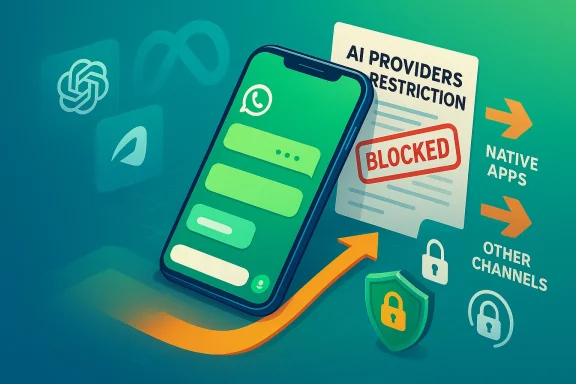
WhatsApp’s decision to block third‑party, general‑purpose AI assistants from its Business API — a move that effectively ends ChatGPT and Microsoft Copilot integrations on the platform — marks a major shift in how conversational AI will be delivered to hundreds of millions of users and tens of thousands of businesses worldwide.
WhatsApp’s parent company, Meta, announced an update to the WhatsApp Business Solution terms that adds a dedicated “AI providers” clause and takes effect on January 15, 2026. The new language prohibits providers of large language models and general‑purpose conversational AI from using WhatsApp’s Business API when those AI systems are the primary functionality being offered. In practical terms this prevents popular assistants like ChatGPT and Copilot from operating through the Business API channel while allowing businesses to continue to use AI incidental to customer‑support workflows, such as automated ticket routing, confirmations, or guided forms.
The policy change didn’t occur in a vacuum. Meta has been rolling Meta AI into its ecosystem — including WhatsApp, Instagram, Facebook, and Messenger — and has introduced features such as message summaries and an in‑app assistant invoked with an AI icon. Meta justifies the Business API restriction on technical and strategic grounds: some third‑party AI flows created unexpectedly large message volumes and support burdens, and the Business API was designed around transactional and customer‑service uses rather than open “ask me anything” assistants.
For users and businesses, the immediate task is pragmatic: link accounts, safeguard chat histories, and plan migrations. For the industry, the episode is a reminder of how crucial platform governance is to the modern AI ecosystem. Messaging channels are not neutral pipes; control over them can shape who innovates, how users discover AI, and which assistants become ubiquitous. The coming months will show whether the market, regulators, and consumers accept Meta’s framing — or whether pressure will force more open pathways for third‑party conversational AI.
Source: Mix Vale WhatsApp will end integration with ChatGPT and Copilot to prioritize its own artificial intelligence
 Background
WhatsApp’s parent company, Meta, announced an update to the WhatsApp Business Solution terms that adds a dedicated “AI providers” clause and takes effect on January 15, 2026. The new language prohibits providers of large language models and general‑purpose conversational AI from using WhatsApp’s Business API when those AI systems are the primary functionality being offered. In practical terms this prevents popular assistants like ChatGPT and Copilot from operating through the Business API channel while allowing businesses to continue to use AI incidental to customer‑support workflows, such as automated ticket routing, confirmations, or guided forms.The policy change didn’t occur in a vacuum. Meta has been rolling Meta AI into its ecosystem — including WhatsApp, Instagram, Facebook, and Messenger — and has introduced features such as message summaries and an in‑app assistant invoked with an AI icon. Meta justifies the Business API restriction on technical and strategic grounds: some third‑party AI flows created unexpectedly large message volumes and support burdens, and the Business API was designed around transactional and customer‑service uses rather than open “ask me anything” assistants.
What changed, exactly
Key elements of the policy update
- New “AI providers” restriction: The Business API terms now explicitly name providers or developers of machine learning and generative AI platforms as entities that cannot use the API to provide general‑purpose AI assistants where those assistants are the primary functionality.
- Effective date: The restrictions became enforceable on January 15, 2026, with new account registrations restricted from October 2025.
- Scope: The ban targets general‑purpose LLM‑based assistants (the kind of chatbots that answer broad queries and creative prompts). It does not sweep away AI used as an adjunct to business workflows, such as automated order confirmations or guided customer service scripts.
- Operational impact: Third‑party contacts and bot numbers that users added to access ChatGPT, Copilot, Perplexity, and similar assistants will stop responding on WhatsApp after the cutoff date. Providers have been given guidance to help users preserve chat history by linking accounts or moving conversations to native apps.
How vendors responded
Major vendors affected by the policy responded quickly. OpenAI advised WhatsApp users to link their ChatGPT accounts and migrate history before the deadline; Microsoft published guidance explaining Copilot would no longer be available via third‑party messaging apps and encouraged customers to switch to Copilot’s native apps and web surfaces. Several AI companies preemptively announced discontinuation of their WhatsApp offerings in compliance with the policy.Why Meta made the change — unpacking the stated reasons
Meta’s public explanation for the restriction cites a mismatch between WhatsApp’s intended use cases and the unexpected demand created by open AI assistants. Two arguments are central to Meta’s rationale:- Operational strain and support complexity: Some general‑purpose AI bots generate high volumes of messages, unseen usage patterns, and unique support needs that strain the Business API and the resources Meta allocates to it. The Business API was historically engineered to deliver transactional messages, notifications, and supervised support flows; open assistant usage diverged from that purpose.
- Strategic platform control: By restricting third‑party general AI access but continuing to operate Meta AI on WhatsApp, Meta narrows the distribution channels available to competitors. From a product strategy perspective, the change consolidates conversational AI interactions within Meta’s ecosystem, preserving WhatsApp’s role as a business communications channel while channeling general assistant traffic toward Meta’s own models.
Who is affected — users, developers, and enterprises
End users
Millions of consumers used WhatsApp as a convenient messaging interface to chat with assistants — for research, content generation, quick translations, and more. OpenAI stated that tens of millions of users had engaged ChatGPT on WhatsApp; Microsoft confirmed Copilot support was being retired via messaging apps. For casual users, the immediate effect is a change in convenience: chat history tied to WhatsApp will need linking or export, and assistants will remain available but on their native apps and web portals.Businesses and customer‑service teams
- Transactional and support bots are largely unaffected if AI is used as an auxiliary tool to assist human agents or automate routine, well‑bounded tasks.
- Companies that built open assistant flows through WhatsApp — booking assistants, Q&A bots, or creative chat endpoints — must redesign those experiences. These flows may need to migrate to owned web apps, mobile apps, or other messaging platforms that still permit LLM integrations.
Developers and AI providers
Third‑party AI firms that used WhatsApp as a distribution channel for broad assistant features will lose a major reach vector. For providers, the business challenge is twofold: technical migration of users, and product positioning when a dominant messaging platform limits third‑party access. Many vendors are steering users to native clients, alternate platforms, or white‑label integrations.Regulatory and competition risks
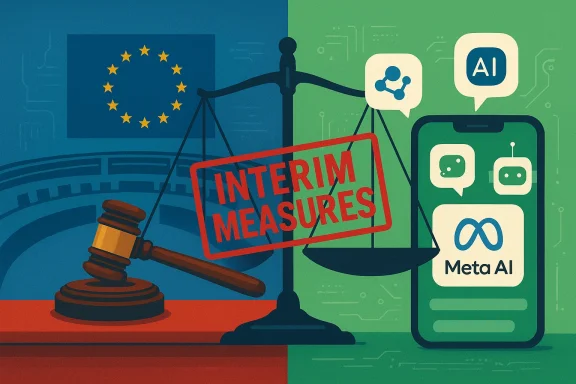
Antitrust attention
European regulators opened an antitrust investigation into Meta’s policy change, citing concerns that the decision could unfairly advantage Meta AI and impede competition. The European Commission’s probe focuses on whether Meta is abusing dominance over a core messaging channel to favor its own AI. Antitrust scrutiny is a realistic risk for any platform that changes access rules in ways that align with its commercial AI ambitions.Regulatory angles to watch
- Digital Markets and Competition: Enforcement bodies will examine whether the Business API change constitutes self‑preferencing or exclusionary conduct in jurisdictions where WhatsApp has significant market power.
- Privacy and data protection: Meta’s claims about not using WhatsApp messages to train models, and the use of private processing for summary features, will be scrutinized for compliance with data‑protection rules — particularly in the EU.
Technical implications and privacy considerations
End‑to‑end encryption and AI processing
WhatsApp’s end‑to‑end encryption complicates how AI features are delivered without exposing messages to platform operators. Meta has highlighted private processing techniques for features like message summarization, stating that the summarization process can occur without Meta accessing raw messages. That technology uses on‑device processing or cryptographic techniques to minimize data exposure; the specifics vary by feature.Data portability and chat history
Because many users interacted with assistants via a WhatsApp contact number rather than a full account linkage, preserving history required explicit linking steps. OpenAI and others provided account‑linking flows so users could transfer conversations to the vendor’s own platform prior to the January 15, 2026 cutoff. WhatsApp does not support automated export of bot chats in a way that maps directly to external AI accounts, so timely user action was necessary to retain conversational records.Security implications
- Spoofing and phishing risk: As bot numbers deactivate, opportunistic actors may attempt to impersonate official assistant contacts on alternative channels. Users must verify official app store listings and vendor communications before migrating.
- Support burden: Enterprises relying on third‑party assistants should anticipate increased human support work during migration windows, potentially requiring prepared FAQs and transitional customer communications.
Strategic and market implications
For Meta
- Control of the conversational surface: By restricting third‑party assistants and running Meta AI across its apps, Meta can keep users within its ecosystem for more engagement and data‑driven product iteration.
- Monetization paths: Owning the AI experience on WhatsApp opens subscription and advanced feature monetization opportunities within Meta’s broader product stack.
For OpenAI, Microsoft, and other AI players
- Distribution loss: WhatsApp was a high‑reach channel with a low friction interaction model. Losing it reduces casual discovery of assistants via messaging.
- Consolidation to native apps: Providers will intensify investment in native mobile and web clients, platform partnerships with other messaging services, and enterprise SDKs for in‑app deployment.
For alternative platforms
Messaging apps that still permit LLM integrations (or that position themselves as developer‑friendly) will see demand from AI providers and businesses migrating their bots. This creates competition among messaging platforms for one of AI’s most valuable channels: frictionless conversational access on users’ phones.Practical guidance: what users and businesses should do now
For individual users
- Link accounts: If you used ChatGPT, Copilot, or other assistants via WhatsApp, follow vendor instructions to link your phone number to your account and preserve chat history before the effective date.
- Install native apps: Download and sign into the assistant’s official app (mobile or desktop) to continue using the service and retain persistent history.
- Verify official channels: Only follow instructions within official vendor channels (in‑app notices, vendor support pages, or their verified social profiles) to avoid scams.
For businesses using the WhatsApp Business API
- Audit your bot flows: Identify which automation flows are general‑purpose chat vs. transactional support. You must rework general‑purpose assistant flows to non‑WhatsApp surfaces or remove the LLM as the primary functionality.
- Communicate with customers: Prepare clear messaging for customers about where to find migrated services and how to reach human support during transition.
- Invest in fallback channels: Build or strengthen alternative touchpoints (web chat, in‑app messaging, email) that can host LLM features you no longer can host on WhatsApp.
For developers and AI vendors
- Design migration paths: Provide one‑click account linking and data export tools to reduce customer churn.
- Consider enterprise embeds: Shift focus toward SDKs and embeddable AI experiences delivered inside company apps where you control the interface and data flow.
- Monitor regulatory developments: Antitrust inquiries could change the legal landscape rapidly; plan for multiple outcomes including potential reversals or interim remedies.
Strengths and potential legitimacy of Meta’s case — and the counterarguments
Notable strengths in Meta’s position
- Operational fit: The Business API was indeed meant for businesses and transactional use cases, not open assistants; enforcing that design intent is reasonable from an engineering standpoint.
- Infrastructure costs: Large‑scale LLM interactions can generate disproportionate load and support needs. Tightening the use policies can protect service quality for businesses that rely on the API for critical communications.
Important counterarguments and risks
- Self‑preferencing concerns: Restricting third‑party assistants while offering Meta AI on the same surfaces invites legitimate competition concerns. Regulators in multiple jurisdictions have already opened inquiries.
- User harm through reduced choice: Users who enjoyed convenient access to independent assistants on WhatsApp now face friction to continue the same behaviors. That loss of choice is not just commercial — it affects accessibility and user experience.
- Market foreclosure risk: If a dominant messaging app closes a critical distribution channel for AI providers, innovation may be stifled and smaller vendors disadvantaged.
Scenarios going forward: likely outcomes and what to watch
Short term (next 3–9 months)
- Migration to native apps: Users and providers will shift to vendor apps and other messaging platforms.
- Business rework: Companies will normalize new support flows and possibly split services: transactional interactions on WhatsApp, general assistance on other channels.
- Regulatory noise: Expect continued media coverage and formal inquiries in major jurisdictions, with potential interim measures recommended by regulators.
Medium term (9–24 months)
- Platform competition heats up: Messaging services that remain open to third‑party AI could gain market share among AI vendors and certain user segments.
- Productized enterprise AI: More AI providers will package specialized, regulated versions of assistants suitable for enterprise deployments and targeted use cases, avoiding the “general‑purpose” label.
Long term (24+ months)
- Potential policy reversals or settlements: Antitrust enforcement or negotiated remedies could require Meta to reopen channels or offer non‑discriminatory access under defined conditions.
- Diverse conversation surfaces: We could see a more fragmented conversational AI landscape where assistants live across native apps, enterprise embeds, and niche messaging platforms rather than a single universal messenger channel.
A checklist for IT leaders and product teams
- Reassess where your AI experiences live and whether WhatsApp remains the proper channel for the primary functionality.
- Build a user migration playbook that includes account linking, clear customer communications, and contingency support during the transition window.
- Harden authentication and verification for official assistant channels to prevent phishing as bot numbers and contacts change.
- Monitor regulatory developments and maintain legal readiness for changes in platform rules that affect commercial strategy.
- Evaluate alternative messaging partners and direct‑to‑app strategies to diversify distribution risk.
Final assessment
WhatsApp’s policy change is both a technical housekeeping measure and a strategic platform decision. On one level, limiting the Business API to its original purpose — transactional business interactions — is a defensible engineering and product governance choice. On another, restricting a powerful distribution channel for independent AI assistants while continuing to operate an in‑house assistant raises competitive and consumer‑choice concerns that regulators are unlikely to ignore.For users and businesses, the immediate task is pragmatic: link accounts, safeguard chat histories, and plan migrations. For the industry, the episode is a reminder of how crucial platform governance is to the modern AI ecosystem. Messaging channels are not neutral pipes; control over them can shape who innovates, how users discover AI, and which assistants become ubiquitous. The coming months will show whether the market, regulators, and consumers accept Meta’s framing — or whether pressure will force more open pathways for third‑party conversational AI.
Source: Mix Vale WhatsApp will end integration with ChatGPT and Copilot to prioritize its own artificial intelligence