

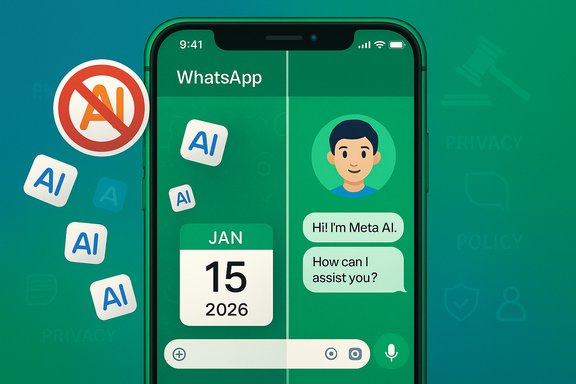
Meta’s latest tweak to WhatsApp’s Business Solution terms will force most third‑party AI chatbots — including ChatGPT and Microsoft Copilot — off the platform on January 15, 2026, leaving Meta’s own Meta AI as the dominant in‑app assistant for users who want an AI inside WhatsApp.
WhatsApp has long offered a Business Solution (often called the WhatsApp Business API) to let companies automate messages, provide customer support, and integrate services into the app. Over 2024 and 2025, a number of large language model (LLM) providers and AI startups used that channel to publish general‑purpose chatbots that consumers could message directly — a frictionless distribution strategy that bypassed app stores and independent authentication.
In October 2025 WhatsApp updated its Business Solution terms with a new section targeting “AI providers.” The new wording prohibits “providers and developers of artificial intelligence or machine learning technologies … from accessing or using the WhatsApp Business Solution … when such technologies are the primary (rather than incidental or ancillary) functionality being made available,” and set a compliance deadline of January 15, 2026. Within weeks, several major AI vendors publicly acknowledged the effect: OpenAI updated its help pages to say ChatGPT will stop working on WhatsApp after January 15, 2026, and Microsoft posted guidance telling users Copilot on WhatsApp will be discontinued on the same date and pointing people toward Copilot’s mobile, web and Windows surfaces.
Those facts redraw one of the clearest battlegrounds between platform owners and AI innovators: the right of third‑party assistants to use a messaging app with billions of users as a distribution surface.
That rationale is plausible on its face. Open‑ended LLM conversations can be long, interactive, and produce large message volumes and moderation questions that differ from a standard support bot. But Meta has not disclosed the underlying operational metrics (message volumes, moderation incidents, cost increases) tied to the decision. Those load and cost figures are currently company assertions and therefore cannot be independently verified from public data.
Flag: Meta’s operational burden claim is credible but not independently substantiated in public records; treat it as an asserted rationale rather than a fully verified causal fact.
Flag: Regulatory outcomes are uncertain; agencies can and do change the business landscape, but forecasts about legal results are speculative. The existence of probes is a matter of public record; their consequences are not yet determined.
That sentiment matters because if WhatsApp becomes a single‑assistant environment for in‑app AI, user dissatisfaction may translate into reputational costs for WhatsApp and Meta. At the same time, vendors forced off WhatsApp will lean on their own branded apps and web experiences, where they may provide richer features and better performance than the stripped‑down, chat‑centric integration.
Flag: Social media criticism is a meaningful signal of user experience but should be understood as anecdotal and selective rather than a statistically representative survey.
For users, the immediate practical steps are straightforward: link accounts where possible, export chat threads you want to keep, and install the first‑party apps of your preferred assistants. For regulators and competitors, the change represents a flashpoint in platform governance: the balance between product integrity, operational limits, and competitive fairness will determine whether this policy proves temporary, modified, or enduring.
Companies and consumers alike should prepare for January 15, 2026: that date will either cement a Meta‑dominated in‑WhatsApp AI future or mark the beginning of a broader legal and policy fight over platform access and the rules that govern AI distribution in messaging apps.
Source: TechRadar https://www.techradar.com/ai-platfo...yone-to-use-its-unpopular-ai-chatbot-instead/
 Background
WhatsApp has long offered a Business Solution (often called the WhatsApp Business API) to let companies automate messages, provide customer support, and integrate services into the app. Over 2024 and 2025, a number of large language model (LLM) providers and AI startups used that channel to publish general‑purpose chatbots that consumers could message directly — a frictionless distribution strategy that bypassed app stores and independent authentication.In October 2025 WhatsApp updated its Business Solution terms with a new section targeting “AI providers.” The new wording prohibits “providers and developers of artificial intelligence or machine learning technologies … from accessing or using the WhatsApp Business Solution … when such technologies are the primary (rather than incidental or ancillary) functionality being made available,” and set a compliance deadline of January 15, 2026. Within weeks, several major AI vendors publicly acknowledged the effect: OpenAI updated its help pages to say ChatGPT will stop working on WhatsApp after January 15, 2026, and Microsoft posted guidance telling users Copilot on WhatsApp will be discontinued on the same date and pointing people toward Copilot’s mobile, web and Windows surfaces.
Those facts redraw one of the clearest battlegrounds between platform owners and AI innovators: the right of third‑party assistants to use a messaging app with billions of users as a distribution surface.
What exactly is changing in WhatsApp’s terms?
The “AI providers” clause — what it says in plain language
WhatsApp’s revised Business Solution terms add a blanket restriction on entities it defines as “AI Providers” — a broadly drawn category that includes LLMs, generative AI platforms, and “general‑purpose artificial intelligence assistants.” The rule allows WhatsApp to block such providers from using the Business Solution if the AI assistant is the main thing being offered through that API.- The rule exempts business use cases where AI is ancillary to customer support: transactional messages, booking confirmations, ticket triage, and similar workflows remain permitted.
- The prohibition is explicitly about distribution on the Business Solution — not about whether a business can use AI internally for customer service or productivity.
- Enforcement is at WhatsApp/Meta’s discretion: the company can decide what counts as “primary” versus “ancillary.”
Timeline and the immediate cutoff
- New terms announced: mid‑October 2025.
- Enforcement/mandatory cutoff: January 15, 2026.
- Effect: General‑purpose third‑party chatbots that used the Business Solution as their distribution channel must cease operations on WhatsApp by the enforcement date.
Why Meta says it made the change — and what’s unverifiable
Meta framed the change as a product fit and operational issue: WhatsApp’s Business Solution was built for enterprise messaging and customer workflows, not the unpredictable, high‑volume, open‑ended traffic generated by general‑purpose LLMs. Meta claims the unintended use of the API placed new support and infrastructure burdens on the service.That rationale is plausible on its face. Open‑ended LLM conversations can be long, interactive, and produce large message volumes and moderation questions that differ from a standard support bot. But Meta has not disclosed the underlying operational metrics (message volumes, moderation incidents, cost increases) tied to the decision. Those load and cost figures are currently company assertions and therefore cannot be independently verified from public data.
Flag: Meta’s operational burden claim is credible but not independently substantiated in public records; treat it as an asserted rationale rather than a fully verified causal fact.
Immediate consequences for users
If you use ChatGPT or Copilot on WhatsApp
- ChatGPT: OpenAI is instructing WhatsApp users to link their phone numbers to ChatGPT accounts so prior WhatsApp conversations can be preserved inside the ChatGPT app before January 15, 2026. Unlinked WhatsApp chat history will not automatically migrate.
- Copilot: Microsoft has posted an advisory that Copilot on WhatsApp will stop working on January 15, 2026. Because the WhatsApp integration used an unauthenticated contact model, Microsoft says it cannot automatically import WhatsApp conversations into Copilot accounts. Users who want chat records must export them from WhatsApp before the deadline.
What users will lose on the platform
- The convenience of “no‑app” AI: messaging a phone number or contact on WhatsApp to access an assistant without installing separate apps or managing new accounts.
- Cross‑device, account‑backed history continuity for unauthenticated integrations; where integrations were unauthenticated, there’s no automatic migration.
- The ability to use a preferred third‑party assistant inside WhatsApp after the cutoff unless the assistant is offered by Meta.
Migration steps users should take now
- Link accounts where the vendor offers it (for ChatGPT, follow the linking process via the chatbot’s WhatsApp contact to connect to a ChatGPT account).
- Export chat histories you want to keep using WhatsApp’s built‑in “Export chat” tools for each affected thread.
- Install vendors’ first‑party apps (e.g., ChatGPT app, Copilot app) or use their web experiences so you retain authenticated access and persistent history.
Developer and business impacts
For AI companies and startups
- Loss of a powerful distribution channel: WhatsApp’s enormous reach made it easy for startups to reach users with minimal friction. That route is being closed for many AI providers.
- Forced migration to first‑party apps or web: companies must build, promote, and maintain their own surfaces (apps, web, browser extensions) or look for alternate messaging partners that permit third‑party assistants.
- Data portability headaches: many WhatsApp integrations were unauthenticated, so chat threads users created there do not map to vendor accounts. That complicates continuity and retention.
For businesses using WhatsApp for customer service
- Little direct change for businesses that use AI as an incidental feature of customer workflows. Businesses can still deploy automated support and notifications that use AI behind the scenes, provided the AI is ancillary to the primary business function.
- Potential friction: companies that had experimented by power‑user distribution through chatbots may need to rework workflows and customer onboarding.
Competition and antitrust risk — the strategic dimension
This is where the policy change goes beyond technical housekeeping and looks like a strategic market move.- The practical effect of the ban is to remove rival assistants from the WhatsApp interface. When third‑party assistants are excluded, Meta’s own assistant benefits from reduced competition for in‑app attention.
- The rule grants Meta broad discretion to judge what counts as an AI provider and what is primary functionality, giving it a tool for gatekeeping access to the platform.
- Regulators have already noticed. Competition authorities in Europe — and in particular one major enforcement agency — have broadened probes into whether Meta’s integration of AI tools in WhatsApp and its new Business Solution terms could amount to an abuse of market dominance. That authority has signaled it may consider emergency interim measures to block the policy’s immediate effect if it concludes irreparable competitive harm could occur.
Flag: Regulatory outcomes are uncertain; agencies can and do change the business landscape, but forecasts about legal results are speculative. The existence of probes is a matter of public record; their consequences are not yet determined.
Privacy, security and moderation implications
Data handling and privacy
Meta has claimed some user‑facing Meta AI features use privacy‑preserving techniques such as on‑device or private processing when summarizing or analyzing messages. However, the Business Solution policy change does not directly change the privacy status of messages sent to third parties — it changes who can host the assistant inside WhatsApp.- For users, the main privacy issue is where conversations are stored and how they are controlled. ChatGPT’s linking option brings WhatsApp conversations into ChatGPT’s account history; Copilot’s unauthenticated model meant no automatic linkage.
- Users should read vendor privacy policies carefully before linking phone numbers or exporting chats.
Content moderation and safety
- Open‑ended LLM chats present unique moderation challenges: hallucinations, harmful content, and misinformation. Hosting assistants within WhatsApp shifts moderation and legal liabilities in complex ways between platform and provider.
- Meta’s stated operational concern included moderation and support burdens; removing third‑party assistants reduces some moderation heterogeneity inside WhatsApp but centralizes responsibility for an in‑app assistant under Meta.
Security risks
- Exporting and storing chat transcripts carries security risks if users save sensitive data. Exports should be stored securely and deleted when no longer needed.
- Third‑party bots historically introduced attack surfaces: malicious bots, phishing via bot contacts, and social‑engineering scams impersonating assistants. Platform policing can reduce this risk — but it also concentrates access to a single provider.
User sentiment — Meta AI’s uphill battle
Public reaction to Meta AI’s presence inside WhatsApp has been mixed and, often, negative in social media threads and community forums. Many users have expressed disappointment with Meta AI’s performance relative to established assistants such as ChatGPT and Copilot, citing accuracy, utility, and conversational quality.That sentiment matters because if WhatsApp becomes a single‑assistant environment for in‑app AI, user dissatisfaction may translate into reputational costs for WhatsApp and Meta. At the same time, vendors forced off WhatsApp will lean on their own branded apps and web experiences, where they may provide richer features and better performance than the stripped‑down, chat‑centric integration.
Flag: Social media criticism is a meaningful signal of user experience but should be understood as anecdotal and selective rather than a statistically representative survey.
Practical migration checklist (for everyday users)
- Identify which AI assistants you use in WhatsApp (open each assistant chat).
- If the assistant offers linking, follow vendor instructions to link your WhatsApp phone number to a vendor account (this preserves history inside that vendor’s ecosystem where supported).
- For assistants that are unauthenticated (no linking offered), export any threads you want to keep:
- Open the chat → More options → Export chat → choose whether to include media.
- Install the vendor’s native app or bookmark its web experience:
- ChatGPT: official mobile apps or web.
- Copilot: Copilot mobile app, web, or Windows features.
- Securely store exported chat files and remove copies from insecure devices.
- Monitor email or vendor announcements for updates and any migration tools.
What this means for the AI ecosystem and platform dynamics
- Short term: users will have to migrate off WhatsApp for third‑party assistants or accept Meta AI as the default in‑app assistant.
- Medium term: vendors that relied on WhatsApp for discovery will likely invest more heavily in their own apps, partnerships with other messaging platforms, and cross‑platform authentication to retain users.
- Strategic shift: this sets a precedent where platform owners can close distribution channels to competitors under the guise of product fit. That precedent will be scrutinized by rivals, regulators, and policy makers.
- Product evolution: vendors will accelerate feature development in their native apps (voice, vision, account‑sync) to compensate for lost reach on WhatsApp.
Likely scenarios and what to watch
- Regulatory pushback and delay: enforcement could be paused or altered if competition authorities impose emergency measures or require changes to the terms.
- Workarounds and partnerships: some AI companies may seek partnerships with channel partners (e.g., businesses that use WhatsApp in a verified business flow) to offer assistant functionality in an ancillary way that complies with the new terms.
- Platform fragmentation: users will experience a fragmentation of AI experiences — different assistants across different apps — which could slow mass adoption of a single dominant assistant outside Meta’s control.
- Product consolidation: vendors may respond by improving account portability and import tools to make migrations easier for users leaving WhatsApp.
Strengths and weaknesses of Meta’s approach
Strengths
- Simplicity for businesses: re‑centering the Business Solution on enterprise workflows aligns a channel with its original commerce and support intent.
- Operational control: Meta gains a simpler moderation and support posture inside WhatsApp by standardizing what types of services can use the Business Solution.
- Strategic leverage: controlling the in‑app assistant increases Meta’s ability to monetize and define the user experience inside WhatsApp.
Weaknesses and risks
- Antitrust exposure: the move risks regulatory intervention and litigation focused on exclusionary conduct and market foreclosure.
- User backlash: forcing users to migrate away from favored assistants or rely on Meta AI risks user dissatisfaction and migration to other messaging platforms.
- Innovation dampening: startups that used WhatsApp as a low–friction go‑to‑market channel lose a valuable avenue to reach users, which could slow competition and innovation.
Conclusion
WhatsApp’s Business Solution policy revision is more than a narrow API update — it is a disruptive reallocation of a major distribution channel for conversational AI. By banning general‑purpose third‑party chatbots on the Business Solution, WhatsApp is effectively centralizing first‑class, in‑chat AI under its own control, accelerating vendor migration to first‑party apps and web experiences, and inviting regulatory scrutiny.For users, the immediate practical steps are straightforward: link accounts where possible, export chat threads you want to keep, and install the first‑party apps of your preferred assistants. For regulators and competitors, the change represents a flashpoint in platform governance: the balance between product integrity, operational limits, and competitive fairness will determine whether this policy proves temporary, modified, or enduring.
Companies and consumers alike should prepare for January 15, 2026: that date will either cement a Meta‑dominated in‑WhatsApp AI future or mark the beginning of a broader legal and policy fight over platform access and the rules that govern AI distribution in messaging apps.
Source: TechRadar https://www.techradar.com/ai-platfo...yone-to-use-its-unpopular-ai-chatbot-instead/
