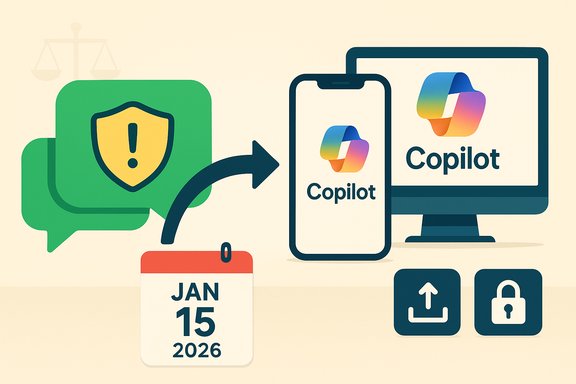
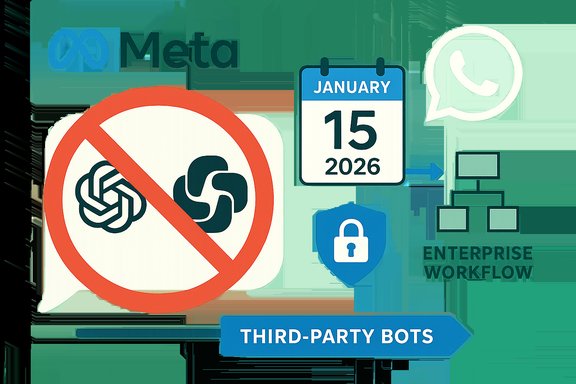
Microsoft’s decision to pull Copilot and other third‑party AI chatbots out of WhatsApp marks a clear and immediate shift: beginning January 15, 2026, WhatsApp’s Business Solution will no longer be usable as a distribution channel for general‑purpose large‑language‑model assistants, forcing vendors and users to migrate to first‑party apps, web portals, or alternative messaging surfaces.
Since late 2024, a number of AI providers experimented with delivering conversational assistants inside existing messaging apps rather than building standalone apps. WhatsApp’s Business Solution (commonly called the WhatsApp Business API) became a convenient, low‑friction channel: users could message an AI contact like any other number, ask questions, request summaries, generate text or images, and receive replies inside a familiar chat interface. Microsoft’s Copilot was among the higher‑profile assistants that adopted this route and reportedly served millions of users through a WhatsApp contact.
In mid‑October 2025, Meta updated the WhatsApp Business Terms of Service to add an “AI providers” restriction that explicitly prohibits providers of large language models, generative AI platforms, and general‑purpose AI assistants from accessing or using the WhatsApp Business Solution when those AI capabilities are the primary functionality being delivered. The rule becomes enforceable on January 15, 2026. Meta framed the change as a move to preserve the Business API’s original purpose — transactional and customer‑support messaging — while mitigating unexpected operational burdens from open‑ended chatbot traffic.
Microsoft has confirmed that Copilot’s WhatsApp contact will stop functioning on that date and has published migration guidance, directing users to Copilot’s native mobile apps (iOS and Android), the web experience (copilot.microsoft.com), and integrated Copilot features on Windows. Microsoft also warns that conversations that occurred inside WhatsApp will not migrate automatically to Copilot accounts because the WhatsApp integration used an unauthenticated, contact‑based model; users who want to preserve transcripts must export their WhatsApp chats before the cutoff.
Source: heise online Microsoft's Copilot and other AI chatbots must leave WhatsApp in early 2026
 Background
Since late 2024, a number of AI providers experimented with delivering conversational assistants inside existing messaging apps rather than building standalone apps. WhatsApp’s Business Solution (commonly called the WhatsApp Business API) became a convenient, low‑friction channel: users could message an AI contact like any other number, ask questions, request summaries, generate text or images, and receive replies inside a familiar chat interface. Microsoft’s Copilot was among the higher‑profile assistants that adopted this route and reportedly served millions of users through a WhatsApp contact.In mid‑October 2025, Meta updated the WhatsApp Business Terms of Service to add an “AI providers” restriction that explicitly prohibits providers of large language models, generative AI platforms, and general‑purpose AI assistants from accessing or using the WhatsApp Business Solution when those AI capabilities are the primary functionality being delivered. The rule becomes enforceable on January 15, 2026. Meta framed the change as a move to preserve the Business API’s original purpose — transactional and customer‑support messaging — while mitigating unexpected operational burdens from open‑ended chatbot traffic.
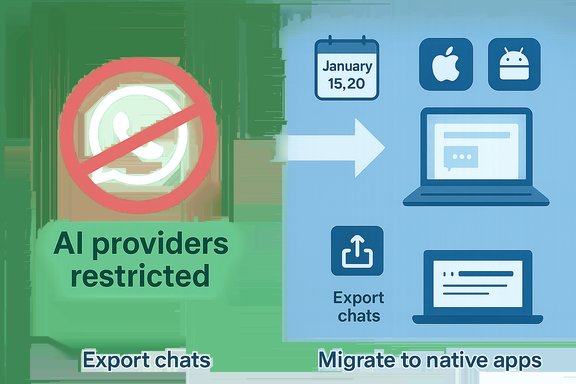
Microsoft has confirmed that Copilot’s WhatsApp contact will stop functioning on that date and has published migration guidance, directing users to Copilot’s native mobile apps (iOS and Android), the web experience (copilot.microsoft.com), and integrated Copilot features on Windows. Microsoft also warns that conversations that occurred inside WhatsApp will not migrate automatically to Copilot accounts because the WhatsApp integration used an unauthenticated, contact‑based model; users who want to preserve transcripts must export their WhatsApp chats before the cutoff.
What changed (plain language)
The new policy, summarized
- WhatsApp’s Business Solution terms now identify “AI providers” and prohibit them from using the API when AI assistants are the main product being offered via that interface.
- There is an explicit carve‑out for business‑incidental AI: AI that is ancillary to customer‑service workflows (order updates, appointment confirmations, ticket triage) remains permitted.
- Enforcement and interpretation are left to Meta’s discretion, which gives the company broad authority to determine what counts as “primary functionality.”
Timeline and immediate consequence
- October 2025 — Meta publishes the revised Business Solution Terms.
- January 15, 2026 — The AI provider restriction takes effect and third‑party, general‑purpose LLM chatbots using the Business API will be disallowed.
- After January 15, 2026 — Microsoft’s Copilot contact on WhatsApp and similar third‑party bots will be deactivated; only Meta’s own Meta AI will remain as an in‑WhatsApp assistant (subject to Meta’s product choices).
Technical and operational detail
Why platforms care: infrastructure and moderation
Open‑ended chat assistants produce unpredictable, heavy conversational traffic: long sessions, extensive context windows, high token counts, and multimodal payloads (text + images). Those patterns differ substantially from the comparatively predictable, transactional exchanges WhatsApp Business Solution was designed for. Meta’s public rationale cites increased operational strain — higher message volumes, moderation load, and support complexity — as reasons to narrow permitted uses of the API. That reasoning is consistent across reporting and vendor statements.Authentication and portability
Many third‑party bots on WhatsApp used a simple contact model rather than a signed‑in, account‑backed integration. This unauthenticated approach prioritizes ease of access but sacrifices continuity: there is no server‑side linkage between a WhatsApp chat and the provider’s account system, so chat histories cannot be migrated automatically to a Copilot account or other vendor accounts. Microsoft has therefore recommended that users export any WhatsApp Copilot chats they want to keep before January 15, 2026.Enforcement scope and ambiguity
The policy’s language gives Meta latitude to decide what qualifies as an “AI provider” and whether a given integration’s AI is “primary.” That ambiguity means some integrations that are borderline — for example, a retail support bot that heavily relies on generative responses — may be subject to enforcement, depending on Meta’s interpretation. This creates uncertainty for developers and businesses building on top of the Business Solution.Immediate user impact and migration checklist
For consumers who used Copilot or other chatbots inside WhatsApp, the change is disruptive but manageable if acted upon early.What users must do now
- Export chat history for any Copilot conversations you want to retain before January 15, 2026. Microsoft and reporting repeatedly emphasize this because the WhatsApp integration does not provide account‑based portability.
- Install and sign in to vendor‑owned Copilot apps (iOS/Android) or use the web portal for an authenticated, synced experience.
- Link phone numbers or accounts where vendors provide account‑linking tools to avoid fragmentation, where possible.
- Recreate essential flows (saved prompts, templates, document‑based workflows) inside the provider’s native app or web portal.
Quick export steps (general guidance)
- Open the WhatsApp chat with the Copilot contact.
- Tap the chat header → choose Export Chat (iOS: Share Chat / Android: More → Export chat).
- Decide whether to include media (images will increase file size).
- Choose a secure destination (email to self, cloud storage you control, or local backup).
Note: UI labels vary across Android/iOS and different WhatsApp builds. If unsure, consult WhatsApp’s in‑app help.
What stops working after the cutoff
- The WhatsApp contact will stop responding to messages; chat threads will become inert.
- Any automation or workflows that depended on in‑chat assistant replies will cease to function until migrated to an alternative channel.
What this means for developers, startups, and enterprises
For startups and API consumers
WhatsApp’s Business Solution provided a discovery and distribution channel: small vendors could expose AI experiences to users who never downloaded a dedicated app. That growth path is now restricted, raising the bar for user acquisition and increasing the cost of distribution.- Short‑term reactions will include:
- Migrating to permissive messaging platforms (for example, Telegram or Signal) or to web PWAs and native apps.
- Reworking features to classify AI as ancillary within a business automation flow so it remains within policy allowances.
- Building authenticated interactions (OAuth, phone‑number linking) so user history and identity persist across surfaces.
For enterprises and vendors
Enterprises that incorporated third‑party assistants into customer‑facing WhatsApp workflows must audit their usage and either:- Reengineer the flow to fit the Business API’s intended transactional/notification model; or
- Move general‑purpose capabilities to vendor‑controlled channels (apps, web) and retain narrow, permitted automations on WhatsApp.
Strategic and competitive analysis
Platform control vs. open distribution
Meta’s enforced restriction consolidates a valuable interaction surface inside its own product stack: Meta AI will remain the in‑WhatsApp assistant and therefore capture those conversational touchpoints. That outcome has a direct competitive effect: third‑party vendors lose a high‑reach distribution channel while Meta preserves access to user attention, engagement data, and potential monetization opportunities. While Meta framed the decision as operational policy, the competitive consequences are real and widely noted in analysis. Readers should treat motive claims beyond operational reasons as analytic inferences rather than explicit admissions.Regulatory and antitrust considerations
When a platform that hosts third‑party services changes access rules in a way that benefits its own offerings, regulators frequently take notice. This type of policy shift raises standard questions for competition authorities: does the restriction unfairly foreclose rivals? Is it an essential facility? The presence and severity of regulatory scrutiny will depend on jurisdiction, the demonstrated impact on competition, and whether Meta’s enforcement is transparently applied. Expect heightened attention in markets with active digital competition enforcement.Winners and losers
- Winners: Platform owners that consolidate AI experiences (Meta), and AI vendors that can successfully migrate users to authenticated, monetizable apps or web portals (Microsoft, OpenAI).
- Losers: Startups and smaller providers that relied on WhatsApp as a low‑cost distribution channel, and casual consumers who favored the convenience of in‑chat assistants without installing new apps.
Privacy, security, and compliance considerations
Data residency and message handling
WhatsApp’s Business Solution mediates message flows between customers and enterprises. When a third‑party LLM operates as an intermediary, it raises questions about where conversation data is stored, how long it is retained, and which parties have access. Removing third‑party assistants from the Business Solution reduces the number of external services that process WhatsApp conversations but consolidates data handling inside platform‑owned systems or vendor‑controlled apps — both of which have different compliance and threat‑model implications.Moderation and content liability
Open‑ended LLMs can generate unpredictable outputs that require different moderation pipelines than simple transactional responses. Platforms cited moderation demands as part of the operational burden. Vendors that shift to first‑party surfaces should expect to be responsible for content moderation, safety filters, and compliance processes on their own channels. This raises costs and operational complexity for AI providers.User consent and transparency
Users who interacted with an assistant via WhatsApp may not have realized where model prompts were processed or how long data was retained. Vendors moving to native apps should provide clear, accessible privacy notices and export options as part of migration guidance to preserve trust and meet privacy obligations in regulated markets.Practical migration playbook (for product teams)
- Audit all WhatsApp integrations and classify them: transactional vs. general‑purpose.
- For transactional flows, ensure they comply with WhatsApp Business Solution permitted uses and document that AI is ancillary.
- For general‑purpose features:
- Build or expand native mobile/web experiences.
- Add account linking (phone number ↔ provider account) to preserve history.
- Provide data export/import tools for users.
- Communicate early and often with customers: timelines, how to export chats, and recommended alternatives.
- Consider alternative messaging channels for discovery, but avoid reliance on a single external platform.
- Reassess pricing and monetization: first‑party surfaces may unlock subscription or premium feature models not feasible inside WhatsApp.
Broader implications for the AI ecosystem
A turning point for distribution strategy
The WhatsApp change crystallizes a broader industry test: who owns conversational AI distribution — platform holders or AI vendors? The practical consequence is that vendors will increasingly prioritize authenticated, account‑linked surfaces where they can own the customer relationship, gather consent, and control monetization. That shift reduces friction for vendors to manage features (multimodal inputs, personalization) but increases acquisition costs and raises the stakes for user retention.Potential for standardized interoperability
One long‑term architectural response to this problem would be a standardized interchange format or protocol for assistants (verifiable identities, consented data exchange, cross‑client session handoff). Such interoperability could restore some of the convenience users enjoyed when assistants lived inside third‑party messengers. However, building such standards requires coordination across competitors and platforms — a difficult political and technical lift.Risks and open questions
- Enforcement mechanics: The policy allows Meta to decide what is “primary functionality,” but the operational thresholds and detection methods are not public. That ambiguity can chill innovation.
- Regulatory response: If competition authorities find that Meta’s rule unduly favors Meta AI, we may see complaints or investigations. The timing and outcome are uncertain.
- Small vendors’ survival: Startups that depended on WhatsApp for distribution face an abrupt fundraising and go‑to‑market challenge; some may pivot successfully, but many will incur additional costs.
- User friction and fragmentation: Consumers who valued in‑chat convenience now must adopt and manage multiple apps and accounts, which erodes the single‑surface simplicity that gave WhatsApp in‑chat assistants their appeal.
What Microsoft users should know specifically about Copilot
- Copilot on WhatsApp will stop functioning on January 15, 2026. Microsoft’s guidance is to transition to Copilot’s native apps (iOS/Android), use Copilot on the web, or use built‑in Copilot features on Windows.
- Conversations on WhatsApp cannot be migrated automatically to Copilot’s account‑backed surfaces because the integration used unauthenticated sessions; export chats if you want to preserve records.
- Copilot’s native surfaces typically provide richer features (voice, vision, account sync) and enterprise controls not available inside the constrained WhatsApp contact experience. Microsoft highlights these as advantages of migration.
Long‑term outlook
This episode is likely a bellwether rather than a one‑off. Platform owners will continue to refine how they allow — or disallow — third‑party services in their ecosystems. The immediate effect will be a consolidation of high‑value conversational real estate inside platform‑owned assistants and vendor‑owned authenticated applications. Over time, market and regulatory pressures could push for clearer portability guarantees and standardized identity layers that reduce the fragility of today’s integrations. For the near term, though, the practical reality is clear: plan migrations, export critical data, and assume that third‑party in‑chat AI inside closed messaging ecosystems may be a short‑lived phenomenon unless regulated or standardized differently.Conclusion
WhatsApp’s decision to bar third‑party, general‑purpose AI assistants from the Business Solution is consequential: it forces a strategic redistribution of where conversational AI lives and who controls the user relationship. For consumers, the immediate action is straightforward — export any chat history you wish to keep and move to vendor‑provided apps or web portals. For developers and startups, it’s a prompt to reassess distribution strategies, invest in authenticated experiences, and design for portability. For regulators and industry observers, the change raises familiar tensions between platform stability, product governance, and competitive fairness. The January 15, 2026 deadline crystallizes these tensions into concrete choices — and the ripples from those choices will help determine how conversational AI is built, sold, and controlled in the years ahead.Source: heise online Microsoft's Copilot and other AI chatbots must leave WhatsApp in early 2026