EU Probes AWS and Azure Under DMA in Cloud Regulation Push

  • Thread Author
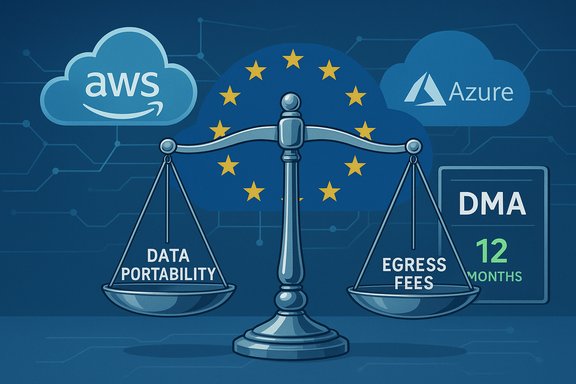
EU data portability vs egress fees battle on AWS and Azure clouds.
In a decisive escalation of EU tech regulation, the European Commission has opened market investigations into Amazon Web Services (AWS) and Microsoft Azure under the Digital Markets Act (DMA), seeking to determine whether their cloud offerings function as “gatekeeper” services and whether the DMA’s toolbox can be applied effectively to the cloud computing market; the Commission said it aims to complete the inquiries within 12 months, and Microsoft has publicly stated it will cooperate with the probe.

Background​

Cloud infrastructure now powers everything from consumer apps to national digital services, and a handful of global hyperscalers—chiefly Amazon, Microsoft and Google—dominate supply. The DMA, which reached full force earlier in 2024, was designed to place ex‑ante obligations on dominant digital platforms designated as “gatekeepers” to prevent self‑preferencing, improve interoperability, and reduce lock‑in. The Commission’s decision to investigate AWS and Azure brings cloud infrastructure squarely into that regulatory frame for the first time at scale. This move follows intense, multi‑jurisdictional scrutiny of cloud market structure. The UK’s Competition and Markets Authority (CMA) has previously flagged Microsoft and AWS for holding up to roughly 30–40% of some cloud markets and recommended further action—observations that helped crystallize the regulatory calculus in Brussels. The CMA’s provisional findings pointed to high switching costs, egress charges and licensing arrangements that may deter customers from migrating workloads between providers. At the same time, European policymakers have become increasingly focused on “digital sovereignty” and systemic resilience as AI and large‑scale workloads drive unprecedented demand for specialized cloud compute. That strategic context — concerns about outages, concentration risk and dependence on non‑EU providers — is a major reason cloud is now under the DMA microscope.

What the Commission is investigating​

1. Gatekeeper designation for cloud services​

The DMA’s gatekeeper framework sets quantitative thresholds and a qualitative test for services that can control access between businesses and end users. The Commission’s probes will assess whether AWS and Azure meet those functional and economic criteria for cloud infrastructure services — effectively asking whether IaaS and other cloud platform offerings should be treated like other core platform services already covered by the DMA. Reuters reported the Commission has opened two separate market investigations—one for AWS and one for Azure—alongside a third study into whether the DMA is fit for purpose in this domain.

2. Specific conduct: portability, self‑preferencing and pricing structures​

Investigators will probe conduct that creates switching friction and tilts competition in favour of the incumbent provider. Typical focus areas include:
  • Data portability and egress fees — charges or technical friction that make leaving a provider expensive or slow.
  • Licensing and pricing practices — whether Microsoft’s licensing or pricing makes it cheaper to run Microsoft workloads on Azure than on rivals’ clouds.
  • Self‑preferencing and bundling — whether hyperscalers give preferential access, feature parity, or performance to their own managed services and marketplaces.
  • Interoperability and APIs — lack of standard interfaces or proprietary control‑plane primitives that lock workloads to one stack.
These are the same levers regulators and market participants have flagged across recent UK and EU inquiries, and they’re now the explicit focus in Brussels.

3. The DMA’s suitability for cloud​

A distinct part of the Commission’s work is methodological: testing whether the DMA’s consumer‑facing gatekeeper rules can be sensibly adapted to enterprise cloud infrastructure. The DMA was drafted around consumer and business‑facing core platform services (search, app stores, social networks, etc., and mapping its metrics—active users, revenues in the EU—onto enterprise cloud contracts and IaaS technical primitives is non‑trivial. The Commission’s third investigation will evaluate whether tailored DMA obligations are required or whether other competition and sectoral tools are more appropriate.

Why this matters: stakes for customers, competitors and the EU tech ecosystem​

Cloud is now critical economic infrastructure. The issues at hand are not abstract policy disputes; they affect the cost, security and strategic autonomy of governments, telecoms, banks, healthcare systems and countless businesses. Key practical stakes include:
  • Switching costs and vendor lock‑in — If egress fees and proprietary managed services make migrations costly, public and private buyers can become captive to a small set of suppliers, reducing bargaining power and slowing innovation. The CMA and other authorities have documented how these features raise switching frictions.
  • AI and compute concentration — The largest AI workloads require specialized hardware and integrated stacks. When a few hyperscalers control most such capacity, they also shape the business and technical terms of access to leading AI infrastructure. Regulators are concerned this dynamic will cement market power in an AI era.
  • Digital sovereignty and resilience — European public sector customers want verifiable guarantees around data residency, access controls and legal jurisdiction. Regulators worry that marketing claims about “sovereign” or in‑region processing can mask cross‑border flows and legal exposure.

How the DMA could change cloud markets (possible remedies)​

If the Commission finds cloud services meet the gatekeeper test — or identifies DMA‑style remedies that are applicable — the possible toolkit includes strong, ex‑ante obligations:
  • Mandated interoperability and standard APIs — forcing non‑discriminatory access to critical control‑plane functions and interfaces used to deploy, monitor, and port workloads.
  • Restrictions on self‑preferencing — barring practices that give platform‑owned offerings unfair operational or commercial advantages in marketplaces and managed services.
  • Data‑portability and egress rules — capping or standardizing egress fees and mandating audit‑grade migration tooling to reduce switching friction.
  • Transparency, audits and remedies — obligation to publish technical and commercial terms, submit to independent audits, and face fines up to 10% (or higher for repeat breaches) of global turnover for non‑compliance under the DMA’s enforcement scheme.
However, implementing these remedies in cloud is complex. The DMA’s enforcement regime has teeth, but translating obligations designed for consumer platforms into cloud‑native technical requirements will demand careful, technical rule‑making and likely extended legal arguments. The Commission’s third probe is explicitly assessing that mapping.

Independent perspectives: what big players and challengers are saying​

Hyperscalers publicly defend their market practices as investments in resilience, scale, and innovation. Microsoft has said it will cooperate with the Commission’s inquiry, signaling willingness to engage constructively even as it contests some regulatory narratives. AWS and other large providers typically argue that scale yields security, performance, global reach and lower costs for customers. Reuters covered Microsoft’s stated readiness to participate in the probe. Smaller cloud providers, European sovereign cloud advocates, and some large customers argue that entrenched market power, pricing differentials and proprietary primitives reduce contestability. UK regulators and Google Cloud spokespeople have echoed these concerns in prior public filings and statements, which helped push the issue onto the Commission’s agenda. Industry groups warn, however, that heavy‑handed rules could fragment markets and unintentionally disadvantage European buyers that currently rely on non‑EU providers for performance or cost reasons. These trade‑offs are central to the policy debate.

Risks, unintended consequences and legal complexity​

Risk 1 — Overreach and fragmentation​

Mandated data‑localization, rigid interface rules or forced code changes could fragment global cloud operations, increase costs, and reduce economies of scale that underpin many cloud benefits. Industry submissions to Commission consultations have argued that poorly calibrated rules might “edge foreign providers out” of EU procurement and harm competitiveness.

Risk 2 — Enforcement complexity and technical precision​

Cloud control‑planes and proprietary managed services are deeply technical; enforcing non‑discrimination or interoperability obligations will require granular, technical standards (APIs, SLAs, telemetry, control‑plane behaviours). Regulators may lack the immediate technical levers to monitor complex runtime behaviours without sustained, expert engagements and audit frameworks. The Commission’s DMA compliance workshops show it’s already taking technical input, but the adaptation will be resource‑intensive.

Risk 3 — Slower innovation or higher costs​

If gatekeeper obligations reduce feature differentiation or force decoupling of tightly integrated services, hyperscalers might slow deployment of new managed capabilities or raise prices to cover compliance costs. That could harm smaller cloud customers who currently benefit from integrated, low‑cost offerings. The counterbalance is that more open competition could spur alternative innovation over time.

Practical implications for IT buyers and procurement teams​

The investigations already change procurement risk profiles. Public and private buyers should act now to reduce exposure and preserve options:
  1. Review contractual exit rights and negotiate robust egress commitments, including pricing caps and data‑transfer SLAs.
  2. Require independent audit rights and external attestation of data residency, key management and control‑plane practices.
  3. Insist on customer‑managed encryption keys (bring‑your‑own‑key, BYOK) and explicit language about key locality, rotation and revocation.
  4. Validate telemetry and support flows to confirm whether logs, backups and metadata remain under asserted jurisdictional controls.
  5. Plan for multi‑cloud portability by limiting use of deeply proprietary managed primitives for critical workloads, or encapsulating them behind abstraction layers.
  6. Establish “runbook” migration plans and test them periodically so exit is operationally feasible, not just contractual.
These measures won’t remove all risk, but they materially reduce the costs and friction of moving workloads should market or regulatory changes force unexpected transitions.

Timeline and probable outcomes​

The Commission has set a 12‑month target to conclude the probes—a relatively rapid window for market investigations of this depth. That timeline suggests the Commission aims to move from fact‑gathering to a policy decision promptly, whether that decision is designation, tailored obligations, or referral to other instruments. Reuters reports the 12‑month target and Microsoft’s willingness to contribute. Possible outcomes include:
  • No DMA designation but competition measures — the Commission could find the DMA is not the right instrument and instead use competition law or sectoral rules to remedy specific harms.
  • Designation of cloud services or providers as gatekeepers — triggering DMA obligations and potential fines for future non‑compliance.
  • Tailored remedies or negotiated undertakings — a middle path where the Commission imposes technical and contractual requirements adapted to cloud realities.
Expect parallel activity from national regulators (for example, the CMA in the UK) and private litigation or industry settlements as stakeholders jockey for favourable treatment.

Critical assessment: strengths and blind spots of the Commission’s approach​

Strengths​

  • Proactive systemic focus — treating cloud as strategic infrastructure recognizes real systemic risk in concentration and outage exposure.
  • Ex‑ante framing — the DMA framework — if applied appropriately — could prevent lock‑in mechanics before harms calcify, protecting future innovation and procurement flexibility.
  • Political traction — the Commission has enforcement experience under the DMA and the credibility to impose significant remedies if breaches are found.

Blind spots and challenges​

  • Fit of DMA to enterprise services — the DMA’s consumer‑oriented metrics and remedies are not a natural fit for complex enterprise contracts and technical architectures; careful tailoring will be essential.
  • Technical enforcement capacity — ensuring compliance with technical interoperability at runtime will demand new audit models, standards and likely industry collaboration.
  • Risk of chilling investment — over‑prescriptive remedies could reduce incentives for hyperscalers to invest in regional capacity or specialized AI accelerators, ironically weakening Europe’s cloud capacity if rules are applied without nuance.

What stakeholders should watch next​

  • Commission statements and non‑confidential decisions — the Commission will publish updates as probes progress; watch for technical annexes or requests for information that clarify the Commission’s theory of harm.
  • Industry engagements — DMA compliance workshops, consultation responses and national regulator filings will reveal where political and technical pressure points lie.
  • Parallel national remedies — the CMA and other national competition authorities may pursue complementary measures, increasing regulatory coordination or divergence.
  • Customer procurement updates — expect large public buyers to revise cloud procurement rules to demand more portability and sovereignty assurances.

Conclusion​

The European Commission’s decision to probe Amazon Web Services and Microsoft Azure under the Digital Markets Act marks a watershed moment for cloud regulation: it brings the EU’s strongest ex‑ante digital law to bear on the infrastructure layer that underpins today’s AI and cloud economy. The inquiries aim to determine both whether leading cloud platforms should be designated as DMA gatekeepers and whether the DMA’s instruments can be adapted to address cloud‑specific market failures. While the move has the potential to reduce lock‑in, improve portability and bolster competition, it also raises complex technical, legal and geopolitical questions about enforcement, market fragmentation and investment incentives. For IT leaders and procurement teams, the immediate implication is clear: strengthen contractual exits, demand stronger audit and key‑management controls, and design workloads for mobility now—because the regulatory and competitive landscape is shifting rapidly, and the outcome will influence cloud strategy for years to come.
Source: Devdiscourse EU Probes Amazon and Microsoft Over Cloud Dominance | Technology
 

The European Commission has opened a set of market investigations to determine whether Amazon Web Services (AWS) and Microsoft Azure should face additional regulatory scrutiny under the Digital Markets Act (DMA), and has launched a parallel review to test whether the DMA’s toolbox is fit for cloud infrastructure — a move that places hyperscale cloud providers at the centre of Europe’s competition, resilience and AI policy debate.

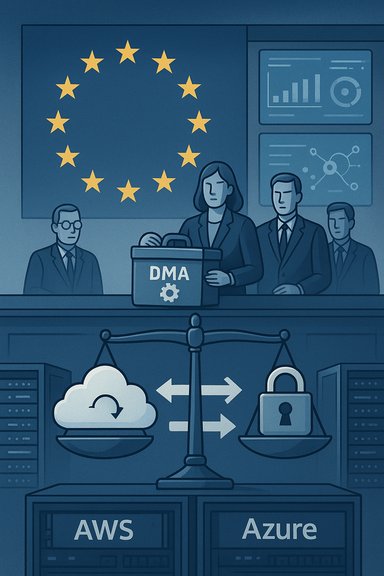
EU DMA hearing on cloud services competition between AWS and Azure.Background: why cloud, why now​

Cloud infrastructure is no longer a background procurement choice — it is the strategic compute layer that powers banking systems, national public services, consumer apps and the large-scale AI workloads reshaping entire industries. Regulators now view the concentration of public-cloud capacity among a handful of hyperscalers as a risk to competition, resilience and Europe’s digital sovereignty.
Two immediate drivers pushed cloud onto Brussels’ front page this year. First, national and supranational competition reviews documented considerable market concentration in public cloud spending, with AWS and Microsoft repeatedly flagged as leading providers in many European markets. The UK’s Competition and Markets Authority (CMA) estimated that each of the two companies can hold roughly 30–40% of market spend in certain segments — findings that sharpened the EU’s focus. Second, a string of high-impact outages on major hyperscalers exposed how provider failures can cascade across sectors — from streaming services and retail platforms to government systems — turning competition concerns into concrete systemic-risk questions. Brussels explicitly cited resilience and lock‑in issues when announcing the market inquiries.
Taken together, those pressures explain the Commission’s decision to use the DMA’s investigatory route: two company‑specific market probes (one for AWS; one for Azure) and a horizontal review of whether the DMA, designed initially for consumer-facing platforms, can be applied effectively to cloud infrastructure.

Overview of the Commission’s action​

What Brussels has opened​

  • Two company-level market investigations to test whether AWS and Microsoft Azure function as DMA “gatekeepers” despite cloud services not mapping cleanly to the DMA’s original user-count thresholds.
  • A horizontal policy review to determine whether the DMA’s obligations and enforcement methods are appropriate for cloud markets, or whether sector-specific adaptations are needed.
The Commission intends to gather technical evidence, contractual documents and stakeholder testimony and has signalled a roughly 12‑month target for the investigations, a compressed timetable by regulatory standards aimed at delivering timely findings.

Legal mechanics: DMA, gatekeepers and the qualitative pathway​

The DMA imposes ex‑ante obligations on designated “gatekeepers” — firms whose services act as essential intermediaries between businesses and end users. Gatekeeper designation typically relies on quantitative thresholds (for example, defined revenue and user counts), but the DMA also grants the Commission a discretionary investigatory route allowing qualitative assessment of services that operate as de facto gateways even if they fall short of numerical criteria. The current cloud probes use that qualitative pathway.
Key DMA levers that would matter for cloud:
  • Non‑discrimination: prohibitions on favouring first‑party services.
  • Interoperability and portability: technical requirements to reduce lock‑in where feasible.
  • Transparency: obligations to disclose metrics and decisioning that affect business users.
  • Enforcement: fines up to 10% (and higher for repeat breaches) of global turnover, plus possible structural remedies.

What the Commission will look for: technical and commercial axes​

The EU teams will probe concrete practices regulators and market participants have repeatedly flagged as competition frictions in cloud markets. The Commission’s lines of inquiry are familiar — they mirror issues raised in UK and national reviews — but they must be adapted to cloud’s technical realities.

Lock‑in mechanics and portability​

  • Egress and data‑transfer costs: whether exit charges and practical constraints make migration materially costly.
  • Proprietary APIs, control planes and custom extensions: platform-specific interfaces that make a workload difficult to rehost without redesign work.

Licensing and pricing​

  • Differential licensing: claims that Microsoft’s licensing terms make it cheaper or operationally simpler to run Microsoft workloads on Azure than on rivals’ clouds — a specific point raised repeatedly in national investigations.
  • Bundle discounts and rebates: pricing structures that indirectly favour an incumbent’s suite of services.

Self‑preferencing and managed services​

  • Preferential treatment of first‑party managed services or marketplaces: whether the hyperscalers tilt performance, placement or integration toward their own offerings.

Systemic risk and resilience​

  • Operational concentration: the impact of outages and control‑plane fragility on critical sectors and public services; regulators will assess how provider failures propagate and whether remedies should include minimum resiliency or redundancy obligations.

Cross‑referencing the evidence: what independent sources say​

Multiple independent outlets and national authorities already documented the underlying facts driving the EU probe:
  • The Associated Press reported the Commission’s move and noted the difficulty of applying user‑count thresholds to cloud services while explaining that the Commission may still use the DMA’s qualitative tools to designate cloud gatekeepers.
  • Reuters and other outlets have documented industry and regulator pressure to adopt cloud‑specific measures across Europe and reported industry concerns about how certification and regulation might favour big providers.
  • The UK CMA’s analysis — widely reported by CNBC and others — concluded that Microsoft and AWS hold significant shares of cloud spending in Britain and highlighted switching costs and licensing practices as potential competition issues.
These independent sources converge on three load‑bearing facts: (1) hyperscalers command a dominant share of public‑cloud spend in many markets; (2) switching costs are non‑trivial and often driven by technical and contractual choices; and (3) outages and AI‑driven demand for specialized hardware have heightened the political stakes.

Legal and technical challenges in applying the DMA to cloud​

The Commission’s move is politically and technically ambitious. Applying a framework built around consumer-facing metrics (monthly active users; consumer-facing app stores) to cloud infrastructure raises practical problems.

Measurement and thresholds​

Cloud markets are measured by contract value, capacity, and regional footprint — not by “monthly active users.” Translating DMA thresholds to cloud metrics is non‑trivial and will require the Commission to justify a qualitative gatekeeper finding on economic and technical grounds.

Interoperability: promise vs. practice​

Technical interoperability for cloud workloads is constrained by performance and semantics: an enterprise running latency-sensitive AI inference pipelines can’t simply “swap” GPUs and control-plane semantics without significant re‑engineering. Mandating interfaces or portability tools risks imposing functional constraints that could reduce performance or raise costs.

Remedies and unintended consequences​

  • Over‑prescriptive requirements could deter investment in capacity and specialized hardware, slowing the very AI and cloud innovation regulators want Europe to benefit from.
  • Fragmentation risk: divergent national or sectoral remedies may produce a patchwork of obligations that increase complexity for multinational customers and providers.

Potential benefits for European IT buyers and startups​

If the Commission finds gatekeeper behaviour or otherwise adapts DMA remedies to cloud, there are tangible benefits for enterprise customers and cloud‑native startups:
  • Reduced switching friction through more robust data portability and clearer egress regimes.
  • Less risk of unfair self‑preferencing, opening space for independent ISVs and specialized cloud providers.
  • Improved transparency on performance, pricing and data‑use policies — all helpful for procurement and risk management.
  • Stronger negotiating position for public buyers and SMEs when contract terms are harmonised by regulation.
Those benefits are precisely the policy rationale Brussels is weighing: increased contestability in cloud markets, better resilience and greater capacity for European firms to compete in AI‑driven markets.

Risks and trade‑offs: what regulators must avoid​

Regulatory action carries costs and trade‑offs. The Commission will need to thread a narrow needle to achieve benefits without undermining cloud capacity, innovation or security.
  • Investment chilling: heavy-handed rules or uncertain enforcement can reduce incentives for hyperscalers to expand regional capacity — a risk to latency, compliance and sovereign data strategies.
  • Performance gaps: enforcing generic portability or interface standards may prevent providers from optimizing stacks that deliver performance advantages for high‑value AI workloads.
  • Compliance complexity: imposing divergent DMA‑style obligations on infrastructure could require complex audits, reporting and technical modifications that raise operational costs for providers and customers alike.
  • National fragmentation: unilateral national measures inspired by the EU probe (or inconsistent remedies from member states) could fragment the single market and complicate cross‑border cloud contracts.
Regulators must balance stronger contestability with preserving an investment environment that supports large-scale compute, hardware refresh cycles (GPUs/TPUs) and the operational resilience necessary for critical services.

What this means for customers, IT leaders and procurement teams​

The investigations are a policy signal and a practical prompt. IT leaders should treat them as an invitation to sharpen cloud governance and to reduce exposure rather than as an immediate compliance deadline.

Immediate actions for enterprise IT teams​

  • Inventory critical workloads and dependencies. Map which systems use provider‑specific services, proprietary control‑plane constructs or managed AI stacks.
  • Assess portability costs. Run realistic migration proofs‑of‑concept for representative workloads to quantify lift, time and toolchain changes.
  • Review licensing arrangements. Check whether software licensing terms (especially for Windows Server, SQL Server and enterprise middleware) have differential costs or restrictions across cloud vendors.
  • Strengthen resiliency and multi‑region strategies. Consider architecture changes that reduce single‑provider failure blast radius (multi‑region replication, provider‑agnostic orchestration where feasible).
  • Harden contracts on egress and data access. Negotiate clearer egress caps, exit‑support commitments, and data export SLAs.

Procurement and legal checklist​

  • Require detailed migration playbooks and defined runbooks for data export.
  • Insist on audit rights for SLAs and for verification of portability claims.
  • Add exit milestone payments or escrow arrangements to ensure the provider supports migration if a dispute arises.
  • Build cost‑model scenarios that include egress, re‑architecture and license re‑pricing to evaluate total cost of ownership.
These pragmatic steps reduce vendor lock‑in and put customers in a stronger negotiating position irrespective of regulatory outcomes.

What providers likely will argue — and how Brussels will respond​

Hyperscalers will make familiar, evidence‑based arguments:
  • The cloud market is dynamic and competitive; customers switch and niche providers thrive in specialized areas.
  • Investment cycles for data centres and specialized hardware are capital intensive; regulation that increases compliance costs will reduce capacity investment in Europe.
  • Technical harmonisation risks lowering performance and hurting customers that rely on optimized, proprietary stacks.
Brussels will counter by pointing to persistent structural frictions — differential licensing, egress economics, proprietary APIs, and systemic outages — that impede competition and create public‑policy externalities. The Commission’s challenge will be to craft remedies that target anti‑competitive conduct without crippling the industry’s ability to deliver high‑performance cloud capacity.

Likely timelines and scenarios​

  • The Commission aims to complete the investigations in roughly 12 months, although complex technical evidence could stretch the process.
  • Possible outcomes:
  • No designation or interventions if the Commission concludes the DMA is ill‑fitted to cloud and competition is sufficient.
  • Designation of one or both services as gatekeepers, triggering DMA obligations and compliance timetables (historically the Commission has allowed months for compliance but can escalate enforcement).
  • Tailored, sector‑specific remedies short of full DMA designation — for example targeted interoperability measures, data‑access obligations, or egress transparency rules.
Any designation would start a new compliance phase, potentially requiring operational changes, new APIs or contractual remedies to meet DMA obligations.

Strategic implications for the European cloud ecosystem​

A sustained regulatory push has the potential to reshape the market landscape:
  • Opportunities for specialised European providers if lock‑in mechanics are weakened and portability improves.
  • Higher procurement complexity for multinational buyers who must navigate new compliance and interoperability regimes.
  • Potential acceleration of multi‑cloud and open‑source tooling adoption, as customers hedge regulatory and operational risk.
  • Pressure on hyperscalers to improve transparency on pricing, licensing and resilience capabilities — which benefits customers and smaller ISVs.
However, the transition must be managed carefully to avoid perverse incentives that weaken investment or fragment standards.

Final assessment: strengths, risks and what to watch next​

The Commission’s decision to probe AWS and Azure under the DMA is a logical extension of a multi‑jurisdictional scrutiny of cloud markets. It is a politically powerful move that recognizes cloud infrastructure’s systemic role in modern economies. If executed carefully, regulation can reduce lock‑in, improve contestability and strengthen digital sovereignty.
At the same time, regulators will face hard trade‑offs: technical constraints on interoperability, the capital‑intensive nature of cloud expansion, and the need to preserve security and performance for latency‑sensitive workloads. Over‑broad remedies risk chilling investment, while too‑narrow action will fail to address trapped customers and anti‑competitive conduct.
Key things to watch in the coming months:
  • Evidence releases and stakeholder submissions the Commission uses to justify qualitative gatekeeper findings.
  • Whether the CMA and other national authorities align on coordinated remedies, or whether a patchwork emerges.
  • Technical proposals from both industry and standards bodies on pragmatic portability APIs and egress transparency that can be operationalised without harming performance.
For enterprise IT teams, the prudent response is already clear: perform realistic portability exercises, harden contracts and resiliency plans, and treat this regulatory moment as a chance to reduce hidden vendor dependence rather than a remote policy debate.
The Commission’s inquiries mark a consequential chapter in cloud governance — one that could deliver stronger protections for European buyers and startups if regulators carefully calibrate remedies to the technical realities of cloud infrastructure.
Conclusion
Europe’s decision to scrutinise AWS and Microsoft Azure under the DMA framework recognizes that cloud has evolved from a utility to strategic infrastructure. The Commission’s investigations will test whether the law — originally designed for consumer platforms — can be adapted to an infrastructure market defined by capacity, contracts and specialized hardware. The stakes are high: clearer portability, transparency and anti‑self‑preferencing rules would help customers and competition; heavy‑handed or ill‑fitted obligations could hinder investment and performance. Over the next twelve months, technical evidence, national regulator input and industry responses will determine whether the DMA becomes an effective tool for governing cloud or whether bespoke, sector‑specific approaches are needed.
Source: yourcentralvalley.com https://www.yourcentralvalley.com/n...crosoft-cloud-businesses-need-extra-scrutiny/
 

Back
Top