

France’s decision to take Mistral’s models into the fold of the armed forces — not to pilot missiles but to transcribe, translate and sift through documents — captures the pragmatic heart of how European public administrations are actually using generative AI: focused, utility-driven deployments that promise time savings, but also raise acute questions about data quality, vendor dependence and governance. rview
Europe’s public sector has swung quickly from curiosity to cautious adoption of large language models (LLMs) and other GenAI tools. Where headlines imagine fully autonomous policy-making or battlefield control, reality is far more prosaic: governments are deploying AI to reduce repetitive labor, speed document handling, improve translation and accessibility, and power citizen-facing chat assistants. These use cases map neatly onto the strengths of current LLMs — fast summarisation, translation, transcription and the ability to extract structure from messy text corpora.
At the same time, nonal institutions are experimenting with two very different approaches: contracting commercial vendors (Microsoft, OpenAI, Anthropic, Mistral, and others) for managed tools, and building sovereign or in‑house platforms that limit third‑party exposure. The European Commission’s internal tool GPT@EC — launched as a corporate, Commission‑hosted GenAI service in October 2024 — is one such example of an attempt to square efficiency gains with tighter control over sensitive data.
Source: Euractiv https://www.euractiv.com/news/how-europes-governments-are-using-genai/
Europe’s public sector has swung quickly from curiosity to cautious adoption of large language models (LLMs) and other GenAI tools. Where headlines imagine fully autonomous policy-making or battlefield control, reality is far more prosaic: governments are deploying AI to reduce repetitive labor, speed document handling, improve translation and accessibility, and power citizen-facing chat assistants. These use cases map neatly onto the strengths of current LLMs — fast summarisation, translation, transcription and the ability to extract structure from messy text corpora.
At the same time, nonal institutions are experimenting with two very different approaches: contracting commercial vendors (Microsoft, OpenAI, Anthropic, Mistral, and others) for managed tools, and building sovereign or in‑house platforms that limit third‑party exposure. The European Commission’s internal tool GPT@EC — launched as a corporate, Commission‑hosted GenAI service in October 2024 — is one such example of an attempt to square efficiency gains with tighter control over sensitive data.
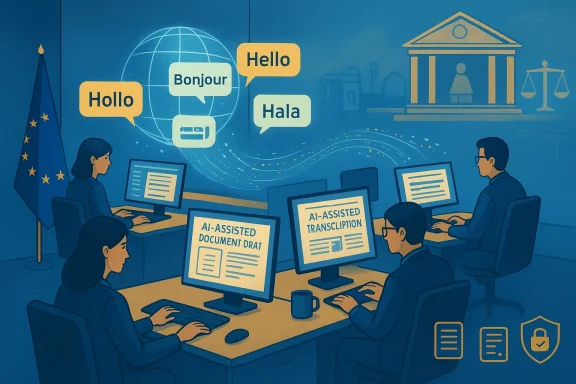 Where GenAI is being used across Europe
Internal productivity: drafting, summarising, translation and transcript workflows
- Civil‑service use often centers on document summarisation, meeting transcription, translation and first-draft creation. These tasks are high-volume and low‑risk compared with policymaking or operational command — which helps explain why they’re the low-hanging fruit for adoption. Evidence from multiple pilots shows consistent prododels are used as first-draft assistants rather than final decision-makers.
Citizen-facing chatbots, tourism and municipal services
- Cities are embedding LLMs into chat assistants for 24/7 citizen support — e.g., multilingual tourism assistants and municipal bots that handle routine queries and route complex cases to staff. These systems typically combine a retrieval layer (a controlled knowledge base) with cloud-hosted LLMs to reduce hallucinations and improve provenance. Independent rollouts frequently use managed cloud services (notably Azure OpenAI) to host the model back-end. Real-world deployments demonstrate accessibility improvements and measurable load reduction for human teams, but they also reveal the need for sustained oversight and content curation.
Education pilots with vendor partnerships
- Several European countries have moved to pilot AI in schools, partnering with major vendors to trial tailored education products. Estonia and Greece have announced national programs that use vendor versions tuned for schools, and Iceland launched a teacher pilot with Anthropic to give educators access to Claude for lesson planning and administrative relief. These programs emphasise training, limits on student access, and evaluation before widescale rollout.
Defence, but carefully bounded
- Headlines around defence AI often inflate the role of LLMs. Leading European startups — notably Mistral — have signed contracts with defence ministries and also partnered with defence tech firms (for example, Mistral’s strategic collaboration with Helsing) to work on vision-language-action systems and other specialist models. Public explanations emphasise that general-purpose chatbots are not being given operational targeting authority; instead, governments are using tailored AI for administrative tasks, data handling and to prototype domain-specific capabilities under strict controls.
The procurement landscape and vendor concentration
Microsoft as default: integration, convenience and risk
- For many EU administrations, Microsoft is the incumbent path to GenAI because of the dominant position of Microsoft 365 in government IT stacks. Integrating a Copilot‑type assistant into the productivity suite is operationally convenient and can be rolled out fast — as seen in major agreements like the Flemish government’s contract for 10,000 Copilot licences. But convenience carries strategic risk: deep technical and contractual dependence on a single foreign vendor creates exposure if geopolitical, legal or contractual circumstances change.
Choice vs. sovereignty
- Governments face a trade-off between rapid procurement of capable proprietary systems and longer-term investment in sovereign or in‑house solutions. The Commission’s GPT@EC is an institutional attempt to offer staff access to models under EU control, and other national initiatives pursue on‑prem or regionally hosted options. These moves aim to reduce legal and operational exposure — but they require substantial technical investment and sustained governance capacity.
The vendor playbook: partnerships and pilots
- OpenAI, Anthropic and Mistral have actively sought public-sector clients with education, startup support and productivity offers — OpenAI with tailored ChatGPT Edu pilots in countries like Greece and Estonia, Anthropic with national education pilots in Iceland, and Mistral winning targeted government contracts. These partnerships are important signals of vendor intent to capture public-sector demand, but they also spotlight the disparity in bargaining power and the need for procurement clauses that protect public data.
Data quality, shadow AI and the human factor
Data quality is the single biggest limiter
- Academics and practitioners repeatedly warn:d as the data they draw on. Public administrations frequently have outdated, fragmented, scanned or unstructured datasets — conditions that make hallucinations and incorrect summarisation more likely. That problem is amplified when models are allowed to probe production systems without strong retrieval‑anchoring or verification steps. Euractiv’s reporting highlights civil‑servant optimism but stresses that many early uses are experimental and often rely on general-purpose chatbots used informally — a phenomenon labelled “shadow AI.”
Shadow AI: unofficial use, official risk
- Frontline staff trying to save time often turn to freely available chatbots even when not sanctioned. This creates uncontrolled data flows (sensitive prompts and files sent to external APIs), audit gaps and compliance exposure. Governments must treat this behavioural reality as a governance problem, not merely a technical one.
Human-in-the-loop and auditability
- For high-stakes outputs — legal texts, eligibility recommendations, national security analyses — a documented human verification step is essential. This includes prompt logging, tamper-evident records and systematic retention of AI interactions for audits. Where deployments are permitted, agencies should mandate guardrails and independent red-team testing. Several countries’ pilot reports and policy playbooks recommend these controls as non-negotiable.
Legal and privacy constraints: GDPR, sovereignty and procurement clauses
- Any public-sector AI use in the EU must account for the GDPR’s requirements on personal data processing, data minimisation, purpose limitation and lawful basis. Governments must ensure that vendor contracts explicitly prevent the use of government inputs for training external models unless explicitly negotiated and legally protected.
- Procurement must include enforceable terms on data residency, telemetry access, training‑data exclusion, audit rights and the right to inspect model provenance. These contractual protections can reduce risk but are not bulletproof in extreme geopolitical scenarios. Independent audits, escrow arrangements and the possibility of migrating workloads are practical procurement levers.
Strengths: what GenAI brings to the public sector
- Speed and scale: LLMs dramatically shorten the time to draft, summarise and translate large volumes of text — real time savings that are attractive to understaffed administrations.
- Accessibility and multilingual service: Generative assistants expand the ability to offer 24/7 citizen service in many languages, improving inclusion for non‑native speakers and tourists.
- Knowledge retrieval: When paired with a retrieval‑augmented design, GenAI can act as a powerful search layer over fragmented internal knowledge stores.
- Workforce enablement: Properly governed, these tools reduce low‑value administrative workload and free staff for complex judgement tasks — provided staff are trained to understand model limits and verification needs.
Risks and blind spots
- Hallucinations and correctness: Confident but incorrect outputs remain the single most visible risk when models are used unchecked in administrative or public‑facing contexts.
- Hidden dependencies and vendor lock‑in: Deep integration with a single vendor’s productivity suite or cloud stack can be costly and strategically risky.
- Data leakage and GDPR exposure: Informal use of consumer chatbots creates legal risk; even managed services can expose data if procurement lacks robust safeguards.
- Operational brittleness: Many pilots report that AI accelerates some tasks but increases editing burden and requires continuous curation. The initial boost may fade if maintenance, monitoring and human oversight are under‑resourced.
Practical governance checklist for governments (recommended)
- Define a use‑case taxonomy: classify cases into low-, medium- and high‑risk groups and allow GenAI only where risk controls match sensitivity.
- Mandate prompt and response logging for any GenAI used in official work; preserve logs in tamper‑evident archives.
- Require procurement clauses that:
- forbid vendors from using government inputs to train external models without explicit consent;
- guarantee data residency and specify legal jurisdictions for data access;
- permit independent audits and red-team testing.
- Enforce human‑in‑the‑loop for all outputs that affect rights, entitlements, or critical public services.
- Pilot with a retrieval‑augmented architecture (RAG) and source citation: prefer document‑grounded assistants over free‑form open web access for factual tasks.
- Invest in staff training and appoint empowered Chief AI Officers (CAIOs) per agency to oversee deployment, audit and workforce transition.
Case studies and corroboration
- France & Mistral: The French Armed Forces’ use of Mistral models for transcription, translation and document analysis — rather than operational targeting — was reported as a measured example of defence-sector GenAI use. That deployment sits alongside a strategic Mistral–Helsing partnership focused on vision-language-action models for defence applications, underlining the careful separation between administrative and operational systems.
- Flanders & Microsoft Copilot: Flanders’ 10,000‑seat Copilot licensing deal demonstrates the speed at which regional governments can choose integration for productivity gains — and the vendor‑concentration risk that follows. Coverage of the Flanders contract and municipal pilots (e.g., Antwerp) shows measurable productivity promises, but also highlights the need for training and GDPR oversight.
- Commission’s GPT@EC: The European Commission’s internal GPT@EC rollout is an explicit institutional attempt to offer staff varied model choices and to host some processing under EU control to reduce third‑party exposure. That model underlines the dual approach: buy where efficient, build where sovereignty is essential.
- Education pilots: Estonia’s national AI-in-education initiative and Greece’s ChatGPT Edu pilot (and Iceland’s Anthropic pilot for teachers) show governments focusing on training, limited pilots and staged expansion rather than wholesale adoption. These projects explicitly pair vendor technology with teacher training, controls and evaluation windows.
What to watch next
- Sovereign infrastructure investments: expect more funding and announcements around on‑shore compute, sovereign cloud offerings and regional data centres designed to host AI workloads under national control.
- Procurement evolution: developing standard contract language that limits training‑data exposure, grants audit rights and clarifies legal recourse will be an urgent priority for public buyers.
- Transparency and public reporting: citizens and oversight bodies will demand clearer disclosures about when AI was used, what models were involved, and how human oversight was applied. Expect pressure for published transparency statements and technical detail on use cases.
- Independent evaluation: vendor ca, but independent audits and third‑party performance assessments will become the gold standard for validating claims about accuracy, scale and data handling.
Conclusion
Generative AI is not a magic bullet but a potent productivity tool when confined to well‑scoped, governed use cases. European governments are moving quickly — pragmatically choosing transcription, translation, retrieval‑anchored assistants and education pilots as the leading frontiers — while also wrestling with obvious trade‑offs: convenience versus sovereignty, speed versus auditability, and short‑term gains versus long‑term vendor dependence. Euractiv’s reporting captures both the enthusiasm and the caution on the front lines of public administration: GenAI can help understaffed civil services catch up with backlogs, but only if adoption is tethered to robust procurement terms, human verification, continuous auditing and a clear plan to protect citizens’ data and rights.Source: Euractiv https://www.euractiv.com/news/how-europes-governments-are-using-genai/
