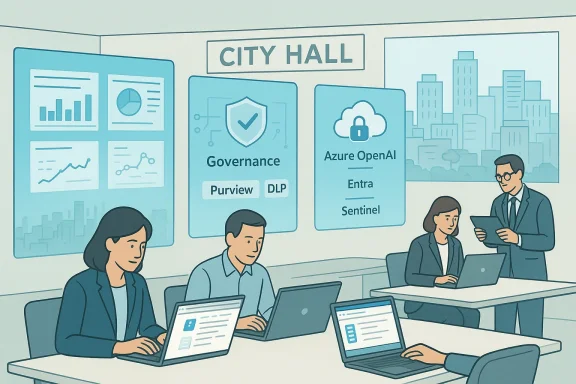
Microsoft’s playbook for bringing AI into city halls is deliberately unglamorous: don’t rip out core systems, embed intelligence into the tools people already use, and bake governance and compliance into the data layer so cities can scale from pilot to production without blowing up budgets or trust.
Local governments face a familiar squeeze: stretched budgets, rising citizen expectations for instant digital services, aging infrastructure, and complex long-term problems such as climate resilience and social inclusion. This pressure has accelerated interest in generative AI and data-driven tooling, not as a magic bullet but as a way to reduce administrative burden and augment human decision-making. SmartCitiesWorld captured this shift, describing Microsoft’s approach as one that focuses on embedding AI across cloud, data, and productivity stacks already in municipal use.
Microsoft’s public‑sector strategy reflects a pragmatic acceptance of how government IT actually works: agencies rarely want wholesale system rip-and-replace projects. They want incremental improvements that slot into current workflows, meet compliance needs, and deliver measurable time or cost savings. That’s the context behind Microsoft’s emphasis on three linked pillars: productivity copilots for employees, unified data and governance via Fabric and Purview, and secure cloud infrastructure (Azure + Azure OpenAI) for custom services and citizen-facing experiences.
Why it matters: Embedding AI into familiar apps reduces change fatigue and speeds adoption. Microsoft also markets specialised government variants (GCC, GCC‑High, DoD) that are designed to meet stricter compliance and data residency requirements; rollout timelines for these environments have been staged and communicated through Microsoft’s public sector roadmaps. However, availability and the exact feature set in high‑security clouds can lag commercial releases.
Why it matters: For cities that need predictive maintenance, demand forecasting, or “digital twin” simulations, the unified Fabric environment reduces ETL complexity and enables cross‑departmental data sharing under common governance. Fabric’s monitoring hub and capacity metrics also help IT managers oversee consumption and performance.
Why it matters: Public trust depends on demonstrable controls. When a city uses AI to triage complaints, allocate benefits, or model flood risk, officials must be able to show who accessed what data, how an AI recommendation was derived, and which policies governed that data. Purview’s lineage and audit features are designed to enable that accountability.
lear, published policies on acceptable AI use, red‑line functions (what AI cannot do), data retention, and recourse procedures.
That said, the model is not risk‑free. Vendor concentration, model reliability, hidden run costs, and the difficulty of cataloguing and governing sprawling civic data estates are substantial hurdles. City leaders who succeed will be the ones who combine Microsoft’s integrated toolset with rigorous procurement discipline, independent validation of vendor claims, and a long view on skilling and governance. Where those elements line up, AI can move from novelty to a reliable tool that reduces admin load, improves citizen responsiveness, and helps cities plan better for an uncertain future.
Conclusion
AI for local government is less about flashy pilots and more about plumbing: secure data pipelines, auditable governance, and productivity tools that empower staff without surrendering oversight. Microsoft’s stack—Copilot, Fabric and Purview, Azure compute, and identity and security services—provides a coherent toolbox for cities willing to invest in governance, skills, and independent validation. That combination increases the odds that local governments will not just experiment with AI, but actually bend the curve on service delivery and community outcomes—provided they proceed with disciplined transparency and an appetite for rigorous evaluation.
Source: Smart Cities World https://www.smartcitiesworld.net/sp...ofts-approach-to-ai-powered-local-government/
 Background
Local governments face a familiar squeeze: stretched budgets, rising citizen expectations for instant digital services, aging infrastructure, and complex long-term problems such as climate resilience and social inclusion. This pressure has accelerated interest in generative AI and data-driven tooling, not as a magic bullet but as a way to reduce administrative burden and augment human decision-making. SmartCitiesWorld captured this shift, describing Microsoft’s approach as one that focuses on embedding AI across cloud, data, and productivity stacks already in municipal use. Microsoft’s public‑sector strategy reflects a pragmatic acceptance of how government IT actually works: agencies rarely want wholesale system rip-and-replace projects. They want incremental improvements that slot into current workflows, meet compliance needs, and deliver measurable time or cost savings. That’s the context behind Microsoft’s emphasis on three linked pillars: productivity copilots for employees, unified data and governance via Fabric and Purview, and secure cloud infrastructure (Azure + Azure OpenAI) for custom services and citizen-facing experiences.
Overview: What “AI for local government” looks like at Microsoft
Microsoft frames AI not as a single product but as capabilities surfaced across existing products and platforms. In practice that means:- Embedding Microsoft 365 Copilot into Word, Excel, Teams and other day‑to‑day apps to automate drafting, summarisation, and knowledge retrieval.
- Offering Copilot Studio and the Azure OpenAI Service as ways for IT teams and partners to build customised assistants and workflow automation for permits, casework, and 24/7 citizen support.
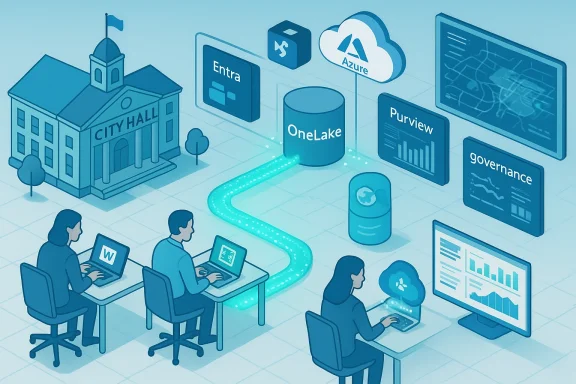
- Using Microsoft Fabric as the unified data platform and Microsoft Purview to provide cataloguing, sensitivity labels, DLP, lineage and audit trails so decisions supported by AI are provably governed and traceable.
Core components explained
Microsoft 365 Copilot and Copilot Studio
What it does: Copilot injects generative AI into everyday productivity apps, turning long meeting notes into concise action lists, drafting policy memos, and surfacing relevant documents from multiple systems. For government, the promise is time savings on routine tasks so staff can focus on complex policy and frontline services.Why it matters: Embedding AI into familiar apps reduces change fatigue and speeds adoption. Microsoft also markets specialised government variants (GCC, GCC‑High, DoD) that are designed to meet stricter compliance and data residency requirements; rollout timelines for these environments have been staged and communicated through Microsoft’s public sector roadmaps. However, availability and the exact feature set in high‑security clouds can lag commercial releases.
Microsoft Fabric (OneLake, analytics, unified governance)
What it does: Fabric provides a single environment for lakehouse, warehouse, and analytics workloads (OneLake as the storage layer) so planners and data teams can combine sensor feeds, asset inventories, and citizen data in one place. Fabric’s goal is to shorten time from data to insight and enable scenario modelling (e.g., transport load, climate risk, preventive maintenance).Why it matters: For cities that need predictive maintenance, demand forecasting, or “digital twin” simulations, the unified Fabric environment reduces ETL complexity and enables cross‑departmental data sharing under common governance. Fabric’s monitoring hub and capacity metrics also help IT managers oversee consumption and performance.
Microsoft Purview (data governance, DLP, labels, lineage)
What it does: Purview provides the governance layer that catalogs data assets, enforces sensitivity labels, applies DLP for supported item types, and records audit trails and lineage so outcomes can be traced back to inputs. Microsoft has increasingly integrated Purview with Fabric to provide a single pane for data governance.Why it matters: Public trust depends on demonstrable controls. When a city uses AI to triage complaints, allocate benefits, or model flood risk, officials must be able to show who accessed what data, how an AI recommendation was derived, and which policies governed that data. Purview’s lineage and audit features are designed to enable that accountability.
Azure + Azure OpenAI + Entra + Sentinel
These components provide the compute, model access, identity management, and security monitoring that underpin Copilot and custom citizen agents. Entra (identity) and Sentinel (SIEM) enable role‑based access, multifactor protections, and continuous monitoring that governments require for sensitive workloads. Azure OpenAI allows municipalities and partners to run tuned models or use foundation models behind controlled APIs. Microsoft’s messaging around the stack stresses a trustworthy AI posture with human-in-the-loop controls.Early adopters and real‑world case studies
Microsoft and its partners have circulated multiple municipal examples where Copilot and Fabric were used to reduce processing times and administrative workloads. These are typically vendor or customer case studies and should be read as indicative rather than independently audited.- Torfaen County Borough Council and several UK councils reported staff time savings from automating meeting minutes and onboarding tasks with Copilot.
- The City of Burlington used Power Platform and Copilot Studio to build a permit‑tracking assistant, reporting permit lead times reduced from roughly 15 weeks to 5–7 weeks in their account.
- Microsoft’s customer story compendium includes examples such as Aberdeen City Council and Barnsley Council showing productivity gains after Copilot adoption. These examples highlight outcomes but are primarily vendor‑published case studies rather than third‑party evaluations.
Strengths of Microsoft’s approach
- Incremental adoption: Embedding AI into tools staff already use significantly lowers adoption friction and limits the need for extensive retraining. This makes "AI in local government" more operationally realistic.
- Integrated governance: The Fabric + Purview integration provides a path to apply sensitivity labels, DLP, and lineage consistently across analytic pipelines—critical for regulated data such as health or social services. Microsoft documentation and security blogs confirm ongoing investment in this integration.
- Compliance‑aware variants: Microsoft’s GCC/GCC‑High/DoD and sovereign region programs show an understanding of the regulatory differences across jurisdictions and provide technical mechanisms (isolated clouds, local regions) to satisfy local rules.
- Partner ecosystem and delivery model: Marketplace offerings and consulting partners reduce time to production with prebuilt governance templates and implementation accelerators for Fabric + Purview. This matters for councils without large in‑house data teams.
Risks, blind spots, and governance challenges
Microsoft’s architecture reduces some risks but introduces others that city leaders must actively manage.- Vendor lock‑in and architectural coupling. When you tie citizen services, analytics, and governance into a single vendor stack, migration or multi‑vendor strategies become harder. Fabric + Purview reduce integration pain, but they also centralise control with Microsoft—procurement teams should explicitly evaluate exit options and data portability.
- Claims vs verifiable impact. Many time‑saving or outcome figures come from vendor or customer case studies that lack independent verification. Treat claimed reductions in processing times or staffing hours as promising but provisional until validated by third‑party evaluation or internal audits.
- Model risk: hallucinations and factual drift. Generative models can produce plausible but incorrect outputs. In government contexts—legal, benefits, regulatory decisions—such errors can have high costs. Operational deployments must include human review gates, clear audit trails, and policies that restrict generative answers in high‑risk workflows. Microsoft’s guidance and documentation emphasise human oversight, but implementation is the city’s responsibility.
- Data protection and privacy complexity. Even with Purview, correctly classifying citizen data at scale is hard. False negatives leave PII exposed; false positives can over‑restrict data and break services. Effective deployment requires sustained investment in data cataloguing, stewards, and domain taxonomies—not a one‑off project.
- Cost and procurement governance. Cloud compute for inference and large‑scale analytics can be expensive. Many city budgets underestimate ongoing operational costs (model hosting, GPU hours, storage, backup, monitoring). Contracts and business cases should include consumption scenarios, SLAs for data residency and availability, and an SRO accountable for run‑costs.
- Skills and change management. Microsoft highlights skilling programs and Copilot Centres of Excellence, and some national deals bundle skilling into the delivery. But local governments need sustained learning programs for data stewards, privacy officers, and front‑line staff to interpret AI outputs responsibly.
Practical checklist for city CIOs and council leaders
If you’re responsible for delivering AI-powered services in a municipality, consider this pragmatic roadmap:- Start small with high‑value, low‑risk pilots (e.g., automating meeting minutes, document triage). Document baseline metrics.
- Establish a data governance foundation before scaling—catalogue sources, assign data stewards, and deploy sensitivity labels. Use Purview + Fabric where appropriate, and verify supported DLP coverage for your item types.
- Require human‑in‑the‑loop for any decision with legal or welfare outcomes. Log every model output and the context used to generate it for auditability.
- Build a financial model that includes inference and storage costs, SLA penalties, and an exit plan to avoid surprise costs.
- Insist on independent evaluation of vendor claims—run third‑party tests or internal audits to validate time savings and accuracy claims before scaling.
- Include the public and legal teams early. Transparent privacy notices and public consultation increase trust—and, in some jurisdictions, are regulatory prerequisites.
- Invest in upskilling and create a Copilot Centre of Excellence (or equivalent) to democratise safe usage patterns and reusable templates.
How to balance ambition with prudence: a governance framework
A city governance model for AI should include:lear, published policies on acceptable AI use, red‑line functions (what AI cannot do), data retention, and recourse procedures.
- Technical controls: Role‑based access (Entra), sensitivity labels (Purview), DLP, model‑query logging, and SIEM monitoring (Sentinel).
- Operational practices: Test datasets, bias audits, performance SLAs, and a schedule for model refresh/retrain.
- Transparency & redress: Public reporting on automated decision systems, a way for residents to challenge AI‑assisted outcomes, and impact assessments for high‑risk uses.
- Independent oversight: Internal audit or external advisory board to evaluate deployments against policy and societal impact.
The smart‑cities opportunity: where measurable wins live
AI will show early, measurable returns where processes are repetitive, transaction volumes are high, and human review remains feasible. Examples include:- Permit processing and case management (reduced routing time, better status transparency).
- Contact centres and citizen self‑service agents (24/7 triage with fallback to humans for complex queries).
- Predictive maintenance for public assets (water, transit, lighting) using Fabric‑powered analytics and modelled scenarios.
Final assessment: practical, not panoptic
Microsoft’s approach to AI in local government is intentionally pragmatic: it prioritises incremental adoption, familiar user experiences, and a governance-first data posture. Those design choices match the organisational realities of many councils and municipalities and create a credible path from pilot to production.That said, the model is not risk‑free. Vendor concentration, model reliability, hidden run costs, and the difficulty of cataloguing and governing sprawling civic data estates are substantial hurdles. City leaders who succeed will be the ones who combine Microsoft’s integrated toolset with rigorous procurement discipline, independent validation of vendor claims, and a long view on skilling and governance. Where those elements line up, AI can move from novelty to a reliable tool that reduces admin load, improves citizen responsiveness, and helps cities plan better for an uncertain future.
Conclusion
AI for local government is less about flashy pilots and more about plumbing: secure data pipelines, auditable governance, and productivity tools that empower staff without surrendering oversight. Microsoft’s stack—Copilot, Fabric and Purview, Azure compute, and identity and security services—provides a coherent toolbox for cities willing to invest in governance, skills, and independent validation. That combination increases the odds that local governments will not just experiment with AI, but actually bend the curve on service delivery and community outcomes—provided they proceed with disciplined transparency and an appetite for rigorous evaluation.
Source: Smart Cities World https://www.smartcitiesworld.net/sp...ofts-approach-to-ai-powered-local-government/