

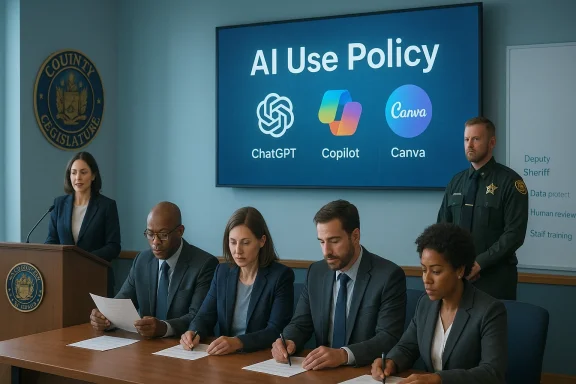
A modest January meeting in Penn Yan produced a consequential decision for Yates County’s technology and governance future: the legislature formally adopted a countywide Artificial Intelligence Use Policy, approved staffing and contract measures, and moved forward several programs funded by opioid settlements — all signals that even small local governments are now making lasting choices about AI, data handling, and digital risk. The new policy names specific tools (including ChatGPT, Microsoft CoPilot, and Canva), forbids AI use with protected or confidential data, mandates human review and transparency for AI-generated content, and establishes an AI Review Committee and training requirements for county employees. That adoption is a practical milestone — and a useful case study in how local governments can balance innovation with privacy, security, and legal compliance.
Local governments are data-rich organizations: personnel records, benefits and payroll, public safety incident reports, public health data, social services case files, and vendor contracts. That makes them both ripe for efficiency gains from AI (drafting public-facing materials, summarizing reports, supporting caseworkers) and vulnerable to data leakage, privacy violations, and legal risks.
Over the past three years, municipal and county governments have moved from informal guidance (“don’t paste Social Security numbers into a chatbot”) to formal policies and procurement changes. Yates County’s move follows this pattern: codify boundaries, authorize approved vendor/consumer tools, require oversight, and set consequences for misuse. For counties with modest IT staffing and limited legal resources, such a policy is often the first practical line of defense against accidental exposure of sensitive data.
Practical implication: County staff must treat AI as an external processing service. No uploading or copy/pasting of case-level health data, client financial records, or any PII into consumer-grade AI tools. That is a sensible baseline, but compliance depends on training and enforcement.
Practical implication: The county recognizes mainstream tools and gives IT the authority to centralize approvals. That’s useful — but it raises questions about which tier of each tool is permitted (consumer vs. enterprise) and whether written vendor assurances (Data Processing Addenda, DPAs) must be in place.
Practical implication: This is an immediate safeguard against hallucinations and misstatements generated by LLMs, and it helps maintain public trust. That said, the policy places the burden of verification on staff without laying out precise QA processes or audit trails.
Practical implication: The inclusion of training and sanctions is vital. The community-level test will be consistent training rollouts, IT monitoring capabilities, and whether the county can meaningfully audit usage.
The county’s decision to name popular platforms by example (ChatGPT, Microsoft CoPilot, Canva) is pragmatic, but it must be paired with explicit vendor-level protections and procurement standards. For local governments across the country, Yates County’s approach offers a replicable model: define limits, delegate technical authority, demand accountability, and plan for iterative improvement. The next chapters will be written in contract negotiations, help-desk tickets, audit logs, and the committee’s meeting minutes — all the operational plumbing that turns policy into practice.
If you work in a county IT shop or manage public-sector procurement, take Yates County’s policy as an invitation: review your contracts, inventory current AI use, and make a prioritized remediation plan. AI can accelerate public services, but only when policy, procurement, training, and technical controls are intentionally aligned.
Source: fingerlakes1.com Yates County lawmakers approve AI policy, contracts | Fingerlakes1.com
 Background — why a county AI policy matters
Local governments are data-rich organizations: personnel records, benefits and payroll, public safety incident reports, public health data, social services case files, and vendor contracts. That makes them both ripe for efficiency gains from AI (drafting public-facing materials, summarizing reports, supporting caseworkers) and vulnerable to data leakage, privacy violations, and legal risks.Over the past three years, municipal and county governments have moved from informal guidance (“don’t paste Social Security numbers into a chatbot”) to formal policies and procurement changes. Yates County’s move follows this pattern: codify boundaries, authorize approved vendor/consumer tools, require oversight, and set consequences for misuse. For counties with modest IT staffing and limited legal resources, such a policy is often the first practical line of defense against accidental exposure of sensitive data.
Overview of the Yates County action
The Yates County Legislature’s January meeting included a package of resolutions: adoption of an AI use policy, authorization to create a new deputy sheriff position (with an estimated annual cost range including benefits), ratification of a multi‑year labor agreement, and multiple contracts tied to broadband, website hosting, opioid-settlement programming and airport improvements. The AI policy — documented in the county’s official meeting packet and discussed at the January session — does several things at once:- Defines the scope of the policy to cover all elected officials, department heads, employees, and interns, and applies when AI is actively used to generate content.
- Prohibits use of AI for protected or confidential data, explicitly referencing PII, medical records, financial information, and data protected by laws such as HIPAA.
- Requires human verification and departmental review for AI-generated public documents, and mandates transparency when AI produced content is used.
- Names a preliminary list of allowed/“preferred” tools (for now: ChatGPT, Microsoft CoPilot, and Canva), while reserving the IT Director’s right to amend that list and block unsafe applications.
- Creates an AI Review Committee led by the IT Director to monitor developments, recommend policy changes, and conduct annual testing of the policy’s effectiveness.
- Establishes training, reporting lines, and sanctions: staff must undergo awareness campaigns, report ethical concerns, and face disciplinary action up to termination for violations.
What the policy actually says — key provisions and practical implications
The policy text attached to the county’s legislative agenda is concrete and operational. Below are the most consequential provisions and what they mean on the ground:Prohibition on protected/confidential data
The policy forbids any use of generative AI to process or generate content that involves Protected or Confidential Data — defined inclusively to cover PII, Social Security numbers, medical records, financial information, and anything protected by applicable laws (including HIPAA).Practical implication: County staff must treat AI as an external processing service. No uploading or copy/pasting of case-level health data, client financial records, or any PII into consumer-grade AI tools. That is a sensible baseline, but compliance depends on training and enforcement.
Approved/Preferred tools and IT oversight
The policy lists ChatGPT, Microsoft CoPilot, and Canva as current preferred applications and gives the IT Director authority to amend the list and to block applications deemed “unreliable, unsafe or unsecure.”Practical implication: The county recognizes mainstream tools and gives IT the authority to centralize approvals. That’s useful — but it raises questions about which tier of each tool is permitted (consumer vs. enterprise) and whether written vendor assurances (Data Processing Addenda, DPAs) must be in place.
Human review, transparency, and departmental signoff
AI-generated public documents must be verified for accuracy and reviewed by a department head or designee before external release. Documents must clearly indicate when AI was used.Practical implication: This is an immediate safeguard against hallucinations and misstatements generated by LLMs, and it helps maintain public trust. That said, the policy places the burden of verification on staff without laying out precise QA processes or audit trails.
Training, monitoring, and sanctions
The county will run awareness campaigns, require staff training, and the county’s AI Review Committee will review policy effectiveness periodically. Noncompliance can lead to disciplinary action including termination.Practical implication: The inclusion of training and sanctions is vital. The community-level test will be consistent training rollouts, IT monitoring capabilities, and whether the county can meaningfully audit usage.
Strengths of the Yates County approach
Yates County’s policy demonstrates several practical strengths that other local governments could emulate:- Clear boundary-setting. By explicitly forbidding AI use with protected/confidential data, the county reduces the chance of obvious privacy breaches.
- Operational controls delegated to IT. Giving the IT Director the authority to approve/ block tools creates a single accountability point for technical risk assessment.
- Human-in-the-loop requirement. Mandating department head review before public release mitigates hallucination and reputational risk.
- Formal governance structure. Creating an AI Review Committee and requiring training shows the county expects AI to be an ongoing program, not a one-off memo.
- Recognizes nuance. The policy excludes “embedded” AI that is not actively invoked (e.g., navigation, autocorrect), which prevents overreach and allows routine vendor software to continue functioning.
Risks, gaps, and operational challenges
No policy is a silver bullet. Below are meaningful risks and practical gaps that Yates County (and similar jurisdictions) should address even as the policy stands as a solid first step.1) Ambiguity about vendor tiers and contract-level protections
The policy permits tools by name (ChatGPT, Microsoft CoPilot, Canva) but does not explicitly require enterprise-tier contracts, Data Processing Agreements (DPAs), or contractual guarantees that vendor log/retention settings exclude county data from model training.- Why it matters: Consumer-grade accounts often use interaction data to refine models or retain it for longer periods. Enterprise agreements (e.g., ChatGPT Enterprise, Microsoft 365 Copilot for Enterprise, or platform-specific DPAs) frequently include non-training commitments, longer-term logging controls, and contractual indemnities.
- What to do: The county should tie permitted-tool use to proof of enterprise or business-level contracts (or explicit DPAs) that prevent those services from using county content for model training and specify retention and breach-notification terms.
2) Detection and enforcement capability
The policy allows IT to block sites and tasks IT deems unsafe, but many staff use mobile devices or personal accounts; shadow IT is an enduring challenge.- Why it matters: Without monitoring and network-level controls, staff may use unsanctioned apps to accomplish tasks quickly, bypassing controls and potentially exfiltrating data.
- What to do: Implement network filtering, endpoint monitoring, and clear reporting mechanisms. Consider a phased rollout of sanctioned tools with single sign-on (SSO) and enforced use of business accounts.
3) Lack of specificity on logging, audit trails, and retention of AI interactions
The policy requires transparency and human verification but does not lay out how AI interactions will be logged, stored, or retained for audit.- Why it matters: If a piece of AI-generated content leads to legal exposure, having an auditable trail of who invoked the tool, what prompt was used, and what version of the model responded is crucial for investigations and remediation.
- What to do: Require that approved AI accounts be centrally provisioned, that prompts and outputs be logged into an internal ticketing or compliance system, and that logs be retained under the county’s document retention rules.
4) Risks from open-ended models: hallucinations, prompt injection, and bias
Although the policy mandates human review, it does not require specific QA steps, red-team testing, or mitigation for prompt injection attacks.- Why it matters: Large language models can invent facts, repeat training-set biases, or be manipulated by maliciously crafted prompts embedded in user content (prompt injection).
- What to do: Provide staff with a verification checklist; use automated detection where possible (e.g., citation requirements, confidence flags), and run periodic red-team exercises using sanitized datasets.
5) Data classification and operational workflows
The policy’s “protected or confidential” definition is broad but operationalizing that classification across departments (social services, public health, public safety) will be time-consuming.- Why it matters: Staff need quick, practical guidance (e.g., a short “can I paste this?” decision tree) so they do not default to unsafe behavior because classification seems complex.
- What to do: Produce job-specific quick-reference guides and embed classification rules into common workflows (forms, case management systems) so AI use is denied by design when sensitive fields are present.
Technical and legal context: what vendors actually offer
When an AI policy names specific platforms, it’s vital to match policy language to vendor guarantees. In broad strokes:- Major cloud vendors and enterprise AI offerings increasingly provide enterprise data protection and contractual assurances that enterprise interactions will not be used to train public models by default. Microsoft’s enterprise Copilot and OpenAI’s enterprise arrangements have published options and contractual additions that limit use of customer data for model training and offer enhanced security controls.
- Consumer and free-tier accounts (or non‑enterprise deployments) are more likely to use interaction data to improve models unless a user explicitly opts out or unless the vendor’s terms say otherwise.
- Different vendors have different default retention windows (temporary logs for abuse monitoring), and many provide DPAs and SOC 2 / ISO attestations at enterprise levels.
A 10-point operational checklist Yates County (or any county) should implement next
- Require enterprise contracts and DPAs for any sanctioned AI service; prohibit consumer accounts for official county business.
- Enforce SSO and centrally managed accounts for approved AI tools; disable use of personal accounts for government work.
- Implement network-level blocking/allowlisting so only approved endpoints can reach sanctioned AI APIs.
- Define logging and retention standards: log prompts, user IDs, timestamps, model versions, and outputs into a secure archive with access controls.
- Create job-specific quick-reference “Can I use AI?” Decision Trees for caseworkers, HR staff, public health, and deputies.
- Mandate a prompt-verification checklist: source citations, confirm facts, list assumptions, and identify potential biases before publishing.
- Assign the AI Review Committee explicit responsibilities and a quarterly cadence for policy review and incident tabletop exercises.
- Require vendor security attestations (SOC 2 Type II or equivalent) and periodic penetration testing evidence for hosted AI solutions.
- Integrate AI risk into existing incident response and breach notification plans; map AI misuse to potential legal liabilities (HIPAA, privacy laws).
- Plan for on-prem or closed‑environment AI options for high-risk workflows (run models within county cloud tenancy or partner with a managed service provider).
Broader governance lessons for local government IT leaders
Yates County’s policy — short and practical — contains the right pillars: risks are identified, limits are set, and oversight is established. But the government technology lifecycle is not solved by a policy alone. Effective AI governance for a county or municipal government requires:- Procurement alignment. IT, legal, and purchasing must coordinate. Purchasing enterprise contracts up front reduces risk and gives negotiating leverage for security and privacy clauses.
- User experience design. If staff find sanctioned tools harder to use than consumer tools, they will circumvent them. Usability and integration with existing workflows (email, case management systems) matter.
- Legal and privacy integration. Legal counsel must evaluate vendor terms, DPAs, and state-specific privacy obligations; HIPAA and child-protection laws create strict non-negotiable constraints for certain departments.
- Scaling training and internal communications. A single training session is insufficient; regular, role-based training and refreshers are necessary as tools change.
- Budgeting for managed AI. Expect to pay for enterprise-grade security and management; “free” consumer tools are the real cost if they create legal exposure.
Where Yates County is likely to be tested first
- Public communications and press releases. With AI now part of the authorized toolset, the county must be disciplined about verifying AI-generated text before it goes public. Errors here are visible and can erode public trust.
- Social services workflows. Social services and public health staff often need speed; the county must ensure these teams use only approved enterprise tools (or internal tools) when anything remotely sensitive is present.
- Procurement for broadband and IT contracts. As the county pursues broadband and other infrastructure contracts, vendor selection and contract drafting must include AI considerations and data protection language.
- Incident response. The first inadvertent leak or improper prompt will test whether reporting, documentation, and sanctions are effective.
Practical recommendations for immediate next steps
- Publish a short “How to use AI safely at work” placard for staff that answers three questions: (a) Can I paste this data into an AI tool? (b) Which account should I use? (c) Who do I contact if I suspect a breach?
- Require department heads to confirm they’ve trained staff and to report back to the AI Review Committee within 90 days.
- Audit existing third-party AI usage (are departments using Canva, ChatGPT, or Copilot via personal accounts?) and remediate risks.
- Negotiate DPAs for any AI vendor the county intends to use for county business; if a vendor refuses to exclude training on county data, disallow its use for county business.
- Start a pilot for a controlled AI deployment — e.g., an internally hosted assistant for non‑sensitive content with centralized logging — to learn technical and operational gaps.
Final assessment — a pragmatic first step with real work ahead
Yates County’s new Artificial Intelligence Use Policy is an important step from ambiguity to governance. It sets useful guardrails — prohibiting AI use with protected data, requiring human review, and centralizing approvals — that should materially reduce obvious privacy and legal risk. Yet the policy alone won’t prevent incidents without follow-through: enterprise contracts, centralized provisioning, logging, practical job-specific guidance, and continuous training.The county’s decision to name popular platforms by example (ChatGPT, Microsoft CoPilot, Canva) is pragmatic, but it must be paired with explicit vendor-level protections and procurement standards. For local governments across the country, Yates County’s approach offers a replicable model: define limits, delegate technical authority, demand accountability, and plan for iterative improvement. The next chapters will be written in contract negotiations, help-desk tickets, audit logs, and the committee’s meeting minutes — all the operational plumbing that turns policy into practice.
If you work in a county IT shop or manage public-sector procurement, take Yates County’s policy as an invitation: review your contracts, inventory current AI use, and make a prioritized remediation plan. AI can accelerate public services, but only when policy, procurement, training, and technical controls are intentionally aligned.
Source: fingerlakes1.com Yates County lawmakers approve AI policy, contracts | Fingerlakes1.com
