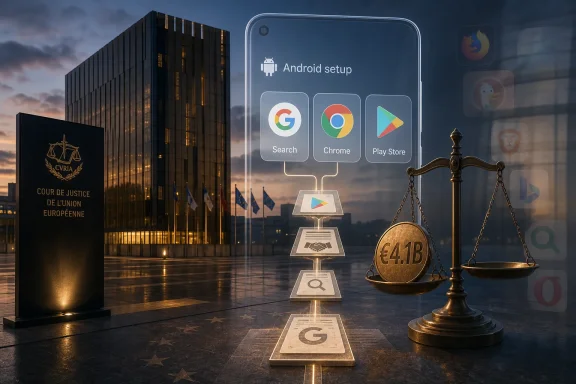
The Court of Justice of the European Union on July 2, 2026, dismissed Google and Alphabet’s final appeal in Luxembourg and confirmed a roughly €4.1 billion antitrust fine over Android agreements that tied manufacturers’ access to Google’s mobile ecosystem to Search, Chrome, and Play Store placement. The legal fight is over, but the argument it settled is still shaping every platform that wants to look open while steering users toward a house stack. For WindowsForum readers, the Android case is not just a mobile story; it is a warning label attached to default apps, bundled services, app stores, browser choice, and the economics of operating systems. Brussels has now put a judicial seal on a principle that Microsoft learned the hard way a generation ago: dominance becomes legally dangerous when distribution turns into destiny.
Google’s defense of Android has always rested on a truth that is also a strategy. Android is distributed as an open-source mobile operating system, and its availability helped create a vast hardware market outside Apple’s vertically integrated iPhone model. Device makers could ship smartphones at every price point, developers could target a global platform, and consumers could buy capable handsets without entering Apple’s walled garden.
But the European Commission’s Android case was never really about whether Android’s source code existed in public or whether manufacturers paid a sticker price for the operating system. It was about the contractual machinery around the commercially useful version of Android: the one with Google Play, Google Search, Chrome, and access to the app ecosystem users expected. In modern platform markets, the free thing is often the entrance hall. The toll booth is somewhere deeper inside the building.
The Commission’s 2018 decision accused Google of using Android’s position to cement Search’s dominance on mobile devices. Manufacturers that wanted the Play Store and core Google apps faced pre-installation conditions, while anti-fragmentation rules limited their ability to ship competing Android forks. The theory was blunt: Google did not merely win because users loved its products; it used control over must-have mobile distribution to make rival search engines and browsers fight uphill from the first boot screen.
That distinction matters because default placement is not cosmetic. Defaults shape behavior, especially on devices used by billions of people who do not customize every setting, install alternate browsers, or rethink search providers after unboxing a phone. Regulators called that inertia a competitive advantage. Google called it an ecosystem design that made Android useful, consistent, and viable against Apple.
The final judgment from the EU’s top court matters because it closes the escape hatch. Google and Alphabet challenged the General Court’s reasoning, but the Court of Justice dismissed the appeal and confirmed the revised penalty. In practical terms, the court did not merely approve a giant invoice. It endorsed the view that Android licensing conditions could restrict competition even in a market where the software was marketed as open and free.
That is why the case will echo beyond this one balance-sheet event. Regulators do not need to prove that every consumer was physically prevented from choosing another browser or search engine. They can focus on the economic reality of pre-installation, app-store dependency, and manufacturer incentives. The legal system has now accepted that platform leverage can operate through contracts, defaults, and technical conditions rather than crude exclusion.
For Google, the financial hit is survivable. Alphabet is not a fragile startup being dragged under by a one-time sanction. The greater cost is the precedent: a court-backed conclusion that the old Android playbook crossed a line in Europe. Even if the company has already changed its contracts, the ruling narrows the rhetorical space in which Big Tech can describe bundling as mere convenience.
But “Android” has always meant several things at once. There is the Android Open Source Project, which anyone can inspect and adapt. There is the Google-certified Android experience, which is what most consumers recognize. And then there is the commercial bundle of services that turns a phone into a device with Maps, Gmail, YouTube, Play Store, Chrome, and Google Search ready to go.
The EU case lived in that gap between open code and controlled distribution. A manufacturer could theoretically use Android without Google’s app layer, but a mainstream consumer handset without Play Store access is not a normal competitive proposition in most Western markets. The freedom to build an Android fork is less meaningful if doing so costs access to the applications and services users expect on day one.
That is why the anti-fragmentation issue was so important. Google argued that fragmentation would damage compatibility and developer confidence. The Commission saw restrictions that discouraged manufacturers from supporting alternative versions of Android that might have carried rival services. Both claims contain a piece of reality. Compatibility is valuable; lock-in is profitable.
The ruling does not mean every effort to maintain platform consistency is illegal. It does mean dominant firms cannot assume that technical coherence will excuse commercial arrangements that reinforce adjacent monopolies. In the Windows world, that lesson is familiar: a platform owner can have legitimate reasons to integrate components, but those reasons become suspect when integration forecloses competitors at scale.
The Android case is not a photocopy of the Microsoft browser wars. Google did not license Android the way Microsoft licensed Windows, mobile hardware economics differ from PC economics, and Apple’s iOS has always provided a powerful counter-model in the premium smartphone market. Still, the family resemblance is obvious enough to matter. Control the operating system, control the defaults, and you can shape the market before consumers make an active choice.
Microsoft eventually learned to live in a world where bundling carried legal and reputational risk. That history shaped everything from browser choice screens to Windows editions without certain media components, and later to the careful language around Edge, Bing, Teams, and Microsoft 365. The company has not stopped integrating services into Windows, but it now operates with a long institutional memory of what happens when integration looks like foreclosure.
Google’s Android judgment lands in a different era, one where the operating system is no longer the only choke point. App stores, identity systems, cloud sync, advertising networks, AI assistants, payment rails, and default search deals all operate as distribution infrastructure. The old Microsoft lesson has been upgraded for the platform age: dominance is no longer just about owning the desktop. It is about owning the path of least resistance.
For Windows users and administrators, that should feel less like ancient history than current affairs. Windows 11 pushes Microsoft accounts, OneDrive backup prompts, Edge recommendations, Bing integration, Copilot branding, and Store distribution in ways that blend product design with business strategy. The Android ruling is aimed at Google, but the legal mood it reflects applies to every company that treats defaults as a revenue engine.
Defaults win because most people do not change them. They win because the first icon seen, the first account prompted, and the first search box used become habits. They win because every additional click required to reach a rival product becomes a tax on competition. That is not an insult to users; it is a recognition of how human attention works.
The EU’s Android case formalizes that intuition in legal language. Pre-installation does not have to make rivals impossible to reach; it can make them less likely to be reached. Status quo bias is not a theoretical quirk. It is one of the foundations of consumer software distribution.
This is why browser and search fights keep returning, no matter how mature the internet seems. Search is not just a website; it is an advertising gateway, a data source, and increasingly a route into AI-generated answers. Browsers are not just rendering engines; they are identity containers, privacy policy surfaces, extension platforms, and payment toeholds. A default browser or search engine is a strategic beachhead.
Seen that way, a €4.1 billion fine is not simply punishment for old paperwork. It is a public valuation of default power. Brussels is saying that control over initial placement can be anticompetitive even when users retain a theoretical ability to switch later. That is a doctrine every platform owner will now have to keep in mind.
The EU’s Digital Markets Act was designed partly to escape that timing problem. Instead of litigating each practice after the fact, the DMA imposes up-front obligations on designated gatekeepers. It targets self-preferencing, data combination, interoperability barriers, app-store restrictions, and default-choice friction before a decade of litigation has passed.
That does not make the Android judgment obsolete. It gives the DMA a foundation. When regulators tell gatekeepers not to privilege their own services or not to make switching unnecessarily difficult, they can point to years of litigation showing why such conduct matters. Traditional antitrust supplied the theory; the DMA supplies the operating manual.
For Google, the overlap is uncomfortable. Android, Search, Chrome, Play, advertising technology, and now Gemini-era AI experiences all sit inside a business model where distribution advantages compound. The company can no longer assume that compliance means adjusting one contract and moving on. European oversight has become a permanent condition of operating at platform scale.
For Microsoft, Apple, Amazon, Meta, and ByteDance, the message is the same. Europe is not merely writing checks against past behavior. It is building a regulatory architecture for the next phase of computing, where assistants, app stores, operating systems, cloud services, and ads become increasingly intertwined. The Android ruling makes that architecture harder to dismiss as political theater.
The weakness is that pro-competitive outcomes in one layer do not immunize anti-competitive conduct in another. A platform can expand a market and still distort competition inside it. Windows helped democratize personal computing while attracting antitrust scrutiny. Amazon made online retail easier while raising questions about marketplace power. Apple built a secure app ecosystem while fighting accusations that its store rules suppress competition.
Google’s dilemma is that Android’s success made the surrounding contracts more powerful. The more essential Play Store access became, the more weight attached to the conditions required to obtain it. The more Android devices shipped globally, the more valuable Search and Chrome placement became. Scale turned a distribution arrangement into a market-shaping instrument.
That is the uncomfortable truth behind many platform defenses. Companies often say, correctly, that they created value. Regulators reply, also correctly, that creating value does not grant a perpetual license to control the lanes through which competitors must travel. The legal fight is not between innovation and regulation; it is over who gets to convert innovation into durable gatekeeping.
Google can still claim that Android remains more open than iOS. In many ways, it is. But the EU judgment says that comparative openness is not enough. A platform does not avoid antitrust liability merely by being less closed than its most closed rival.
A mainstream Android phone still needs access to the app ecosystem. Consumers still expect Google services on many devices. Developers still optimize for the dominant distribution channels. Carriers and retailers still prefer familiar software experiences that reduce support friction. These forces do not disappear because a court confirms a fine.
What manufacturers gain is leverage at the margins. They can negotiate in a regulatory environment where Google’s contractual freedom is more constrained. They can point to the judgment when resisting terms that appear to overreach. They may also find more room for regional variations, especially in markets where regulators are actively encouraging alternatives.
But the ruling does not magically create a robust third mobile ecosystem. Microsoft’s own failed Windows Phone effort is a reminder that operating-system competition is brutally path-dependent. App availability, developer attention, user habits, and services integration matter more than abstract technical merit. Once a platform market consolidates, reopening it is slow work.
That is why the EU focused on barriers before and during market consolidation. The case is partly about what rivals might have achieved had they not faced Google-favored defaults at massive scale. Courts cannot rewind the mobile market to 2011. They can only assign liability, constrain future conduct, and signal to current gatekeepers that similar tactics will be challenged earlier next time.
Browser developers understand this better than most. Building a good browser is difficult, but getting users to switch is harder. Search companies face the same problem. A technically competent product can lose not because users compare it and reject it, but because users never encounter it at the moment when habits form. That is the commercial significance of pre-installation.
The same logic now applies to AI assistants. The assistant that ships in the operating system, appears in the taskbar, answers from the search box, integrates with the browser, and authenticates through the default account enjoys advantages that independent developers cannot easily duplicate. If today’s regulators see Android-era bundling as anticompetitive, tomorrow’s cases may ask similar questions about AI layers embedded into Windows, Android, iOS, and browsers.
This matters for Windows developers watching Microsoft’s Copilot push. Microsoft is building AI into Windows, Office, Edge, GitHub, Azure, and security products at a speed that makes commercial sense. It also raises predictable competition questions. When a platform owner integrates an assistant into default workflows, third-party AI tools may technically remain available while practically becoming secondary.
The Android judgment therefore functions as a precedent for distribution scrutiny across software categories. It tells developers that regulators are increasingly willing to look beyond formal availability and examine whether platform design gives affiliated services a privileged path to users. That will not guarantee fair competition, but it gives challengers a stronger language for complaint.
The larger user impact is subtler. Regulators are trying to make choice appear earlier, more visibly, and with less friction. That can mean search-choice screens, browser-selection prompts, easier default changes, less aggressive tying of app stores to services, and fewer penalties for manufacturers that experiment. These are not glamorous reforms, but they attack the invisible architecture of habit.
There is a risk that such interventions become performative. Choice screens can be confusing, easily gamed, or ignored. Users may select familiar brands anyway. Smaller competitors may lack the quality, localization, or marketing resources to benefit. Regulation can open a door without guaranteeing that anyone compelling walks through it.
Still, the alternative is accepting that defaults chosen by platform owners are natural facts rather than business decisions. They are not. They are monetized design choices. When the first-run experience routes a user toward one search engine, one browser, one cloud backup service, or one assistant, the platform is making a commercial bet with the user’s attention.
The EU judgment strengthens the idea that those bets deserve scrutiny when made by dominant firms. That is not paternalism so much as realism. The market does not begin after the user changes the default; it begins before the user sees the default at all.
That gap has narrowed. U.S. regulators and courts have become more aggressive toward Big Tech, with cases involving Google search distribution, app stores, advertising technology, Amazon’s marketplace, Meta’s acquisitions, and Apple’s iPhone ecosystem. The legal standards differ, but the plot is increasingly familiar: dominant platforms are accused of using control over distribution to protect adjacent businesses.
The Android ruling will not dictate American outcomes. European competition law has its own concepts, institutions, and enforcement culture. But global regulators learn from one another, and large platform cases now travel internationally through briefs, expert testimony, academic commentary, and political pressure. A final judgment from Europe’s top court gives antitrust officials elsewhere a worked example of how to frame defaults and bundling as competitive harms.
India is also relevant. Its competition authority has scrutinized Google’s Android practices and imposed penalties tied to similar concerns. That does not mean every jurisdiction will copy Brussels line by line, but the convergence is real. The more courts uphold cases against tying, pre-installation, and ecosystem restrictions, the harder it becomes for platforms to describe each dispute as a local misunderstanding.
For multinational technology companies, compliance is becoming less about satisfying one regulator and more about designing products that can survive multiple legal regimes. That creates cost, complexity, and sometimes inconsistent user experiences. It also changes product planning. Legal review is no longer an after-the-fact department; it is part of platform architecture.
The real threat is behavioral. If regulators can force gatekeepers to loosen tying arrangements, reduce default advantages, permit alternative stores or billing systems, and create genuine switching paths, the platform owner’s economics change over time. Margins may be pressured not by a single fine but by a thousand small concessions that make distribution less automatic.
That is why companies fight these cases so hard even when they can afford the check. The money matters, but the precedent matters more. A lost appeal becomes a tool for future regulators, competitors, class-action lawyers, and legislators. It becomes part of the background assumption in every negotiation over access to a dominant ecosystem.
The Android case also shows that delay is a strategy with limits. Google fought for years and achieved a reduction in the penalty, but the core decision survived. Meanwhile, Europe built the DMA, global scrutiny intensified, and the public narrative around Big Tech shifted from admiration to suspicion. Winning time did not mean winning the argument.
For platform companies, the lesson is increasingly clear. The safest legal path is not merely to document why integration benefits users. It is to design switching, interoperability, and rival access as first-class features before regulators force them into the product. That is a difficult cultural shift for companies built on controlling the user journey end to end.
Microsoft today is not the Microsoft of 1998, but it remains a platform owner with powerful incentives. Windows is a gateway to search, cloud storage, productivity subscriptions, identity services, gaming, security, developer tools, and AI. Each integration can be defended as user convenience. Each can also become a distribution advantage for Microsoft’s own services.
The European Commission has already shown interest in Microsoft’s bundling choices, most notably around Teams and Microsoft 365. The company has made changes in Europe, but the broader question is not going away. As AI becomes a default layer in operating systems, regulators will ask whether built-in assistants and cloud-connected features create the same kind of unfair head start that Search and Chrome enjoyed through Android placement.
That does not mean every Windows integration is abusive. Users often benefit when features are built in, patched centrally, and supported by the platform vendor. Security tools, accessibility features, backup services, and device management hooks can be stronger when integrated. The challenge is distinguishing integration that improves the platform from integration that colonizes adjacent markets.
The Android judgment sharpens that distinction. It tells platform owners that courts may look past the surface language of convenience and ask whether rivals have a realistic path to users. That question now hangs over every major operating system, including Windows.
The most concrete lessons are not abstract. They are visible in the way platforms are designed, licensed, and monetized.
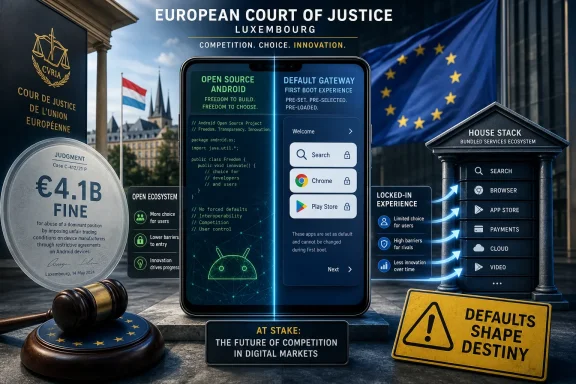 Europe Turns Android’s Free Ride Into a Competition Case
Google’s defense of Android has always rested on a truth that is also a strategy. Android is distributed as an open-source mobile operating system, and its availability helped create a vast hardware market outside Apple’s vertically integrated iPhone model. Device makers could ship smartphones at every price point, developers could target a global platform, and consumers could buy capable handsets without entering Apple’s walled garden.But the European Commission’s Android case was never really about whether Android’s source code existed in public or whether manufacturers paid a sticker price for the operating system. It was about the contractual machinery around the commercially useful version of Android: the one with Google Play, Google Search, Chrome, and access to the app ecosystem users expected. In modern platform markets, the free thing is often the entrance hall. The toll booth is somewhere deeper inside the building.
The Commission’s 2018 decision accused Google of using Android’s position to cement Search’s dominance on mobile devices. Manufacturers that wanted the Play Store and core Google apps faced pre-installation conditions, while anti-fragmentation rules limited their ability to ship competing Android forks. The theory was blunt: Google did not merely win because users loved its products; it used control over must-have mobile distribution to make rival search engines and browsers fight uphill from the first boot screen.
That distinction matters because default placement is not cosmetic. Defaults shape behavior, especially on devices used by billions of people who do not customize every setting, install alternate browsers, or rethink search providers after unboxing a phone. Regulators called that inertia a competitive advantage. Google called it an ecosystem design that made Android useful, consistent, and viable against Apple.
The Fine Was Reduced, but the Theory Survived
The number has moved, but the legal theory has not. The European Commission originally imposed a €4.34 billion fine in July 2018, then the EU’s General Court trimmed it in 2022 to about €4.125 billion after finding flaws in part of the Commission’s analysis, particularly around certain revenue-sharing arrangements. That reduction gave Google a partial procedural win but left the core finding standing.The final judgment from the EU’s top court matters because it closes the escape hatch. Google and Alphabet challenged the General Court’s reasoning, but the Court of Justice dismissed the appeal and confirmed the revised penalty. In practical terms, the court did not merely approve a giant invoice. It endorsed the view that Android licensing conditions could restrict competition even in a market where the software was marketed as open and free.
That is why the case will echo beyond this one balance-sheet event. Regulators do not need to prove that every consumer was physically prevented from choosing another browser or search engine. They can focus on the economic reality of pre-installation, app-store dependency, and manufacturer incentives. The legal system has now accepted that platform leverage can operate through contracts, defaults, and technical conditions rather than crude exclusion.
For Google, the financial hit is survivable. Alphabet is not a fragile startup being dragged under by a one-time sanction. The greater cost is the precedent: a court-backed conclusion that the old Android playbook crossed a line in Europe. Even if the company has already changed its contracts, the ruling narrows the rhetorical space in which Big Tech can describe bundling as mere convenience.
Android’s Openness Was Always More Complicated Than the Marketing
Android became the world’s dominant mobile operating system by solving a problem that handset makers could not solve alone. It gave Samsung, Motorola, HTC, Xiaomi, Oppo, and countless others a shared software base, an app ecosystem, and a counterweight to Apple. That was a genuine technological and commercial achievement.But “Android” has always meant several things at once. There is the Android Open Source Project, which anyone can inspect and adapt. There is the Google-certified Android experience, which is what most consumers recognize. And then there is the commercial bundle of services that turns a phone into a device with Maps, Gmail, YouTube, Play Store, Chrome, and Google Search ready to go.
The EU case lived in that gap between open code and controlled distribution. A manufacturer could theoretically use Android without Google’s app layer, but a mainstream consumer handset without Play Store access is not a normal competitive proposition in most Western markets. The freedom to build an Android fork is less meaningful if doing so costs access to the applications and services users expect on day one.
That is why the anti-fragmentation issue was so important. Google argued that fragmentation would damage compatibility and developer confidence. The Commission saw restrictions that discouraged manufacturers from supporting alternative versions of Android that might have carried rival services. Both claims contain a piece of reality. Compatibility is valuable; lock-in is profitable.
The ruling does not mean every effort to maintain platform consistency is illegal. It does mean dominant firms cannot assume that technical coherence will excuse commercial arrangements that reinforce adjacent monopolies. In the Windows world, that lesson is familiar: a platform owner can have legitimate reasons to integrate components, but those reasons become suspect when integration forecloses competitors at scale.
The Microsoft Parallel Is Unavoidable—and Imperfect
Any antitrust story about operating systems, browsers, defaults, and pre-installation inevitably summons Microsoft. In the late 1990s and early 2000s, regulators on both sides of the Atlantic scrutinized how Windows distribution affected browser competition. Internet Explorer was not just another app; it was welded to the dominant PC operating system at a moment when the browser was becoming the next application platform.The Android case is not a photocopy of the Microsoft browser wars. Google did not license Android the way Microsoft licensed Windows, mobile hardware economics differ from PC economics, and Apple’s iOS has always provided a powerful counter-model in the premium smartphone market. Still, the family resemblance is obvious enough to matter. Control the operating system, control the defaults, and you can shape the market before consumers make an active choice.
Microsoft eventually learned to live in a world where bundling carried legal and reputational risk. That history shaped everything from browser choice screens to Windows editions without certain media components, and later to the careful language around Edge, Bing, Teams, and Microsoft 365. The company has not stopped integrating services into Windows, but it now operates with a long institutional memory of what happens when integration looks like foreclosure.
Google’s Android judgment lands in a different era, one where the operating system is no longer the only choke point. App stores, identity systems, cloud sync, advertising networks, AI assistants, payment rails, and default search deals all operate as distribution infrastructure. The old Microsoft lesson has been upgraded for the platform age: dominance is no longer just about owning the desktop. It is about owning the path of least resistance.
For Windows users and administrators, that should feel less like ancient history than current affairs. Windows 11 pushes Microsoft accounts, OneDrive backup prompts, Edge recommendations, Bing integration, Copilot branding, and Store distribution in ways that blend product design with business strategy. The Android ruling is aimed at Google, but the legal mood it reflects applies to every company that treats defaults as a revenue engine.
Defaults Are the Quietest Form of Market Power
Tech companies love to talk about choice because choice sounds democratic. Users can install another browser. They can change a search engine. They can disable a widget, remove an app, sideload software, or flash a different ROM if they are sufficiently determined. The problem is that markets are not shaped by what expert users can do on a Saturday afternoon.Defaults win because most people do not change them. They win because the first icon seen, the first account prompted, and the first search box used become habits. They win because every additional click required to reach a rival product becomes a tax on competition. That is not an insult to users; it is a recognition of how human attention works.
The EU’s Android case formalizes that intuition in legal language. Pre-installation does not have to make rivals impossible to reach; it can make them less likely to be reached. Status quo bias is not a theoretical quirk. It is one of the foundations of consumer software distribution.
This is why browser and search fights keep returning, no matter how mature the internet seems. Search is not just a website; it is an advertising gateway, a data source, and increasingly a route into AI-generated answers. Browsers are not just rendering engines; they are identity containers, privacy policy surfaces, extension platforms, and payment toeholds. A default browser or search engine is a strategic beachhead.
Seen that way, a €4.1 billion fine is not simply punishment for old paperwork. It is a public valuation of default power. Brussels is saying that control over initial placement can be anticompetitive even when users retain a theoretical ability to switch later. That is a doctrine every platform owner will now have to keep in mind.
The Digital Markets Act Turns Yesterday’s Trial Into Tomorrow’s Rulebook
The Android litigation began in the era of classical antitrust enforcement: investigate, build a case, issue a decision, endure appeals, and wait years for judicial closure. That model produced a landmark result, but it also exposed the weakness of slow-motion enforcement in fast-moving technology markets. By the time the final appeal ended, the smartphone market had already matured, Google had altered agreements, and the industry had shifted attention toward AI and app-store economics.The EU’s Digital Markets Act was designed partly to escape that timing problem. Instead of litigating each practice after the fact, the DMA imposes up-front obligations on designated gatekeepers. It targets self-preferencing, data combination, interoperability barriers, app-store restrictions, and default-choice friction before a decade of litigation has passed.
That does not make the Android judgment obsolete. It gives the DMA a foundation. When regulators tell gatekeepers not to privilege their own services or not to make switching unnecessarily difficult, they can point to years of litigation showing why such conduct matters. Traditional antitrust supplied the theory; the DMA supplies the operating manual.
For Google, the overlap is uncomfortable. Android, Search, Chrome, Play, advertising technology, and now Gemini-era AI experiences all sit inside a business model where distribution advantages compound. The company can no longer assume that compliance means adjusting one contract and moving on. European oversight has become a permanent condition of operating at platform scale.
For Microsoft, Apple, Amazon, Meta, and ByteDance, the message is the same. Europe is not merely writing checks against past behavior. It is building a regulatory architecture for the next phase of computing, where assistants, app stores, operating systems, cloud services, and ads become increasingly intertwined. The Android ruling makes that architecture harder to dismiss as political theater.
Google’s Best Argument Is Also Its Weakness
Google’s public response has emphasized investment, openness, interoperability, and the benefits Android created for manufacturers, developers, and consumers. That argument is not frivolous. Android did lower barriers for handset makers, contributed to cheaper smartphones, and enabled an enormous developer market. It also gave consumers a credible alternative to Apple’s tightly controlled hardware-software stack.The weakness is that pro-competitive outcomes in one layer do not immunize anti-competitive conduct in another. A platform can expand a market and still distort competition inside it. Windows helped democratize personal computing while attracting antitrust scrutiny. Amazon made online retail easier while raising questions about marketplace power. Apple built a secure app ecosystem while fighting accusations that its store rules suppress competition.
Google’s dilemma is that Android’s success made the surrounding contracts more powerful. The more essential Play Store access became, the more weight attached to the conditions required to obtain it. The more Android devices shipped globally, the more valuable Search and Chrome placement became. Scale turned a distribution arrangement into a market-shaping instrument.
That is the uncomfortable truth behind many platform defenses. Companies often say, correctly, that they created value. Regulators reply, also correctly, that creating value does not grant a perpetual license to control the lanes through which competitors must travel. The legal fight is not between innovation and regulation; it is over who gets to convert innovation into durable gatekeeping.
Google can still claim that Android remains more open than iOS. In many ways, it is. But the EU judgment says that comparative openness is not enough. A platform does not avoid antitrust liability merely by being less closed than its most closed rival.
Hardware Makers Won Breathing Room, Not Independence
One tempting reading of the judgment is that smartphone manufacturers are the winners. In theory, a world with fewer restrictive Android conditions gives device makers more freedom to differentiate, strike deals with rival search providers, experiment with browsers, or ship alternative app stacks. In practice, their independence remains constrained by consumer expectations and platform economics.A mainstream Android phone still needs access to the app ecosystem. Consumers still expect Google services on many devices. Developers still optimize for the dominant distribution channels. Carriers and retailers still prefer familiar software experiences that reduce support friction. These forces do not disappear because a court confirms a fine.
What manufacturers gain is leverage at the margins. They can negotiate in a regulatory environment where Google’s contractual freedom is more constrained. They can point to the judgment when resisting terms that appear to overreach. They may also find more room for regional variations, especially in markets where regulators are actively encouraging alternatives.
But the ruling does not magically create a robust third mobile ecosystem. Microsoft’s own failed Windows Phone effort is a reminder that operating-system competition is brutally path-dependent. App availability, developer attention, user habits, and services integration matter more than abstract technical merit. Once a platform market consolidates, reopening it is slow work.
That is why the EU focused on barriers before and during market consolidation. The case is partly about what rivals might have achieved had they not faced Google-favored defaults at massive scale. Courts cannot rewind the mobile market to 2011. They can only assign liability, constrain future conduct, and signal to current gatekeepers that similar tactics will be challenged earlier next time.
Developers Should Read the Judgment as a Distribution Story
For developers, the Android case is less about ideology than route to market. A software business lives or dies by distribution. If the dominant platform privileges its own services at the search, browser, payment, identity, or app-store layer, rivals face costs that do not show up in a compiler error but absolutely affect survival.Browser developers understand this better than most. Building a good browser is difficult, but getting users to switch is harder. Search companies face the same problem. A technically competent product can lose not because users compare it and reject it, but because users never encounter it at the moment when habits form. That is the commercial significance of pre-installation.
The same logic now applies to AI assistants. The assistant that ships in the operating system, appears in the taskbar, answers from the search box, integrates with the browser, and authenticates through the default account enjoys advantages that independent developers cannot easily duplicate. If today’s regulators see Android-era bundling as anticompetitive, tomorrow’s cases may ask similar questions about AI layers embedded into Windows, Android, iOS, and browsers.
This matters for Windows developers watching Microsoft’s Copilot push. Microsoft is building AI into Windows, Office, Edge, GitHub, Azure, and security products at a speed that makes commercial sense. It also raises predictable competition questions. When a platform owner integrates an assistant into default workflows, third-party AI tools may technically remain available while practically becoming secondary.
The Android judgment therefore functions as a precedent for distribution scrutiny across software categories. It tells developers that regulators are increasingly willing to look beyond formal availability and examine whether platform design gives affiliated services a privileged path to users. That will not guarantee fair competition, but it gives challengers a stronger language for complaint.
Users Got Choice in Theory Long Before They Got It in Practice
For ordinary users, the immediate practical effect of the ruling may feel limited. Google says it changed Android agreements after the original 2018 decision. European Android phones already operate in a world shaped by choice screens, altered licensing models, and regulatory pressure. No one should expect their phone to transform overnight because a final appeal was dismissed.The larger user impact is subtler. Regulators are trying to make choice appear earlier, more visibly, and with less friction. That can mean search-choice screens, browser-selection prompts, easier default changes, less aggressive tying of app stores to services, and fewer penalties for manufacturers that experiment. These are not glamorous reforms, but they attack the invisible architecture of habit.
There is a risk that such interventions become performative. Choice screens can be confusing, easily gamed, or ignored. Users may select familiar brands anyway. Smaller competitors may lack the quality, localization, or marketing resources to benefit. Regulation can open a door without guaranteeing that anyone compelling walks through it.
Still, the alternative is accepting that defaults chosen by platform owners are natural facts rather than business decisions. They are not. They are monetized design choices. When the first-run experience routes a user toward one search engine, one browser, one cloud backup service, or one assistant, the platform is making a commercial bet with the user’s attention.
The EU judgment strengthens the idea that those bets deserve scrutiny when made by dominant firms. That is not paternalism so much as realism. The market does not begin after the user changes the default; it begins before the user sees the default at all.
The United States Is Watching a Different Movie With the Same Plot
The EU has long been more willing than the United States to treat platform power as a structural problem. American antitrust enforcement, especially in the consumer internet era, often struggled with services offered at zero monetary price. If users did not pay for search or Android, proving consumer harm became more complicated under traditional U.S. frameworks.That gap has narrowed. U.S. regulators and courts have become more aggressive toward Big Tech, with cases involving Google search distribution, app stores, advertising technology, Amazon’s marketplace, Meta’s acquisitions, and Apple’s iPhone ecosystem. The legal standards differ, but the plot is increasingly familiar: dominant platforms are accused of using control over distribution to protect adjacent businesses.
The Android ruling will not dictate American outcomes. European competition law has its own concepts, institutions, and enforcement culture. But global regulators learn from one another, and large platform cases now travel internationally through briefs, expert testimony, academic commentary, and political pressure. A final judgment from Europe’s top court gives antitrust officials elsewhere a worked example of how to frame defaults and bundling as competitive harms.
India is also relevant. Its competition authority has scrutinized Google’s Android practices and imposed penalties tied to similar concerns. That does not mean every jurisdiction will copy Brussels line by line, but the convergence is real. The more courts uphold cases against tying, pre-installation, and ecosystem restrictions, the harder it becomes for platforms to describe each dispute as a local misunderstanding.
For multinational technology companies, compliance is becoming less about satisfying one regulator and more about designing products that can survive multiple legal regimes. That creates cost, complexity, and sometimes inconsistent user experiences. It also changes product planning. Legal review is no longer an after-the-fact department; it is part of platform architecture.
The Real Threat to Big Tech Is Not the Fine
It is easy to overstate a multibillion-euro penalty and just as easy to understate it. The fine is enormous by ordinary standards, historic by EU competition standards, and manageable by Alphabet’s standards. Investors will care, but they are unlikely to mistake it for an existential event.The real threat is behavioral. If regulators can force gatekeepers to loosen tying arrangements, reduce default advantages, permit alternative stores or billing systems, and create genuine switching paths, the platform owner’s economics change over time. Margins may be pressured not by a single fine but by a thousand small concessions that make distribution less automatic.
That is why companies fight these cases so hard even when they can afford the check. The money matters, but the precedent matters more. A lost appeal becomes a tool for future regulators, competitors, class-action lawyers, and legislators. It becomes part of the background assumption in every negotiation over access to a dominant ecosystem.
The Android case also shows that delay is a strategy with limits. Google fought for years and achieved a reduction in the penalty, but the core decision survived. Meanwhile, Europe built the DMA, global scrutiny intensified, and the public narrative around Big Tech shifted from admiration to suspicion. Winning time did not mean winning the argument.
For platform companies, the lesson is increasingly clear. The safest legal path is not merely to document why integration benefits users. It is to design switching, interoperability, and rival access as first-class features before regulators force them into the product. That is a difficult cultural shift for companies built on controlling the user journey end to end.
Windows Is Back in the Same Conversation
WindowsForum readers do not need a lecture on the power of defaults. They have lived through Internet Explorer, browser ballots, Edge migrations, Bing prompts, Microsoft account nudges, OneDrive folder backup, Teams bundling, and the gradual arrival of Copilot in the Windows experience. The Android ruling belongs in that same mental folder.Microsoft today is not the Microsoft of 1998, but it remains a platform owner with powerful incentives. Windows is a gateway to search, cloud storage, productivity subscriptions, identity services, gaming, security, developer tools, and AI. Each integration can be defended as user convenience. Each can also become a distribution advantage for Microsoft’s own services.
The European Commission has already shown interest in Microsoft’s bundling choices, most notably around Teams and Microsoft 365. The company has made changes in Europe, but the broader question is not going away. As AI becomes a default layer in operating systems, regulators will ask whether built-in assistants and cloud-connected features create the same kind of unfair head start that Search and Chrome enjoyed through Android placement.
That does not mean every Windows integration is abusive. Users often benefit when features are built in, patched centrally, and supported by the platform vendor. Security tools, accessibility features, backup services, and device management hooks can be stronger when integrated. The challenge is distinguishing integration that improves the platform from integration that colonizes adjacent markets.
The Android judgment sharpens that distinction. It tells platform owners that courts may look past the surface language of convenience and ask whether rivals have a realistic path to users. That question now hangs over every major operating system, including Windows.
The Antitrust Lesson Google Could Not Appeal Away
The final Android ruling is a victory for the European Commission, but it is not a clean victory for consumers unless enforcement continues into the markets being built now. A fine for old Android contracts cannot by itself create meaningful competition in mobile search, browsers, app stores, or AI assistants. It can, however, establish the terms of the next fight.The most concrete lessons are not abstract. They are visible in the way platforms are designed, licensed, and monetized.
- The EU’s top court has confirmed the reduced €4.125 billion penalty against Google and Alphabet, ending the company’s final appeal in the Android antitrust case.
- The surviving theory of harm is that Android agreements gave Google Search and Chrome an unfair distribution advantage through pre-installation and ecosystem access conditions.
- Google’s claim that Android is open and free did not defeat the finding that the commercial Android ecosystem could still be used to restrict competition.
- The ruling strengthens the regulatory logic behind the Digital Markets Act, which aims to stop gatekeeper abuses before another decade-long appeal cycle plays out.
- Windows users should read the case as part of a wider fight over defaults, bundled services, app stores, browsers, search, cloud accounts, and AI assistants.
- The fine is financially manageable for Alphabet, but the precedent is harder to absorb because it limits how dominant platforms can convert distribution control into adjacent-market power.
References
- Primary source: pymnts.com
Published: 2026-07-02T10:50:48.163931
CPI | Google Loses Final Appeal Over €4.1 Billion EU Android Antitrus…
Alphabet-owned Google has lost its final appeal against a €4.1 billion EU antitrust penalty tied to its Android mobile operating system... www.pymnts.com
- Independent coverage: INSIGHT EU MONITORING
Published: Thu, 02 Jul 2026 10:30:33 GMT
EU Court of Justice upholds €4.1 billion Google Android fine – INSIGHT EU MONITORING
EU and global regulatory and policy monitoring, fact-checking, legal documents, policy positions, business, finance, digital transformation, security, sustainability. ieu-monitoring.com
- Independent coverage: Whalesbook
Published: 2026-07-02T09:50:48.178382
Alphabet Loses Final EU Appeal; Court Upholds €4.1 Billion Android Fine | Whalesbook
Alphabet's €4.1 billion Android fine is finalized by the EU's top court. Learn what this antitrust ruling means for regulatory risk and Big Tech investors. www.whalesbook.com
- Independent coverage: Yeni Safak English
Published: 2026-07-02T09:50:48.166410
EU court upholds €4.1B antitrust fine against Google over Android
The European Union's highest court has rejected Google's final appeal against a €4.1 billion antitrust penalty, confirming that the company abused its dominant market position through Android-related practices. The ruling reinforces the European Commission's long-running... en.yenisafak.com
- Independent coverage: politico.eu
Published: 2026-07-02T09:50:48.163443
Top EU court upholds Google Android fine in landmark antitrust case – POLITICO
The judgment strengthens Brussels’ hand as it increasingly relies on new digital competition rules to police Big Tech.www.politico.eu
- Independent coverage: bdnews24.com
Published: Thu, 02 Jul 2026 09:12:00 GMT
Google fails to overturn record €4.1bn EU fine
The EU's top court has upheld the 2018 penalty over Google's Android agreements with phone makersbdnews24.com
- Independent coverage: Devdiscourse
Published: 2026-07-02T08:50:48.171765
Google Faces Uphill Battle as EU Court Upholds Record Android Antitrust Fine | Technology
Google has lost its appeal against a substantial antitrust fine imposed by the EU relating to its use of the Android operating system to stifle competition. With the confirmation of a €4.1 billion fine, the decision strengthens Europe's resolve against major tech firms, emphasizing...www.devdiscourse.com - Related coverage: efe.com
Justicia europea confirma multa récord de 4.125 millones a Google
El Tribunal de Justicia de la Unión Europea (TJUE) avaló este jueves la multa de 4.125 millones de euros impuesta a la multinacional Google por abuso de posición dominante a través de su sistema operativo Android, la más alta en la historia de la UE en un caso antimonopolio.efe.com - Related coverage: es.euronews.com
El TJUE tumba el recurso de Google y ratifica una multa de 4.125 millones de euros | Euronews
La máxima instancia judicial europea confirma de forma definitiva la sanción por el abuso de posición dominante con Android. En este 2026, el fallo desestima las alegaciones de la tecnológica y Alphabet al concluir que sus contratos con fabricantes asfixiaron ilegalmente a la competencia.es.euronews.com - Related coverage: ansa.it
La Corte Ue conferma maxi multa da 4,1 miliardi a Google per Android - Altre news - Ansa.it
Definitiva la sanzione per abuso di posizione dominante nel mercato dei dispositivi mobili (ANSA) www.ansa.it
- Related coverage: finance.technews.tw
八年官司纏鬥落幕!歐盟最高法院駁回上訴,Google 須繳 41 億歐元壟斷罰款 | TechNews 科技新報
歐盟最高司法機構歐洲法院(Court of Justice of the European Union)今日宣判,駁回 Google 及母公司 Alphabet 的 41 億歐元(約 47 億美元)反壟斷罰款上訴,為這場長達八年的法律攻防戰畫下句點。 事件源頭為 2018 年,歐盟執委會(Europ...finance.technews.tw - Related coverage: euronews.com
EU Court of Justice rejects Google’s appeal against record €4.1 billion fine | Euronews
Google CEO Sundar Pichai has argued that the company's Android system has created "more choice, not less".www.euronews.com - Related coverage: eldiario.es
La Justicia europea confirma la mayor multa de la historia a Google: 4.125 millones de euros
El Tribunal de Justicia de la UE desestima el recurso de casación interpuesto por Google y por su sociedad matriz, Alphabet, contra la sentencia por abuso de posición dominante del motor de búsqueda Google Search en el contexto del sistema operativo Androidwww.eldiario.es - Related coverage: elpais.com
- Related coverage: cadenaser.com
Varapalo para Google: el TJUE confirma la multa de más de 4.000 millones, la más alta en un caso antimonopolio | Internacional | Cadena SER
El Tribunal de Luxemburgo rechaza el recurso de la tecnológica contra una multa impuesta por la Comisión Europea por incumplir las normas de competenciacadenaser.com - Related coverage: business-standard.com
- Related coverage: elespanol.com
La Justicia europea confirma una multa récord de 4.125 millones a Google por abuso de poder en su sistema de Android
La Corte de Luxemburgo da carpetazo así a un caso que supera los diez años. Más información: El TJUE rebaja un 5% la multa récord contra Google por el caso Android, hasta 4.125 millones de euroswww.elespanol.com - Related coverage: europapress.es
La Justicia europea confirma la multa de más de 4.000 millones a Google por abuso de posición dominante
Google defiende que ya aplicó cambios tras la primera sentencia en 2018 y que su sistema operativo "ofrece...www.europapress.es
- Related coverage: soldionline.it
Google, maxi multa da 4,1 miliardi confermata dalla Corte Ue - SoldiOnline.it
La Corte Ue rende definitiva la maxi multa da 4,125 miliardi a Google per abuso di posizione dominante con Android. Respinto il ricorso del colosso Usa. www.soldionline.it
- Related coverage: investing.com
Google loses fight against record €4.1 billion EU antitrust fine By Reuters
Google loses fight against record €4.1 billion EU antitrust finewww.investing.com - Related coverage: huffingtonpost.es
La Justicia europea lo confirma: habrá multa récord de 4.125 millones a Google
Confirma que la tecnológica impuso restricciones ilegales a los fabricantes de dispositivos Android para consolidar la posición dominante.www.huffingtonpost.es - Related coverage: vbb.com