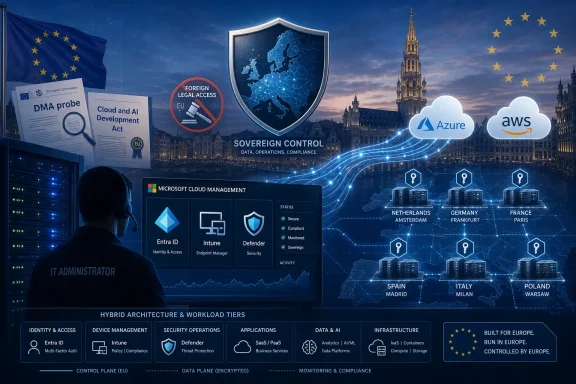
European regulators have opened cloud-focused competition investigations into Microsoft Azure and Amazon Web Services while advancing a Cloud and AI Development Act that would steer Europe’s most sensitive public-sector workloads toward EU-controlled providers. The move is not merely another Brussels antitrust file. It is a direct challenge to the operating model that made American hyperscale cloud the default infrastructure layer for governments, banks, hospitals, and software vendors across the continent. For Windows administrators and Microsoft customers, the fight is no longer abstract: sovereignty is becoming a procurement requirement, not a marketing slogan.
The European Union’s case against American cloud dominance has been building for years, but the latest escalation changes the terrain. Until recently, “digital sovereignty” often sounded like a political aspiration wrapped around existing compliance programs: keep data in the EU, publish a trust center page, add local support, and reassure procurement officers that GDPR boxes had been ticked.
That era is ending. The Commission is now treating control of the cloud stack as a strategic dependency, closer to energy, telecoms, or defense manufacturing than ordinary software procurement. The argument is blunt: if the infrastructure that stores a government’s records, runs its AI workloads, hosts its emergency services, and supports its defense suppliers can be legally or technically influenced from outside Europe, then Europe does not fully control its own digital state.
Microsoft and Amazon sit at the center of that critique because they are not just vendors. Azure and AWS are ecosystems, distribution channels, identity providers, security platforms, developer platforms, and AI backbones. Once an organization builds deeply into their services, switching is no longer a simple matter of moving virtual machines from one provider to another.
That is why the regulatory push has two tracks. The Digital Markets Act track asks whether AWS and Azure have become powerful enough in cloud computing to warrant gatekeeper-style obligations. The sovereignty track asks whether certain government and critical workloads should be allowed to run on foreign-controlled infrastructure at all.
Those are related but distinct fights. One is about competition. The other is about power.
That is changing. Regulators are focusing on whether AWS and Azure exert gatekeeper-like control even if they do not fit neatly into earlier threshold calculations. In cloud, the relevant measure of power is not only the number of users. It is the degree to which customers depend on proprietary databases, identity tools, storage formats, observability systems, AI accelerators, marketplace integrations, and managed services that are painful to unwind.
The most obvious target is the egress fee. These are the charges customers pay to move data out of a provider’s cloud. In theory, they compensate for network costs. In practice, critics argue, they behave like an exit tax: cheap to enter, expensive to leave.
For an enterprise with petabytes of storage, a multi-cloud strategy can become economically irrational if moving data to a rival provider triggers large transfer bills. Even when fees are not the only barrier, they reinforce a broader pattern. The more workloads an organization centralizes in one hyperscaler, the more every surrounding system is pulled into that provider’s orbit.
Microsoft has particular exposure because Azure is often sold not as a standalone cloud but as the natural extension of the Windows, Microsoft 365, Entra ID, Defender, SQL Server, GitHub, and Power Platform estate. That integration is useful, and for many IT teams it is the point. But the same integration can make it harder for a European ministry, hospital network, or regulated enterprise to prove that it has realistic alternatives.
That is where the proposed Cloud and AI Development Act matters. The framework being discussed in Brussels would create graded sovereignty requirements for public-sector cloud and AI services, especially where sensitive workloads are involved. The highest tiers would look beyond data residency and ask who controls the company, the infrastructure, the software supply chain, and the operational levers that keep services running.
That is a major shift. For years, hyperscalers have answered European concerns by building European data regions, contracting with local partners, creating “sovereign cloud” variants, and promising local operations. These measures address important risks, but they do not fully answer the question Brussels is now asking: who ultimately has authority over the provider?
The “kill switch” language used by EU officials captures the political mood. Europe does not want a foreign government, foreign court, or foreign parent company to be able to interrupt or compel access to services that underpin critical public functions. Whether that risk is likely in normal times is not the point. Strategic autonomy policy is written for abnormal times.
This is why the measure is so threatening to American hyperscalers. The issue is not whether Azure or AWS can open a data center in France, Germany, Spain, or Poland. They already can. The issue is whether the most sensitive tier of European public procurement will require control structures that U.S.-based companies cannot satisfy without radical restructuring.
The hyperscalers dispute the most alarmist readings of this risk. They point to encryption, contractual protections, transparency reports, legal challenge processes, and narrowly scoped law-enforcement procedures. Microsoft in particular has spent years arguing that it contests overbroad government demands and that European customers can rely on technical and legal safeguards.
But the sovereignty debate is not only about how often U.S. authorities seek data. It is about whether a non-European legal authority can reach into the chain of control at all. That is a binary procurement concern, and it is especially potent for defense, policing, intelligence-adjacent systems, health records, and strategic infrastructure.
Microsoft’s reported admission before French lawmakers that it could not absolutely guarantee protection from a lawful U.S. demand was damaging because it punctured the comforting simplicity of “European data stays in Europe.” Legally, the answer was not surprising. Politically, it was explosive.
For customers, this creates a more complicated reality than vendor brochures suggest. Data residency tells you where data is stored. Sovereignty asks who can order, operate, access, suspend, patch, audit, decrypt, or compel the systems that manage it. Those are different questions, and Brussels is increasingly unwilling to let the first substitute for the second.
The problem is that Microsoft is uniquely entangled in the very stack Europe is scrutinizing. Azure is tied to Microsoft 365 identity, Windows endpoint management, Defender telemetry, Teams collaboration, GitHub development workflows, and now Copilot and Azure OpenAI-style AI services. For many organizations, Microsoft is not a cloud vendor among others; it is the operating environment of the modern enterprise.
That gives Microsoft enormous practical leverage. It also makes the company an obvious regulatory target. If a European agency standardizes on Microsoft 365, Entra ID, Defender, Azure, and Copilot, the migration path to an EU-controlled alternative becomes less a procurement exercise than a multi-year institutional rebuild.
Microsoft’s likely defense will be that European customers benefit from world-class security, compliance tooling, resilience, and productivity integration. That argument is not trivial. Many local providers cannot match Azure’s scale, service catalog, global resilience, or AI infrastructure, and public bodies do not become more secure simply by choosing a provider with an EU headquarters.
But Brussels is signaling that technical excellence is not the only metric. A cloud that is operationally superior but legally exposed may still fail the sovereignty test for the most sensitive workloads. That is the uncomfortable new standard.
That distinction matters. AWS is often the default choice for teams building cloud-native systems from scratch, while Azure benefits from enterprise continuity. Both roads lead to lock-in, but the mechanisms differ.
AWS customers may begin with compute and object storage, then adopt managed databases, analytics, serverless functions, identity integrations, AI services, security tooling, and deployment pipelines. Over time, architecture becomes provider-specific. Even when applications are containerized, the surrounding platform services are often not portable in any meaningful economic sense.
For European regulators, that makes AWS a gatekeeper candidate even without consumer-facing dominance. A cloud provider can shape competition by controlling the technical and financial terms under which software companies operate. If leaving AWS means rewriting data layers, retraining teams, rebuilding monitoring, renegotiating security controls, and paying to move data out, the market is not as contestable as procurement theory assumes.
AWS has tried to answer sovereignty concerns with its European Sovereign Cloud strategy, including plans for separate infrastructure operated in Europe. That may satisfy many commercial customers and some public-sector use cases. The unresolved question is whether the EU’s highest assurance tiers will accept a U.S.-owned parent with European operational separation, or whether only EU-controlled providers can qualify.
That difference is everything.
Google’s position is somewhat different because it trails AWS and Azure in many European enterprise accounts. That makes it less central to some competition complaints but no less exposed to sovereignty restrictions. If the highest tiers of EU public procurement require European control, Google Cloud has the same parent-company problem.
The AI dimension may sharpen this. Google, Microsoft, and Amazon are not merely selling storage and compute. They are selling the platforms on which governments and businesses will train, deploy, monitor, and govern AI systems. The EU’s sovereignty agenda therefore extends beyond where files live to where models run, where prompts are processed, where logs are retained, and who controls the chips and orchestration layers underneath.
That is why the Cloud and AI Development Act matters as a combined instrument. Cloud sovereignty without AI sovereignty would be obsolete before the ink dried. The next procurement battle is not just over databases; it is over the machine-learning infrastructure that will shape public administration, security analysis, healthcare triage, transport systems, and industrial automation.
For Google, as for Microsoft and Amazon, the strategic question is whether Europe accepts contractual and technical segregation as enough. If not, the hyperscalers may find themselves welcomed for ordinary commercial workloads while fenced out of the most politically valuable public-sector contracts.
There is a reasonable case for doing this. Markets do not always produce strategic resilience. If public agencies choose the most feature-rich hyperscaler every time, European alternatives may never reach the scale required to compete, even where they offer better sovereignty characteristics. Procurement rules can create demand, and demand can fund capability.
But Europe should be honest about the cost. Hyperscale cloud is not just rented servers. It is a decade-plus accumulation of automation, security operations, identity services, compliance frameworks, developer tooling, global networking, AI accelerators, database engineering, and partner ecosystems. Replacing that for sensitive workloads is possible in some areas and brutally difficult in others.
The risk is not that European providers are incapable. The risk is that public-sector buyers may be pushed into a split world where the sovereign option satisfies the legal requirement but lacks the operational maturity, service breadth, or AI capacity that agencies have come to expect. That could slow modernization, especially in member states already struggling with legacy systems and fragmented procurement.
Still, the counterargument from Brussels is powerful: dependence also has a cost, and that cost is usually invisible until a crisis reveals it. Europe’s cloud crackdown is a bet that paying more, moving slower, or accepting fewer features may be justified for the workloads that define state capacity.
Many organizations treat Microsoft’s cloud stack as a single administrative plane. Entra ID handles identity. Intune handles device management. Defender handles endpoint and cloud security signals. Microsoft 365 handles collaboration. Azure hosts workloads. Purview and Sentinel handle governance and security operations. Copilot and other AI services increasingly sit across the top.
A sovereignty-driven procurement review will ask whether that unified control plane is acceptable for sensitive European workloads. If not, administrators may need to split environments that were previously consolidated for efficiency. That means separate identity realms, stricter data classification, isolated logging pipelines, different backup targets, and tighter rules around which telemetry can leave which boundary.
The compliance burden will also become more architectural. It will not be enough to show that a workload is hosted in an EU region. Teams may need to prove who operates the environment, where support personnel are located, what legal entities control access, how encryption keys are managed, whether administrators can be compelled from abroad, and how service dependencies behave during geopolitical disruption.
This will be particularly painful for organizations that adopted cloud quickly during the pandemic or during rapid digital transformation programs. Many made perfectly rational choices at the time: standardize on Microsoft or AWS, reduce on-premises complexity, and let hyperscale resilience replace aging server rooms. The sovereignty turn does not make those choices foolish. It does make them incomplete.
The industry has spent years promoting multi-cloud, but the reality is messier. Running across clouds is easy to diagram and hard to sustain. Teams must duplicate skills, security controls, cost management practices, observability tools, network designs, incident-response procedures, and compliance evidence. The result is often not resilience but complexity.
Containerization and Kubernetes help, but they do not erase lock-in. The application runtime may move, while databases, object storage semantics, event buses, identity integrations, key management, AI services, and monitoring remain provider-specific. The deeper the organization moves into managed services, the better the productivity gains and the worse the portability story.
This is where egress fees become symbolic. Even if regulators force providers to reduce or eliminate certain data transfer costs, the larger switching bill remains embedded in engineering labor and business risk. Moving away from a hyperscaler is not like changing broadband providers. It is more like changing the foundations of a building while people are still working inside.
That does not mean portability remedies are useless. They can make competition more real at the margin and prevent providers from using pricing as a moat. But Europe’s broader goal requires more than lower fees. It requires common standards, credible European capacity, procurement discipline, and customers willing to design for exit before they need one.
That creates an awkward tension for the EU. A sovereignty rule that pushes sensitive workloads away from U.S. hyperscalers may reduce legal and geopolitical exposure while increasing operational or cyber risk if alternatives are less mature. Security-minded administrators understand this tradeoff immediately. Jurisdictional purity does not automatically stop ransomware, misconfiguration, insider abuse, or supply-chain compromise.
But hyperscaler security is not a trump card. The EU’s concern is not merely whether Azure or AWS can defend against attackers. It is whether the political and legal environment around those companies creates risks that technical controls cannot fully neutralize. For defense and law-enforcement workloads, the distinction matters.
The smarter European policy will avoid pretending that sovereignty and security are the same thing. Some workloads need the maximum technical capability available, even if supplied by a foreign hyperscaler with strong safeguards. Others need legal and operational control above all else. The hardest part will be classifying workloads honestly instead of treating every procurement as a symbolic vote for or against America.
Enterprises should adopt the same discipline. Not every SharePoint library is a national-security asset. Not every analytics workload belongs in a sovereign enclave. But some data sets, identities, logs, keys, and AI workflows deserve stricter treatment than “EU region selected” can provide.
Cloud sovereignty puts that bargain under stress because infrastructure is more strategic than software distribution. A social network can be fined. An app store can be forced to change terms. A cloud platform running tax systems, hospitals, rail networks, police data, and AI workloads becomes part of the state’s nervous system.
Geopolitics has made that harder to ignore. Trade disputes, sanctions, war in Ukraine, supply-chain shocks, intelligence concerns, and shifting U.S. politics have all pushed European officials to think in terms of dependencies rather than efficiencies. The question is no longer whether U.S. providers are good partners in ordinary conditions. It is whether Europe can tolerate their dominance under extraordinary conditions.
Washington is unlikely to view this neutrally. If European rules effectively exclude U.S. firms from valuable government contracts, American policymakers may see industrial protectionism dressed as sovereignty. U.S. companies will argue that they are being penalized for hypothetical risks while European customers lose access to best-in-class technology.
Both claims can be partly true. The EU can have legitimate sovereignty concerns and still use those concerns to favor domestic industry. U.S. hyperscalers can provide superior technology and still represent a strategic dependency. The policy fight will be bitter precisely because neither side is arguing from pure fiction.
For years, cloud strategy was often described as a one-way migration. Leave the data center. Retire the hardware. Let hyperscalers handle resilience. Convert capital expense to operating expense. Move faster.
Sovereignty breaks that narrative. Sensitive workloads may remain on-premises, move to nationally controlled providers, run in sovereign cloud enclaves, or use private cloud models. Less sensitive workloads may stay on AWS, Azure, or Google Cloud because the productivity gains are too large to abandon. The future looks less like a single cloud destination and more like deliberate segmentation.
That segmentation will reward organizations with disciplined architecture. Data classification, identity boundaries, encryption-key control, workload portability, and exit planning will matter more. So will boring documentation: knowing which service depends on which cloud API, where logs flow, where backups sit, and who can administer what.
It will also force vendors to become more transparent. “Sovereign cloud” will not survive as a vague label if procurement officers demand proof of ownership, operational control, legal exposure, and dependency mapping. The marketing term will either harden into auditable architecture or lose credibility.
 Brussels Turns Cloud Sovereignty Into Industrial Policy
The European Union’s case against American cloud dominance has been building for years, but the latest escalation changes the terrain. Until recently, “digital sovereignty” often sounded like a political aspiration wrapped around existing compliance programs: keep data in the EU, publish a trust center page, add local support, and reassure procurement officers that GDPR boxes had been ticked.That era is ending. The Commission is now treating control of the cloud stack as a strategic dependency, closer to energy, telecoms, or defense manufacturing than ordinary software procurement. The argument is blunt: if the infrastructure that stores a government’s records, runs its AI workloads, hosts its emergency services, and supports its defense suppliers can be legally or technically influenced from outside Europe, then Europe does not fully control its own digital state.
Microsoft and Amazon sit at the center of that critique because they are not just vendors. Azure and AWS are ecosystems, distribution channels, identity providers, security platforms, developer platforms, and AI backbones. Once an organization builds deeply into their services, switching is no longer a simple matter of moving virtual machines from one provider to another.
That is why the regulatory push has two tracks. The Digital Markets Act track asks whether AWS and Azure have become powerful enough in cloud computing to warrant gatekeeper-style obligations. The sovereignty track asks whether certain government and critical workloads should be allowed to run on foreign-controlled infrastructure at all.
Those are related but distinct fights. One is about competition. The other is about power.
The DMA Probe Targets the Cloud’s Invisible Toll Roads
The Digital Markets Act was designed to stop dominant platforms from using their position to box users and rivals into unfair arrangements. It originally gained public attention through app stores, messaging services, browsers, search, and social platforms. Cloud was always in the frame, but the problem was harder to map because cloud customers are not counted like social-media users and cloud lock-in is often buried in architecture rather than consumer interface design.That is changing. Regulators are focusing on whether AWS and Azure exert gatekeeper-like control even if they do not fit neatly into earlier threshold calculations. In cloud, the relevant measure of power is not only the number of users. It is the degree to which customers depend on proprietary databases, identity tools, storage formats, observability systems, AI accelerators, marketplace integrations, and managed services that are painful to unwind.
The most obvious target is the egress fee. These are the charges customers pay to move data out of a provider’s cloud. In theory, they compensate for network costs. In practice, critics argue, they behave like an exit tax: cheap to enter, expensive to leave.
For an enterprise with petabytes of storage, a multi-cloud strategy can become economically irrational if moving data to a rival provider triggers large transfer bills. Even when fees are not the only barrier, they reinforce a broader pattern. The more workloads an organization centralizes in one hyperscaler, the more every surrounding system is pulled into that provider’s orbit.
Microsoft has particular exposure because Azure is often sold not as a standalone cloud but as the natural extension of the Windows, Microsoft 365, Entra ID, Defender, SQL Server, GitHub, and Power Platform estate. That integration is useful, and for many IT teams it is the point. But the same integration can make it harder for a European ministry, hospital network, or regulated enterprise to prove that it has realistic alternatives.
The Sovereignty Bill Moves the Fight Beyond Prices
Antitrust remedies can reduce switching costs, improve interoperability, and curb contract practices. They cannot resolve the deeper sovereignty complaint. A cheaper exit fee does not change the fact that AWS, Microsoft, and Google are headquartered in the United States and subject to American law.That is where the proposed Cloud and AI Development Act matters. The framework being discussed in Brussels would create graded sovereignty requirements for public-sector cloud and AI services, especially where sensitive workloads are involved. The highest tiers would look beyond data residency and ask who controls the company, the infrastructure, the software supply chain, and the operational levers that keep services running.
That is a major shift. For years, hyperscalers have answered European concerns by building European data regions, contracting with local partners, creating “sovereign cloud” variants, and promising local operations. These measures address important risks, but they do not fully answer the question Brussels is now asking: who ultimately has authority over the provider?
The “kill switch” language used by EU officials captures the political mood. Europe does not want a foreign government, foreign court, or foreign parent company to be able to interrupt or compel access to services that underpin critical public functions. Whether that risk is likely in normal times is not the point. Strategic autonomy policy is written for abnormal times.
This is why the measure is so threatening to American hyperscalers. The issue is not whether Azure or AWS can open a data center in France, Germany, Spain, or Poland. They already can. The issue is whether the most sensitive tier of European public procurement will require control structures that U.S.-based companies cannot satisfy without radical restructuring.
The CLOUD Act Is the Legal Ghost in Every Data Center
The shadow behind the entire debate is the U.S. CLOUD Act. European policymakers and cloud critics see it as proof that data location is not the same as data sovereignty. If an American company can be compelled by American legal process to produce data it controls, then putting the servers in Europe may not be enough.The hyperscalers dispute the most alarmist readings of this risk. They point to encryption, contractual protections, transparency reports, legal challenge processes, and narrowly scoped law-enforcement procedures. Microsoft in particular has spent years arguing that it contests overbroad government demands and that European customers can rely on technical and legal safeguards.
But the sovereignty debate is not only about how often U.S. authorities seek data. It is about whether a non-European legal authority can reach into the chain of control at all. That is a binary procurement concern, and it is especially potent for defense, policing, intelligence-adjacent systems, health records, and strategic infrastructure.
Microsoft’s reported admission before French lawmakers that it could not absolutely guarantee protection from a lawful U.S. demand was damaging because it punctured the comforting simplicity of “European data stays in Europe.” Legally, the answer was not surprising. Politically, it was explosive.
For customers, this creates a more complicated reality than vendor brochures suggest. Data residency tells you where data is stored. Sovereignty asks who can order, operate, access, suspend, patch, audit, decrypt, or compel the systems that manage it. Those are different questions, and Brussels is increasingly unwilling to let the first substitute for the second.
Microsoft’s Sovereign Cloud Pitch Now Faces Its Hardest Audience
Microsoft has invested heavily in European cloud assurances. Its EU Data Boundary, sovereign cloud offerings, local partnerships, encryption controls, and compliance messaging all speak to a market where public-sector trust is increasingly decisive. The company knows that Azure’s future in Europe depends not only on technical capability but on political acceptability.The problem is that Microsoft is uniquely entangled in the very stack Europe is scrutinizing. Azure is tied to Microsoft 365 identity, Windows endpoint management, Defender telemetry, Teams collaboration, GitHub development workflows, and now Copilot and Azure OpenAI-style AI services. For many organizations, Microsoft is not a cloud vendor among others; it is the operating environment of the modern enterprise.
That gives Microsoft enormous practical leverage. It also makes the company an obvious regulatory target. If a European agency standardizes on Microsoft 365, Entra ID, Defender, Azure, and Copilot, the migration path to an EU-controlled alternative becomes less a procurement exercise than a multi-year institutional rebuild.
Microsoft’s likely defense will be that European customers benefit from world-class security, compliance tooling, resilience, and productivity integration. That argument is not trivial. Many local providers cannot match Azure’s scale, service catalog, global resilience, or AI infrastructure, and public bodies do not become more secure simply by choosing a provider with an EU headquarters.
But Brussels is signaling that technical excellence is not the only metric. A cloud that is operationally superior but legally exposed may still fail the sovereignty test for the most sensitive workloads. That is the uncomfortable new standard.
Amazon’s Problem Is Market Gravity, Not Desktop Gravity
AWS faces the same sovereignty suspicion but a different competitive profile. Unlike Microsoft, Amazon does not arrive inside government through Windows desktops, Office documents, Active Directory migrations, or Teams deployments. AWS’s strength is developer gravity, infrastructure breadth, startup familiarity, and a massive catalog of mature managed services.That distinction matters. AWS is often the default choice for teams building cloud-native systems from scratch, while Azure benefits from enterprise continuity. Both roads lead to lock-in, but the mechanisms differ.
AWS customers may begin with compute and object storage, then adopt managed databases, analytics, serverless functions, identity integrations, AI services, security tooling, and deployment pipelines. Over time, architecture becomes provider-specific. Even when applications are containerized, the surrounding platform services are often not portable in any meaningful economic sense.
For European regulators, that makes AWS a gatekeeper candidate even without consumer-facing dominance. A cloud provider can shape competition by controlling the technical and financial terms under which software companies operate. If leaving AWS means rewriting data layers, retraining teams, rebuilding monitoring, renegotiating security controls, and paying to move data out, the market is not as contestable as procurement theory assumes.
AWS has tried to answer sovereignty concerns with its European Sovereign Cloud strategy, including plans for separate infrastructure operated in Europe. That may satisfy many commercial customers and some public-sector use cases. The unresolved question is whether the EU’s highest assurance tiers will accept a U.S.-owned parent with European operational separation, or whether only EU-controlled providers can qualify.
That difference is everything.
Google Is Not Named First, But It Is Not Outside the Blast Radius
The public attention falls on Microsoft and Amazon because of their scale and the reported DMA focus, but Google Cloud is not a bystander. Google is part of the American hyperscaler trio that dominates European cloud infrastructure, and it faces the same structural sovereignty problem: U.S. corporate control, U.S. legal exposure, and deep integration between cloud, AI, data, and security services.Google’s position is somewhat different because it trails AWS and Azure in many European enterprise accounts. That makes it less central to some competition complaints but no less exposed to sovereignty restrictions. If the highest tiers of EU public procurement require European control, Google Cloud has the same parent-company problem.
The AI dimension may sharpen this. Google, Microsoft, and Amazon are not merely selling storage and compute. They are selling the platforms on which governments and businesses will train, deploy, monitor, and govern AI systems. The EU’s sovereignty agenda therefore extends beyond where files live to where models run, where prompts are processed, where logs are retained, and who controls the chips and orchestration layers underneath.
That is why the Cloud and AI Development Act matters as a combined instrument. Cloud sovereignty without AI sovereignty would be obsolete before the ink dried. The next procurement battle is not just over databases; it is over the machine-learning infrastructure that will shape public administration, security analysis, healthcare triage, transport systems, and industrial automation.
For Google, as for Microsoft and Amazon, the strategic question is whether Europe accepts contractual and technical segregation as enough. If not, the hyperscalers may find themselves welcomed for ordinary commercial workloads while fenced out of the most politically valuable public-sector contracts.
Europe Wants a Native Cloud Industry, But It Cannot Regulate One Into Maturity
The EU’s industrial-policy ambition is clear: reduce dependence on U.S. and Chinese technology by creating market space for European providers. Companies such as OVHcloud, IONOS, Scaleway, Hetzner, and a cluster of national and sector-specific providers stand to benefit if public-sector procurement shifts toward EU-controlled infrastructure.There is a reasonable case for doing this. Markets do not always produce strategic resilience. If public agencies choose the most feature-rich hyperscaler every time, European alternatives may never reach the scale required to compete, even where they offer better sovereignty characteristics. Procurement rules can create demand, and demand can fund capability.
But Europe should be honest about the cost. Hyperscale cloud is not just rented servers. It is a decade-plus accumulation of automation, security operations, identity services, compliance frameworks, developer tooling, global networking, AI accelerators, database engineering, and partner ecosystems. Replacing that for sensitive workloads is possible in some areas and brutally difficult in others.
The risk is not that European providers are incapable. The risk is that public-sector buyers may be pushed into a split world where the sovereign option satisfies the legal requirement but lacks the operational maturity, service breadth, or AI capacity that agencies have come to expect. That could slow modernization, especially in member states already struggling with legacy systems and fragmented procurement.
Still, the counterargument from Brussels is powerful: dependence also has a cost, and that cost is usually invisible until a crisis reveals it. Europe’s cloud crackdown is a bet that paying more, moving slower, or accepting fewer features may be justified for the workloads that define state capacity.
Windows Administrators Will Feel This in Identity, Endpoint, and Compliance
For WindowsForum readers, this story is not confined to Brussels policy circles. If the EU turns sovereignty into a hard procurement requirement, the practical consequences will show up in tenant design, identity architecture, backup policy, endpoint management, logging, and vendor selection.Many organizations treat Microsoft’s cloud stack as a single administrative plane. Entra ID handles identity. Intune handles device management. Defender handles endpoint and cloud security signals. Microsoft 365 handles collaboration. Azure hosts workloads. Purview and Sentinel handle governance and security operations. Copilot and other AI services increasingly sit across the top.
A sovereignty-driven procurement review will ask whether that unified control plane is acceptable for sensitive European workloads. If not, administrators may need to split environments that were previously consolidated for efficiency. That means separate identity realms, stricter data classification, isolated logging pipelines, different backup targets, and tighter rules around which telemetry can leave which boundary.
The compliance burden will also become more architectural. It will not be enough to show that a workload is hosted in an EU region. Teams may need to prove who operates the environment, where support personnel are located, what legal entities control access, how encryption keys are managed, whether administrators can be compelled from abroad, and how service dependencies behave during geopolitical disruption.
This will be particularly painful for organizations that adopted cloud quickly during the pandemic or during rapid digital transformation programs. Many made perfectly rational choices at the time: standardize on Microsoft or AWS, reduce on-premises complexity, and let hyperscale resilience replace aging server rooms. The sovereignty turn does not make those choices foolish. It does make them incomplete.
The Multi-Cloud Dream Meets the Bill for Portability
The EU’s competition concerns and sovereignty concerns intersect at one point: portability. A sovereign strategy is weak if customers cannot move workloads. A competitive market is weak if exit costs make switching theoretical. In both cases, the question is whether cloud users can make credible choices after the first migration.The industry has spent years promoting multi-cloud, but the reality is messier. Running across clouds is easy to diagram and hard to sustain. Teams must duplicate skills, security controls, cost management practices, observability tools, network designs, incident-response procedures, and compliance evidence. The result is often not resilience but complexity.
Containerization and Kubernetes help, but they do not erase lock-in. The application runtime may move, while databases, object storage semantics, event buses, identity integrations, key management, AI services, and monitoring remain provider-specific. The deeper the organization moves into managed services, the better the productivity gains and the worse the portability story.
This is where egress fees become symbolic. Even if regulators force providers to reduce or eliminate certain data transfer costs, the larger switching bill remains embedded in engineering labor and business risk. Moving away from a hyperscaler is not like changing broadband providers. It is more like changing the foundations of a building while people are still working inside.
That does not mean portability remedies are useless. They can make competition more real at the margin and prevent providers from using pricing as a moat. But Europe’s broader goal requires more than lower fees. It requires common standards, credible European capacity, procurement discipline, and customers willing to design for exit before they need one.
The Security Argument Cuts Both Ways
American hyperscalers will not struggle to argue that they are among the most secure infrastructure providers in the world. In many cases, they are. Their security teams, physical infrastructure, threat intelligence, patch velocity, redundancy, and compliance investments exceed what most national agencies or regional providers can build alone.That creates an awkward tension for the EU. A sovereignty rule that pushes sensitive workloads away from U.S. hyperscalers may reduce legal and geopolitical exposure while increasing operational or cyber risk if alternatives are less mature. Security-minded administrators understand this tradeoff immediately. Jurisdictional purity does not automatically stop ransomware, misconfiguration, insider abuse, or supply-chain compromise.
But hyperscaler security is not a trump card. The EU’s concern is not merely whether Azure or AWS can defend against attackers. It is whether the political and legal environment around those companies creates risks that technical controls cannot fully neutralize. For defense and law-enforcement workloads, the distinction matters.
The smarter European policy will avoid pretending that sovereignty and security are the same thing. Some workloads need the maximum technical capability available, even if supplied by a foreign hyperscaler with strong safeguards. Others need legal and operational control above all else. The hardest part will be classifying workloads honestly instead of treating every procurement as a symbolic vote for or against America.
Enterprises should adopt the same discipline. Not every SharePoint library is a national-security asset. Not every analytics workload belongs in a sovereign enclave. But some data sets, identities, logs, keys, and AI workflows deserve stricter treatment than “EU region selected” can provide.
The Transatlantic Cloud Bargain Is Being Renegotiated
For two decades, Europe’s implicit bargain with U.S. technology firms was pragmatic. American companies supplied world-leading platforms; European regulators imposed privacy, competition, and consumer-protection rules; customers received powerful services faster than Europe could build them domestically. The arrangement was tense but functional.Cloud sovereignty puts that bargain under stress because infrastructure is more strategic than software distribution. A social network can be fined. An app store can be forced to change terms. A cloud platform running tax systems, hospitals, rail networks, police data, and AI workloads becomes part of the state’s nervous system.
Geopolitics has made that harder to ignore. Trade disputes, sanctions, war in Ukraine, supply-chain shocks, intelligence concerns, and shifting U.S. politics have all pushed European officials to think in terms of dependencies rather than efficiencies. The question is no longer whether U.S. providers are good partners in ordinary conditions. It is whether Europe can tolerate their dominance under extraordinary conditions.
Washington is unlikely to view this neutrally. If European rules effectively exclude U.S. firms from valuable government contracts, American policymakers may see industrial protectionism dressed as sovereignty. U.S. companies will argue that they are being penalized for hypothetical risks while European customers lose access to best-in-class technology.
Both claims can be partly true. The EU can have legitimate sovereignty concerns and still use those concerns to favor domestic industry. U.S. hyperscalers can provide superior technology and still represent a strategic dependency. The policy fight will be bitter precisely because neither side is arguing from pure fiction.
The Real Winner May Be Hybrid Architecture
The immediate winners from Europe’s cloud turn are obvious: EU-controlled cloud providers, sovereignty consultants, compliance lawyers, encryption vendors, data-classification platforms, and anyone who can help agencies prove control. But the longer-term winner may be hybrid architecture.For years, cloud strategy was often described as a one-way migration. Leave the data center. Retire the hardware. Let hyperscalers handle resilience. Convert capital expense to operating expense. Move faster.
Sovereignty breaks that narrative. Sensitive workloads may remain on-premises, move to nationally controlled providers, run in sovereign cloud enclaves, or use private cloud models. Less sensitive workloads may stay on AWS, Azure, or Google Cloud because the productivity gains are too large to abandon. The future looks less like a single cloud destination and more like deliberate segmentation.
That segmentation will reward organizations with disciplined architecture. Data classification, identity boundaries, encryption-key control, workload portability, and exit planning will matter more. So will boring documentation: knowing which service depends on which cloud API, where logs flow, where backups sit, and who can administer what.
It will also force vendors to become more transparent. “Sovereign cloud” will not survive as a vague label if procurement officers demand proof of ownership, operational control, legal exposure, and dependency mapping. The marketing term will either harden into auditable architecture or lose credibility.
The Fine Print Is Now the Product
The lesson for IT leaders is not to panic-migrate away from American cloud. The lesson is to stop treating jurisdiction, ownership, and exit costs as secondary paperwork. Europe’s regulators are turning those details into first-order design constraints.- Organizations should classify workloads by sovereignty sensitivity before choosing cloud services, not after an auditor asks where the data went.
- Azure and AWS customers should review egress exposure, proprietary managed-service dependencies, and realistic exit paths while they still have negotiating leverage.
- Microsoft-heavy environments should pay special attention to identity, endpoint management, security telemetry, and Copilot-era data flows because those layers often bind the whole estate together.
- Public-sector buyers should distinguish between ordinary data residency and genuine operational control over keys, administrators, support access, and legal entities.
- European providers will gain a major opening, but they will still need to prove that sovereignty does not come at the expense of resilience, security, and service maturity.
- The most likely near-term outcome is not a full hyperscaler retreat from Europe but a more fragmented cloud market divided by workload sensitivity and procurement tier.
References
- Primary source: streamlinefeed.co.ke
Published: 2026-06-18T12:52:20.860094
Microsoft and Amazon Face Severe EU Cloud Sovereignty Crackdown | Streamline
The European Union has launched major antitrust probes into Amazon and Microsoft while unveiling strict new cloud sovereignty laws. The implications for U.S....streamlinefeed.co.ke - Related coverage: sota.io
CADA Cloud Sovereignty: The 4 Assurance Levels and Which Cloud Providers Actually Qualify — sota.io Blog
The EU Cloud and AI Development Act defines four assurance levels for public-sector cloud. Level 3 requires EU ownership, EU personnel, and EU jurisdiction — which disqualifies AWS, Azure, and GCP regardless of their German or Dutch data centres. A developer guide to CADA's qualification...www.sota.io - Related coverage: agenceurope.eu
European Commission proposes sovereignty risk assessments for public cloud services | AGENCE EUROPE
The European Commission proposes sovereignty risk assessments for cloud computing services.agenceurope.eu
- Related coverage: theregister.com
Microsoft exec admits it 'cannot guarantee' data sovereignty
Updated: Under oath in French Senate, exec says it would be compelled – however unlikely – to pass local customer info to US adminwww.theregister.com - Related coverage: winbuzzer.com
Microsoft Admits It Cannot Guarantee EU Cloud Data Sovereignty from US Government
A Microsoft executive admitted under oath that the company cannot guarantee EU data is safe from US government access due to the CLOUD Act, undermining 'sovereign cloud' promises. winbuzzer.com
- Related coverage: grosswald.org
European Commission Tables Cloud and AI Development Act, Ring-Fencing Defence Procurement
Brussels, 3 June 2026 Key points * The European Commission presented the Cloud and AI Development Act on 3 June as the centrepiece of its European Technological Sovereignty Package, alongside a revised European Chips Act easing direct EU investment in cross-border semiconductor projects... www.grosswald.org
- Related coverage: euinsider.eu
EU Launches Cloud Sovereignty Rules and Chips Act 2.0 to Reduce Digital Dependence
The European Commission unveiled a sweeping legislative package on Wednesday to cut the EU's 80% dependence on American and Chinese digital infrastructure, restricting US cloud giants from sensitive government contracts and giving Brussels new emergency powers over global chip supplies.www.euinsider.eu - Related coverage: computerweekly.com
European Commission launches AWS and Microsoft-focused cloud competition probes | Computer Weekly
The European Commission has launched three investigations into how the continent's cloud market operates, with two focused specifically on Microsoft and Amazon Web Serviceswww.computerweekly.com - Related coverage: techradar.com
Microsoft admits it would have to let Trump spy on EU data if demanded | TechRadar
Microsoft says it can't promise data sovereignty for EU firmswww.techradar.com - Official source: cdn-dynmedia-1.microsoft.com