

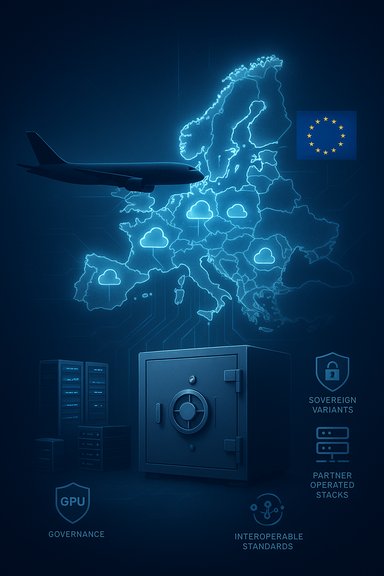
Airbus’s public shift — framed in several recent reports as a move “towards farewell to big tech” and a call for an EU sovereign cloud for data — crystallises a defining debate for Europe’s digital infrastructure: how to reconcile the scale and innovation of hyperscalers with the legal, operational and political demands of data sovereignty. The development is not an isolated soundbite. It sits at the intersection of industry strategy, procurement practice and EU-level regulation, and it forces IT leaders to pick a practical path between immediate risk reduction and long-term industrial policy.
Background / Overview
Europe’s cloud debate has moved fast from abstract policy to concrete procurement and investment choices. Two parallel trends are shaping the landscape:- Major cloud providers are offering sovereign variants of their platforms — contractual and technical features meant to keep data and certain processing inside EU/EFTA geographies and to give customers stronger audit and operational controls. These are practical, near-term market responses to regulatory and customer pressure.
- Industrial and political voices are proposing an “Airbus‑for‑AI” or a multi‑state European champion model to deliver genuinely independent compute and control for critical workloads. That framing borrows the governance model of Airbus — pooled procurement, shared governance and cross‑border industrial coordination — and applies it to compute, data and high‑risk AI. Practitioners and analysts see this as appealing for defence, national registries and certain public‑sector AI workloads, but costly and legally complex.
What the Il Sole 24 Ore reporting and industry analysis actually say
The headline claim: Airbus “towards farewell to big tech”
Reports referencing Airbus’s stance characterise it as emblematic: a major European industrial player publicly signalling discomfort with dependency on U.S. hyperscalers and endorsing the case for stronger European control over sensitive data. That language is shorthand for a broader policy conversation, not necessarily a literal all‑out divorce from all global cloud providers. Readers should treat the phrase as a political and industrial framing rather than a single contractual decision by Airbus disclosed in full.The Airbus analogy explained
The “Airbus for AI” analogy captures three ideas:- Pooling national political will and procurement to create scale.
- Building cross‑border governance structures that bind member states and embed auditability.
- Creating an industrial champion able to deliver sectoral sovereignty for a targeted class of workloads (defence, critical national registries, high‑risk public AI services).
What “sovereign cloud” vendors are actually selling today
When vendors advertise a sovereign cloud they typically bundle:- Data residency (storage and some processing inside EU sites).
- Operational controls (local staff, audit rights, contractual commitments).
- Technical isolation (local control planes, validated landing zones, and partner‑operated stacks).
Why this matters: legal, technical and political stakes
Legal and regulatory drivers
- GDPR and the EU AI Act increase demand for auditable, in‑region processing for regulated and high‑risk AI workloads. Sovereign variants lower procurement friction for public buyers and highly regulated industries.
- Extraterritorial risk: U.S. legal instruments and other foreign statutes (for example, measures that have prompted operational restrictions in the past) create the possibility of provider actions or compelled disclosures that cut across geographic residency. Contracts and local incorporations reduce but do not fully eliminate that legal complexity. Buyers seeking absolute legal insulation must plan for physically separate suppliers and customer‑held cryptographic keys.
Technical and supply‑chain constraints
- GPU and accelerator supply: Building Europe‑scale GPU farms requires supply agreements with a handful of hardware providers, which currently are heavily concentrated outside Europe. That creates a practical dependence even for locally run clouds.
- Scale and cost: A full hyperscale build‑out is capital intensive and energy hungry, with environmental and permitting concerns that can delay projects. Expect timelines measured in years, not months.
Political economy
- The EU’s toolbox mixes regulation (DMA, Data Act, AI Act), procurement leverage and possible targeted funding. The pragmatic policy route emerging from analysis is a mix: use procurement and regulation to secure near‑term control for critical workloads, and selectively invest in industrial capacity where strategic value justifies the cost. Uncoordinated national projects risk fragmentation; interoperability standards are essential.
Strengths of the emerging sovereign-cloud offers
- Faster time‑to‑compliance: For hospitals, finance and public agencies that need auditable processing, sovereign variants reduce procurement barriers and accelerate adoption of AI services that otherwise would be blocked.
- Operational continuity: Local staffing, on‑site managed options and stronger contractual remedies improve governance and oversight.
- Lower short‑term legal friction: For many use cases, keeping telemetry and prompts within EU/EFTA jurisdictions materially reduces GDPR and AI Act exposure and enables productivity AI adoption with fewer legal hurdles.
- Pragmatic hybrid options: Partner‑operated sovereign stacks (European telcos or SI partners operating hyperscaler technology under local governance) create a pragmatic route that retains platform compatibility while boosting local control.
The real risks and what they mean for buyers
- Residual extraterritorial legal exposure: Even when data sits physically in Europe, corporate ownership and certain legal obligations (extraterritorial orders, access requests) can expose tenants. Contracts can help, but litigation and political processes can be slow and uncertain — buyers should plan for that residual risk.
- Hidden vendor‑lock‑in: Some “sovereign” partner models still run on hyperscaler control planes or depend on proprietary primitives that make exit expensive. Procurement must demand portability, clear exit paths and escrowed artifacts to avoid being locked into an ecosystem despite the sovereign label.
- Scale and cost realities: Creating GPU farms and hyperscale datacentres is expensive. Political opposition to datacentre expansion, grid and land constraints, and environmental pushback can slow timelines and raise costs. Short‑term sovereignty will therefore be hybrid and selective, not wholesale.
- Fragmentation risk: Uncoordinated national builds could produce incompatible stacks and raise cross‑border costs. Europe should prioritise federated standards and validated architectures to avoid creating an expensive patchwork.
Concrete models and how they compare
1) Hyperscaler sovereign variants (practical, fast)
- Operated by major cloud providers but with contractual, organisational and technical controls to localise data and processing.
- Strengths: speed, existing platform features, scale.
- Weaknesses: residual legal exposure; dependence on vendor control‑plane and accelerators.
2) Partner‑operated sovereign stacks (telco/SI operators)
- European operators run hyperscaler technology under local governance (examples being branded partner models).
- Strengths: better local governance and procurement fit; maintains platform compatibility.
- Weaknesses: underlying primitives may still come from non‑European vendors; portability must be enforced through contracts.
3) Federated commons / GAIA‑X style
- Focus on standards, trust labels and interoperability across federated nodes offering essential public utilities (identity, secure mail, archiving).
- Strengths: lowers vendor lock‑in, emphasises portability and open standards.
- Weaknesses: does not replicate hyperscaler scale; best for non‑commodity services.
4) Airbus‑style industrial champion (long horizon, capital intensive)
- A pan‑European, politically backed entity that pools procurement and builds targeted compute zones for strategic workloads.
- Strengths: potential for institutionalised sovereignty for high‑value sectors.
- Weaknesses: requires multibillion‑euro funding, faces competition law and exportability issues, long timeline.
Policy and regulation — what’s already moving
- The Digital Markets Act (DMA) and other EU instruments are actively being applied and studied as levers to reshape cloud competition and portability; the Commission has opened formal investigations into major cloud providers under the DMA. This regulatory pressure changes bargaining power and could force interoperability or portability improvements.
- Targeted procurement rules and sectoral funding instruments will be decisive. Analysts recommend targeting the 10–20% of workloads that truly require sovereignty (defence, finance, certain public services) instead of duplicating every hyperscaler service across the continent. That prioritised approach reduces cost and fragmentation risk.
Practical checklist for IT, procurement and security teams
- Classify your workloads by sovereignty sensitivity: defence, regulated finance, citizen registries, high‑risk AI, etc. Prioritise the top 10–20% for stronger guarantees.
- Demand precise contractual language: data residency, audit rights, escrow of code/configuration, post‑incident forensic reporting and migration/runbook clauses.
- Insist on portability and validated exit paths: containerised architectures, Kubernetes deployment patterns and verified migration runbooks.
- Use customer‑held keys where legal insulation is critical; plan for BYOK/HSM to reduce residual disclosure risk.
- Test failover and migration regularly (chaos engineering): rehearse provider failovers and migration runbooks.
- Require independent audits and third‑party verification of sovereignty claims — don’t rely solely on vendor marketing.
- Consider hybrid architectures: use sovereign landing zones for critical data, and public sovereign variants for less critical services to balance cost and resilience.
- Engage legal and policy teams early: understand extraterritorial legal exposure and ensure contractual remedy paths.
- Track hardware supply chains: if training‑scale compute is needed, secure supplier commitments for accelerators and consider regional supply diversification.
- Include sustainability and community impact in planning: datacentre expansions will face environmental and permitting scrutiny; plan power and heat reuse strategies.
Short‑, medium‑ and long‑term outlook
- Short term (1–2 years): Expect a surge in sovereign product variants, partner‑operated stacks and procurement rules tightening for public buyers. These are the fastest, lowest‑cost ways to materially reduce regulatory and operational risk.
- Medium term (3–5 years): Targeted investments in European compute zones for defence and regulated sectors, with coordinated procurement and funding across member states. Hybrid sovereignty models will be the default for many customers.
- Long term (5+ years): Political choices determine whether Europe attempts a genuine industrial champion for selected workloads. If pursued, it will be expensive, legally complex and require competition‑sensitive governance. The alternative is a mature hybrid market with certified, interoperable sovereign offerings.
What this means for Windows and enterprise IT users
- Windows‑centric enterprise services will follow the same patterns: expect sovereign variants of enterprise SaaS and productivity AI features (for example, localised Copilot processing and EU data boundary options) — useful for compliance but requiring careful scope checks. Procurement teams should map which platform features are covered by a vendor’s sovereign promise and which require additional configurations.
- Legacy Windows estates can benefit from Sovereign Landing Zones and validated architectures that bring compliance controls into cloud migration templates; but migration complexity remains real and requires cross‑team planning (security, identity, logging and backup).
- Security posture: Customer‑held keys, BYOK strategies and rigorous logging/audit plans are practical levers Windows IT teams can adopt immediately to improve control over cloud‑hosted Windows workloads.
Numbers and investments — what we can verify now
Industry reporting indicates significant hyperscaler commitments in Europe: public reporting and industry commentaries name investments such as Microsoft’s large multi‑year pledges and other major commitments to expand regional AI hub capacity. Headlines have quoted figures — for example, notable multi‑billion euro investments announced for datacentre and AI infrastructure in EU states — which reflect the scale of capital now moving into Europe’s cloud ecosystem. These reported commitments underscore why pragmatic sovereignty (sovereign variants plus partner stacks) is viable in the near term while native European capacity is built out. Readers should note that announced investment numbers often refer to multi‑year plans and phased capital deployment; they represent headline commitments rather than immediate, available compute capacity.Balanced verdict: pragmatic sovereignty, not a single silver bullet
The most defensible conclusion from the reporting and analysis is that Europe’s path will be pragmatic and hybrid. Sovereign variants from hyperscalers and partner‑operated stacks already deliver meaningful risk reduction for many regulated buyers, and they should be used where speed and functionality matter. At the same time, Europe should selectively fund and coordinate longer‑term industrial projects for workloads where absolute legal and operational independence is indispensable. That blended approach minimises cost and fragmentation while addressing genuine strategic needs — the policy advice repeated across expert analyses.Caveats and unverifiable elements
- Where headlines suggest a clean “farewell” to major cloud vendors, treat the language as rhetorical framing. In practice, most proposals aim for selective decoupling rather than categorical disengagement. Public dialogue often mixes political posturing with procurement realism; readers should not equate heated language with immediate contractual exits.
- Many vendor claims about sovereign features and contingency mechanisms rely on contractual texts, operational playbooks and technical runbooks that are not fully public. Independent verification of exact trigger conditions, escrow mechanics and control‑plane handover details is limited in the record; procurement teams should insist on third‑party audits and contractual clarity before wholly relying on these mechanisms.
Final recommendations for IT and policy decision‑makers
- Adopt a tiered sovereignty strategy: identify the most critical 10–20% of workloads that require the strongest legal and operational guarantees and procure accordingly.
- Use sovereign product variants and partner‑operated stacks to reduce immediate legal and operational risk while negotiating portability and escrowed exit paths.
- Demand independent audits and rehearse migration/runbook playbooks before moving mission‑critical services to any single provider.
- Push for interoperable standards and validated landing zones at national and EU levels to avoid fragmentation and to make future migration feasible.
- Be realistic on timelines and costs: expect incremental improvement rather than overnight sovereignty — and budget accordingly.
Source: Il Sole 24 ORE https://en.ilsole24ore.com/art/airbus-l-goodbye-big-tech-cloud-sovereign-eu-data-AIX05ha/
