

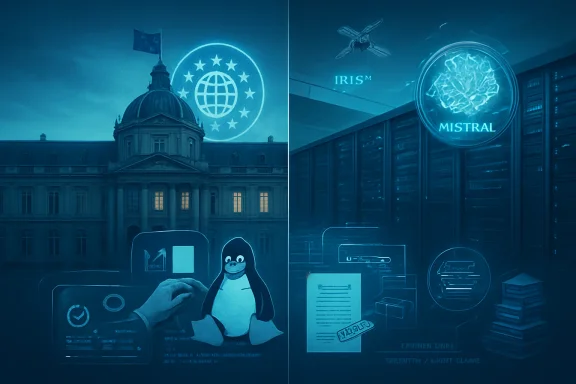
Europe’s push to reduce dependence on U.S. software has moved from policy seminar to procurement reality, and the result is more complicated than a clean technological divorce. A new wave of sovereign cloud contracts, French Linux migration plans, open source collaboration tools, European search infrastructure, and AI alternatives shows that governments now see software as strategic infrastructure, not merely office plumbing. Yet the same governments still renew contracts with companies such as Palantir, buy connectivity from Starlink, and rely on hyperscaler-adjacent partnerships when domestic options are not yet strong enough. The story is not anti-Americanism so much as risk management after a decade of uncomfortable lessons.
Europe has been talking about digital sovereignty for years, but the phrase has often meant different things to different audiences. For regulators, it means enforceable control over data, jurisdiction, security, and competition. For public-sector buyers, it means avoiding lock-in and knowing whether a foreign court order can pierce a service boundary. For European vendors, it also means something more commercial: a chance to win contracts long dominated by American cloud, software, search, and AI platforms.
The backdrop is a long period of European dependence on U.S. software stacks. Windows, Microsoft 365, Azure, AWS, Google Cloud, Google Search, Zoom, Slack, GitHub, Salesforce, Oracle, and Palantir all became embedded in parts of Europe’s public and private sectors because they were mature, scalable, and available when institutions needed them. European alternatives often existed, but they were fragmented, underfunded, less integrated, or unable to match the feature depth of American platforms.
Several shocks changed the political calculation. The Snowden disclosures made U.S. surveillance a mainstream European policy concern. The Schrems II judgment in 2020 invalidated the EU-U.S. Privacy Shield and forced lawyers, data protection officers, and public agencies to confront the fragility of transatlantic data-transfer arrangements. The CLOUD Act, enacted in 2018, added a separate anxiety by clarifying that U.S. providers can be compelled to produce data under their control even when that data is stored abroad.
The most recent acceleration comes from geopolitics. Trump-era and post-Trump uncertainty, sanctions politics, disputes over Greenland, the war in Ukraine, concerns about Elon Musk’s influence through X and Starlink, and the public ideology of some Silicon Valley executives have all made European officials more sensitive to dependence. In that environment, not being American has become a marketable feature for some European vendors.
Key forces now overlap:
The act did not create every concern from scratch, but it sharpened them. If a provider is subject to U.S. jurisdiction, European public agencies must ask whether a U.S. legal demand could reach data held in Europe. Encryption, key management, contractual safeguards, and legal challenge mechanisms can reduce risk, but they do not erase the political problem.
This is why “sovereign cloud” has become a loaded phrase. A cloud region in Frankfurt or Paris is not automatically sovereign if the parent company, management chain, support access, software control plane, or cryptographic keys remain subject to non-European control. Europe is increasingly asking for legal sovereignty, operational sovereignty, and technical sovereignty at the same time.
That legal uncertainty pushes conservative public bodies toward suppliers that can keep data, support, operations, and ownership inside Europe. It also strengthens the case for open standards and portability. If a legal basis changes, governments do not want to discover that moving away from a provider will take five years and a budget emergency.
The practical implications are now visible:
The French digital administration has framed the move as part of a broader reduction of extra-European dependencies. The focus is not only the operating system, but also collaboration tools, antivirus software, databases, virtualization, AI, and network equipment. That broader scope matters because replacing Windows while leaving every major workflow tied to Microsoft cloud services would merely move the dependency up the stack.
For WindowsForum readers, the key point is that this is not necessarily about Windows being technically weak. In many enterprise environments, Windows remains deeply capable, manageable, and familiar. The issue is that governments increasingly view the desktop as a strategic control plane, and proprietary foreign control planes are now politically vulnerable.
Linux offers several sovereignty advantages. Its source code can be audited, distributions can be customized, and governments can build hardened configurations without waiting for a single vendor’s roadmap. It also reduces licensing exposure and gives public agencies more leverage in negotiations with proprietary suppliers.
But the migration will be difficult:
The tender’s design reveals Europe’s balancing act. On one hand, the Commission wants to support providers that develop their own technology and meet sovereignty criteria. On the other, it still allows a consortium involving S3NS, a Thales and Google Cloud joint venture, which shows how difficult it is to separate completely from hyperscaler technology.
France’s Health Data Hub decision reinforces the same trend. Moving away from Microsoft Azure toward Scaleway for health data hosting gives sovereign cloud advocates a concrete victory. Health records are among the most sensitive datasets a government holds, so the contract has symbolic weight far beyond its value.
European buyers are now asking harder questions:
France’s tools such as Tchap, Visio, FranceTransfert, and LaSuite reflect a “build or coordinate common goods” philosophy. The logic is that public money should create reusable digital infrastructure rather than perpetual license flows to external vendors. This aligns with the European Commission’s earlier open source strategy and with the broader “public money, public code” movement.
The challenge is execution. Public-sector software projects often struggle with user experience, speed, documentation, and long-term maintenance. A tool can be sovereign and still fail if users bypass it for WhatsApp, Zoom, Teams, or Google Docs because those tools are easier.
The best open source strategy is not “build everything internally.” It is to combine European procurement, community development, professional support, and interoperable standards. Governments should fund the components they depend on and avoid turning every ministry into a software company.
A mature approach would include:
Security agencies do not buy ideology. They buy systems that work under pressure, integrate messy data, support investigations, and deliver results. If a vendor has spent years embedding workflows, training analysts, and proving reliability, replacing it becomes a major operational risk.
That does not mean critics are wrong. Palantir’s public posture, defense links, immigration enforcement associations, and executive rhetoric make it a uniquely controversial supplier in Europe. The issue is that governments often discover their sovereignty concerns after a system has already become mission-critical.
For health systems, the stakes are different but equally sensitive. NHS data platforms must improve capacity planning, waiting lists, resource allocation, and clinical coordination without undermining trust. If patients believe a foreign analytics company has inappropriate influence over health data, even a legally compliant system can lose legitimacy.
This creates a procurement dilemma:
The Starlink example is revealing. Lufthansa and Air France have selected Starlink for in-flight connectivity, even as European governments support satellite sovereignty through IRIS². Customers want fast Wi-Fi, airlines want reliable deployment, and Starlink has a functioning constellation now. European alternatives may be politically attractive, but commercial buyers do not wait for strategic autonomy roadmaps unless regulators or customers force them to.
The same is true in cloud and productivity software. A CIO may support European resilience in principle, but still choose Microsoft, Amazon, Google, or Salesforce if the alternative lacks certifications, integrations, support coverage, or migration tooling. Sovereignty must become a feature that wins on business value, not merely national sentiment.
European suppliers have opportunities in regulated sectors where control is valuable. Banking, healthcare, defense, energy, public transport, and critical manufacturing all have reasons to prefer local jurisdiction and auditable infrastructure. But the products must be excellent.
Private adoption will depend on:
Search sovereignty is difficult because web indexing is expensive, spam resistance is hard, and relevance improves with scale. Qwant’s earlier reliance on Bing showed the trap: a European front end can still depend on an American back end. Staan is an attempt to build deeper infrastructure rather than merely rebrand someone else’s results.
AI creates an even bigger version of the same challenge. Mistral AI has become Europe’s flagship answer to OpenAI, Anthropic, Google, and Meta, while the Cohere-Aleph Alpha merger aims to create a transatlantic enterprise AI player with roots in Canada and Germany. These moves show that “sovereign AI” is becoming a procurement category.
Europe has strengths in enterprise trust, multilingual requirements, regulation, industrial data, and privacy-conscious deployment. It has weaknesses in capital scale, frontier compute access, consumer platform reach, and speed of commercialization. That makes enterprise and public-sector AI a more realistic battleground than consumer chatbots.
The emerging European AI opportunity includes:
Microsoft is especially exposed because it sits across the desktop, identity, productivity, collaboration, developer, security, cloud, and AI layers. France’s Linux push may not dent Microsoft revenue immediately, but it challenges the assumption that Windows and Microsoft 365 are unavoidable in public administration. Once governments prove alternatives can work in one domain, procurement officers elsewhere gain political cover.
Google faces a different issue. Its search and advertising dominance makes European alternatives strategically attractive, while Google Cloud partnerships can both help and complicate sovereign cloud bids. Amazon’s AWS European Sovereign Cloud is designed to answer similar concerns, but some European buyers still question whether structural separation can overcome parent-company jurisdiction.
Their likely strategy is pragmatic:
European tech products can also compete on cultural fit. A service built for Europe’s languages, privacy expectations, public institutions, and regulatory norms can feel different from one designed primarily for the U.S. market. This is especially true in education, healthcare, public administration, and local commerce.
Still, consumer markets are brutally hard. Network effects favor incumbents, and people rarely switch for sovereignty alone. They switch when a product is better, cheaper, more trusted, or socially necessary.
European vendors should avoid moralizing and focus on practical benefits. Better privacy, clearer contracts, local support, transparent governance, and easy exit paths will persuade more buyers than slogans. Sovereignty must become boringly useful.
Consumer-facing sovereign tech will need:
Several milestones will matter over the next two years:
Europe’s sovereign tech movement will succeed only if it becomes more than a reaction to Washington, Silicon Valley, or the latest billionaire manifesto. The durable path is harder: build products people want, fund infrastructure people rely on, enforce interoperability, and use public procurement to create competitive markets rather than protected museums. If Europe can do that, the shift away from U.S. software dependence will not be a messy breakup for its own sake; it will be the beginning of a more balanced digital order.
Source: TechCrunch What’s behind Europe’s efforts to ditch US software in favor of sovereign tech | TechCrunch
 Background
Europe has been talking about digital sovereignty for years, but the phrase has often meant different things to different audiences. For regulators, it means enforceable control over data, jurisdiction, security, and competition. For public-sector buyers, it means avoiding lock-in and knowing whether a foreign court order can pierce a service boundary. For European vendors, it also means something more commercial: a chance to win contracts long dominated by American cloud, software, search, and AI platforms.The backdrop is a long period of European dependence on U.S. software stacks. Windows, Microsoft 365, Azure, AWS, Google Cloud, Google Search, Zoom, Slack, GitHub, Salesforce, Oracle, and Palantir all became embedded in parts of Europe’s public and private sectors because they were mature, scalable, and available when institutions needed them. European alternatives often existed, but they were fragmented, underfunded, less integrated, or unable to match the feature depth of American platforms.
Several shocks changed the political calculation. The Snowden disclosures made U.S. surveillance a mainstream European policy concern. The Schrems II judgment in 2020 invalidated the EU-U.S. Privacy Shield and forced lawyers, data protection officers, and public agencies to confront the fragility of transatlantic data-transfer arrangements. The CLOUD Act, enacted in 2018, added a separate anxiety by clarifying that U.S. providers can be compelled to produce data under their control even when that data is stored abroad.
The most recent acceleration comes from geopolitics. Trump-era and post-Trump uncertainty, sanctions politics, disputes over Greenland, the war in Ukraine, concerns about Elon Musk’s influence through X and Starlink, and the public ideology of some Silicon Valley executives have all made European officials more sensitive to dependence. In that environment, not being American has become a marketable feature for some European vendors.
A messy breakup, not a clean break
Europe is not simply uninstalling U.S. technology and replacing it overnight. The region is trying to distinguish between tolerable dependency, unacceptable strategic exposure, and areas where domestic capability must be built even if it costs more at first.Key forces now overlap:
- Legal exposure from U.S. jurisdiction and surveillance law.
- Operational lock-in created by proprietary formats, cloud APIs, and identity systems.
- Security concerns around critical infrastructure and public-sector data.
- Industrial policy aimed at keeping more digital spending in Europe.
- Political pressure from citizens and officials who want alternatives to U.S. platforms.
The Legal Trigger: Why Data Location Was No Longer Enough
For years, the standard reassurance from global cloud providers was simple: European data could stay in European data centers. That mattered under GDPR, and it still matters for latency, auditability, and regulatory comfort. But the CLOUD Act shifted the debate from where the server sits to who controls the company operating it.The act did not create every concern from scratch, but it sharpened them. If a provider is subject to U.S. jurisdiction, European public agencies must ask whether a U.S. legal demand could reach data held in Europe. Encryption, key management, contractual safeguards, and legal challenge mechanisms can reduce risk, but they do not erase the political problem.
This is why “sovereign cloud” has become a loaded phrase. A cloud region in Frankfurt or Paris is not automatically sovereign if the parent company, management chain, support access, software control plane, or cryptographic keys remain subject to non-European control. Europe is increasingly asking for legal sovereignty, operational sovereignty, and technical sovereignty at the same time.
The Schrems legacy
The Schrems II decision made data transfers a board-level issue by exposing the gap between European privacy rights and U.S. intelligence access. Later frameworks attempted to repair the transatlantic arrangement, but European institutions learned a durable lesson: adequacy decisions can be challenged, invalidated, or rewritten.That legal uncertainty pushes conservative public bodies toward suppliers that can keep data, support, operations, and ownership inside Europe. It also strengthens the case for open standards and portability. If a legal basis changes, governments do not want to discover that moving away from a provider will take five years and a budget emergency.
The practical implications are now visible:
- Sensitive health data is being treated as a sovereignty test case.
- Public-sector cloud contracts increasingly include jurisdictional requirements.
- Encryption key control is becoming a central procurement question.
- Data transfer impact assessments are influencing vendor selection.
- Open source and interoperability are being framed as legal risk mitigations.
France’s Linux Turn Puts Windows in the Political Spotlight
France’s plan to reduce dependence on Windows is symbolically powerful because Windows is not just another application. It is the desktop layer through which millions of civil servants interact with files, identity systems, security tools, browsers, collaboration software, and administrative workflows. Moving even a subset of those users toward Linux is a direct challenge to decades of Microsoft default status.The French digital administration has framed the move as part of a broader reduction of extra-European dependencies. The focus is not only the operating system, but also collaboration tools, antivirus software, databases, virtualization, AI, and network equipment. That broader scope matters because replacing Windows while leaving every major workflow tied to Microsoft cloud services would merely move the dependency up the stack.
For WindowsForum readers, the key point is that this is not necessarily about Windows being technically weak. In many enterprise environments, Windows remains deeply capable, manageable, and familiar. The issue is that governments increasingly view the desktop as a strategic control plane, and proprietary foreign control planes are now politically vulnerable.
Why the desktop still matters
The desktop has often been dismissed as old news in a cloud-first era. But governments still run complex endpoint estates, many with legacy applications, strict authentication requirements, and highly regulated document workflows. A workstation migration touches everything from procurement to cybersecurity training.Linux offers several sovereignty advantages. Its source code can be audited, distributions can be customized, and governments can build hardened configurations without waiting for a single vendor’s roadmap. It also reduces licensing exposure and gives public agencies more leverage in negotiations with proprietary suppliers.
But the migration will be difficult:
- Legacy Windows applications may require rewriting, virtualization, or compatibility layers.
- Active Directory dependencies can be hard to unwind in large estates.
- User training will become a major hidden cost.
- Device management tooling must match enterprise reliability expectations.
- Accessibility and specialized software must be validated before broad rollout.
Sovereign Cloud Becomes Real Procurement
The European Commission’s sovereign cloud tender marks a shift from rhetoric to purchasing power. A six-year framework worth up to €180 million may not transform the cloud market by itself, but it sends a clear signal to EU institutions, agencies, and member states. The winners include European players such as Scaleway, OVHcloud-linked consortium partners, Clever Cloud, STACKIT, and Proximus-led arrangements.The tender’s design reveals Europe’s balancing act. On one hand, the Commission wants to support providers that develop their own technology and meet sovereignty criteria. On the other, it still allows a consortium involving S3NS, a Thales and Google Cloud joint venture, which shows how difficult it is to separate completely from hyperscaler technology.
France’s Health Data Hub decision reinforces the same trend. Moving away from Microsoft Azure toward Scaleway for health data hosting gives sovereign cloud advocates a concrete victory. Health records are among the most sensitive datasets a government holds, so the contract has symbolic weight far beyond its value.
The sovereignty test
A sovereign cloud is not just a local data center with a European flag on the brochure. Real sovereignty depends on who owns the company, who can access operations, whose law applies, who controls encryption keys, and whether the customer can leave without reengineering the entire application estate.European buyers are now asking harder questions:
- Can foreign courts compel access to data or metadata?
- Are support engineers located inside approved jurisdictions?
- Who controls the management plane and update pipeline?
- Can workloads move to another provider without major rewrites?
- Does the provider depend on U.S. APIs, chips, software, or funding?
The Open Source Gamble
Open source has become Europe’s preferred answer to vendor lock-in because it changes the power relationship between buyer and supplier. With LibreOffice, Linux, Matrix-based messaging, Nextcloud-style file systems, and public-sector collaboration suites, governments can inspect code, fund improvements, and switch support providers. That makes open source attractive even when it lacks the polish of Microsoft 365 or Google Workspace.France’s tools such as Tchap, Visio, FranceTransfert, and LaSuite reflect a “build or coordinate common goods” philosophy. The logic is that public money should create reusable digital infrastructure rather than perpetual license flows to external vendors. This aligns with the European Commission’s earlier open source strategy and with the broader “public money, public code” movement.
The challenge is execution. Public-sector software projects often struggle with user experience, speed, documentation, and long-term maintenance. A tool can be sovereign and still fail if users bypass it for WhatsApp, Zoom, Teams, or Google Docs because those tools are easier.
Open source is not automatically sovereign
Open source software can run on American cloud infrastructure, depend on non-European maintainers, or rely on underfunded libraries maintained by volunteers. Sovereignty requires governance, funding, security maintenance, and deployment discipline. Otherwise, Europe risks trading commercial lock-in for maintenance fragility.The best open source strategy is not “build everything internally.” It is to combine European procurement, community development, professional support, and interoperable standards. Governments should fund the components they depend on and avoid turning every ministry into a software company.
A mature approach would include:
- Shared public-sector code repositories for reusable services.
- Professional maintenance contracts for critical open source components.
- Security audits funded at European scale.
- Interoperability mandates for documents, messaging, and identity.
- Exit plans built into every major software procurement.
Why Palantir Still Wins Contracts
The paradox at the heart of Europe’s breakup with U.S. tech is that Palantir remains present in sensitive government environments even as European politicians criticize American platform power. France’s domestic intelligence agency renewed its relationship with Palantir, and the U.K.’s NHS Federated Data Platform remains a major flashpoint. This contradiction is not accidental; it reflects the difference between political intent and operational need.Security agencies do not buy ideology. They buy systems that work under pressure, integrate messy data, support investigations, and deliver results. If a vendor has spent years embedding workflows, training analysts, and proving reliability, replacing it becomes a major operational risk.
That does not mean critics are wrong. Palantir’s public posture, defense links, immigration enforcement associations, and executive rhetoric make it a uniquely controversial supplier in Europe. The issue is that governments often discover their sovereignty concerns after a system has already become mission-critical.
The data platform problem
Data platforms are sticky because they become part of institutional memory. They ingest data, encode workflows, define permissions, produce dashboards, and shape how officials make decisions. Once embedded, the switching cost is not only technical but cultural.For health systems, the stakes are different but equally sensitive. NHS data platforms must improve capacity planning, waiting lists, resource allocation, and clinical coordination without undermining trust. If patients believe a foreign analytics company has inappropriate influence over health data, even a legally compliant system can lose legitimacy.
This creates a procurement dilemma:
- Choose the best available tool quickly when public services need modernization.
- Accept foreign supplier risk because domestic alternatives are immature.
- Face political backlash once the supplier becomes controversial.
- Attempt a sovereign replacement after dependency has already formed.
Private Buyers May Decide the Outcome
Public procurement can create early demand, but Europe’s sovereign tech ambitions will fail if large private buyers do not follow. Airlines, banks, manufacturers, retailers, telecoms, and pharmaceutical firms control enormous IT budgets. If they continue choosing U.S. providers because they are faster, cheaper, and more mature, sovereign tech will remain a government niche.The Starlink example is revealing. Lufthansa and Air France have selected Starlink for in-flight connectivity, even as European governments support satellite sovereignty through IRIS². Customers want fast Wi-Fi, airlines want reliable deployment, and Starlink has a functioning constellation now. European alternatives may be politically attractive, but commercial buyers do not wait for strategic autonomy roadmaps unless regulators or customers force them to.
The same is true in cloud and productivity software. A CIO may support European resilience in principle, but still choose Microsoft, Amazon, Google, or Salesforce if the alternative lacks certifications, integrations, support coverage, or migration tooling. Sovereignty must become a feature that wins on business value, not merely national sentiment.
The enterprise calculus
Enterprises ask different questions than ministries. They care about uptime, cost, compliance, talent availability, ecosystem maturity, and global scalability. A European vendor must meet those expectations while also offering sovereignty advantages.European suppliers have opportunities in regulated sectors where control is valuable. Banking, healthcare, defense, energy, public transport, and critical manufacturing all have reasons to prefer local jurisdiction and auditable infrastructure. But the products must be excellent.
Private adoption will depend on:
- Feature parity with U.S. incumbents in core workflows.
- Migration support that reduces operational disruption.
- Transparent pricing without hyperscaler-style complexity.
- Strong partner ecosystems for integration and support.
- Proof at scale from demanding enterprise deployments.
Search, AI, and the Stack Beneath the Stack
Europe’s dependency problem is not limited to visible applications. Search indexes, AI models, cloud APIs, app stores, identity systems, analytics tools, and advertising networks form the deeper layers of digital power. This is why the Qwant and Ecosia effort to build Staan, a European search index, matters even if their user numbers are tiny compared with Google.Search sovereignty is difficult because web indexing is expensive, spam resistance is hard, and relevance improves with scale. Qwant’s earlier reliance on Bing showed the trap: a European front end can still depend on an American back end. Staan is an attempt to build deeper infrastructure rather than merely rebrand someone else’s results.
AI creates an even bigger version of the same challenge. Mistral AI has become Europe’s flagship answer to OpenAI, Anthropic, Google, and Meta, while the Cohere-Aleph Alpha merger aims to create a transatlantic enterprise AI player with roots in Canada and Germany. These moves show that “sovereign AI” is becoming a procurement category.
AI sovereignty is about more than models
A model is only one layer of AI sovereignty. Training data, chips, cloud infrastructure, inference endpoints, safety policies, fine-tuning tools, monitoring systems, and legal accountability all matter. A European model hosted on a U.S. hyperscaler may be useful, but it does not fully solve the sovereignty problem.Europe has strengths in enterprise trust, multilingual requirements, regulation, industrial data, and privacy-conscious deployment. It has weaknesses in capital scale, frontier compute access, consumer platform reach, and speed of commercialization. That makes enterprise and public-sector AI a more realistic battleground than consumer chatbots.
The emerging European AI opportunity includes:
- Private deployments for regulated companies.
- Multilingual models tuned for European languages and law.
- Auditable systems for public administration.
- Industrial AI using proprietary manufacturing and engineering data.
- Sovereign inference hosted under European operational control.
Competitive Implications for Microsoft, Google, Amazon, and Apple
For U.S. giants, Europe’s sovereign turn is both threat and opportunity. Microsoft, Google, and Amazon have responded with data boundaries, sovereign cloud offerings, local partnerships, encryption controls, and compliance-heavy messaging. They know that Europe is too large to ignore, but they also know that full legal separation from U.S. jurisdiction is hard to promise.Microsoft is especially exposed because it sits across the desktop, identity, productivity, collaboration, developer, security, cloud, and AI layers. France’s Linux push may not dent Microsoft revenue immediately, but it challenges the assumption that Windows and Microsoft 365 are unavoidable in public administration. Once governments prove alternatives can work in one domain, procurement officers elsewhere gain political cover.
Google faces a different issue. Its search and advertising dominance makes European alternatives strategically attractive, while Google Cloud partnerships can both help and complicate sovereign cloud bids. Amazon’s AWS European Sovereign Cloud is designed to answer similar concerns, but some European buyers still question whether structural separation can overcome parent-company jurisdiction.
The hyperscaler counteroffensive
The U.S. hyperscalers will not sit idle. They have deeper capital reserves, stronger engineering benches, mature security certifications, and broad partner ecosystems. They can also localize, partner, discount, and lobby.Their likely strategy is pragmatic:
- Offer sovereign-branded regions with local operations and residency controls.
- Partner with European firms to satisfy procurement requirements.
- Expand encryption and customer-managed keys to reduce access concerns.
- Invest in European data centers and AI infrastructure to signal commitment.
- Argue that resilience comes from global scale, not regional fragmentation.
The Consumer Dimension: Boycotts, Trust, and Cultural Fit
Consumer sentiment is becoming part of the sovereign tech story. Danish app-store surges for boycotting American products after Greenland-related tensions showed that geopolitical frustration can reach ordinary users. Europeans leaving X, questioning Meta, or seeking local alternatives may not transform markets overnight, but they can create openings.European tech products can also compete on cultural fit. A service built for Europe’s languages, privacy expectations, public institutions, and regulatory norms can feel different from one designed primarily for the U.S. market. This is especially true in education, healthcare, public administration, and local commerce.
Still, consumer markets are brutally hard. Network effects favor incumbents, and people rarely switch for sovereignty alone. They switch when a product is better, cheaper, more trusted, or socially necessary.
Trust as a product feature
Trust is becoming a measurable product feature in Europe. Companies that can credibly say they are not subject to U.S., Chinese, or Russian geopolitical leverage may gain an advantage in sensitive sectors. That does not guarantee success, but it changes the sales conversation.European vendors should avoid moralizing and focus on practical benefits. Better privacy, clearer contracts, local support, transparent governance, and easy exit paths will persuade more buyers than slogans. Sovereignty must become boringly useful.
Consumer-facing sovereign tech will need:
- Excellent user experience rather than patriotic friction.
- Clear privacy guarantees written in plain language.
- Interoperability with global services during transition.
- Competitive mobile apps because desktop-only strategies will fail.
- Community trust built through transparency and responsiveness.
Strengths and Opportunities
Europe’s sovereign tech push has real strengths, especially when it focuses on resilience rather than symbolic purity. The region has strong regulators, sophisticated public buyers, world-class industrial companies, deep open source communities, and a privacy culture that can become a competitive advantage. If aligned with procurement and capital, these assets could create a healthier technology market.- Public procurement can create anchor demand for European cloud, open source, AI, and collaboration tools.
- Open standards can reduce lock-in and give buyers more leverage against all vendors.
- Sovereign cloud contracts can help local providers scale beyond niche deployments.
- Health, defense, energy, and government data provide strong use cases for European-controlled infrastructure.
- AI sovereignty can differentiate European vendors in regulated enterprise markets.
- Consumer distrust of Big Tech can create openings for privacy-focused European services.
- Hybrid strategies can reduce risk quickly while domestic capabilities mature.
Risks and Concerns
The risks are equally significant. Europe could spend heavily on fragmented tools that users dislike, create protectionist procurement rules that reduce competition, or define sovereignty so loosely that hyperscalers win under new branding. Worse, governments could confuse local ownership with security and overlook whether systems are actually maintained, audited, and usable.- Fragmentation across member states could prevent European vendors from reaching scale.
- Inferior user experience could push officials and employees back to shadow IT.
- Protectionism without performance standards could reward weak suppliers.
- Hyperscaler partnerships may dilute sovereignty if control remains outside Europe.
- Open source projects may become underfunded dependencies without long-term maintenance.
- Migration costs may exceed political expectations, especially for Windows and Microsoft 365 replacements.
- Security agencies may resist switching from proven tools such as Palantir unless alternatives are operationally credible.
Looking Ahead
The next phase will reveal whether Europe is building a serious sovereign technology market or merely renegotiating terms with U.S. incumbents. Watch the implementation details, not just the announcements. The real story will be in workstation migration plans, cloud workload transfers, procurement criteria, AI deployment rules, and whether private-sector buyers join the movement.Several milestones will matter over the next two years:
- France’s Linux transition planning across ministries and public operators.
- Health Data Hub migration execution from Microsoft Azure to Scaleway.
- EU sovereign cloud adoption rates under the new framework.
- IRIS² progress as Europe tries to offer a strategic alternative to Starlink.
- Mistral, Cohere, and Aleph Alpha enterprise traction against OpenAI, Anthropic, Google, and Microsoft.
Europe’s sovereign tech movement will succeed only if it becomes more than a reaction to Washington, Silicon Valley, or the latest billionaire manifesto. The durable path is harder: build products people want, fund infrastructure people rely on, enforce interoperability, and use public procurement to create competitive markets rather than protected museums. If Europe can do that, the shift away from U.S. software dependence will not be a messy breakup for its own sake; it will be the beginning of a more balanced digital order.
Source: TechCrunch What’s behind Europe’s efforts to ditch US software in favor of sovereign tech | TechCrunch
