

Microsoft’s latest partner-news cycle is once again showing how quickly the AI Cloud Partner Program is becoming a badge of strategic relevance, not just a certification line item. Expedience Software’s decision to join the program and position its proposal automation platform around Microsoft Copilot in Word underscores a broader shift in enterprise AI: customers increasingly want generative features embedded inside the tools they already trust, not bolted on through a separate interface. That matters in proposal-heavy industries, where speed, governance, and formatting fidelity can determine whether a sales team wins business or misses a deadline.
The announcement also lands at a moment when Microsoft is actively encouraging partners to build around Copilot and the Microsoft 365 stack, and when Microsoft itself has emphasized that Copilot is embedded in everyday productivity apps such as Word, Excel, PowerPoint, Outlook, and Teams. The result is a partnership story that is both tactical and symbolic: tactical because it targets a specific workflow pain point, and symbolic because it reflects how Microsoft’s ecosystem is increasingly organized around AI-enabled modern work.
Expedience Software is not trying to reinvent the proposal process from scratch. Instead, it is betting that the most durable AI advantage comes from meeting enterprise users inside their existing document workflows, especially in Microsoft Word, where many teams still draft, edit, and finalize their most sensitive business content. The company’s pitch is simple but strategically important: combine generative AI with structured automation and you get speed without sacrificing control.
That approach fits neatly into a market that has grown skeptical of flashy AI demos that look impressive in a browser but force employees to abandon the systems they already know. Proposal teams tend to live in a world of approved language, compliance clauses, reusable content libraries, branded templates, and last-minute redlines. In that environment, the real innovation is not simply generating text; it is making sure every paragraph, table, image, and legal statement lands in the right place consistently.
Microsoft has spent the last few years making Copilot a core part of its modern-work strategy. The company introduced Microsoft 365 Copilot as an assistant integrated into the apps millions use daily, and it has continued to expand Copilot’s presence inside Word and across the Microsoft 365 suite. That broader ecosystem context matters because partner announcements like this one often signal where Microsoft expects independent software vendors to build their next wave of solutions.
The timing is also notable. Expedience was recently featured in Gartner’s market coverage for RFP response management applications, which suggests it is already positioned in a specialized, high-value category rather than a generic document tooling niche. In practical terms, that gives the company a useful story to tell: it is not merely “adding AI,” but refining an established workflow product for the current Copilot era.
At a higher level, this reflects one of the strongest trends in enterprise software in 2026: the move from standalone AI experiences toward workflow-native AI. Buyers increasingly prefer solutions that respect the structure of existing systems, because those systems are already tied to identity, security, compliance, and content governance. For proposal management, that means Word-native automation is not an old-school constraint; it is a competitive feature.
The company says its platform helps organizations reuse approved corporate content, maintain formatting precision, and generate fully formatted proposals with tables, images, and embedded objects. Those details sound mundane, but they are exactly where real proposal projects live or die. A sales team can tolerate a weak brainstorm; it cannot tolerate a broken compliance matrix or a malformed appendix in a late-stage RFP response.
That matters for adoption, but it also matters for risk. Enterprises are wary of allowing sensitive proposal content to be copied into external AI tools or proprietary SaaS systems without careful security review. By staying inside Microsoft’s environment, Expedience is positioning itself as a lower-friction option for organizations that already have Microsoft 365 controls, retention policies, and access governance in place.
That distinction is important because it avoids the common trap of assuming generative AI alone is enough. It is not. Proposal teams still need controlled content libraries, standardized sections, and mechanisms to prevent the wrong boilerplate from slipping into a customer-facing document. In other words, the best AI proposal workflow is still a workflow, not just a chatbot.
The program itself is broader than a simple logo badge. Microsoft explains that the AI Cloud Partner Program includes pathways and benefits for partners building software and services on the Microsoft Cloud, and that Solutions Partner designations are aligned to solution areas and customer scenarios. Microsoft also notes that these designations should not be interpreted as an endorsement or guarantee, which is a reminder that partner status is still a commercial and technical milestone rather than a promise of performance.
Microsoft’s partner ecosystem helps solve some of that credibility gap. A partner that builds around Microsoft Word, Microsoft 365, SharePoint, and OneDrive can present itself as part of an existing enterprise operating model rather than as a separate island of AI functionality. That is especially attractive to procurement teams that already standardize on Microsoft licensing and infrastructure.
This is a classic platform strategy: make the core product indispensable, then let partners extend it into specialized vertical and horizontal use cases. Expedience is effectively betting that proposal automation is one of those use cases where Microsoft’s AI stack can be made even more compelling by a domain-specific workflow layer.
That creates a new product design challenge. Traditional proposal software focused on templates, content libraries, and approval workflows. AI changes the equation by adding drafting acceleration, language variation, and summarization. The best vendors are now combining those layers rather than replacing one with the other.
Expedience’s pitch suggests a workflow where AI helps create the rough material, while the platform ensures the final document stays aligned with enterprise standards. That is a much more credible proposition than asking AI to author an entire bid end to end. It is also more consistent with how high-stakes business writing actually happens.
In consumer AI, a slightly off answer is a nuisance. In enterprise RFP work, a slightly off answer can damage a bid, create a compliance issue, or expose the company to contractual risk. That is why governance and document fidelity remain central selling points, and why the phrase practical AI is doing a lot of work in this announcement.
Microsoft has repeatedly framed Copilot as embedded in the apps people use every day, including Word, and has continued to add capabilities that support document creation and editing. That gives partners like Expedience a foundation that is both technically and psychologically convenient for users. The user no longer has to decide whether to “go use AI”; the AI is simply there inside the document.
This approach is particularly valuable for proposal teams that work with strict formatting requirements. Tables, images, footnotes, and embedded objects are often part of a polished submission, and external web-based editors can still struggle with faithful reproduction of these features. Native document formats reduce that risk.
That does not mean the approach is risk-free. It does mean that, relative to a separate web-based proposal environment, Expedience is solving the adoption problem from the inside out. That is often a smarter path in the enterprise than trying to replace the user’s home base.
That puts pressure on competitors in two directions. Standalone proposal platforms will need to prove that their proprietary environments deliver a meaningful advantage over Microsoft-native workflows. Meanwhile, generic AI writing tools will need to show that they can handle governance and format complexity, not just produce fluent prose.
Expedience’s move suggests it believes the winning configuration is not “AI instead of proposal automation,” but “AI inside proposal automation and inside Word.” That framing is more sophisticated and, arguably, more durable.
That matters because service partners often help shape customer expectations. If consultants begin packaging Copilot-enhanced workflow solutions as the default enterprise recommendation, the market will move faster toward Microsoft-centered AI architecture. Expedience is helping normalize that model.
Expedience says its approach keeps proposal content inside existing Microsoft 365 environments and supports storage in SharePoint or OneDrive. That matters because the value of enterprise AI is not just in output generation, but in keeping sensitive data under the same policy controls companies already use for other business content.
The security conversation is especially important for enterprises already investing in Microsoft 365 governance. If an organization can keep permissions, retention, and access management aligned with its existing environment, it avoids creating yet another shadow content repository. That is often the difference between a tool that becomes part of the operating model and one that gets sidelined after the pilot.
In the short term, though, most enterprises will take governance over novelty every time. That is why this kind of partnership is attractive: it promises AI progress without creating an ungoverned content sprawl.
That is smart positioning. Buyers in proposal operations are often skeptical by default, because they have seen too many tools that promise acceleration but end up creating more review work. The winning message in this category is not “more AI”; it is “more throughput with no loss of control.”
That makes the announcement appealing to both operational and executive audiences. Operators hear lower manual effort, while leaders hear better cycle times and more consistent brand output.
That is where the next stage of the story begins. Announcements are easy; proof is harder. The market will want evidence that Copilot-enabled proposal automation actually improves the economics of bid management, rather than simply modernizing the pitch deck.
It will also be worth watching whether Expedience broadens its story beyond proposal automation. Microsoft’s ecosystem makes it tempting to extend into adjacent knowledge-work workflows, and many of the same principles apply to contracts, compliance writing, and customer-facing documentation. If the company can demonstrate a coherent roadmap, this could be the start of a broader Microsoft-aligned productivity platform rather than a single-feature enhancement.
Expedience’s move into the Microsoft AI Cloud Partner Program is therefore more than a routine ecosystem update. It is a reminder that the strongest AI products in the enterprise may be the ones that disappear into the workflow so completely that users barely notice the technology at all. In proposal management, that invisibility may be the clearest sign that the AI is finally doing its job.
Source: GlobeNewswire Expedience Software Joins Microsoft AI Cloud Partner Program to Deliver Copilot-Powered Proposal Automation in Microsoft Word
The announcement also lands at a moment when Microsoft is actively encouraging partners to build around Copilot and the Microsoft 365 stack, and when Microsoft itself has emphasized that Copilot is embedded in everyday productivity apps such as Word, Excel, PowerPoint, Outlook, and Teams. The result is a partnership story that is both tactical and symbolic: tactical because it targets a specific workflow pain point, and symbolic because it reflects how Microsoft’s ecosystem is increasingly organized around AI-enabled modern work.
 Background
Expedience Software is not trying to reinvent the proposal process from scratch. Instead, it is betting that the most durable AI advantage comes from meeting enterprise users inside their existing document workflows, especially in Microsoft Word, where many teams still draft, edit, and finalize their most sensitive business content. The company’s pitch is simple but strategically important: combine generative AI with structured automation and you get speed without sacrificing control.That approach fits neatly into a market that has grown skeptical of flashy AI demos that look impressive in a browser but force employees to abandon the systems they already know. Proposal teams tend to live in a world of approved language, compliance clauses, reusable content libraries, branded templates, and last-minute redlines. In that environment, the real innovation is not simply generating text; it is making sure every paragraph, table, image, and legal statement lands in the right place consistently.
Microsoft has spent the last few years making Copilot a core part of its modern-work strategy. The company introduced Microsoft 365 Copilot as an assistant integrated into the apps millions use daily, and it has continued to expand Copilot’s presence inside Word and across the Microsoft 365 suite. That broader ecosystem context matters because partner announcements like this one often signal where Microsoft expects independent software vendors to build their next wave of solutions.
The timing is also notable. Expedience was recently featured in Gartner’s market coverage for RFP response management applications, which suggests it is already positioned in a specialized, high-value category rather than a generic document tooling niche. In practical terms, that gives the company a useful story to tell: it is not merely “adding AI,” but refining an established workflow product for the current Copilot era.
At a higher level, this reflects one of the strongest trends in enterprise software in 2026: the move from standalone AI experiences toward workflow-native AI. Buyers increasingly prefer solutions that respect the structure of existing systems, because those systems are already tied to identity, security, compliance, and content governance. For proposal management, that means Word-native automation is not an old-school constraint; it is a competitive feature.
What Expedience Is Really Selling
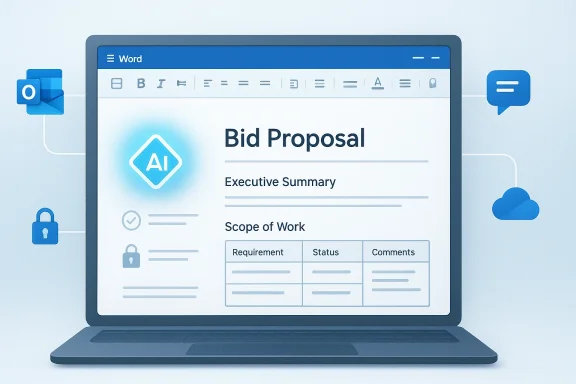
The headline sounds like a partner-program update, but the underlying product message is more interesting. Expedience is effectively selling a way to bring Copilot-assisted drafting into a controlled proposal assembly process, while keeping the final artifact in Word and the content governance inside Microsoft 365. That is a meaningful distinction in a market where many AI vendors still ask users to move content into separate web portals.The company says its platform helps organizations reuse approved corporate content, maintain formatting precision, and generate fully formatted proposals with tables, images, and embedded objects. Those details sound mundane, but they are exactly where real proposal projects live or die. A sales team can tolerate a weak brainstorm; it cannot tolerate a broken compliance matrix or a malformed appendix in a late-stage RFP response.
Why Word-native matters
Word-native software is not just about familiarity. It is about reducing the friction between drafting, review, approval, and delivery. When the entire process stays in Microsoft Word, content can flow through familiar check-in/check-out patterns, template logic, and collaboration workflows without forcing users to learn a new authoring surface.That matters for adoption, but it also matters for risk. Enterprises are wary of allowing sensitive proposal content to be copied into external AI tools or proprietary SaaS systems without careful security review. By staying inside Microsoft’s environment, Expedience is positioning itself as a lower-friction option for organizations that already have Microsoft 365 controls, retention policies, and access governance in place.
- Keeps authors in the tool they already use
- Reduces change management overhead
- Preserves native document formatting
- Makes governance easier to explain to compliance teams
- Avoids unnecessary duplication of content stores
The difference between drafting and delivering
Copilot is useful for first drafts, rewrites, summaries, and idea generation. But proposal work is not simply writing. It is assembly, validation, and packaging. Expedience is trying to occupy the layer where AI can accelerate drafting while automation handles structure, versioning, and assembly.That distinction is important because it avoids the common trap of assuming generative AI alone is enough. It is not. Proposal teams still need controlled content libraries, standardized sections, and mechanisms to prevent the wrong boilerplate from slipping into a customer-facing document. In other words, the best AI proposal workflow is still a workflow, not just a chatbot.
Why Microsoft Matters Here
Joining the Microsoft AI Cloud Partner Program is as much about market signaling as it is about technology. Microsoft’s partner ecosystem is built to help companies validate their capabilities, show alignment with Microsoft solution areas, and sell into customers already standardized on Microsoft products. For an ISV like Expedience, that affiliation can help translate a niche product into a more credible enterprise story.The program itself is broader than a simple logo badge. Microsoft explains that the AI Cloud Partner Program includes pathways and benefits for partners building software and services on the Microsoft Cloud, and that Solutions Partner designations are aligned to solution areas and customer scenarios. Microsoft also notes that these designations should not be interpreted as an endorsement or guarantee, which is a reminder that partner status is still a commercial and technical milestone rather than a promise of performance.
Partner credibility in a crowded AI market
The AI software market is crowded with vendors promising faster drafting, better summaries, and smarter content generation. For buyers, that creates a trust problem: almost every product sounds similar until someone asks where the data lives, how permissions are enforced, and whether the output can be governed at scale.Microsoft’s partner ecosystem helps solve some of that credibility gap. A partner that builds around Microsoft Word, Microsoft 365, SharePoint, and OneDrive can present itself as part of an existing enterprise operating model rather than as a separate island of AI functionality. That is especially attractive to procurement teams that already standardize on Microsoft licensing and infrastructure.
- Better alignment with enterprise procurement norms
- Easier fit for Microsoft-centric IT teams
- Stronger story around identity and access management
- More obvious path to integration with existing repositories
- Lower perceived risk than a completely standalone AI platform
What this says about Microsoft’s strategy
Microsoft has an obvious incentive to promote partner solutions that make Copilot more useful inside real business workflows. The more often customers see AI improving a concrete task like proposal generation, the more valuable Copilot becomes as an enterprise platform rather than a general-purpose assistant. That helps Microsoft deepen stickiness across Microsoft 365, SharePoint, Teams, and OneDrive.This is a classic platform strategy: make the core product indispensable, then let partners extend it into specialized vertical and horizontal use cases. Expedience is effectively betting that proposal automation is one of those use cases where Microsoft’s AI stack can be made even more compelling by a domain-specific workflow layer.
Proposal Automation in the AI Era
Proposal automation has always been a niche with outsized commercial impact. Winning one enterprise RFP can justify major investment in software, services, and staffing, so any platform that saves time or improves consistency can create real financial leverage. In 2026, the difference is that automation is no longer enough on its own; customers expect AI augmentation on top of the old assembly-line logic.That creates a new product design challenge. Traditional proposal software focused on templates, content libraries, and approval workflows. AI changes the equation by adding drafting acceleration, language variation, and summarization. The best vendors are now combining those layers rather than replacing one with the other.
AI helps, but structure still wins
The weakness of pure generative AI in proposal work is that it can sound polished while still being wrong, incomplete, or non-compliant. Proposal teams cannot afford “good enough” text if the answer must reflect technical precision, pricing discipline, or legal obligations. That is why structured automation remains central even when Copilot is introduced.Expedience’s pitch suggests a workflow where AI helps create the rough material, while the platform ensures the final document stays aligned with enterprise standards. That is a much more credible proposition than asking AI to author an entire bid end to end. It is also more consistent with how high-stakes business writing actually happens.
- AI speeds up the first draft
- Automation enforces structure and brand standards
- Approved content libraries reduce error rates
- Human review remains essential
- Final output must still be defensible
Enterprise vs. consumer expectations
Consumer AI tools often optimize for convenience, novelty, and quick output. Enterprise proposal automation optimizes for auditability, consistency, and repeatability. Those are different goals, and they produce different product requirements.In consumer AI, a slightly off answer is a nuisance. In enterprise RFP work, a slightly off answer can damage a bid, create a compliance issue, or expose the company to contractual risk. That is why governance and document fidelity remain central selling points, and why the phrase practical AI is doing a lot of work in this announcement.
The Copilot-in-Word Advantage
Microsoft Word remains one of the most important authoring environments in enterprise computing, precisely because it is both familiar and deeply embedded in business processes. By aligning with Copilot inside Word, Expedience is tapping into a huge installed base and avoiding the adoption friction that comes with a new interface. That is not a trivial advantage; it is the difference between a pilot and a platform.Microsoft has repeatedly framed Copilot as embedded in the apps people use every day, including Word, and has continued to add capabilities that support document creation and editing. That gives partners like Expedience a foundation that is both technically and psychologically convenient for users. The user no longer has to decide whether to “go use AI”; the AI is simply there inside the document.
Keeping work in the document
There is a strong practical case for keeping the entire process in a native Word file. Enterprise teams already know how to edit, comment, track changes, and manage document versions in this environment. They also know how to store final output in SharePoint or OneDrive, which makes governance and retention policies easier to apply.This approach is particularly valuable for proposal teams that work with strict formatting requirements. Tables, images, footnotes, and embedded objects are often part of a polished submission, and external web-based editors can still struggle with faithful reproduction of these features. Native document formats reduce that risk.
- Familiar editing experience
- Better preservation of formatting and branding
- Easier collaboration with legal and subject-matter experts
- Compatibility with Microsoft 365 storage and controls
- Less rework during final packaging
Why this matters to Microsoft-centric enterprises
For Microsoft-heavy organizations, Word-native AI is a comfort story and a governance story at the same time. Security teams are more likely to approve software that fits into existing identity and data-handling patterns, and users are more likely to adopt tools that look and feel like the applications they already live in every day.That does not mean the approach is risk-free. It does mean that, relative to a separate web-based proposal environment, Expedience is solving the adoption problem from the inside out. That is often a smarter path in the enterprise than trying to replace the user’s home base.
Competitive Implications
The competitive significance of this announcement goes beyond Expedience itself. It reinforces a broader market pattern: specialized software vendors are increasingly differentiating by how well they integrate with Microsoft’s AI and productivity stack, not by how dramatically they reimagine the interface. In a sense, Microsoft’s ecosystem is becoming the new center of gravity for enterprise workflow innovation.That puts pressure on competitors in two directions. Standalone proposal platforms will need to prove that their proprietary environments deliver a meaningful advantage over Microsoft-native workflows. Meanwhile, generic AI writing tools will need to show that they can handle governance and format complexity, not just produce fluent prose.
The race is no longer just about AI features
For years, software vendors could win attention by adding an AI label to a familiar workflow product. That play is less effective now because buyers have seen enough demos to understand the difference between a feature and a system. The real competition is increasingly around integration depth, workflow fit, and compliance readiness.Expedience’s move suggests it believes the winning configuration is not “AI instead of proposal automation,” but “AI inside proposal automation and inside Word.” That framing is more sophisticated and, arguably, more durable.
- Competes on workflow fit, not novelty
- Raises the bar for standalone AI writing tools
- Strengthens Microsoft-native vendors
- Pressures rivals to improve governance
- Rewards products with deeper enterprise roots
A signal to services partners too
The announcement is not only about software. It is also a sign to Microsoft-focused consultancies, systems integrators, and services firms that there is demand for domain-specific AI built around known workflows. Proposal automation is one example, but the pattern can extend into legal drafting, compliance reporting, contract lifecycle support, and knowledge management.That matters because service partners often help shape customer expectations. If consultants begin packaging Copilot-enhanced workflow solutions as the default enterprise recommendation, the market will move faster toward Microsoft-centered AI architecture. Expedience is helping normalize that model.
Enterprise Governance and Security
One of the strongest parts of Expedience’s announcement is its emphasis on governance and security. That is not marketing filler; it is the key constraint that determines whether generative AI is acceptable in a serious enterprise proposal process. If the content cannot be controlled, the AI benefit is largely irrelevant.Expedience says its approach keeps proposal content inside existing Microsoft 365 environments and supports storage in SharePoint or OneDrive. That matters because the value of enterprise AI is not just in output generation, but in keeping sensitive data under the same policy controls companies already use for other business content.
Governance is the real buying criterion
Proposal teams often work with proprietary pricing data, customer-specific commitments, legal caveats, and standardized statements that cannot drift. A system that makes content easier to generate but harder to govern may actually increase risk, even if it saves time in the short term. That is why this announcement leans so heavily on controlled content libraries and document fidelity.The security conversation is especially important for enterprises already investing in Microsoft 365 governance. If an organization can keep permissions, retention, and access management aligned with its existing environment, it avoids creating yet another shadow content repository. That is often the difference between a tool that becomes part of the operating model and one that gets sidelined after the pilot.
- Content stays in Microsoft-controlled repositories
- Existing access policies can be reused
- Sensitive proposal material is less exposed
- Governance workflows remain understandable
- Compliance teams face fewer surprises
The hidden cost of flexibility
There is, however, a subtle tradeoff. The more tightly AI is bound to existing workflows and controls, the less room there may be for unconventional experimentation. That may be a sensible tradeoff for proposal work, but it can also limit speed of innovation if vendors become overly dependent on Microsoft’s roadmap.In the short term, though, most enterprises will take governance over novelty every time. That is why this kind of partnership is attractive: it promises AI progress without creating an ungoverned content sprawl.
Market Positioning and Buyer Psychology
The language in Expedience’s announcement is carefully chosen because it speaks directly to buyer psychology. Words like fidelity, governance, consistency, and native Microsoft formats are not accidental. They are designed to reassure decision-makers that AI will not destabilize one of the most sensitive parts of the sales process.That is smart positioning. Buyers in proposal operations are often skeptical by default, because they have seen too many tools that promise acceleration but end up creating more review work. The winning message in this category is not “more AI”; it is “more throughput with no loss of control.”
Why the message resonates
For proposal leaders, the daily pain is usually not a lack of ideas. It is the accumulation of administrative friction: chasing content owners, fixing formatting drift, reconciling old boilerplate, and making sure the final response matches the requirements document. If Copilot can reduce drafting time and Expedience can automate assembly, the team gets back hours without losing the discipline that enterprise sales demands.That makes the announcement appealing to both operational and executive audiences. Operators hear lower manual effort, while leaders hear better cycle times and more consistent brand output.
- Shorter proposal cycles
- Better content reuse
- Reduced formatting errors
- Stronger alignment with brand standards
- Less time spent on repetitive editing
How buyers may interpret the deal
Some customers will see this as a genuine workflow improvement. Others will see it as a channel expansion move by a niche vendor trying to ride the Copilot wave. Both readings can be true at the same time. The difference will be whether Expedience can demonstrate measurable time savings, better win rates, or lower rework in real deployments.That is where the next stage of the story begins. Announcements are easy; proof is harder. The market will want evidence that Copilot-enabled proposal automation actually improves the economics of bid management, rather than simply modernizing the pitch deck.
Strengths and Opportunities
Expedience’s Microsoft partnership has several clear strengths, and the opportunity set is larger than the announcement headline suggests. The company is aligning itself with a platform that enterprise buyers already know, while targeting a workflow that is both painful and commercially important. If executed well, this could strengthen its standing in a specialized but valuable segment.- Deep Microsoft fit should make adoption easier for Microsoft-centric organizations.
- Word-native workflows reduce training and change-management overhead.
- Governance-first positioning speaks directly to enterprise compliance needs.
- AI plus automation is more compelling than either capability alone.
- RFP response management is a high-value niche where time savings matter.
- Content libraries and reuse can improve consistency and reduce errors.
- Microsoft ecosystem expansion opens the door to adjacent workflows and integrations.
Risks and Concerns
The risks are equally real, and they mostly revolve around dependency, differentiation, and execution. Joining Microsoft’s partner ecosystem can improve credibility, but it also makes the product story more dependent on Microsoft’s evolving roadmap and the market’s appetite for Copilot-led workflows. If the product cannot prove measurable business outcomes, the announcement may be remembered as positioning rather than transformation.- Microsoft dependency could limit strategic flexibility over time.
- Copilot expectations may outpace what the product can deliver today.
- AI output quality still requires heavy human review in proposal work.
- Competitive overlap with other Microsoft-native vendors may intensify.
- Integration depth will need to be more than a marketing claim.
- Enterprise security reviews can slow sales cycles regardless of features.
- Buyer skepticism remains high in AI tools that promise productivity gains.
Looking Ahead
The next question is whether Expedience can turn this partner announcement into a repeatable enterprise motion. The most important proof points will be customer references, measurable cycle-time reductions, and evidence that the Microsoft-native workflow really does reduce friction without degrading quality. In a market full of AI claims, those practical metrics will matter more than the partnership badge itself.It will also be worth watching whether Expedience broadens its story beyond proposal automation. Microsoft’s ecosystem makes it tempting to extend into adjacent knowledge-work workflows, and many of the same principles apply to contracts, compliance writing, and customer-facing documentation. If the company can demonstrate a coherent roadmap, this could be the start of a broader Microsoft-aligned productivity platform rather than a single-feature enhancement.
- Customer adoption and renewal signals
- Proof of cycle-time improvement in live deployments
- Expansion into related document-heavy workflows
- Deeper Microsoft 365 integration milestones
- Competitive responses from other proposal vendors
Expedience’s move into the Microsoft AI Cloud Partner Program is therefore more than a routine ecosystem update. It is a reminder that the strongest AI products in the enterprise may be the ones that disappear into the workflow so completely that users barely notice the technology at all. In proposal management, that invisibility may be the clearest sign that the AI is finally doing its job.
Source: GlobeNewswire Expedience Software Joins Microsoft AI Cloud Partner Program to Deliver Copilot-Powered Proposal Automation in Microsoft Word
