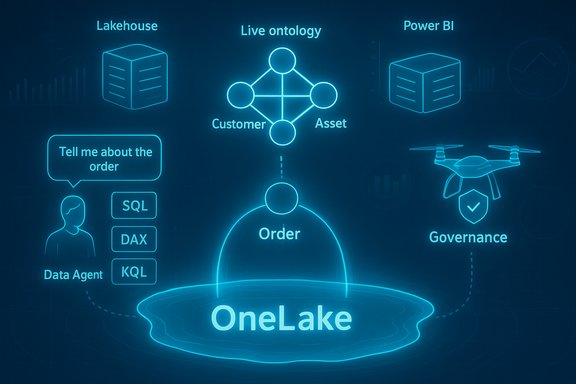
Microsoft’s Ignite keynote and product pages have confirmed a deliberate step toward making enterprise data “meaningful” to both people and machines: Fabric IQ, introduced as a preview capability inside Microsoft Fabric, layers semantic intelligence over analytics, time‑series, geospatial and operational systems so agents and applications can reason about business concepts (customers, orders, inventory) instead of raw tables and streams. This new IQ family — which also includes Work IQ for Microsoft 365 context and Foundry IQ for managed knowledge grounding — is positioned as the data backbone for identity‑bound, auditable AI agents and operational automation across Azure, Microsoft 365 and Fabric.
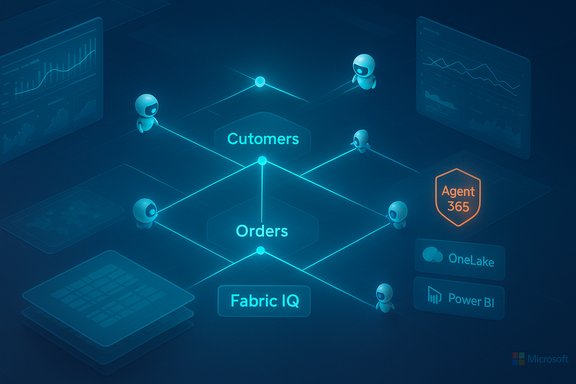
Microsoft framed Ignite 2025 around the idea of the “agentic” enterprise: fleets of specialized AI agents that plan, act and are governed as first‑class services. Fabric IQ sits at the center of this vision for data: it promises a single semantic layer that maps analytical artifacts and operational records into a shared ontology of business entities and relationships. That ontology becomes the lingua franca agents use to reason, make decisions and trigger actions in operational systems. Three strategic pieces make the announcement significant:
Fabric IQ marks a pragmatic next step in the enterprise AI journey: it shifts the conversation from “can models answer questions?” to “can models and agents act with shared business meaning, traceability and governed authority?” The answer will depend on how well enterprises invest in the plumbing — the ontology, lineage and controls — required to make that shared meaning trustworthy and operational at scale.
Source: InfoWorld Microsoft Fabric IQ adds ‘semantic intelligence’ layer to Fabric
 Background / Overview
Microsoft framed Ignite 2025 around the idea of the “agentic” enterprise: fleets of specialized AI agents that plan, act and are governed as first‑class services. Fabric IQ sits at the center of this vision for data: it promises a single semantic layer that maps analytical artifacts and operational records into a shared ontology of business entities and relationships. That ontology becomes the lingua franca agents use to reason, make decisions and trigger actions in operational systems. Three strategic pieces make the announcement significant:- A semantic layer aimed at closing the gap between analytics and operational automation.
- A managed knowledge and grounding service (Foundry IQ) to reduce RAG complexity for agent builders.
- A governance/control plane (Agent 365) and tooling (Copilot Studio, Microsoft Agent Factory) that treat agents like tenant principals with identity, telemetry and policy attachments.
What Fabric IQ is designed to do
Fabric IQ is presented as a preview workload inside Microsoft Fabric that converts existing data artifacts into a business‑centric semantic model. The stated design goals are practical and ambitious:- Provide a no‑code and IT‑governed way to build a live ontology of business entities, rules and objectives so domain experts and business users can express meaning without changing raw schemas.
- Extend BI definitions into a semantic model that is consumable by AI agents and operations pipelines, not just reports.
- Offer a native graph engine to enable multi‑hop reasoning across entities and relationships, improving an agent’s ability to draw conclusions that require chained lookups.
- Deliver data agents (virtual analysts) that answer business questions using the semantic model rather than ad‑hoc SQL joins.
- Power autonomous operations agents that can reason over live telemetry, evaluate tradeoffs and, under governance, take actions in real time.
How the semantic model differs from classic data modeling
Traditional data modeling focuses on schemas optimized for storage and queries. Fabric IQ’s premise is different: the ontology is a live, business‑centric abstraction that sits above raw schemas and ties tables, time‑series streams and operational records to business semantics (for example, mapping shipment telemetry, ERP records and service tickets to a single shipment entity). That lets agents and downstream automation work against business concepts rather than brittle schema joins. The upshot is fewer one‑off mappings and more consistent decision logic if the ontology is well governed.Architecture and technical plumbing
Fabric IQ is built to leverage core Fabric building blocks and Microsoft’s broader agent stack. Key architectural points announced or documented:- OneLake as the underlying storage and sharing fabric, enabling shortcuts and mirrored datasets to be surfaced into the semantic model without unnecessary copies.
- Connectors and mirroring support (Dataverse, SAP, SharePoint shortcuts, etc. to bring transactional and operational systems into Fabric with minimal ETL. These are critical to keep the semantic model up to date.
- A native graph engine for relationship traversal and multi‑hop reasoning, enabling agents to answer questions that require chaining across entities (e.g., “Which customers saw a delivery delay that triggered a service incident and were on a priority contract?”).
- Integration points for Foundry IQ (managed knowledge retrieval) and Work IQ (people/work context) so that agents can combine business entity reasoning, curated knowledge, and human/context signals.
The broader “IQ” ecosystem: how Fabric IQ fits with Work IQ and Foundry IQ
Fabric IQ is one of three complementary intelligence layers Microsoft presented:- Work IQ — a people‑centric intelligence layer built from Microsoft 365 signals (mail, files, chats, meetings, relationships and inferred memory) that supplies agents with work context and continuity.
- Foundry IQ — a managed knowledge grounding service that aggregates and routes queries across Microsoft 365, Fabric IQ, custom apps and web sources to provide provenance‑aware, permissioned retrieval for agents.
- Fabric IQ — the business‑entity semantic layer for analytics and operational systems.
Real‑world use cases (practical scenarios)
Fabric IQ’s value is clearest in use cases that require combining analytics, telemetry and operational state with business logic:- Supply chain triage and routing — combine inventory, shipment telemetry and order records to autonomously reroute a delayed shipment or trigger corrective logistics actions under policy approval.
- Customer resolution automation — join CRM records, support tickets and delivery telemetry to enable a data agent to present a consolidated remediation plan and—when authorized—create a follow‑up ticket automatically.
- Sales enablement and seller copilot — surface role‑specific insights by blending conversation transcripts, CRM notes and sales performance models so a data agent supplies precise answers backed by SQL counts plus supporting documents via Foundry IQ. (A commercial customer example showed voice‑first copilot flows using Fabric embeddings and SQL.
- Cloud operations orchestration — combine observability telemetry, configuration records and runbooks; operations agents can propose or enact remediation steps governed by Agent 365 policies and approval gates.
Strengths and notable engineering choices
- Semantic grounding reduces brittle mappings. When done well, a shared ontology avoids repeated ad‑hoc joins and inconsistent interpretations of the same concept across teams. That promotes operational consistency and reduces downstream maintenance.
- Integration with existing modeling work. Organizations with mature Power BI or Dataverse models can reuse those assets to accelerate ontology creation. This lowers the ramp for Microsoft‑centric customers.
- Governance‑first design. Treating agents as directory principals (Entra Agent IDs), offering Agent 365 for catalog/telemetry, and integrating Defender and Purview are pragmatic steps toward enterprise readiness. Those choices make it easier to apply existing identity and compliance controls to agents.
- Hybrid grounding and retrieval. Foundry IQ and Fabric IQ together give a cleaner path for RAG‑style grounding that preserves provenance and access controls — a real win for explainability and auditability.
Risks, limitations and unverifiable claims
No product launches in the agent era are risk‑free. Several clear caveats stood out in the announcements and early reporting:- Preview status and evolving APIs. Fabric IQ and Foundry IQ are in preview. Enterprises should treat initial behaviors as subject to change and validate the API surface and policies during pilots.
- Data quality and modeling work required. Ontologies do not create themselves — successful adoption requires investment in entity design, lineage, metadata and Purview tagging. That migration effort can be substantial and often falls to central data teams.
- Vendor lock‑in risk. Several analysts cautioned that heavy investment in a Fabric IQ ontology can increase migration costs if an organization later wants to move away from Microsoft’s stack. Treat this as an architectural trade‑off rather than a technical defect.
- Operational blast radius from autonomous agents. Agents that can act (create tickets, change infra, order stock) expand the potential for automation‑driven faults. Agent 365 and approval gates reduce risk, but humans, runbooks and staged rollouts remain essential.
- Unverified performance claims. Related Azure data services (HorizonDB, DiskANN indexing, etc. include vendor benchmarks; independent validation remains essential before committing to large‑scale production. Treat vendor numbers as directional until proven in your workload.
Governance, security and compliance checklist
To pilot Fabric IQ safely, organizations should treat agentization as an operational program, not a feature toggle. A recommended starter checklist:- Define a bounded pilot with clear KPIs (time saved, MTTR reduction, error rate) and a rollback plan.
- Model critical entities first (one or two): define ownership, sensitivity, retention and access rules.
- Integrate Purview classification and test that Fabric IQ’s ontology honors existing data labels and DLP rules.
- Publish agents in Agent 365 registry only after security review; enforce Entra Agent IDs, conditional access and least‑privilege scopes.
- Start agents in monitor‑only or suggest‑only modes; require human approval for any write or destructive actions.
- Instrument agent telemetry into SIEM/SOAR, create alerts and update runbooks to include agent‑specific incidents.
Practical adoption roadmap — a staged approach
- Discovery and scoping. Inventory candidate workflows where Fabric IQ can reduce mapping complexity (order routing, ticket triage, inventory reconciliation).
- Entity pilot. Build a minimal ontology for a single domain (e.g., Order → Shipment → Incident), mirror source data into OneLake, and validate joins and lineage.
- Agent prototype. Create a data agent that answers a narrow class of business questions; log decisions and expose provenance via Foundry IQ.
- Governed shadowing. Run operations agents in monitor‑only mode inside Agent 365 with SIEM integration; compare proposed actions to human decisions.
- Graduated autonomy. Move to suggest‑and‑execute modes with approval gates, then to limited automated actions once performance and auditability are proven.
- Scale and refine. Expand the ontology, add graph relationships, and roll out approved agents to additional domains with quotas and cost controls.
What to watch next (verification points)
- Billing and SKU details for Fabric IQ ontology items and Agent 365 licensing; Microsoft has indicated pricing details will be published after preview. Validate with your Microsoft account team before broad rollouts.
- Performance and scale characteristics of the native graph engine and mirroring pipelines under realistic enterprise event rates. Vendor claims should be benchmarked against your workload.
- Foundry IQ SLAs, data residency and routing controls — because Foundry IQ becomes a dependency for agent grounding in many scenarios. Confirm SLAs and access controls for high‑assurance use cases.
- Interoperability tests if you intend to use non‑Microsoft agents or multi‑cloud model routing (MCP and Agent‑to‑Agent patterns lower friction but require proof‑of‑concepts).
Final assessment
Fabric IQ is an important and logical extension of Microsoft’s Fabric and Copilot roadmap: by codifying business meaning in an ontology and coupling that layer to managed retrieval and a governance control plane, Microsoft addresses several real blockers for enterprise agent adoption — chiefly, context, provenance and control. For Microsoft‑centric enterprises with mature data modeling and governance practices, Fabric IQ will likely accelerate useful agent deployments and reduce some operational friction that made agents brittle in earlier pilots. That said, the promise comes with tradeoffs. Ontology creation and upkeep are nontrivial, vendor lock‑in and migration costs can be real, and autonomous agents increase operational complexity. Organizations should approach Fabric IQ as a strategic program: invest in metadata, pilot deliberately, instrument telemetry and keep humans in the loop for high‑impact actions. The winners will be teams that combine disciplined data engineering, security controls and focused business pilots to turn semantic intelligence into repeatable automation.Fabric IQ marks a pragmatic next step in the enterprise AI journey: it shifts the conversation from “can models answer questions?” to “can models and agents act with shared business meaning, traceability and governed authority?” The answer will depend on how well enterprises invest in the plumbing — the ontology, lineage and controls — required to make that shared meaning trustworthy and operational at scale.
Source: InfoWorld Microsoft Fabric IQ adds ‘semantic intelligence’ layer to Fabric