

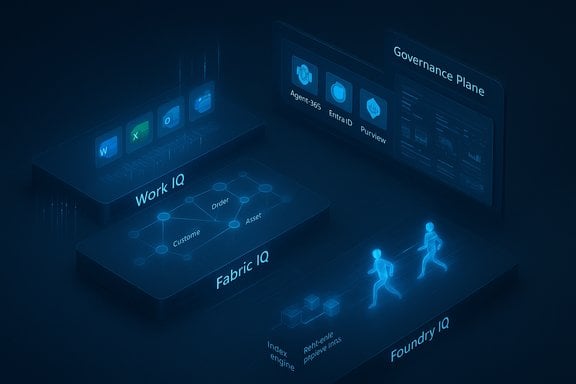
Microsoft’s Ignite keynote this year introduced a deliberate and cohesive strategy for making AI agents useful, auditable, and business‑grade: a three‑tiered intelligence layer — Work IQ, Fabric IQ, and Foundry IQ — tied together with a governance and runtime fabric that treats agents as first‑class workforce identities. The announcement repositions Microsoft’s Copilot and Foundry efforts from a collection of point products into an integrated platform for building, grounding, and operating agentic AI at enterprise scale, and it signals a pragmatic pivot: enterprises will be asked to trade some of the “bolted‑on” AI approaches of the last two years for an architecture that binds data, semantic business meaning, and knowledge retrieval together under governance and observability at every level.
Microsoft set the scene at Ignite by framing a new problem statement for enterprise AI: models alone aren’t enough. For AI to be both valuable and safe in production, systems must understand the way an organization actually works, map raw data to business concepts, and make the right knowledge accessible to agents — all under enterprise security and compliance controls. This is the design space that Work IQ, Fabric IQ, and Foundry IQ attempt to occupy.
The announcements bundle three major themes:
What this means in practice:
Key benefits:
Core elements:
What that delivers:
However, the feature set also places Microsoft in direct competition with startups and cloud rivals offering managed RAG, vector databases, and retrieval services. Microsoft’s differentiator is the breadth of its ecosystem — Microsoft 365 data, Power BI/Fabric semantics, Azure runtime, and end‑to‑end governance. For customers already invested in Microsoft technologies, the integrated IQ stack offers an attractive, lower‑friction path to production.
However, adoption will be a measured process. The technical capabilities are compelling, but the business value depends on practical items — semantic modelling investment, index freshness, observability integration, and rigorous governance testing. Organizations should approach the IQ stack with the same discipline they apply to any production system: pilot, measure, harden, and only then scale.
For enterprise teams ready to adopt agentic AI, Microsoft now offers a clear, opinionated path that can reduce the engineering drag of building retrieval pipelines and governance tooling from scratch. For industry watchers and security teams, the new primitive to monitor is no longer just the model but the agent fleet — a collection of identities that will act on your systems, and the policies and observability you deploy to keep them predictable and safe.
In short: Microsoft’s intelligence layer reframes the question from “which model should we use?” to “how will our agents understand our business, and how will we manage them?” That reframing, when implemented with discipline, is exactly what enterprises need to move AI from experiments into reliable operational practice.
Source: Cloud Wars Microsoft Debuts Work IQ, Fabric IQ, and Foundry IQ: A Unified Intelligence Layer for the AI-Powered Enterprise
 Background
Microsoft set the scene at Ignite by framing a new problem statement for enterprise AI: models alone aren’t enough. For AI to be both valuable and safe in production, systems must understand the way an organization actually works, map raw data to business concepts, and make the right knowledge accessible to agents — all under enterprise security and compliance controls. This is the design space that Work IQ, Fabric IQ, and Foundry IQ attempt to occupy.The announcements bundle three major themes:
- Turning productivity assistants into agentic workers that can perform multi‑step tasks and take actions.
- Building a semantic, governed data layer so agents reason about business entities (customers, orders, products) instead of raw tables and text.
- Providing an operational control plane for identity, lifecycle, observability, and runtime policy enforcement for fleets of agents.
Overview of the three IQ layers
Work IQ: company‑specific signals and memory for Copilot
Work IQ is the intelligence fabric that sits closest to everyday users. It is described as a three‑part system:- Data — the canonical signals from email, chats, files, meetings, and other Microsoft 365 artifacts.
- Memory — models of how your company, teams, and individual workers operate: preferences, workflows, relationships, and patterns.
- Inference — the logic that connects data and memory to predict the next best action, recommend the most relevant agent, or surface contextual suggestions inside Office apps.
What this means in practice:
- Copilot will be able to use workplace context (meeting history, recent projects, team roles) to tailor outputs.
- Microsoft positions this as safe for enterprises: Work IQ respects existing permissions, sensitivity labels, and compliance controls.
- Work IQ powers dedicated Office Agents (Word, Excel, PowerPoint) and domain agents like People Agent, Workforce Insights Agent, and Learning Agent for upskilling.
- Strength: Paring persistent, contextual memory with workspace signals reduces repetitive prompts and can cut task friction.
- Caveat: Persistent memory is also a new attack surface for data leakage and privacy errors; enterprises must validate retention, access audit trails, and opt‑in boundaries for memory features before broad deployment.
Fabric IQ: the semantic model for business meaning
Fabric IQ extends the Power BI semantic model into a broader enterprise ontology. Instead of forcing agents to reason in terms of raw tables, columns, and timestamps, Fabric IQ lets teams define business entities — customers, orders, contracts, assets — and map analytical, time series, and geolocation sources to those entities. Fabric IQ becomes the shared vocabulary for both human analysts and agentic applications.Key benefits:
- Single semantic model across analytics and agent logic reduces misinterpretation (an agent and a Power BI report will use the same definition of “churn”).
- Fabric IQ ingests and aligns data from OneLake, Power BI models, and operational systems, enabling agents to act with a live, connected view of the business.
- It supports operations agents that monitor telemetry streams and take actions when thresholds or patterns emerge.
- Fabric IQ is powerful for reducing RAG (retrieval‑augmented generation) brittleness because if an agent asks “what is a customer?” it gets the canonical business definition, not a fuzzy text snippet.
- For organizations already using Power BI and Fabric, existing semantic models are a fast on‑ramp to creating agent‑ready datasets.
- Semantic modelling is labor‑intensive. Fabric IQ will speed adoption for organizations that already invested in Power BI semantics, but enterprises without curated models face an initial modelling workload and possible governance questions about who owns entity definitions.
Foundry IQ: knowledge grounding and automated RAG
Foundry IQ is the knowledge layer powered by Azure AI Search and integrated into Microsoft Foundry (the Azure service for building agentic applications). It is described as a fully managed knowledge system that:- Indexes and federates knowledge across Microsoft 365, Fabric IQ, custom apps, and the web.
- Automates traditional RAG pipelines (ingest → index → retrieval → synthesis) and adds agentic retrieval capabilities such as query planning, iterative search, and reflection.
- Offers reusable knowledge bases with a single API, smart retrieval engines, and built‑in enterprise security and governance.
- The need for teams to build bespoke RAG plumbing — connectors, indexers, retrieval heuristics, and prompt templates — for each agent.
- Manual effort in stitching knowledge from scattered sources and aligning it with agent pipelines.
- Foundry IQ acts as the single endpoint agents query to discover the right context and data for a task.
- By offering a managed retrieval engine with policy‑aware filtering and integration with Microsoft Purview, Foundry IQ aims to reduce hallucination risk and streamline production deployments.
- Automating RAG is attractive, but the quality of retrieval will still depend on metadata quality, index freshness, and semantic alignment. Enterprises should verify SLOs for indexing latency and freshness before trusting agents for high‑risk tasks.
Governance, identity, and runtime: Agent 365, Entra Agent ID, Purview, Defender
The intelligence layers are bound together by a governance and operational fabric designed for enterprise risk management.Core elements:
- Agent 365 — a control plane and registry for agent lifecycle, discovery, and operational governance. It inventories agents, applies policies, and provides observability and alerts.
- Entra Agent ID — a directory identity for agents so they can be managed, deprovisioned, and controlled like human accounts. Identity mapping lets existing IAM processes (access reviews, conditional access) extend to machines.
- Microsoft Purview and Defender integrations — policy enforcement, data‑loss prevention for prompts, and runtime threat detection are part of the control plane.
- Foundry Control Plane — runtime governance for agents built in Foundry, including model routing, tool permits, and behavioral guardrails.
- Treating agents as directory principals eliminates a large class of “shadow agent” risk where rogue agents access data or inadvertently execute actions.
- Integrated telemetry and audit trails are essential for compliance teams who need to reconstruct how an agent reached a decision or acted on data.
- Map agent roles to existing IAM groups and conditional access policies.
- Require Entra identity enrollment and automated deprovisioning for agents given access to sensitive systems.
- Integrate Agent 365 logs into SIEM/SOAR early to detect anomalous agent behavior.
- Many governance primitives are in preview; real‑world effectiveness depends on APIs, log formats, retention policies, and integration depth with third‑party SIEMs.
- Enterprises should validate retention policies, red‑team agent behaviors, and legal implications of agent identities acting autonomously.
Anthropic, multi‑model choice, and model routing
A notable commercial move in the announcements was deeper model choice: Anthropic’s Claude family is now available within Microsoft’s Foundry and as an option inside Copilot Studio/Agent Mode. Microsoft’s positioning is multi‑model routing: pick the model best suited for a task (reasoning vs. real‑time throughput vs. coding) and enforce routing policies via the Foundry control plane.What that delivers:
- Developers can select models optimized for specific agent workloads (e.g., Claude Sonnet for complex reasoning, Claude Haiku for throughput).
- Model choice reduces vendor lock‑in concerns and allows enterprises to tune cost/performance tradeoffs.
- Claims about “best” models are typically marketing; organizations should benchmark models against their specific tasks and safety requirements.
- Multi‑model routing increases operational complexity: organizations must now manage multiple model SLOs, cost controls, and possibly multiple vendor contracts.
What this means for enterprise adoption: benefits and the practical path forward
Benefits Microsoft is selling:- Faster time to value for agent projects through reusable knowledge bases and semantic models.
- Lower technical debt by outsourcing RAG automation and retrieval logic to Foundry IQ.
- Better governance by treating agents as managed identities and providing a unified control plane.
- Improved alignment between analysts and agents via Fabric IQ semantic models.
- Start with a defined use case: automate one domain (e.g., IT ticket triage, financial reporting, or sales lead research) before scaling.
- Invest in semantic modelling: partner analytics and domain teams to build Fabric IQ models that capture your business entities and rules.
- Pilot with Foundry and Copilot Studio in restricted, read‑only modes to validate retrieval quality and audit trails.
- Require Entra Agent ID enrollment for any agent touching sensitive systems and integrate Agent 365 logs into your SIEM.
- Benchmark models for safety, accuracy, latency, and cost before mixing them in production.
- Proof of value: low‑risk read‑only agents using Fabric IQ for contextual retrieval.
- Governance validation: connect Agent 365 to SIEM, validate identity lifecycle, and test policy enforcement.
- Controlled write pilots: enable agents to take bounded actions (e.g., create a draft, schedule a meeting) with human approval required for execution.
- Production rollout: automate select workstreams where agent SLOs and governance checks meet enterprise thresholds.
Risks, limitations, and what to validate in early tests
Technical and operational risks:- Data quality and entity alignment — Fabric IQ’s power depends on clean entity definitions. Poor modelling yields incorrect agent reasoning.
- Index freshness and retrieval SLOs — Foundry IQ’s usefulness depends on up‑to‑date indices. For real‑time decisions, validate index latency and refresh windows.
- Memory and privacy — Work IQ’s conversational memory must be governed. Validate retention policies, opt‑out mechanisms, and scoped access.
- Model safety and hallucinations — Even with grounding, agents can produce plausible but incorrect outputs. Require human‑in‑the‑loop controls for high‑risk outputs.
- Operational complexity — Multi‑model orchestration and a fleet of agent identities increase the complexity of cost control, monitoring, and incident response.
- Vendor and pricing exposure — Model routing and multi‑vendor support reduce lock‑in but increase procurement complexity; validate billing mechanics and SLAs.
- Confirm that Purview integration meets your regulatory requirements for data residency, retention, and audit.
- Validate contractual terms for third‑party models (billing alignment, data usage, indemnities).
- Ensure agent identities and audit logs satisfy internal audit and external regulator needs.
- Marketing statements that a particular model is “the best” for broad categories should be validated with benchmark tests on concrete workloads.
- Pledges of “governance by default” require operational validation — that is, confirm logging, evidence retention, and customizable policy enforcement meet your audit requirements.
Developer and platform implications
For engineering teams, the announcements change the developer story in several ways:- Foundry becomes the primary production runtime for agentic workloads with built‑in tools for discovery, testing, and governance.
- Copilot Studio remains the low‑code authoring surface for non‑engineers to compose agents and workflows that leverage Work IQ and Fabric IQ.
- Developers must adapt to declarative semantic models (Fabric IQ) and reusable knowledge bases (Foundry IQ) rather than building ad‑hoc retrieval and indexing pipelines.
- Tooling and open standards (MCP, A2A, OpenAPI) are emphasized to smooth integrations with third‑party models and services, though maturity varies by partner.
- Learn the Foundry SDKs and how they integrate with Entra identities and the Agent 365 control plane.
- Design for observability: instrument agent flows, model choices, retrieval contexts, and tool calls.
- Implement staged rollouts with kill switches and human approval steps for write actions.
Competitive and market positioning
Microsoft’s approach is pragmatic and enterprise‑centric: it bundles data semantics, knowledge retrieval, and governance into a unified narrative that appeals to CIOs and CISOs. By integrating third‑party models (Anthropic) and promising multi‑model routing, Microsoft reduces the single‑vendor model risk that worried many IT buyers.However, the feature set also places Microsoft in direct competition with startups and cloud rivals offering managed RAG, vector databases, and retrieval services. Microsoft’s differentiator is the breadth of its ecosystem — Microsoft 365 data, Power BI/Fabric semantics, Azure runtime, and end‑to‑end governance. For customers already invested in Microsoft technologies, the integrated IQ stack offers an attractive, lower‑friction path to production.
Closing analysis: pragmatic architecture for a risk‑aware enterprise
The Work IQ + Fabric IQ + Foundry IQ stack reflects a mature next step in enterprise AI thinking. It acknowledges three hard truths enterprises face:- AI must be grounded in enterprise context to be consistently useful.
- Agents are a new operational model that requires identity, lifecycle, and observability controls.
- Semantic alignment between analytics and agents reduces ambiguity and accelerates safe value delivery.
However, adoption will be a measured process. The technical capabilities are compelling, but the business value depends on practical items — semantic modelling investment, index freshness, observability integration, and rigorous governance testing. Organizations should approach the IQ stack with the same discipline they apply to any production system: pilot, measure, harden, and only then scale.
For enterprise teams ready to adopt agentic AI, Microsoft now offers a clear, opinionated path that can reduce the engineering drag of building retrieval pipelines and governance tooling from scratch. For industry watchers and security teams, the new primitive to monitor is no longer just the model but the agent fleet — a collection of identities that will act on your systems, and the policies and observability you deploy to keep them predictable and safe.
In short: Microsoft’s intelligence layer reframes the question from “which model should we use?” to “how will our agents understand our business, and how will we manage them?” That reframing, when implemented with discipline, is exactly what enterprises need to move AI from experiments into reliable operational practice.
Source: Cloud Wars Microsoft Debuts Work IQ, Fabric IQ, and Foundry IQ: A Unified Intelligence Layer for the AI-Powered Enterprise
