

Microsoft’s Ignite stage this year accelerated a strategic pivot: Copilot is no longer merely a conversational helper folded into Office apps — Microsoft unveiled an agentic platform built to create, run, and govern fleets of AI agents across Microsoft 365, Windows and Azure, and packaged a set of SMB-focused commercial moves that lower the barrier for small businesses to adopt Copilot-powered productivity. The announcements center on a new control plane called Agent 365, an intelligence layer branded Work IQ (plus companion layers for data grounding), expanded Agent Mode inside Word/Excel/PowerPoint, voice and Teams-driven agent experiences, and a lower‑cost Microsoft 365 Copilot Business SKU for organizations under 300 users — all framed around a governance‑first message intended to make agent deployments auditable, identity‑bound and enterprise‑ready.
Background / Overview
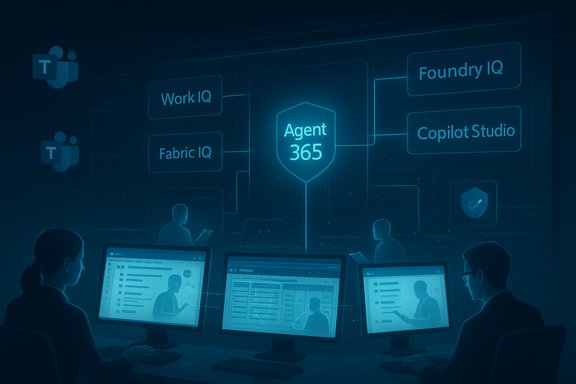
Microsoft used Ignite 2025 to codify what it calls the “Frontier Firm” thesis: organizations that succeed with AI will treat agents as first‑class operational workers — identity‑bound, governed, and observable services that can plan, act and hand off to humans. The product stack announced at Ignite stitches several layers together:- Work IQ — a context and memory layer that ingests mail, files, meetings and behavioral signals so agents can be role‑aware and persist useful context.
- Fabric IQ / Foundry IQ — data and knowledge grounding layers that let agents reason over business entities and governed analytics rather than raw tables.
- Agent 365 — a tenant control plane and registry to discover, authorize, monitor and secure agents at scale.
- Copilot Studio, Agent Store, and MCP (Model Context Protocol) — authoring, cataloging and integration primitives to build and safely connect agents to apps and third‑party systems.
What Microsoft Announced (at a glance)
Agent 365: governance and lifecycle management for agents
Agent 365 is the new central management surface Microsoft says will let IT teams treat agents like directory objects: discover registered agents, assign identities, apply least‑privilege access, visualize agent behaviors, instrument telemetry, and enforce policy-driven constraints. The control plane is explicitly positioned to work with agents authored in Copilot Studio, third‑party vendor agents, or open‑source frameworks, and is currently being made available through early access programs. Why it matters: If enterprises actually adopt thousands of specialized agents, a central registry with identity, policy enforcement, and audit trails will be essential to reduce attack surface, prevent data exfiltration and maintain compliance. The underlying message is clear — Microsoft wants agents to be manageable like services rather than ephemeral assistants.Work IQ and the “IQ” stack: context, data, and grounding
Work IQ is presented as the contextual brain that understands your work patterns, preferences, and the organizational structure that shapes how tasks should be done. Microsoft pairs Work IQ with data‑grounding layers (Fabric IQ inside Microsoft Fabric and Foundry IQ as a managed knowledge grounding service) so agents can reason about business entities — customers, orders, inventory — and make multi‑step decisions grounded in governed data. This reduces prompt friction and is central to the company’s claim that agents can be useful and auditable at scale. Caveat: many governance and retention details are reliant on tenant settings and forthcoming admin consoles; organizations must validate how Work IQ persists memory, how Purview and sensitivity labels are enforced, and the defaults for retention and audit.Agent Mode and Office Agents: agents that act inside files
Microsoft extended Copilot with two complementary Office experiences:- Agent Mode (in‑canvas) — an agent embedded in the document/workbook/canvas that decomposes a high‑level brief into stepwise tasks, executes edits and transformations directly in the file, and exposes a visible plan and intermediate artifacts for human inspection and rollback.
- Office Agents (chat‑first) — agents surfaced from Copilot Chat optimized to research and assemble near‑final deliverables (reports, slide decks, complex workbooks) that can be handed off to Office apps with a click.
Teams, Outlook, and voice: agents across the flow of work
Updates include Teams Mode (add Copilot as a chat participant), facilitator and interpreter agents for meetings, voice‑led mobile triage for Outlook, and deeper inbox/calendar understanding. Agents can join chats, extract action items, generate agendas, and coordinate with third‑party tools via MCP servers (Jira, Asana, GitHub). Microsoft positions these as the connective tissue that brings agentic workflows into daily collaboration.Windows 365 for Agents and endpoint runtime
Microsoft previewed Windows 365 for Agents — Cloud PC instances tuned to host agent runtimes in sandboxed environments with policy and audit controls. The idea is to safely host agent compute off‑endpoint where required while surfacing agent experiences on the Windows taskbar and via an Agent Workspace that isolates runtime and connectors.Commercial moves: Microsoft 365 Copilot Business for SMBs
A headline commercial announcement at Ignite was Microsoft 365 Copilot Business, a new SKU for small and medium businesses supporting up to 300 users, priced at $21 per user per month, available starting December 1, 2025. Bundles with Microsoft 365 Business Basic/Standard/Premium and promotional discounts were also announced for partner and CSP channels. Microsoft’s partner materials and independent reporting corroborate the price and caps. Why this is significant: the lower price and direct bundles make Copilot economics materially more accessible for SMBs — which is particularly consequential for regions where small businesses form a large share of economic activity. The SKU includes the core Copilot capabilities that have previously been positioned behind the enterprise Copilot add‑on, meaning small teams can run agentic workflows without enterprise licensing overhead.Security, governance and identity: a governance‑first sales narrative
Microsoft repeatedly framed agent adoption as a governance challenge and offered integrated primitives to mitigate risk:- Agent identities via Entra to let agents be included in access reviews and conditional access policies.
- Copilot Studio and Agent 365 as the authoring and control surfaces for lifecycle, telemetry and policy enforcement.
- Purview and Defender integrations for sensitivity labeling, DLP, threat detection and incident response tied to agent activity.
- Model routing and choice controls that allow admins to opt into third‑party models (Anthropic/OpenAI) for specific workloads.
Critical analysis: strengths, weaknesses and unanswered questions
Strengths and opportunities
- Integrated platform with governance primitives: Microsoft’s combination of Copilot Studio, Agent 365, Entra, Purview and Defender forms a coherent stack that addresses the lifecycle and security needs enterprises repeatedly cite as blockers to AI adoption. Having authoring, runtime, and governance in the same vendor ecosystem reduces friction for many IT organizations.
- Work IQ and data grounding: Grounding agents with structured business entities and persistent context reduces hallucination risk and improves relevance — critical for high‑value tasks such as finance forecasts or legal drafting. Fabric IQ and Foundry IQ are specifically positioned to let agents reason over governed analytics rather than raw blobs.
- SMB pricing and bundles: The $21/user/month Copilot Business SKU and promotional bundles lower barriers for small and medium organizations to pilot and operationalize agentic workflows affordably. This is likely to accelerate adoption in markets where SMBs drive GDP and employment.
- Model choice and multi‑model strategy: Microsoft’s multi‑model posture (supporting Anthropic and OpenAI models in specific paths) is a practical hedge that lets customers route tasks to the model suited to the workload and risk profile.
Risks, gaps and practical caveats
- Cost predictability and FinOps: Agents that act autonomously can spin unpredictable cloud consumption (multi‑step reasoning, retrieval, multimodal processing). Seat pricing simplifies license cost, but metered compute for large agent factories may create unpredictable bills. Organizations must adopt FinOps practices and meter agent workloads as rigorously as other cloud services.
- Data residency and governance nuances: Work IQ’s memory and how long it retains context are tenant‑configurable, but default behaviors and cross‑region grounding may create compliance headaches in regulated markets. Admins must validate retention policies, Purview integration and data flows in their tenant before broad rollout.
- Over‑automation and false confidence: Agent Mode’s visible plan is an excellent UX for auditability, but it does not absolve the need for domain expertise or human review; critical calculations, legal text or compliance outputs still require human validation. Treat agent outputs as drafts, not final legal or financial artifacts.
- Security vector expansion: Agents increase the attack surface — they hold credentials, call APIs, and may access sensitive systems. Agent 365’s controls mitigate this, but attacker strategies will also evolve (prompt injection, chained attack flows). Security teams must instrument agent telemetry, enforce least privilege, and run red/blue tests that include agents in threat models.
- Vendor claims and sponsored research: Some large headline numbers (e.g., IDC’s projection of 1.3 billion agents by 2028) are cited in Microsoft materials but are vendor‑commissioned or industry forecast estimates. These are useful as planning signals but should not be treated as deterministic outcomes without scrutiny. Treat such projections as directional and design pilots that measure real ROI against controlled baselines.
Practical guidance: how to evaluate and pilot agentic features
For IT leaders preparing to pilot or evaluate Microsoft’s agentic stack, adopt a staged, evidence‑driven approach.- Identify high‑value, low‑risk use cases
- Start with internal automation where errors can be tolerated and rollback is easy (meeting summarization, agenda drafting, inbox triage).
- Avoid placing agents on compliance‑sensitive tasks (contracts, financial close) until governance and testing are mature.
- Create a governance guardrail
- Register agent prototypes in a sandboxed tenant or isolated agent workspace.
- Require Entra binding, least‑privilege connectors, and short‑lived credentials for any agent with data access.
- Use Agent 365 or equivalent to catalog agents and enforce lifecycle policies.
- Measure productivity and cost — define baselines
- Run A/B pilots with control groups; measure time saved, error rates, and cloud consumption.
- Track not just seat license cost but metered compute, storage and connector calls.
- Validate grounding and model routing
- Ensure agent outputs are grounded in Fabric/Foundry IQ or trusted tenant data sources.
- Test model routing and compare precision/cost tradeoffs across routing options (Anthropic vs OpenAI where available).
- Integrate security testing into deployment pipelines
- Include SAST/DAST for agent code, data exfiltration tests, and adversarial prompt‑injection simulations.
- Ensure Sentinel, Defender and Purview policies include agent activity telemetry.
- Train people, not just tech
- Invest in change management — employees must learn how to inspect plan views, roll back changes, and escalate when outputs diverge from expectations.
What this means for Kenya and wider Africa — opportunities and practical constraints
Microsoft positioned many of the Ignite announcements as globally relevant and explicitly highlighted the SMB pricing and partner programs designed to help local ecosystems adopt Copilot Business. For African enterprises, especially in markets like Kenya where SMEs are economic pillars, the updates matter in concrete ways:- SMBs gain an accessible on‑ramp: The $21/user/month Copilot Business SKU (for up to 300 users) enables small Kenyan firms to test agentic productivity without the premium enterprise seat price, making automation of routine tasks, customer responses and internal reporting more feasible.
- Sectoral use cases are immediate: Finance (recon, reporting), retail (cataloging, customer service), education (content creation, grading assistance), aviation and government (document drafting, schedule coordination) can benefit from agentic features if governance and data residency are accounted for. Local partner programs and App Accelerate incentives may lower integration costs for ISVs and resellers in the region.
- Connectivity and latency considerations: For African deployments, network reliability and regional datacenter coverage will influence agent responsiveness and potential on‑prem/edge design choices. Where latency or residency matters, test Windows 365 for Agents and any local Azure region options to ensure SLA requirements are met.
- Skills and governance gaps: Widespread adoption will require investment in IT governance, data classification, and FinOps skills. Partners and Microsoft’s partner programs can accelerate capability building, but public sectors and larger local enterprises should expect a multi‑quarter effort to operationalize agents safely.
- Regulation and compliance: National data protection laws and sectoral regulations (e.g., financial services, telecoms) must be reconciled with Work IQ’s memory and cross‑tenant data flows. Organizations should prioritize pilot designs that keep sensitive data in controlled stores and use Purview controls before adding agents with broad data access.
Verification notes and cautionary flags
- Pricing and licensing details for Microsoft 365 Copilot Business ($21/user/month, up to 300 users) are published in Microsoft’s Ignite communications and Partner Center materials and are corroborated by independent coverage; pricing shown is accurate as of November 2025 but may be subject to regional tax, partner promotions and promotional windows. Confirm list prices and promotion eligibility with your Microsoft representative.
- Agent 365, Work IQ and the in‑canvas Agent Mode features are documented in Microsoft’s Ignite Book of News and product blogs. Many features are being distributed via preview/Frontier programs; availability is staged — tenant admin consoles and official GA dates should be checked before planning large rollouts.
- Projections cited in vendor material (for example IDC’s 1.3 billion agents by 2028) are industry forecasts used for planning context. Treat them as directional market signals rather than guaranteed outcomes and require vendor transparency on methodologies when these numbers are used to justify investments.
- Any vendor performance claims that promise dramatic time savings or conversion lifts should be validated in your environment. Pilot results vary by data quality, integration depth, model routing and the quality of prompts and prompting workflows; do not assume vendor-reported percent lifts without local validation.
The bottom line
Microsoft Ignite 2025 pushed a coherent and ambitious narrative: the next phase of enterprise AI is agentic — intelligent, identity‑bound software agents that can be authored, discovered, governed and measured like other enterprise services. The company paired that vision with concrete governance tooling (Agent 365), a contextual intelligence stack (Work IQ + Fabric/Foundry IQ), and pragmatic commercial moves (Copilot Business at $21/user/month for SMBs) designed to accelerate adoption.These advances represent a meaningful step toward reducing the friction of moving from experiments to production deployments of generative AI. They also raise the bar on enterprise readiness: security, data governance, FinOps and process redesign are no longer optional peripherals — they are foundational requirements. For organizations in Kenya and across Africa, the lower SMB pricing and partner programs open realistic paths to pilot and scale agentic workflows, but success will depend on disciplined pilots, strong governance, and careful cost and data controls.
The technology is now capable of doing more of the routine work. The practical question for CIOs, CHROs and CFOs is whether their organizations have the policies, telemetry and cultural readiness to make agents helpful — and to keep them safe and accountable — at scale.
Source: Soko Directory Microsoft Ignite 2025 Unveils Powerful AI Innovations Set to Transform Productivity and Business Growth
