

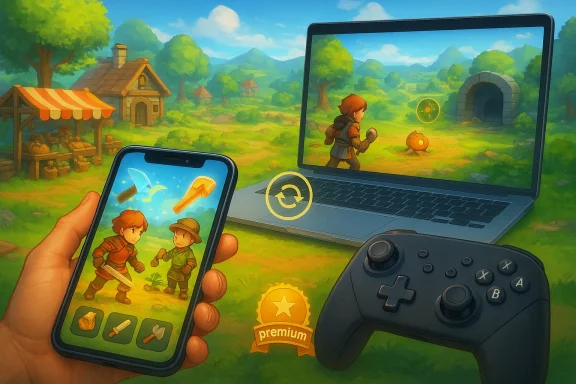
Fantasy Life i is making the jump to mobile in a way that feels unusually respectful to players, and that alone makes this announcement stand out. Level-5 is bringing the game to iOS and Android this summer as a premium paid release, not another free-to-play storefront designed around friction and monetization. More importantly, the mobile version will support cross-save and cross-play, meaning the same adventure can follow players between phone, console, and PC without forcing a second grind. The timing also matters: Level-5 says the game has now topped 1.5 million units sold worldwide, which gives the publisher a strong incentive to widen the audience while the momentum is still fresh.
The original Fantasy Life series has always occupied a slightly unusual space in the RPG landscape. It mixes life simulation, crafting, village-building, and action-RPG combat in a way that feels closer to a cozy sandbox than a traditional quest-driven fantasy epic. That blend helped the 3DS original stand out years ago, and it explains why the new game has been able to attract both returning fans and curious newcomers.
Fantasy Life i: The Girl Who Steals Time arrived first on modern platforms in 2025, launching on PlayStation 5, Xbox Series, PlayStation 4, Nintendo Switch, and Steam, with Switch 2 support following shortly after. At launch, Level-5 emphasized the game’s open-world exploration, job switching, town building, and multiplayer features, along with cross-play and cross-save tied to an Epic Games account. The mobile release is therefore not a side experiment; it is the next step in a multiformat strategy that has already been in motion for months.
The commercial side of the story is just as important. Level-5’s own messaging now frames the game as a hit that has passed 1.5 million units sold worldwide, a meaningful benchmark for a new IP revival in a crowded market. When a publisher sees that kind of traction, a mobile port becomes more than a convenience feature: it becomes a way to expand the lifetime value of a game without redesigning it around mobile-first monetization.
The broader context also reflects a familiar industry pattern, but with a better-than-usual execution. Too often, console-to-mobile adaptations are either stripped-down companion apps or aggressive free-to-play reinventions. Fantasy Life i appears to be taking the opposite route by preserving the complete premium experience, including updates and DLC already released on other platforms. That choice suggests confidence in the game’s inherent appeal rather than dependence on daily-login economics.
That approach also reflects a shift in player expectations. Modern audiences are increasingly comfortable with one purchase, multiple devices if the implementation is seamless. Cross-save is no longer a luxury feature; for many players, it is the difference between “interesting port” and “usable everyday game.”
The mobile version also supports both touch controls and full controller input. That might sound like a technical footnote, but it is actually central to the port’s credibility. Fantasy Life i is not a lightweight tap-and-go puzzle game; it is a progression-heavy RPG with gathering loops, combat encounters, and town management, all of which benefit from precise input options.
That bet could pay off because the game’s structure encourages long sessions and repeated return visits. A player who wants to craft, farm, battle, and decorate has little reason to tolerate artificial gates if the same game is available elsewhere without them. A clean premium port is therefore not just more ethical; it is commercially coherent.
Fantasy Life i is built around the kind of habitual loop that benefits most from device flexibility. You can gather materials, finish a quest, reorganize your village, or run a dungeon in a spare pocket of time. If the save follows you, the phone becomes a legitimate extension of the play session rather than a different version of the game.
This also changes how players think about platform loyalty. A premium RPG that respects save portability is harder to abandon and easier to recommend. The practical effect is simple: the game stays alive in the player’s routine longer, which tends to improve both goodwill and word of mouth.
A useful way to think about this is in three steps:
The result is a port that looks designed to preserve player trust. When consumers hear “mobile version,” they usually expect some combination of compromises: ads, timers, missing features, or cloud-save restrictions. Here, the pitch is almost the reverse. Level-5 is saying that the mobile release is a way to broaden access while preserving continuity and feature richness.
That said, premium mobile success still depends on presentation. The store listing, control polish, and battery performance will matter a great deal. A mobile port can be conceptually right and still fail if it feels awkward in hand, so execution remains the deciding factor.
It would also help Level-5’s broader strategy. The company has been trying to strengthen its multi-platform identity, and a successful mobile premium title would show that its existing franchises can travel without being rebuilt around monetization-first design.
This matters because the game’s appeal is cumulative. Its charm is not just in the main story but in how systems interlock over time: gathering leads to crafting, crafting supports combat, combat feeds exploration, and exploration feeds village growth. A stronger content bundle magnifies that cycle.
For mobile players, that is especially valuable because the app-store environment is crowded and easy to ignore. A feature-rich release gives the game more reasons to exist beyond nostalgia. It also makes the port easier to justify against any premium price Level-5 chooses.
That kind of packaging is often what separates a successful premium port from a forgotten one. When the content story is coherent, the value story becomes easier to explain.
The world itself is built around variety. Players can switch between different Lives, such as gathering, crafting, and combat roles, which keeps the loop from feeling repetitive. That means a smartphone session does not have to be a truncated version of the game; it can be a genuine slice of the core loop.
Even the game’s social and cooperative elements can work in this format. Players can hop in, accomplish a task, and then step away without losing the thread of their larger goals. That makes the title a good fit for both daily use and longer weekend sessions.
That would be the best-case scenario: mobile as the maintenance platform, main hardware as the spectacle platform. In that model, the port does not replace the original release. It enhances it.
For newcomers, the appeal is straightforward. Fantasy Life i is now a mature, content-rich RPG with a broad systems base and an established reputation. Mobile gives people a lower-friction way to try it, especially if they have been waiting for a chance to play without buying a console or PC version.
It also helps that the game’s identity is broad rather than niche. The combination of RPG progression, life-sim elements, and social mechanics gives it a wider appeal than a combat-only action title would have. That broadness makes it a better candidate for mobile discovery.
The most likely returning-player use case is continuity play: a session starts on console or PC, continues on the phone, then returns to the original platform when the player is back home. That pattern is exactly what modern cross-save is supposed to enable, and it is why the feature feels so important here.
The competitive implication is less about direct genre rivals and more about player expectation. If a premium portable RPG can sell well on mobile, it creates pressure on other publishers to stop assuming that every phone game must be monetized around scarcity and speed bumps. That would be healthy for players and potentially lucrative for developers with the right catalog.
Another lesson is that content parity reduces risk. Players are increasingly wary of versions that feel half-finished. When the mobile release is the same game, just portable, the trust barrier falls dramatically.
That matters in a market where skepticism can linger long after a launch window passes. A well-executed mobile version is not just extra revenue; it is reputational proof.
That template could be especially powerful for a studio with strong character-driven, systems-heavy properties. It gives the company more ways to monetize success without resorting to the practices that have damaged other franchises’ reputations.
There is also a monetization risk, even with a premium release. If the pricing feels too close to a full console game without enough clarity on what mobile buyers get, adoption may be slower than Level-5 hopes. Mobile users are accustomed to lower entry costs, and that expectation will not disappear just because the game is better than average.
That is why the launch will be worth watching closely. It is not just a release; it is a test of whether premium cross-platform RPGs can build real mobile traction without compromising identity.
If the rollout is handled cleanly, Fantasy Life i could become one of the more persuasive examples of a premium console RPG making a credible move onto mobile. That would help Level-5, but it would also be a useful proof point for the wider industry: players will pay for convenience, completeness, and continuity when those things are delivered well.
Source: games.gg Fantasy Life i Coming to Mobile With Cross-Save This Summer | GAMES.GG
 Background
The original Fantasy Life series has always occupied a slightly unusual space in the RPG landscape. It mixes life simulation, crafting, village-building, and action-RPG combat in a way that feels closer to a cozy sandbox than a traditional quest-driven fantasy epic. That blend helped the 3DS original stand out years ago, and it explains why the new game has been able to attract both returning fans and curious newcomers.Fantasy Life i: The Girl Who Steals Time arrived first on modern platforms in 2025, launching on PlayStation 5, Xbox Series, PlayStation 4, Nintendo Switch, and Steam, with Switch 2 support following shortly after. At launch, Level-5 emphasized the game’s open-world exploration, job switching, town building, and multiplayer features, along with cross-play and cross-save tied to an Epic Games account. The mobile release is therefore not a side experiment; it is the next step in a multiformat strategy that has already been in motion for months.
The commercial side of the story is just as important. Level-5’s own messaging now frames the game as a hit that has passed 1.5 million units sold worldwide, a meaningful benchmark for a new IP revival in a crowded market. When a publisher sees that kind of traction, a mobile port becomes more than a convenience feature: it becomes a way to expand the lifetime value of a game without redesigning it around mobile-first monetization.
The broader context also reflects a familiar industry pattern, but with a better-than-usual execution. Too often, console-to-mobile adaptations are either stripped-down companion apps or aggressive free-to-play reinventions. Fantasy Life i appears to be taking the opposite route by preserving the complete premium experience, including updates and DLC already released on other platforms. That choice suggests confidence in the game’s inherent appeal rather than dependence on daily-login economics.
Why this matters now
Mobile gaming has become the largest gaming segment by reach, but not every premium RPG translates cleanly to it. Titles built around deep progression systems usually fail when they are chopped up into energy timers and transaction prompts. Fantasy Life i avoids that trap by keeping the structure intact and letting mobile serve as an access point rather than a compromise.That approach also reflects a shift in player expectations. Modern audiences are increasingly comfortable with one purchase, multiple devices if the implementation is seamless. Cross-save is no longer a luxury feature; for many players, it is the difference between “interesting port” and “usable everyday game.”
- The game is now a proven commercial property, not a speculative revival.
- Mobile is being treated as an extension of the main release, not a separate economy.
- Cross-save turns casual play into a meaningful part of the overall experience.
What Level-5 Is Actually Shipping
The most notable aspect of the mobile announcement is what Level-5 is not doing. The company is not turning Fantasy Life i into a stripped-down social RPG or a gacha-driven shell of its console counterpart. Instead, it is promising the full game, with every update and every DLC addition included at the time of release. That is a strong statement in an era when many mobile adaptations arrive with missing systems and a long tail of monetized unlocks.The mobile version also supports both touch controls and full controller input. That might sound like a technical footnote, but it is actually central to the port’s credibility. Fantasy Life i is not a lightweight tap-and-go puzzle game; it is a progression-heavy RPG with gathering loops, combat encounters, and town management, all of which benefit from precise input options.
Premium design over monetization tricks
This is where the release strategy becomes especially interesting. A paid mobile title with full feature parity is still relatively rare in a market that often trains users to expect “free” and then backfills the cost with ads, stamina systems, and battle passes. By avoiding that model, Level-5 is making a bet that Fantasy Life i’s audience values completeness more than nominal price entry.That bet could pay off because the game’s structure encourages long sessions and repeated return visits. A player who wants to craft, farm, battle, and decorate has little reason to tolerate artificial gates if the same game is available elsewhere without them. A clean premium port is therefore not just more ethical; it is commercially coherent.
What’s included
Level-5 says the mobile release will include the content already released on other platforms, which matters because the game has seen meaningful post-launch support. The presence of the free New Year update and its roguelike mode means the mobile audience is not getting an early build or a subset of the final design. It is getting a version that already reflects the game’s live evolution.- Paid premium release rather than free-to-play.
- All updates and DLC included at launch on mobile.
- Touch and controller support for different play styles.
- Cross-save and cross-play with existing platforms.
Cross-Save Changes the Value Proposition
Cross-save is the feature that gives this announcement real strategic weight. Without it, a mobile port would mostly function as a curiosity for new buyers. With it, the game becomes a true anywhere continuation of an existing investment, which is far more compelling for players who have already put substantial time into their farms, villages, and character builds.Fantasy Life i is built around the kind of habitual loop that benefits most from device flexibility. You can gather materials, finish a quest, reorganize your village, or run a dungeon in a spare pocket of time. If the save follows you, the phone becomes a legitimate extension of the play session rather than a different version of the game.
Why mobile plus save continuity matters
For many players, mobile gaming happens in fragments. That means a title needs to respect interruptions, short sessions, and spontaneous returns. Fantasy Life i already has the kind of systems that support that behavior, but cross-save makes it feel intentional rather than incidental. It turns the commute, the couch, and the checkout line into meaningful touchpoints.This also changes how players think about platform loyalty. A premium RPG that respects save portability is harder to abandon and easier to recommend. The practical effect is simple: the game stays alive in the player’s routine longer, which tends to improve both goodwill and word of mouth.
A useful way to think about this is in three steps:
- Start on a large screen where exploration feels comfortable.
- Continue on mobile when convenience matters most.
- Return to the main platform for longer combat or building sessions.
Cross-play broadens the social side
Cross-play adds another layer by preventing the mobile audience from becoming isolated. The game’s multiplayer systems, including cooperative exploration, work best when the community is unified rather than split by platform. That is especially important for a game that benefits from shared progression and spontaneous collaboration.- Cross-save protects existing progress.
- Cross-play helps keep matchmaking and co-op active.
- Mobile becomes a companion platform rather than a separate product.
- Returning players can re-engage without restarting the grind.
Why This Is Different From the Usual Mobile Port
Most premium console-to-mobile ports face the same suspicion: what got cut? That concern is reasonable because mobile adaptations often simplify controls, reduce systems, or repackage a complete game into a shorter and more monetized experience. Fantasy Life i appears to be resisting that pattern by bringing over the entire current version of the game instead of an abbreviated subset.The result is a port that looks designed to preserve player trust. When consumers hear “mobile version,” they usually expect some combination of compromises: ads, timers, missing features, or cloud-save restrictions. Here, the pitch is almost the reverse. Level-5 is saying that the mobile release is a way to broaden access while preserving continuity and feature richness.
The premium mobile niche
There is still an audience for paid mobile games, especially among RPG fans who want depth rather than compulsion loops. Those players are often willing to pay upfront if they know the game will not later pressure them with recurring purchases. Fantasy Life i enters that niche with an established brand and a proven content base, which gives it a better chance than a generic new release.That said, premium mobile success still depends on presentation. The store listing, control polish, and battery performance will matter a great deal. A mobile port can be conceptually right and still fail if it feels awkward in hand, so execution remains the deciding factor.
A signal to the broader market
If Fantasy Life i performs well on mobile, it could reinforce a simple but important lesson: not every mobile audience wants a free-to-play treadmill. Some players want a complete, portable RPG they can buy once and enjoy across devices. That is an old-school impulse, but it is not an outdated one.It would also help Level-5’s broader strategy. The company has been trying to strengthen its multi-platform identity, and a successful mobile premium title would show that its existing franchises can travel without being rebuilt around monetization-first design.
- The game keeps its identity instead of being simplified into a shell.
- Mobile players are being asked to buy quality, not gambling mechanics.
- Feature parity gives the port credibility in a skeptical market.
Fantasy Life i’s Content Strategy
The inclusion of all updates and DLC is more than a nice bonus; it is part of the game’s identity as a living package. Fantasy Life i has already received meaningful support, including the addition of a full roguelike mode in a free update. That makes the mobile release feel like a curated complete edition rather than a launch-day compromise.This matters because the game’s appeal is cumulative. Its charm is not just in the main story but in how systems interlock over time: gathering leads to crafting, crafting supports combat, combat feeds exploration, and exploration feeds village growth. A stronger content bundle magnifies that cycle.
The role of post-launch updates
Many games rely on updates to fix issues, but Fantasy Life i appears to have used them to expand identity. That is a very different proposition. A free roguelike mode, additional adjustments, and content refinements help the game feel less like a one-and-done release and more like a platform for ongoing play.For mobile players, that is especially valuable because the app-store environment is crowded and easy to ignore. A feature-rich release gives the game more reasons to exist beyond nostalgia. It also makes the port easier to justify against any premium price Level-5 chooses.
The content-completeness advantage
A complete edition has three practical benefits. First, it reduces buyer confusion, because players do not need to wonder what was cut. Second, it protects the community from fragmentation between versions. Third, it makes marketing easier, because the game can be framed as the definitive way to experience Fantasy Life i on the go.That kind of packaging is often what separates a successful premium port from a forgotten one. When the content story is coherent, the value story becomes easier to explain.
- Updates and DLC make the mobile edition feel current.
- The roguelike mode strengthens replay value.
- A complete package reduces skepticism about the port.
The Gameplay Loop and Why It Fits Mobile
Fantasy Life i’s design is unusually well suited to portable play because it mixes short-term activities with long-term progression. You can spend a few minutes harvesting, crafting, or checking village changes, then return later for a dungeon run or story sequence. That kind of flexibility is what mobile audiences tend to appreciate most, provided the interface is comfortable.The world itself is built around variety. Players can switch between different Lives, such as gathering, crafting, and combat roles, which keeps the loop from feeling repetitive. That means a smartphone session does not have to be a truncated version of the game; it can be a genuine slice of the core loop.
Systems that work in small bursts
A game’s mobile suitability often comes down to how cleanly its systems can be parsed into short sessions. Fantasy Life i offers that naturally because many of its activities are self-contained. Resource gathering, house management, and trade progression all create natural stopping points without making the player feel punished for leaving.Even the game’s social and cooperative elements can work in this format. Players can hop in, accomplish a task, and then step away without losing the thread of their larger goals. That makes the title a good fit for both daily use and longer weekend sessions.
Where the mobile version could shine
The mobile edition may be particularly strong in the game’s lower-intensity systems. Village arrangement, resource checks, and crafting menus often map well to touch interfaces when they are thoughtfully implemented. If Level-5 has tuned the UI correctly, the phone version could become a preferred way to handle routine tasks even for players who still favor console or PC for combat-heavy segments.That would be the best-case scenario: mobile as the maintenance platform, main hardware as the spectacle platform. In that model, the port does not replace the original release. It enhances it.
- Gathering and crafting can fit naturally into short mobile sessions.
- Village management is likely to benefit from quick access.
- Touch controls may be especially strong for menu-heavy tasks.
The Audience Split: Newcomers vs Returning Players
The mobile release serves two very different audiences, and the success of the port depends on satisfying both. Newcomers need an entry point that feels complete and approachable. Returning players need reassurance that their time investment is protected and portable. Level-5’s announcement is smart precisely because it addresses both groups with the same set of features.For newcomers, the appeal is straightforward. Fantasy Life i is now a mature, content-rich RPG with a broad systems base and an established reputation. Mobile gives people a lower-friction way to try it, especially if they have been waiting for a chance to play without buying a console or PC version.
New players: why mobile lowers the barrier
A mobile port reduces hardware friction. That sounds obvious, but it matters a great deal in practice. If someone hears that Fantasy Life i is a cozy open-world RPG with crafting and village building, the ability to play on a phone can be the deciding factor between curiosity and action.It also helps that the game’s identity is broad rather than niche. The combination of RPG progression, life-sim elements, and social mechanics gives it a wider appeal than a combat-only action title would have. That broadness makes it a better candidate for mobile discovery.
Returning players: why cross-save is the hook
For existing players, the pitch is much more specific. They already know whether they like the loop. What they need is convenience. Cross-save lets them preserve momentum, which is crucial for a game where progress often accumulates slowly but meaningfully.The most likely returning-player use case is continuity play: a session starts on console or PC, continues on the phone, then returns to the original platform when the player is back home. That pattern is exactly what modern cross-save is supposed to enable, and it is why the feature feels so important here.
- New players get an easier way into a substantial RPG.
- Existing players get portable continuity instead of a new purchase.
- Both groups benefit from the same content-complete release.
Competition and Market Implications
Fantasy Life i’s mobile release lands in a market where many publishers are still chasing either giant free-to-play audience pools or aggressive live-service retention. Level-5 is positioning its game differently: as a premium, feature-complete RPG that just happens to be available on smartphones. That is a small but notable strategic rebellion against the dominant mobile business model.The competitive implication is less about direct genre rivals and more about player expectation. If a premium portable RPG can sell well on mobile, it creates pressure on other publishers to stop assuming that every phone game must be monetized around scarcity and speed bumps. That would be healthy for players and potentially lucrative for developers with the right catalog.
Lessons for other publishers
The most obvious lesson is that quality matters more than platform stereotypes. A deep RPG with controller support and cross-save can work on mobile if the underlying game is already strong. That does not mean every console title should be ported to phones, but it does mean the ceiling is higher than many publishers assume.Another lesson is that content parity reduces risk. Players are increasingly wary of versions that feel half-finished. When the mobile release is the same game, just portable, the trust barrier falls dramatically.
Level-5’s brand recovery angle
There is also a brand dimension here. Level-5 has spent years trying to reassert itself with a more coherent multi-platform pipeline. A polished Fantasy Life i mobile release would strengthen the company’s image as a studio capable of shipping modern games across ecosystems without abandoning premium values.That matters in a market where skepticism can linger long after a launch window passes. A well-executed mobile version is not just extra revenue; it is reputational proof.
- It challenges the assumption that mobile must be free-to-play.
- It expands the potential lifetime of a successful RPG.
- It reinforces Level-5 as a multi-platform publisher.
Strengths and Opportunities
Fantasy Life i’s mobile expansion has several clear advantages, and the smartest part of the plan is how naturally they reinforce one another. The game is already commercially validated, the content package is complete, and the save system makes multi-device play genuinely practical. That combination creates a rare chance to turn a successful console/PC RPG into a truly flexible ecosystem title.- Premium pricing can attract players tired of exploitative mobile monetization.
- Cross-save makes the port useful to existing owners instead of duplicative.
- Cross-play keeps the social layer unified across devices.
- Full DLC and updates make the mobile version feel definitive.
- Touch and controller support broadens accessibility and comfort.
- Portable progression fits the game’s crafting and life-sim loops.
- Brand momentum from 1.5 million sales strengthens discovery and trust.
Why the opportunity is bigger than one port
The real opportunity here is not just selling more copies of the same game. It is proving that Fantasy Life can function as a platform-agnostic franchise. If players embrace the mobile version, Level-5 gains a template for future launches: preserve the premium experience, respect saves, and let convenience drive adoption.That template could be especially powerful for a studio with strong character-driven, systems-heavy properties. It gives the company more ways to monetize success without resorting to the practices that have damaged other franchises’ reputations.
Risks and Concerns
Even a strong concept has plenty of execution risks, and mobile ports are notorious for finding them. The biggest concern is whether the phone version can actually deliver the same sense of precision and flow that players expect from a premium RPG. Touch controls can be excellent, but only if the interface, camera behavior, and menu density are tuned carefully. If the UI feels cramped, the whole pitch weakens fast.- Control complexity could frustrate players on smaller screens.
- Performance and battery drain may limit long sessions on older phones.
- Price sensitivity is higher on mobile than on console or PC.
- Account setup friction could slow cross-save adoption.
- Regional rollout differences may confuse potential buyers.
- Feature parity expectations leave little room for mistakes.
- Brand trust risk is real if launch quality slips.
The biggest execution test
Cross-save is powerful, but it also introduces a support burden. Any sign of syncing problems, account-linking confusion, or data loss would damage confidence quickly. Players are willing to forgive many things in a mobile game; broken save continuity is not one of them.There is also a monetization risk, even with a premium release. If the pricing feels too close to a full console game without enough clarity on what mobile buyers get, adoption may be slower than Level-5 hopes. Mobile users are accustomed to lower entry costs, and that expectation will not disappear just because the game is better than average.
The larger strategic risk
The broader risk is that a successful concept could still be misread if it underperforms due to platform realities rather than product quality. In other words, a good port can fail for market reasons that have little to do with game design. That makes it harder for publishers to learn the right lesson unless they track not just sales, but player retention and save-link usage.That is why the launch will be worth watching closely. It is not just a release; it is a test of whether premium cross-platform RPGs can build real mobile traction without compromising identity.
Looking Ahead
The next major milestone is the actual summer release window for iOS and Android, because that is when the idea becomes a product. Until Level-5 names a firm date, the announcement remains promising but still provisional. What matters after that is how clearly the company communicates pricing, account requirements, and the exact mechanics of cross-save.If the rollout is handled cleanly, Fantasy Life i could become one of the more persuasive examples of a premium console RPG making a credible move onto mobile. That would help Level-5, but it would also be a useful proof point for the wider industry: players will pay for convenience, completeness, and continuity when those things are delivered well.
Key things to watch
- Whether Level-5 confirms the final price point for mobile.
- Whether Epic account linkage remains required for save transfer.
- Whether the mobile version launches with full content parity from day one.
- Whether performance on midrange Android and older iPhones is strong.
- Whether the game’s app-store presentation makes the premium value obvious.
Source: games.gg Fantasy Life i Coming to Mobile With Cross-Save This Summer | GAMES.GG
