

That is a sharper claim than the usual “AI for finance” pitch, and it matters because finance departments have always been among the least forgiving places to deploy probabilistic software. A hallucinated marketing draft is embarrassing. A hallucinated revenue bridge, margin explanation, or budget variance can become a governance problem.
Farseer Is Selling Trust Before It Sells Intelligence
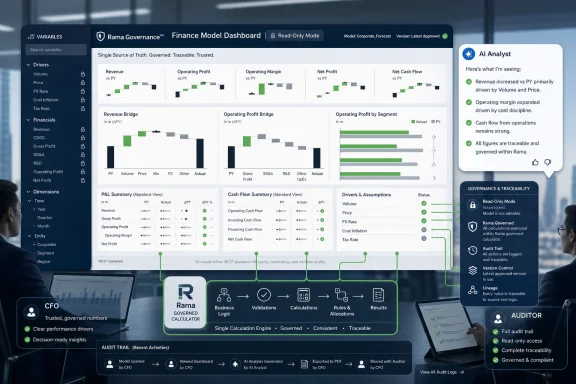
The most important detail in Farseer’s announcement is not that AI Analyst accepts natural-language questions. By 2026, that is table stakes. The important detail is the separation of duties: the AI layer interprets and explains, while Farseer’s governed finance model, Rama, performs the calculations.
That distinction sounds technical, but it is the whole argument. Generic AI systems are impressive because they can synthesize language across huge contexts. Finance teams, however, do not primarily need a system that sounds fluent; they need one that can say exactly which definition of revenue, which dimension of geography, which version of the forecast, and which actuals feed produced the answer.
Farseer is presenting AI Analyst as a read-only conversational layer over live model data. That means the model is not supposed to change the financial record, create figures out of statistical inference, or smuggle in an answer because it sounds plausible. It is supposed to expose what the governed model already knows.
That is a very enterprise-friendly way to frame AI. It shifts the product from magic to accountability. For boards and auditors, the difference between “the AI says” and “the model calculated, and the AI explained” is not cosmetic; it is the difference between a toy and a control surface.
The Spreadsheet Problem Has Become an AI Problem
Farseer’s pitch lands because finance teams were already drowning in fragmentation before generative AI arrived. Planning data often lives across ERP systems, CRM exports, departmental spreadsheets, BI dashboards, and email attachments. A monthly reporting cycle can become less an exercise in analysis than a reconciliation ritual.
The company’s co-founder Matej Trbara put the problem bluntly in the announcement: when finance leaders ask the same question in two different places and receive different answers, reporting becomes a negotiation rather than a fact. That line is vendor messaging, but it captures a familiar enterprise reality. Many finance teams do not lack analytical ambition; they lack a clean operating layer where definitions, versions, and responsibilities are synchronized.
AI makes that mess more visible. A chatbot placed on top of inconsistent spreadsheets does not repair the data estate. It accelerates access to inconsistency. The user gets an answer faster, but the organization still cannot prove whether that answer came from the right spreadsheet, the right business definition, or the latest planning cycle.
That is why “AI for finance” is not the same problem as “AI for office productivity.” A writing assistant can help a manager draft an email even when the underlying facts are later checked by a human. A finance assistant that answers margin, cash-flow, or variance questions has to be grounded before it speaks.
Farseer’s argument is that AI cannot be bolted onto finance as a novelty interface. It has to sit above governed models, standardized definitions, and auditable workflows. That is a less glamorous story than agentic autonomy, but it is much closer to what enterprise buyers can actually approve.
The UK and North America Are the Stress Test
Expansion into the UK and North America gives Farseer access to enormous finance and enterprise software markets, but it also raises the bar. These are regions with sophisticated CFO organizations, entrenched planning tools, large consulting ecosystems, and cautious procurement teams. A vendor entering these markets cannot simply claim that AI is transformative; it has to show where the controls live.
The timing is logical. Farseer raised a $7.2 million Series A earlier in 2026, led by Aymo Ventures with participation from SQ Capital and Apertu Capital. The company has been positioning itself as an enterprise operating system for finance rather than a point solution for planning, reporting, or analytics. The UK and North America expansion is the commercial version of that product story: if the platform is truly a finance operating layer, it has to compete where finance technology budgets are largest and scrutiny is highest.
Those markets are also where the “boardroom-ready AI” phrase becomes more than branding. Boards are increasingly asking management teams how AI is being used, what data it touches, and whether outputs can be explained. Finance is a natural flashpoint because it combines operational urgency with formal accountability.
A finance team may want faster scenario analysis, but it cannot afford ambiguity about where the numbers came from. A CFO may welcome AI-generated commentary, but not if it introduces a second version of the truth. Farseer’s opportunity is that the enterprise appetite for AI is real; its constraint is that enterprise tolerance for untraceable finance outputs is low.
Certification Turns Reporting Into Part of the Product
Farseer’s IBCS certification is easy to overlook beside the AI launch, but it may be the more strategically interesting piece. The International Business Communication Standards are designed to make charts, tables, dashboards, and reports more consistent and easier to interpret. ISO 24896:2026 now formalizes standardized notation for business reporting, giving this area a stronger international standards footing.
In practical terms, Farseer is trying to make reporting format part of the trust layer. That is sensible. Finance communication fails not only when the numbers are wrong, but when the same performance story is displayed differently across packs, dashboards, and presentations. Executives waste time decoding visuals before they can debate decisions.
Standardized reporting is not glamorous software. It is closer to punctuation, grammar, and road signs. But that is exactly why it matters in board settings: standardization reduces cognitive load, makes comparisons clearer, and lowers the chance that visual design choices distort the business message.
The AI connection is obvious. If AI Analyst eventually generates IBCS-aligned reports, as Farseer says its roadmap intends, the company can claim a more defensible output chain. The numbers come from governed models, the explanation comes from the AI layer, and the presentation follows a recognized reporting notation.
That does not eliminate risk. Certification is not the same as proof that every generated report is analytically sound. But it does help Farseer distinguish itself from generic AI dashboards that rely on novelty instead of discipline.
The Real Competitor Is Not Just Another FP&A Platform
Farseer describes itself as the enterprise operating system for finance, a phrase that every seasoned IT buyer will treat with caution. Enterprise software vendors love becoming “the system of record,” “the control plane,” or “the operating system” for someone else’s department. The phrase is aspirational by design.
Still, the ambition is coherent. Farseer says its platform spans live data infrastructure, modeling, planning, reporting, and AI. It claims finance teams can launch forecast cycles, load and reconcile actuals from ERP and CRM systems, assign stakeholders, set deadlines, and accelerate planning cycles while automating large portions of manual finance work.
That puts the company in a broad and crowded market. FP&A has no shortage of vendors promising to modernize budgeting and forecasting. Business intelligence vendors already provide dashboards. ERP vendors want finance workflows to remain close to the transactional core. Collaboration platforms like Microsoft Teams and Slack are becoming natural homes for workplace AI.
Farseer’s differentiator is the claim that these layers should not remain separate. If planning, reporting, analytics, and AI all draw from different definitions, the organization inherits complexity. If they sit on a connected finance model, AI becomes easier to govern.
That is a strong architectural thesis. The challenge is execution. Enterprise buyers have long memories for platforms that promised unified finance and delivered another integration project. Farseer has to prove not only that its model is governed, but that implementation does not become the very spreadsheet-and-consultant workaround it is trying to replace.
Conversational Finance Moves the Interface to Where Work Already Happens
AI Analyst is designed to work inside tools finance teams already use, including Slack, Microsoft Teams, and WhatsApp. That detail deserves attention, especially for WindowsForum readers who have watched Microsoft turn Teams into a front door for enterprise workflows. The interface battle is moving away from dedicated application windows and toward conversational surfaces embedded in daily work.
For finance users, that can be powerful. A regional manager who needs to understand a sales variance should not always have to open a planning application, navigate a dashboard, filter dimensions, and export a table. Asking a controlled finance assistant for a variance breakdown is a more natural interaction.
But this is also where governance can quietly erode. The more convenient the interface, the more likely users are to treat answers as ambient truth. If AI Analyst appears inside a chat thread, the product has to make lineage visible without overwhelming the conversation. Farseer says the assistant shows variables and dimensions used in answers, which is exactly the kind of friction enterprise AI needs.
The broader lesson is that the UI revolution is not just about convenience. It is about where authority appears. When a finance answer lands in Teams beside a human conversation, it carries organizational weight. That makes traceability, permissions, and version control central product features, not back-office details.
Read-Only AI Is a Feature, Not a Limitation
Some vendors sell autonomy as the inevitable next step: agents that prepare budgets, trigger workflows, update systems, and execute business processes. Farseer is more cautious with AI Analyst’s first version, emphasizing read-only analysis. In finance, that restraint is probably a selling point.
Read-only AI can still be extremely useful. It can explain why gross margin changed, rank underperforming units, compare actuals against forecasts, identify seasonal trends, or surface the assumptions behind a plan. It can shorten the distance between a business question and a credible answer.
What it does not do is quietly rewrite the planning model, alter a forecast, or push a budget change into production. That matters because finance workflows are full of approvals, ownership boundaries, and audit trails. The cost of premature autonomy is higher here than in many other departments.
Farseer says future development will move from analysis to action, including IBCS report generation and budgeting workflow management. That is the right direction commercially, but it is also where the company’s architecture will face its hardest test. The moment AI stops explaining and starts initiating, controls become more complex.
The safest path is likely staged autonomy: explain first, suggest next, draft after that, and only then execute under explicit workflow governance. That may sound slow compared with the agent hype cycle, but it is how enterprise finance software earns trust.
Finance AI Will Be Judged by Its Failure Modes
The industry has spent much of the generative AI era celebrating what models can do when they work. Finance departments are more interested in what happens when they do not. A wrong answer in a board pack can trigger follow-up work, reputational damage, or worse, depending on the context.
Farseer’s “the governed model does the math, the AI does the reasoning” framing is designed to address exactly that fear. The calculation layer is deterministic and controlled. The language layer interprets, summarizes, and explains. If the AI is wrong, the organization should be able to inspect whether the error came from a bad prompt interpretation, an incorrect model definition, stale source data, or a flawed business assumption.
That diagnostic ability is essential. Enterprise AI governance is not only about preventing errors; it is about making errors legible. If a system cannot explain why it produced an answer, IT and finance teams cannot improve it, audit it, or safely expand its use.
This is where many AI products will struggle. A slick conversational demo can hide lineage problems, permission gaps, and semantic ambiguity. The harder enterprise question is whether the system can distinguish “net revenue” as defined by finance from “revenue” as casually used by sales, or whether it can handle competing forecast versions without collapsing them into a confident narrative.
Farseer is at least aiming at the right target. The risk is not that finance users will reject AI outright. The risk is that they will adopt AI faster than their data governance can support, then discover that speed without control simply creates faster confusion.
Windows Shops Should Watch the Teams Angle Closely
For many organizations, Microsoft Teams has become the default workplace surface, especially in Windows-centric environments. Any finance AI product that integrates with Teams is effectively entering Microsoft’s collaboration and identity orbit. That creates both opportunity and dependency.
The opportunity is adoption. Finance teams already live in chat, meetings, files, and approval conversations. If AI Analyst can answer governed finance questions inside that flow, it reduces the friction that has historically kept specialist planning tools confined to finance power users.
The dependency is platform gravity. Microsoft is aggressively embedding Copilot across Microsoft 365, Dynamics, Power BI, and Teams. Any third-party AI assistant inside Teams has to justify why it is not merely a feature Microsoft might absorb, replicate, or undercut through native integrations.
Farseer’s answer appears to be domain depth. Copilot can be a broad productivity layer, but Farseer wants to be the governed finance model underneath the conversation. That is a defensible niche if the model, workflow, and reporting controls are strong enough.
For IT departments, the practical evaluation should be familiar: identity integration, access controls, audit logs, data residency, retention policies, and administrative visibility. A finance chatbot is not just another Teams app. It is a doorway into sensitive business performance data.
The Boardroom Is the New AI Benchmark
The phrase “boardroom-ready” is doing heavy work in Farseer’s announcement. It implies more than accuracy. It implies explainability, consistency, formatting discipline, and enough process control that a finance leader can defend the output under scrutiny.
That is a useful benchmark because it cuts through AI theater. A boardroom-ready system cannot rely on vibes. It has to show its work. It has to respect definitions. It has to distinguish actuals from forecasts, budgets from plans, and commentary from calculation.
There is a reason Farseer emphasizes variance breakdowns, rankings, price-volume-mix analysis, trend and seasonality, profitability, and comparisons across actuals, budgets, forecasts, and plans. These are not futuristic tasks. They are the everyday mechanics of finance analysis, and they are precisely where inconsistency creates trouble.
If AI can make those mechanics faster while preserving control, finance teams will listen. If it merely wraps existing mess in conversational polish, they will eventually retreat to spreadsheets because spreadsheets, for all their flaws, at least make the sausage visible.
The boardroom benchmark also reframes adoption. The question is not whether a junior analyst can get a quick answer from a bot. The question is whether a CFO can put that answer in front of directors and survive the follow-up: where did this number come from?
Farseer’s Claims Need Proof in the Messy Middle
The announcement includes bold platform claims: faster financial planning, automation of much manual finance work, real-time warehousing capable of processing millions of rows quickly, and connected workflows across planning and reporting. Those claims fit the category, but customers will care about the messy middle.
Finance transformation rarely fails because a demo cannot produce a chart. It fails because source systems disagree, business units defend local definitions, permissions are awkward, and close-cycle pressure forces teams back to familiar spreadsheets. Any platform that promises a single source of truth has to win political as well as technical battles.
Farseer’s early deployments, including references to TT Hotels and EuroTeleSites, suggest the company has moved beyond concept. But expansion into larger markets will expose it to more complex procurement, heavier security review, and larger incumbent footprints. That is where the product story must become operational evidence.
The IBCS certification helps by giving reporting a standards-based anchor. The read-only AI design helps by lowering risk. The Series A funding helps by giving the company resources to expand. None of those guarantees market traction.
What Farseer has, however, is a narrative that matches the moment. Enterprises want AI, but they increasingly understand that AI without governance is not modernization. It is liability with a better interface.
The Numbers Matter Less Than the Model Behind Them
The most concrete lesson from Farseer’s launch is that finance AI is becoming less about generating content and more about enforcing context. The winners in this category will not simply be the systems that answer questions in natural language. They will be the systems that know which questions are allowed, which definitions apply, which version is current, and which assumptions are visible.
That is why the company’s “does not generate financial numbers” claim is so central. In most AI announcements, saying what the system does not do would sound defensive. Here, it is the product philosophy.
Finance professionals do not need AI to be creative with figures. They need it to be disciplined with meaning. The commentary can be fluent, but the arithmetic must be grounded.
That distinction will likely shape enterprise AI well beyond finance. Legal, healthcare, security operations, compliance, and procurement all face the same basic problem: probabilistic interfaces are useful only when attached to controlled systems of record. Farseer’s launch is one more sign that the market is moving from general AI amazement to domain-specific accountability.
The Useful Version of Finance AI Looks Deliberately Boring
Farseer’s announcement is notable because its most important ideas are almost anti-hype. Read-only access. Governed models. Standardized reporting. Visible variables and dimensions. Integration into existing tools. These are not the phrases that dominate AI keynote stages, but they are the phrases that make enterprise deployment possible.
The launch leaves a few practical takeaways for finance and IT teams watching the category:
- A finance AI assistant should be evaluated first on data lineage and model governance, not on how natural the chat interface feels.
- A system that refuses to invent financial numbers may be more useful in enterprise settings than one that appears more autonomous.
- Teams integration can accelerate adoption, but it also turns finance AI into an access-control and auditability issue for IT.
- IBCS certification and ISO 24896 alignment matter because reporting consistency is part of trust, not merely a design preference.
- The hardest phase for Farseer will come when AI Analyst moves from explaining results to initiating budgeting and reporting workflows.
Farseer is entering the UK and North America with a message that fits the post-novelty phase of enterprise AI: the chatbot is not the product, the governed system behind it is. If the company can prove that thesis in complex finance environments, AI Analyst may become less a spectacular assistant than a trusted interpreter of the business model. That would be a quieter revolution than the agentic future vendors keep promising, but for CFOs, auditors, and boards, quiet may be exactly the point.
References
- Farseer Expands into UK and North America as It Launches AI Analyst to Make Finance AI Boardroom-Ready The Manila Times · 2026-06-23T13:42:07.997434