

February 2026 will be remembered not as another month of incremental AI advances but as the moment conversational assistants stopped being primarily answer machines and began acting like hired hands — capable of planning, executing, reasoning, and fixing problems across real-world systems. In a span of days, Anthropic, Perplexity, OpenAI, and Microsoft each released or scaled products that convert prompts into sustained, autonomous work: Claude Remote Control and Claude Code Security from Anthropic; Perplexity Computer; OpenAI Frontier; and Microsoft Copilot Tasks. Together they mark the shift from “SaaS as a seat‑based service” to “AI-as-a-workforce,” with profound technical, economic, and security consequences. verview
The five announcements share a single design pivot: agents that do, not just explain. These systems combine reasoning-capable models, execution environments (browsers, sandboxes, local terminals), connectors to enterprise systems, and governance layers that aim to make agents auditable and safe for production use. OpenAI frames this as a platform for “AI coworkers” with onboarding, identity, and continuous improvement; Microsoft positions Tasks as Copilot moving from answers to actions; Perplexity built a cloud-first “Computer” that orchestrates many models; and Anthropic added both local session remote-control and reasoning-based security scanning to its developer toolkit. Each company delivers a different architectural choice — local-first versus cloud-first, single-model versus multi-model orchestration, or detection-first versus execution-first — but the business implication is the same: agents now replace portions of human task labor rather than merely augmenting it.
Below I unpack each product’s design, capabilities, and technical tradeoffs; cross-check the most consequential public claims; and assess the macroeconomic and competitive impact on the enterprise software market and existing SaaS business models.
Will the SaaS era immediately end? No. But the economics of SaaS seat‑based pricing and narrow product value props will face accelerating downward pressure as agents take over repeated human tasks and knit applications together. The real story is not a single product dethroning software incumbents overnight; it is the re‑composition of enterprise software value around orchestration, governance, and trusted compute. Organizations that plan carefully — inventory use cases, harden remediation, adopt governance, and re‑architect pricing and value capture — will win. Those that treat agents as a fad or skip the hard systems work behind safe deployment risk being disrupted.
The future that began in February 2026 is not a binary replacement of humans by machines, but the rapid arrival of digital colleagues who need onboarding, monitoring, and governance just like employees. That final observation is the practical, and enduring, headline: agents will work for you — but they will only be as safe, scalable, and valuable as the systems you build around them.
Source: Xpert.Digital - Konrad Wolfenstein New: Claude Remote Control, Claude Code Security, Perplexity Computer, OpenAI Frontier and Microsoft Copilot Tasks
The five announcements share a single design pivot: agents that do, not just explain. These systems combine reasoning-capable models, execution environments (browsers, sandboxes, local terminals), connectors to enterprise systems, and governance layers that aim to make agents auditable and safe for production use. OpenAI frames this as a platform for “AI coworkers” with onboarding, identity, and continuous improvement; Microsoft positions Tasks as Copilot moving from answers to actions; Perplexity built a cloud-first “Computer” that orchestrates many models; and Anthropic added both local session remote-control and reasoning-based security scanning to its developer toolkit. Each company delivers a different architectural choice — local-first versus cloud-first, single-model versus multi-model orchestration, or detection-first versus execution-first — but the business implication is the same: agents now replace portions of human task labor rather than merely augmenting it.
Below I unpack each product’s design, capabilities, and technical tradeoffs; cross-check the most consequential public claims; and assess the macroeconomic and competitive impact on the enterprise software market and existing SaaS business models.
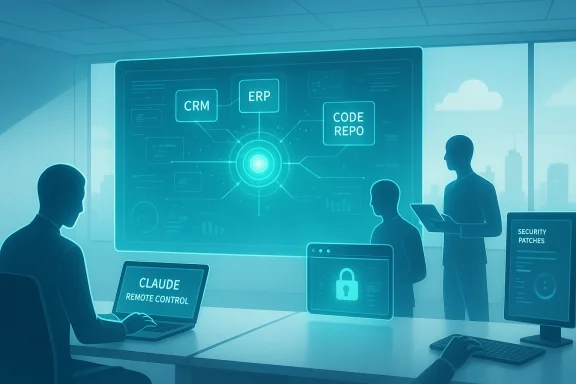 Claude Remote Control — your workstation, but smarter and mobile
What it is and why it matters
Anthropic’s Remote Control for Claude Code rethinks what “local AI” means. Instead of lifting files to a cloud instance, Remote Control lets a Claude session continue running on a developer’s workstation while the user interacts from another device (phone, tablet, or browser), so the agent retains access to the local filesystem, build tools, and private configuration without sending sensitive code to the public cloud. That continuity removes context switches that have historically fragmented developer work and productivity. Practical scenarios include continuing a multi-hour static analysis or a complex refactor started at a desktop, then giving directions and reviewing results from a phone while commuting. Early coverage and user reports describe a research‑preview rollout to paying tiers and rapid community testing.Technical design and limits
Remote Control is not “running the model on your phone.” Instead, it creates a remote UI into a live session running on the local machine (the “MCP” or local Claude session). Key engineering points reported by early coverage and community posts:- The agent retains full access to local tools and files because computation stays on the workstation.
- The mobile/web UI is a secure, ephemeral window into that session; traffic is outbound‑only and authenticated with short‑lived credentials in reported implementations.
- The local machine must remain available (powered and networked) to maintain the session; reconnection policies and idle-time behavior vary by build.
Questions and caveats
- Local sessions mean security responsibilities shift toward endpoint management. Attackable vectors include session tokens, clipboard leaks via mobile browsers, and rogue local plugins. Community reports note early bugs and rollout imperfections, which is expected in an evolving feature set.
- Remote Control reduces cloud-exposure but does not eliminate the need for enterprise controls (MFA, endpoint EDR, role-based policies). Organizations must treat local agent sessions as first‑class assets in their threat model.
Claude Code Security — reasoning-based vulnerability hunting
A new class of code scanner
Anthropic’s Claude Code Security layer moves scanning from pattern matching to reasoning over entire codebases. Unlike classic SAST (static analysis) or fuzzing tools that look for signatures or generate random inputs, Claude Code Security uses its large‑context reasoning model to trace data flows, simulate attacker strategies, and infer logic errors that span multiple files and services. Reported internal red-team exercises claim hundreds of previously undetected high‑severity findings in production open‑source projects, subjected to human verification before any disclosure. Early articles and vendor commentary highlight the tool’s multi-stage verification (self-checks, severity scoring, patch suggestions) and human-in-the-loop triage.Why this matters economically
- Security teams pay six- to seven-figure sums for layered vulnerability management. A reasoning-based scanner that reduces false negatives (or surfaces new classes of logic bugs) threatens to upend SAST vendors’ value proposition.
- The true economic effect depends on how many findings are actionable and how efficiently teams can fix them at scale — scanning is only the first step in a pipeline that historically creates long backlogs. Several experts caution that faster discovery will shift effort into triage, patching, and release management rather than eliminate work altogether.
Security and governance implications
- Anthropic explicitly keeps a human‑approval gate: automated patches are suggested but not applied without human sign-off. The product is being previewed to Enterprise and Team customers with strict permissioning and code‑ownership restrictions. That mitigates immediate risk but does not remove systemic responsibilities for secure deployment and change control.
- Independent security researchers have already flagged various issues in AI-assistant stacks (e.g., misconfiguration, code-injection vectors in toolchains) and have urged careful change‑management. The existence of AI-flagged vulnerability dumps will stress remediation pipelines and incident response processes.
Perplexity Computer — 19 models acting like a staffed team
Multi-model orchestration as a product
Perplexity’s Computer is an intentionally cloud‑first, multi‑agent platform that decomposes a user goal into subtasks and automatically selects the best model for each subtask, reportedly drawing on 19 different models from multiple vendors. The product emphasizes prolonged, asynchronous workloads that can run for hours or months in isolated sandboxes with real file systems and browsers. Perplexity positions Computer as a digital worker that delegates to specialists — e.g., one model for deep reasoning, another for fast lightweight tasks, others for image or video generation — instead of blending everything through a single generalist model. It’s available initially to Perplexity Max subscribers at a premium price tier.Why multi-model matters
- Different models specialize: some excel at long‑context reasoning, others at retrieval and citation, some at multimodal generation. Orchestrating those strengths can, in theory, produce higher-quality outputs and efficiency than forcing all tasks through one monolithic model. TechCrunch and VentureBeat reporters highlight Perplexity’s argument that orchestration is the strategic growth layer of agentic AI.
Architecture and operational tradeoffs
- Orchestration complexity: Perplexity must maintain routing logic, latency-aware selection, billing reconciliation across providers, and a monitoring plane for model performance and safety. These are nontrivial engineering problems and become a competitive moat if executed well.
- Cost and pricing: Computer appears to have token-based or credits billing and reserves the highest tier for early access — a practical response to the large variable costs of calling multiple frontier models. The $200/month initial price (Perplexity Max) puts this capability in a power‑user / small‑team bracket.
OpenAI Frontier — treating agents like employees inside the enterprise
Frontier’s four pillars
OpenAI’s Frontier is an enterprise platform that explicitly treats AI agents as workers you hire: identity and governance, shared business context (CRM, data warehouses), execution environments, and built-in evaluation/optimization loops. Frontier bundles advanced models (the GPT‑5 series in OpenAI’s public materials) with systems to onboard, measure, and govern agents operating across organizational data and applications. The public announcement lists high-profile enterprise pilots and partners and positions Frontier as a semantic layer that sits above existing IT stacks.Strategic effect on SaaS incumbents
- OpenAI pitches Frontier as an alternative or complement to enterprise SaaS: instead of paying by seats for narrow apps, companies could buy intelligence that navigates multiple apps and automates workflows end‑to‑end. When agents can hold context across CRM, ERP, and documents and act with permissioned access, the utility of many single-purpose SaaS seat licenses is reduced.
- OpenAI’s partner ecosystem (consultancies and systems integrators) is a deliberate move to accelerate enterprise adoption and change operating models. Early customers named in OpenAI’s announcement include major brands and pilots with banks, insurers, and industrial companies — indicating both interest and the complexity of adoption at scale.
Practical deployment concerns
- Data plumbing is hard: connecting agents safely to enterprise systems requires careful IAM, audit logging, and data-residency controls. Frontier’s promise is the orchestration of those controls, but enterprise adoption will be slowest where tight regulatory compliance is required.
- Vendor lock‑in and governance: as agents gain authority to act, organizations must codify liability, escalation, and audit policies. This is exactly the governance gap that enterprise security and legal teams will push back on first.
Microsoft Copilot Tasks — sandboxed agentic automation at scale
Copilot Tasks in practice
Microsoft’s Copilot Tasks moves Copilot from an on‑demand chat assistant to a scheduled background worker with its own cloud computer and browser. Tasks can run recurring or one‑off jobs, interact with web pages, coordinate across apps, and report results when finished. Microsoft emphasizes opt‑in consent for actions that make external changes (send messages, make payments), and positions the feature as a research preview for careful real‑world feedback. Early reporting highlights the feature’s ability to act across web apps and integrate with users’ accounts when the user permits it.Platform-level advantages
- Microsoft bundles Copilot Tasks with Windows, Office, and Azure enterprise controls — an enormous distribution channel that lowers friction for mass deployment. Microsoft already exposes Copilot inside file management and Office apps, and Tasks makes those assistants durable, schedulable, and autonomous. File‑level agent actions combined with enterprise identity and compliance controls are a unique advantage for Microsoft.
Safety and sandboxing
- Microsoft says Tasks run in sandboxed cloud environments with dedicated browsers and compute. That reduces risk from agents directly interacting with enterprise internal networks from unmanaged endpoints. The preview emphasizes user control (review, pause, cancel) and consent for consequential actions — a design likely informed by enterprise risk concerns.
The macro picture: is this the end of the SaaS era?
Market projections and the scale of disruption
Independent market research firms converge on a simple point: agentic AI is rapidly commercializing. MarketsandMarkets and Grand View Research each forecast the AI/agent market expanding from a base in the low single‑digit billions in the mid‑2020s to roughly $50B by 2030, implying multi‑year CAGRs in the mid‑40% range. Gartner predicts that by the end of 2026 roughly 40% of enterprise applications will integrate task‑specific AI agents, up from under 5% in 2025 — a seismic adoption acceleration if realised. These forecasts help quantify the economics behind the new product rush.- MarketsandMarkets projects the AI agents market will grow from USD 7.84 billion in 2025 to USD 52.62 billion by 2030 (CAGR ~46.3%).
- Grand View Research reports a similar projection: USD 50.31 billion by 2030 at a CAGR ~45.8%.
- Gartner predicts 40% of enterprise applications will include task‑specific agents by the end of 2026 (up from less than 5% in 2025).
Hyperscaler capex: fueling the agent economy
The infrastructure cost to run agentic AI at scale is enormous. Multiple outlets report that the major cloud and AI infrastructure providers announced combined capital expenditure guidance in the high‑hundreds of billions for 2026, figures often reported in the $600–$700 billion range for the major firms combined. This spending underpins the compute capacity that agents consume and highlights why enterprise-scale agent deployment will concentrate around hyperscalers and cloud‑enabled vendors. Financial Times reporting and market analysis pieces quantify this hyperscaler buildout and the investor reaction to it.Economic mechanism for SaaS disruption
The traditional SaaS seat model charges per user or per named seat for narrow applications (CRM, HRIS, ITSM). Agentic AI changes the underlying utility:- A single agent can automate workflows spanning multiple SaaS products (create tickets, update CRM, generate legal drafts) without purchasing additional seats.
- If one agent performs the equivalent work of several human seats, seat-based pricing and consumption-based licensing become harder to justify.
- Consulting and systems-integration revenue — traditionally sold as bespoke projects — is now also threatened because agents can bundle orchestration logic and workflow automation as a product feature rather than a bespoke engineering effort.
Winners, losers, and what enterprise IT should do now
Strategic winners (probable)
- Cloud platforms and multi‑model orchestrators that can cheaply host, monitor, and govern agents will capture disproportionate value. The hyperscalers’ capex plays and platform hooks (identity, billing, compliance) are strong competitive advantages.
- Orchestration vendors and integrators that help companies lift and shift workflows into safe, governed agents will find enormous demand. OpenAI’s consulting alliances are explicit examples of how strategy firms are positioning to win.
At-risk incumbents
- Seat-based SaaS vendors with little capacity to expose platform-level APIs or integrate agentic workflows risk commoditization: agents can automate user tasks across many apps, reducing the per‑seat utility of standalone products.
- Point-tool security and monitoring vendors will face new competition from reasoning-based tools; conversely, they will also find new opportunities to provide remediation, governance, and agent‑safe patches. Real disruption depends on who controls the end‑to‑end remediation loop.
Practical steps for IT leaders (1–5)
- Inventory “agentable” processes: prioritize tasks where agents can meaningfully reduce cost or cycle time and where governance is tractable.
- Treat agents as first‑class services: add them to IAM, audit, change management, and incident response processes.
- Pilot with heavy measurement: use narrow, high‑value workflows (e.g., contract abstraction, recurring report generation) and quantify error-correction costs.
- Build remediation capacity: faster discovery (e.g., by Claude Code Security) without remediation pipelines creates risk. Invest in automated patching and CI/CD integration.
- Negotiate platform terms: ensure cloud/agent providers support audit access, data‑residency guarantees, and model‑choice transparency.
Risks, unknowns, and claims that need scrutiny
Model capability versus real-world reliability
Reasoning models can infer complex flows, but they can also hallucinate plausible yet incorrect proofs. Product teams mitigate this with multi‑stage verification, human approval gates, and confidence scores — but the enterprise risk surface expands when agents act autonomously. Microsoft’s explicit consent model for consequential actions and Anthropic’s staged previews indicate vendors know the stakes.Financial and factual claims to treat cautiously
Some public claims circulating in commentary and single-source reporting — for example, precise annualized revenue figures for private AI firms or blockbuster Series G valuations — could not be independently validated in public filings at the time of writing. Xpert.Digital’s piece (the prompt driving this analysis) attributes specific revenue and valuation numbers to Anthropic, but those figures are not corroborated in official Anthropic filings or widely distributed financial statements available publicly. Treat such single‑source financial claims as provisional until company disclosures or audited reports appear. Where market‑research firms and press releases exist (MarketsandMarkets, Grand View Research, Gartner), they provide corroborated market projections and should be relied upon for trend analysis rather than company‑level revenue specifics.Security taxonomy shifts
AI agents introduce new threat vectors: maliciously crafted projects that trigger execution in AI-integrated developer tools; supply‑chain attacks against shared agent skills; and privileged-agent exploit paths. Early vulnerability reports and disclosures already show that AI assistant tooling requires a rethinking of the trusted computing base and CI/CD security models. Organizations must expand threat models beyond classic SAST/DAST considerations to include agent-specific risks.Conclusion — pragmatic revolution, not instant apocalypse
February 2026’s flurry of announcements is correctly read as a turning point: AI is moving from answering to acting. The products launched this month show divergent but complementary architectures — local continuity (Claude Remote Control), reasoning-led security (Claude Code Security), multi-model orchestration (Perplexity Computer), enterprise agent platforms (OpenAI Frontier), and sandboxed autonomous workers (Microsoft Copilot Tasks). Each of these choices reshapes where work happens, how it is priced, and who controls the stack.Will the SaaS era immediately end? No. But the economics of SaaS seat‑based pricing and narrow product value props will face accelerating downward pressure as agents take over repeated human tasks and knit applications together. The real story is not a single product dethroning software incumbents overnight; it is the re‑composition of enterprise software value around orchestration, governance, and trusted compute. Organizations that plan carefully — inventory use cases, harden remediation, adopt governance, and re‑architect pricing and value capture — will win. Those that treat agents as a fad or skip the hard systems work behind safe deployment risk being disrupted.
The future that began in February 2026 is not a binary replacement of humans by machines, but the rapid arrival of digital colleagues who need onboarding, monitoring, and governance just like employees. That final observation is the practical, and enduring, headline: agents will work for you — but they will only be as safe, scalable, and valuable as the systems you build around them.
Source: Xpert.Digital - Konrad Wolfenstein New: Claude Remote Control, Claude Code Security, Perplexity Computer, OpenAI Frontier and Microsoft Copilot Tasks
