
Welcome to 2026: AI agents are no longer a novelty you try on for a quarter — they are becoming persistent, identity-bearing software coworkers that plan, act, and execute across apps and services, and that shift will reshape how Windows users, IT teams, and enterprise architects design workflows, security, and operations.
The short claim you already saw in headlines — “2026 will be the year of AI agents” — compresses two related truths. First, the technology stack that powers agentic behavior (long-context models, multimodal reasoning, tool-invocation APIs, and long-running runtimes) has matured fast enough for real productization. Second, enterprise pressure for measurable ROI and automation is forcing vendors to move from suggestion-focused copilots to agents that can complete multi-step tasks end-to-end on behalf of users. The result is a practical pivot from “AI assists” to “AI acts.” Independent industry research and vendor roadmaps show the same direction. Analyst firms listed multiagent systems and AI supercomputing platforms among their top trends for 2026, arguing that modular agents and denser inference/training infrastructure are foundational to widespread agent adoption. Major consultancies and survey data back this up: a major PwC survey found that 79% of respondents report AI agent adoption and two‑thirds of adopters say they’re seeing measurable value. Taken together, those signals explain the torrent of product launches, cloud infrastructure builds, and ecosystem positioning from hyperscalers and enterprise software vendors: everyone is racing to provide agent runtimes, marketplaces, identity primitives, and governance tooling that make agents practical in production.
Practical leadership in the agent era will look like this: run short, measurable pilots; build AgentOps early; treat agents as identities; and insist on provenance, auditability, and human sign‑off for sensitive actions. When those pieces are in place, teams running Windows and enterprise stacks will gain a genuine multiplier: less time on repetitive work, more time on strategy, and faster product cycles — provided the transition is managed with discipline and a clear eye on operational risk.
The age of AI agents has begun — the critical question for Windows users and IT leaders is whether they will shape this era with governance and engineering rigor, or be shaped by it.
Source: Analytics Insight 2026 Will Be the Year of AI Agents: Here’s Why
 Background / Overview
The short claim you already saw in headlines — “2026 will be the year of AI agents” — compresses two related truths. First, the technology stack that powers agentic behavior (long-context models, multimodal reasoning, tool-invocation APIs, and long-running runtimes) has matured fast enough for real productization. Second, enterprise pressure for measurable ROI and automation is forcing vendors to move from suggestion-focused copilots to agents that can complete multi-step tasks end-to-end on behalf of users. The result is a practical pivot from “AI assists” to “AI acts.” Independent industry research and vendor roadmaps show the same direction. Analyst firms listed multiagent systems and AI supercomputing platforms among their top trends for 2026, arguing that modular agents and denser inference/training infrastructure are foundational to widespread agent adoption. Major consultancies and survey data back this up: a major PwC survey found that 79% of respondents report AI agent adoption and two‑thirds of adopters say they’re seeing measurable value. Taken together, those signals explain the torrent of product launches, cloud infrastructure builds, and ecosystem positioning from hyperscalers and enterprise software vendors: everyone is racing to provide agent runtimes, marketplaces, identity primitives, and governance tooling that make agents practical in production.What exactly are AI agents — and how do they differ from chatbots?
AI agents are systems that combine four core capabilities into a persistent, goal-oriented runtime:- Planning and decomposition — they break a goal into sub‑tasks and sequence actions autonomously.
- Tool use — they call APIs, drive browsers, edit files, and interact with systems beyond plain text generation.
- Memory and context — they retain long‑running state and history so actions are informed by prior interactions.
- Execution and monitoring — they perform multi-step tasks and provide observability/audit logs for what they did.
Why 2026 — why now?
Several concrete enablers converged to make agentic systems practical in the near term:- Infrastructure economics: New accelerators and server designs (for example, AWS Trainium3 / Trn3 UltraServers) reduced cost and increased sustained throughput for long‑duration, large-context training and inference jobs — workloads agents often require. These changes make always‑on or long‑running agent runtimes economically realistic for many enterprises.
- Enterprise readiness: Vendors embedded agent capabilities into business suites (Microsoft Copilot / Copilot Studio, Salesforce Einstein agents, Amazon Q, Google Gemini agents), making the path from pilot to production shorter for organizations already on those platforms.
- Organizational demand: Surveys and analyst reports show broad interest and early adoption: executives want automation that does complete work, not just generate drafts or answers — and many early pilots are delivering measurable productivity gains.
Major vendor plays and their positioning
Microsoft: Agent-first integration across Windows and 365
Microsoft has positioned Copilot and Copilot Studio as the primary conduit for agent capabilities inside Windows and Microsoft 365 apps, aiming to make persistent agents part of everyday workflows (meeting prep, inbox management, document orchestration). The company’s messaging emphasizes agent identity, lifecycle management, and tooling for composing agents that act across enterprise systems. This is a platform play: enable customers to design, host, and govern agents inside the Microsoft stack.AWS: Infrastructure and product agents
AWS is attacking from the infra + ops side. Announcements such as EC2 Trn3 UltraServers and Bedrock enhancements were explicitly framed to support frontier-scale training and the long-duration inference patterns agents need. AWS also pushed productized agents for security, DevOps, and developer assistance during re:Invent, reflecting a full-stack strategy: cheap, dense compute + agent runtime + vertical agents.Google, OpenAI, Salesforce, and others
Google’s Gemini agents, OpenAI’s operator-style agents, and Salesforce’s Einstein Agents target both consumer and enterprise problems — from personal productivity to CRM automation. Each vendor stresses different balances of model capability, tool access, and integration into core business workflows. Analytics outlets summarized the competitive landscape as an increasingly crowded field where interoperability, governance, and vertical-specific capabilities will matter most.Strengths: What the agent wave genuinely delivers
- Real productivity gains for repetitive, multi-step work. Early pilots (marketing briefs, meeting prep, first-line ticket triage) show agents reduce human touchpoints and speed cycle times. When engineers, analysts, or product teams offload routine synthesizing work to agents, human time shifts toward higher-value planning and oversight.
- Composability and reuse. Agent “skills” or modules can be packaged, shared, and reused across teams, accelerating rollout and lowering engineering costs compared to bespoke automations for every workflow.
- Platform momentum lowers integration cost. When hyperscalers embed agents into suites and provide authorized connectors, teams avoid building complex plumbing to make agents act across calendars, mail, and enterprise apps.
Risks, blind spots, and what vendors understate
While the upside is large, several structural risks must be taken seriously.- Agent sprawl and operational debt. Each deployed agent becomes a new identity, a set of credentials, and a maintenance burden. Without AgentOps — identity lifecycle, telemetry, and rollback processes — organizations will create brittle, unmanaged agent fleets that generate security incidents and surprise costs. WindowsForum analysis emphasized the urgency of treating agents like first-class identities in enterprise directories.
- Expanded attack surface and supply-chain exposure. Agents call tools and third‑party connectors. A compromised agent, or malicious skill inside an agent marketplace, could escalate access across systems. The combination of many small agents with cross-system privileges increases persistence vectors for attackers. Security teams must adapt detection and response to this new class of actor.
- Regulatory and compliance pressure. Agents making decisions in regulated domains (healthcare, finance, public sector) will face explainability and auditability requirements. Empirical performance on curated research benchmarks does not equal clinical or regulatory readiness. Microsoft’s own research prototypes show promise, but production adoption in regulated spaces requires prospective validation and compliance workflows.
- Economic and cost surprises. Long‑running agents with large context and multimodal workloads can consume substantial compute; the cloud bill can balloon without strict limits, usage controls, and queuing strategies. The infrastructure announcements that make agent compute cheaper (Trainium3, etc. are helpful — but they don’t eliminate misconfiguration or runaway inference loops.
- Overreliance and institutional knowledge erosion. If processes rely on agents without documenting decision rationale or exception handling, organizations risk losing human expertise and institutional memory. Agents should not become unverified sources of truth.
Technical verification: key claims checked
- Claim: “Hyperscalers built denser AI servers that enable long-running agent workloads.” Verified: AWS announced EC2 Trn3 UltraServers (Trainium3) that scale to 144 chips per server and claim multi-fold improvements in perf/watt and memory bandwidth vs prior generations — specs that target exactly the sustained workloads agent runtimes require.
- Claim: “Multiagent systems and MAS are a top trend for 2026.” Verified: Gartner listed Multiagent Systems among its Top Strategic Technology Trends for 2026, signifying analyst consensus and reflecting a shift in CIO planning priorities.
- Claim: “Major consultancies report high agent adoption and ROI metrics.” Verified but nuanced: PwC’s April 2025 survey reported 79% adoption among the executives sampled and two‑thirds reporting measurable value — yet PwC also cautions that adoption does not always mean deep transformation and urges design, orchestration and trust-building. This is a directional indicator of adoption, not a universal proof of large-scale impact everywhere.
- Claim: “Quantum hybrid breakthroughs are enabling new compute axes.” Partly verified: Microsoft published Majorana 1, a topological‑qubit prototype, and framed it as a step toward lower‑overhead QEC; however, major practical quantum advantage for broad agentic workloads remains exploratory and will require years of engineering. Treat quantum claims as long‑term potential, not immediate enabler.
Concrete guidance for Windows admins, IT leaders and developers
Adopting agents responsibly is an operational and governance challenge as much as an engineering one. The following prioritized roadmap translates analysis into action:- Inventory and categorize candidate workloads.
- Rank opportunities by risk, expected ROI, and human‑in‑the‑loop complexity.
- Start with low-risk, high-frequency tasks (meeting briefs, email triage, template generation). Pilots should be 8–12 weeks with measurable KPIs.
- Treat agents as identities from day one.
- Register agents in your directory service, assign scoped roles, rotate credentials, and require conditional access and MFA where applicable.
- Implement least-privilege templates for agent roles (data reader, mailer, scheduler).
- Build AgentOps: registry, telemetry, lifecycle and rollback.
- Create a central registry for agent artifacts, permissions, and approved skills.
- Pipe agent logs into SIEM/XDR with custom detection rules for agent-to-agent and agent-to-tool anomalies.
- Define incident playbooks that include agent isolation, revocation of tokens, and forensics.
- Institute human approval gates for sensitive outputs.
- For regulated or high-impact workflows (finance fixes, clinical recommendations), require human sign-off before agent outputs are authoritative.
- Use canary deployments and staged rollouts.
- Harden connector supply chains.
- Vet third-party skills and connectors with static analysis, privacy impact assessments, and runtime monitoring.
- Set runtime sandbox limits and network egress policies for agent execution environments.
- Budget compute and cost‑control guardrails.
- Enforce per-agent budgets, token or inference quotas, and usage alerts.
- Use efficient model routing (private DSLMs for domain work) to avoid pushing all traffic to expensive frontier models.
- Train the workforce for an agentic world.
- Invest in “context engineers” and governance training — people who can design agent goals, craft constraints, and interpret audit artifacts.
- Update role descriptions and SLAs to reflect agent participation.
- Pilot interoperable approaches, avoid lock-in.
- Prefer architectures that allow model routing and skill reuse across vendors to reduce vendor lock-in and enable fallback strategies.
Use cases that make sense early (practical, high ROI)
- Meeting and sales preparation: compile bios, recent messages, and priority items into briefings.
- Support triage: draft first-line replies, prioritize tickets and surface root-cause candidates for agents to escalate.
- Developer productivity: multi‑session developer agents that run tests, propose patches, or triage CI failures with human oversight.
- Document automation: contract redlines, standardized reports generation, and RAG-backed research assistants that cite sources and attach provenance.
Governance, regulation and ethical guardrails
Agentic systems magnify the need for governance:- Explainability and provenance: Agents must attach provenance metadata to outputs — which model, which data sources, which connector and what chain of reasoning. This is unavoidable in regulated domains and increasingly expected by auditors.
- Consent and privacy: When agents handle customer or patient data, consent flows and least-privilege ensures regulated data isn’t used outside its purpose.
- Continuous evaluation: Agents degrade or drift. Build continuous validation and adversarial testing into the AgentOps pipeline to catch bias, hallucination, or rule‑drift.
Where vendors and narratives deserve caution
- Benchmarks vs real-world results: Vendor pilot metrics and curated benchmarks are useful signals but do not equal robust, cross-context production performance. Validate with your own telemetry and acceptance tests.
- Quantum and other long‑horizon claims: Proof-of-concept devices (Majorana 1, etc. are important steps but not immediate panaceas for agent compute needs. Treat quantum as a medium‑to‑long‑term research axis, not a near-term cost-reducer.
- Marketplace maturity: Agent marketplaces and third‑party skills promise rapid capability growth but will require governance standards and vetting frameworks before they become safe for regulated workloads.
The Windows angle: What changes on the desktop, in admin consoles and for power users
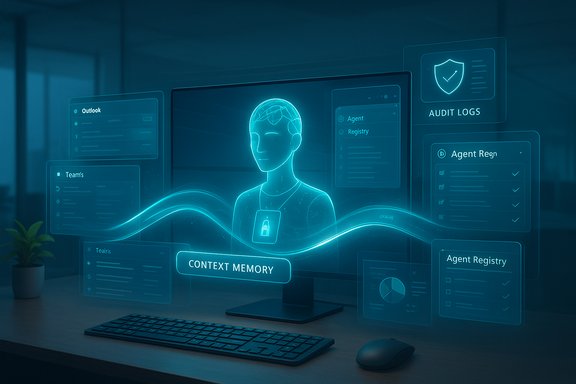
- Desktop integration will deepen. Expect agents embedded across Outlook, Teams, Edge and Windows shell experiences that can orchestrate file edits, meeting summaries, and calendar management with a persistent memory model.
- Admin tooling must evolve. Windows and Microsoft ecosystem administrators will need inventory, policy, and audit features for agents alongside machines and users — enabling identity controls, conditional access, and per-agent policy enforcement.
- Endpoint security must handle agent-originated actions. EDR/XDR rules will need logic to distinguish a legitimate agent action from compromised human credentials or malicious process injection.
What to watch in 2026 (operational signals)
- Production pilots migrate to regulated environments (healthcare, finance) with demonstrable audit trails and human-in-the-loop protocols.
- Cloud providers ship more agent-first identity and governance primitives (agent registry entries, token lifetimes, scoped connectors).
- SIEM/XDR vendors release agent-aware detection rules and telemetry schemas.
- Interoperability efforts and open standards emerge for agent skills and runtime protocols to avoid closed silos.
- Market consolidation and specialization: expect specialist agent marketplaces and vertical agent integrators to grow as enterprises demand vetted domain expertise.
Conclusion
2026 will be remembered not because an application changed color or a new model size arrived, but because software started to act on behalf of people at scale. The transition from assisted suggestions to autonomous, goal‑directed agents changes the production model for software: agents are digital co-workers that need identity, governance, telemetry, and operational discipline. The opportunity is real — measurable productivity gains exist today — but so are the risks: security, compliance, and operational debt loom large if organizations treat agents as toys instead of first‑class entities.Practical leadership in the agent era will look like this: run short, measurable pilots; build AgentOps early; treat agents as identities; and insist on provenance, auditability, and human sign‑off for sensitive actions. When those pieces are in place, teams running Windows and enterprise stacks will gain a genuine multiplier: less time on repetitive work, more time on strategy, and faster product cycles — provided the transition is managed with discipline and a clear eye on operational risk.
The age of AI agents has begun — the critical question for Windows users and IT leaders is whether they will shape this era with governance and engineering rigor, or be shaped by it.
Source: Analytics Insight 2026 Will Be the Year of AI Agents: Here’s Why
