
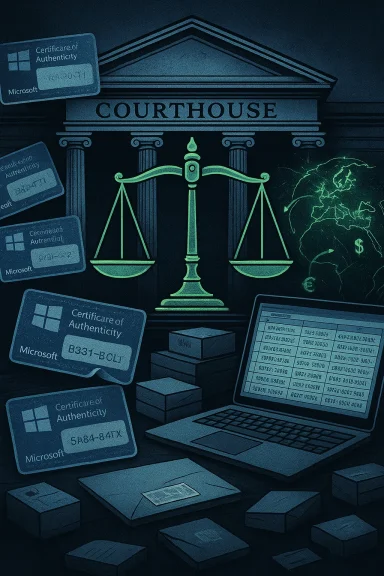
A federal jury’s conviction and a subsequent prison sentence have put a spotlight on an under‑reported corner of the software licensing ecosystem: the market for genuine Microsoft Certificate of Authenticity (COA) labels and the ease with which those labels — when separated from the hardware or sealed packaging they were meant to accompany — can be converted into usable product keys and resold around the world. Heidi Richards, the 52‑year‑old operator of an e‑commerce business called Trinity Software Distribution, was sentenced to 22 months in federal prison and ordered to pay a $50,000 fine after a jury found her guilty of conspiring to traffic in illicit Microsoft COA labels and related offenses. Court filings and an indictment show Richards and her company purchased tens of thousands of genuine COA labels from a Texas supplier between 2018 and 2023, wired more than $5.1 million in payments, and instructed employees to transcribe product activation codes from the stickers into spreadsheets for resale as standalone licenses.
Despite those measures, COAs still bear a printed product activation code, and when those labels are detached from their intended device or retail package they can become a commodity on a global gray market. That market has, until recently, mainly been tolerated as a low‑level nuisance; the Richards case shows it can also be the foundation of large‑scale criminal enterprises that end up in federal court.
Over a multi‑year period the indictment alleges wire transfers totaling roughly $5,148,181.50 were sent to the supplier to acquire COA labels. The court documents list specific purchases that illustrate the scale and economics: for example, a July 2018 purchase of several hundred Windows 10 COA labels for a few tens of thousands of dollars, and December 2022 purchases involving thousands of Windows 10 Pro COAs for sums in the low six figures. Prosecutors pursued charges including conspiracy to traffic in illicit labels (18 U.S.C. § 2318) and trafficking in unauthorized access devices (18 U.S.C. § 1029), statutes that criminalize the sale of labels and access devices used to bypass software licensing controls.
Legal doctrines that sometimes protect purchasers of physical goods — such as the first‑sale doctrine — are of limited use in this context. Courts have increasingly recognized that the downstream distribution of software product keys and similar access devices can be restricted by licensing and statutory law, which complicates the position of buyers who think they’re getting a legitimate bargain.
The economics are telling: when thousands of COA labels can be acquired in a multi‑thousand‑dollar transaction and each key can be sold at a mark‑up relative to the purchase price, the aggregate returns can be substantial — and that is exactly the dynamic alleged in the Richardson indictment.
Marketplaces and payment processors should take notice, too. Platforms that facilitate the bulk sale of activation codes or that turn a blind eye to sellers who provide codes detached from licensed hardware can face reputational and legal consequences if they become conduits for criminal activity. Expect more takedown requests, tighter seller verification, and possible civil suits from rights holders.
Readers should treat the smaller $242,000 figure with caution pending confirmation from primary sentencing materials or the court docket. In short: the large transactional trail and multiple overt acts are well documented in public filings and DOJ releases; the particular prosecutors’ restitution or proceeds figure cited in some press accounts requires closer verification in the sentencing record.
For organizations and consumers, the practical takeaway is straightforward: prioritize authorized channels, insist on proper documentation tying software to hardware or accounts, and treat suspiciously cheap offers as a potential operational and legal risk. For vendors and regulators, the case highlights the need for continued modernization of licensing models and stronger supply‑chain controls to make the gray market less profitable and less viable. The prosecution closes one door for large‑scale COA trafficking — but addressing the systemic vulnerabilities will require coordinated action across vendors, marketplaces, and enforcement agencies.
Source: TechRadar Florida woman jailed for illegally selling Microsoft product keys
 Background
What is a COA label and why does it matter?
A Certificate of Authenticity (COA) is a physical label affixed to OEM hardware or included with sealed retail packaging that contains a product key used to activate Microsoft Windows or Office products. COA labels exist to help customers and vendors identify legitimate copies of Microsoft software and to discourage simple forms of counterfeiting. Over time Microsoft and hardware partners have added security measures to COA labels — including color‑shifting inks and, more recently, a scratch‑off panel concealing the printed product key — specifically to prevent casual extraction of keys by third parties.Despite those measures, COAs still bear a printed product activation code, and when those labels are detached from their intended device or retail package they can become a commodity on a global gray market. That market has, until recently, mainly been tolerated as a low‑level nuisance; the Richards case shows it can also be the foundation of large‑scale criminal enterprises that end up in federal court.
How the scheme worked (as alleged in court papers)
According to a federal indictment, Richards — doing business as Trinity Software Distribution — bought COA labels in bulk from a Texas‑based supplier and others, often at prices far below the manufacturer’s suggested retail price for the software those keys originally licensed. Employees were directed to physically remove or otherwise obtain the COA labels, uncover or read the activation keys, and transcribe those product codes into spreadsheets. Those codes were then sold in bulk to customers worldwide.Over a multi‑year period the indictment alleges wire transfers totaling roughly $5,148,181.50 were sent to the supplier to acquire COA labels. The court documents list specific purchases that illustrate the scale and economics: for example, a July 2018 purchase of several hundred Windows 10 COA labels for a few tens of thousands of dollars, and December 2022 purchases involving thousands of Windows 10 Pro COAs for sums in the low six figures. Prosecutors pursued charges including conspiracy to traffic in illicit labels (18 U.S.C. § 2318) and trafficking in unauthorized access devices (18 U.S.C. § 1029), statutes that criminalize the sale of labels and access devices used to bypass software licensing controls.
Why this case is legally significant
Federal statutes at play
The prosecution relied on two pillars of federal statutory law:- 18 U.S.C. § 2318 — which criminalizes trafficking in counterfeit or illicit labels and packaging for computer programs, and
- 18 U.S.C. § 1029 — which targets fraud and related activity in connection with access devices, a term broadly defined to include codes, account numbers, or other identifiers that can be used to obtain goods, services, or any thing of value.
Courtroom consequences and precedents
The Richards conviction and sentence underscore how prosecutors are increasingly willing to use these statutes to pursue grey‑market software sellers. The Department of Justice’s Computer Crime & Intellectual Property Section (CCIPS) was involved in the case, reflecting a broader federal focus on cybercrime, intellectual property protection, and large‑scale software licensing fraud. CCIPS activity has led to many convictions in recent years, and this case is one in a string of actions that treat illicit software key markets as criminal enterprises rather than merely civil disputes.Legal doctrines that sometimes protect purchasers of physical goods — such as the first‑sale doctrine — are of limited use in this context. Courts have increasingly recognized that the downstream distribution of software product keys and similar access devices can be restricted by licensing and statutory law, which complicates the position of buyers who think they’re getting a legitimate bargain.
Anatomy of the gray market and supply‑chain vulnerabilities
How legitimate COAs end up on the market
There are several pathways by which valid COA labels can be separated from their intended hardware or packaging and make their way into resellers’ hands:- Defective or off‑spec packaging — surplus inventory, refurbishers, or liquidation stock can include labels that should still be bound to their associated hardware but become separated during handling.
- Bulk purchases from intermediaries — a supplier may acquire large quantities of COAs from multiple sources and offer them at discounted bulk prices to resellers who then strip the labels for keys.
- Refurbisher channels — legitimate refurbishers have specific COAs and rules; bad actors may traffic in standard OEM COAs rather than authorized refurbisher labels.
- Theft or diversion — in some cases, labels may be the product of theft or diversion from authorized channels.
Why demand persists
There is a persistent market demand for low‑cost Microsoft licenses driven by consumers, small businesses, and global price differentials. Buyers seeking a cheap Windows or Office license may be tempted to buy product keys from online marketplaces, auction sites, or resellers that promise genuine Microsoft keys at a fraction of retail cost. That demand keeps margins for gray‑market distributors high and provides the incentive for intermediaries to find and supply COA labels.The economics are telling: when thousands of COA labels can be acquired in a multi‑thousand‑dollar transaction and each key can be sold at a mark‑up relative to the purchase price, the aggregate returns can be substantial — and that is exactly the dynamic alleged in the Richardson indictment.
Practical risks for buyers and businesses
Short‑term gains, long‑term losses
An individual or small business may save money immediately by purchasing a cheap activation key, but the risks are real and immediate:- License invalidation — Microsoft can and does deactivate keys once abuse is detected. Buyers may find their seemingly legitimate copy of Windows or Office deactivated, disrupting operations.
- Lack of support and updates — keys obtained off channel may not entitle the user to full vendor support or guarantees; critical security updates and patches could be affected.
- No legal protection — buyers who purchase keys sold in violation of distribution restrictions risk losing the purchase price and may have limited legal recourse.
- Data and operational risks — the sellers of illicit keys sometimes require customers to provide personal data or payment methods that are then reused or sold elsewhere, exposing buyers to additional privacy and fraud risks.
Red flags to spot illicit keys and dodgy sellers
If you’re evaluating a low‑cost license offer, watch for these warning signs:- The product is sold without the original hardware or sealed retail packaging.
- The seller provides keys in spreadsheets or text files rather than on physical media or authorized license documents.
- Prices are dramatically below the vendor’s typical retail or authorized reseller price.
- The seller discourages transfer paperwork or refuses to provide any documentation that ties the license to a physical device or sealed product.
- The COA sticker photograph shows that the scratch‑off has already been removed — or the seller explicitly discloses the code rather than offering the sealed label.
Enforcement and industry implications
What the Richards case signals to resellers and marketplaces
This prosecution demonstrates that law enforcement sees large‑scale COA trafficking as more than civil commercial misconduct: it can be criminal activity involving wire transfers, interstate commerce, and the trafficking of access devices. For sellers who flip COAs as a business model, the risks are now demonstrated in a high‑visibility conviction and jail time.Marketplaces and payment processors should take notice, too. Platforms that facilitate the bulk sale of activation codes or that turn a blind eye to sellers who provide codes detached from licensed hardware can face reputational and legal consequences if they become conduits for criminal activity. Expect more takedown requests, tighter seller verification, and possible civil suits from rights holders.
What legitimate vendors can and should do
Vendors like Microsoft have several tools to reduce abuse of physical keys:- Move to account‑bound activation — tying licenses more tightly to user accounts (as Microsoft has for many modern Office products) reduces the value of standalone codes.
- Harden distribution controls — work with OEMs and refurbishers to improve tracking and ensure COAs are bound to devices in ways that make diversion harder.
- Supply‑chain audits and partner vetting — apply stricter onboarding and auditing of distributors and intermediaries who sell bulk COAs.
- Automated abuse detection — improve telemetry and backend checks that detect bulk activation patterns inconsistent with legitimate retail use.
Critical analysis — strengths, weaknesses, and the bigger picture
Strengths of the prosecution and public interest case
- Clear statutory basis. Prosecutors relied on statutes designed to target the exact conduct at issue: trafficking in illicit labels and trafficking in access devices. Those statutes map well to the alleged facts and provide significant sentencing exposure, sending a deterrent signal.
- Documentary evidence. The indictment includes wire transfer records, invoices, emails, and spreadsheets showing purchases and the transcribed keys, giving the government a strong evidentiary trail for jury presentation.
- Impact on end users. Public enforcement reinforces the notion that the downstream buyer may not be insulated from consequences — a public interest point that strengthens compliance incentives in the channel.
Weaknesses and limits of the enforcement approach
- Supply‑chain opacity remains. The underlying vulnerability is systemic: legitimate labels can be diverted in many ways. Criminal prosecutions of distributors address symptoms but not all root causes.
- Selective visibility. Focusing enforcement on large transactions and clear criminal conduct is sensible, but a vast gray market at smaller scales remains active and harder to police.
- Potential buyer confusion. Consumers and small businesses may be unaware that a “genuine” printed COA sold without hardware is nontransferable; enforcement alone won’t necessarily educate every buyer.
Systemic risks and unintended consequences
- Over‑reliance on criminal enforcement. Relying heavily on prosecutions risks treating what is also a commercial problem as primarily a law‑enforcement one. That approach works for large fraud rings but is a blunt instrument for market failures and informational asymmetries.
- Market displacement. When COA trafficking is pushed out, some demand may migrate to counterfeit keys, cracked activators, or pirated builds — each presenting different but equally serious security and legal risks for customers.
- International complexity. The cross‑border nature of digital markets complicates enforcement: suppliers and buyers may be located in jurisdictions with different laws, creating safe havens for bad actors.
What companies and IT teams should do now
For IT managers and procurement teams
- Buy from authorized channels. Purchase Microsoft licenses from authorized resellers, the Microsoft Store, or directly from OEMs. Ensure invoices tie the license to specific hardware or user accounts.
- Validate licenses. Use Microsoft’s license entitlement tools and check activation history when buying refurbished devices or discounted software bundles.
- Document everything. Maintain receipts, order confirmations, and transfer documentation that ties software to hardware or a named account.
- Educate staff. Make sure procurement and help‑desk teams know the red flags of illicit keys and the operational risks of using them.
For individual consumers
- Avoid deals that are too good to be true. Extremely cheap Windows or Office keys rarely come with the protections and guarantees you’d get buying through authorized channels.
- Prefer digital, account‑bound licensing. Where possible, sign in and buy through a vendor account that ties the license to your identity rather than a printed key.
- If already using a cheap key, verify status. If your license behaves oddly — losing activation or failing updates — contact Microsoft support and be ready to replace the license from an authorized source.
The reporting gap and one claim to treat cautiously
Several popular news outlets reported that prosecutors in the Richards case sought to recover $242,000 as proceeds obtained from the offenses. That specific dollar figure appears in a few media summaries, but it did not appear in the Department of Justice’s public sentencing announcement and could not be directly found in the public indictment PDF or the readily available court press release. The indictment and court documents do, however, detail a much larger aggregate of wire transfers to the supplier — roughly $5.15 million — and list multiple specific purchases and invoices.Readers should treat the smaller $242,000 figure with caution pending confirmation from primary sentencing materials or the court docket. In short: the large transactional trail and multiple overt acts are well documented in public filings and DOJ releases; the particular prosecutors’ restitution or proceeds figure cited in some press accounts requires closer verification in the sentencing record.
Where this leaves the industry and what to watch next
- Tighter channel controls. Expect Microsoft and OEM partners to accelerate efforts to control COA distribution and devalue standalone physical keys by pushing customers toward account‑based activation.
- Marketplace scrutiny. Online marketplaces and payment processors will face increasing pressure to detect and remove sellers who traffic in activation keys or COA labels detached from hardware.
- More prosecutions for large‑scale activity. This case shows that federal authorities treat large, organized redistribution of activation keys as criminal — a pattern likely to continue where clear evidence and money trails exist.
- Evolving attacker economics. Criminals will adapt and may turn to counterfeit keys, account takeover, or other methods to achieve similar ends. Vigilance and continuous improvement of vendor controls remain necessary.
Conclusion
The sentencing of Heidi Richards for trafficking in Microsoft COA labels is a cautionary tale about the intersection of legitimate physical artifacts (COA stickers), global e‑commerce, and criminal entrepreneurship. It underscores the legal reality that activation codes are not fungible commodities to be bought and resold at will: when separated from the hardware or sealed package they were designed to authenticate, those codes become trafficking targets under federal law.For organizations and consumers, the practical takeaway is straightforward: prioritize authorized channels, insist on proper documentation tying software to hardware or accounts, and treat suspiciously cheap offers as a potential operational and legal risk. For vendors and regulators, the case highlights the need for continued modernization of licensing models and stronger supply‑chain controls to make the gray market less profitable and less viable. The prosecution closes one door for large‑scale COA trafficking — but addressing the systemic vulnerabilities will require coordinated action across vendors, marketplaces, and enforcement agencies.
Source: TechRadar Florida woman jailed for illegally selling Microsoft product keys
