

The Federal Circuit has stepped into a high-stakes cloud‑computing patent fight and reversed a Western District of Texas ruling that had effectively ended Exafer Ltd.’s case against Microsoft — vacating a no‑damages summary judgment and holding that the district court abused its discretion by excluding Exafer’s damages expert under Rule 702. The appellate court concluded that the district court misapplied prior precedent when it barred a damages methodology tied to virtual‑machine (VM) hours and remanded the case for further proceedings, restoring a path for Exafer to prove a reasonable royalty tied to Azure features that Microsoft calls SmartNICs and VFP Fastpath. (cafc.uscourts.gov)
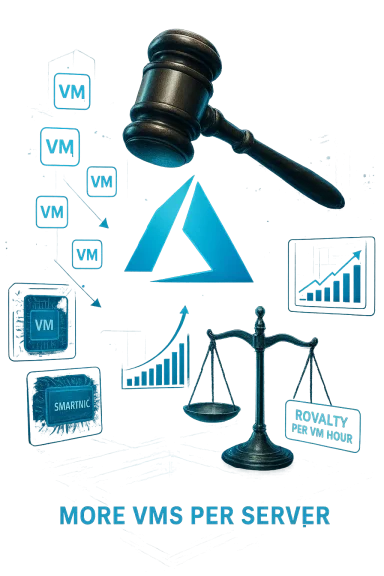
Exafer sued Microsoft, alleging that certain Azure networking optimizations — specifically Azure Smart Network Interface Cards (SmartNICs) and the Virtual Filtering Platform (VFP) Fastpath — infringe two patents covering techniques for forwarding and optimizing network traffic. The dispute centered not only on infringement and claim construction but crucially on damages: Exafer’s damages expert valued the patented features in terms of VM‑hours (the number of virtual machines Microsoft could host per physical server as a function of CPU savings attributable to the accused features). The district court excluded that expert testimony as unreliable under Federal Rule of Evidence 702, then granted Microsoft summary judgment of no remedy. The Federal Circuit reversed. (cafc.uscourts.gov)
This decision, filed March 6, 2026 (No. 24‑2296), is significant for patent‑damages practice in the cloud era: it clarifies that a damages expert may rely on company internal evidence showing the economic causal connection between a patented feature and broader platform metrics (like VM density and VM pricing), and it warns against an overbroad reading of Enplas that would erect categorical bars to using certain types of royalty bases. (cafc.uscourts.gov)
The Federal Circuit’s approach recognizes that platform economics are a legitimate currency for patent damages so long as the valuation is tethered to the patented contribution and supported by record evidence (especially the defendant’s own documents). For the cloud industry, that means engineering and product teams’ internal performance metrics will increasingly be discoverable evidence in IP litigation. Companies should therefore be mindful: internal benchmarking and efficiency estimates can be double‑edged swords — persuasive business planning tools that can also become litigation vulnerabilities. (cafc.uscourts.gov)
For IT leaders and cloud architects, the practical lesson is unambiguous: internal benchmark slides, architectural whitepapers, and performance roadmaps can later be deployed as evidence of how a given optimization translates into economics. Teams should coordinate with legal counsel to assess the potential IP risks and the discoverability of performance testing artifacts. For in‑house counsel, early mapping of engineering artifacts to potential IP exposure is now a best practice. (cafc.uscourts.gov)
Source: VitalLaw.com Wolters Kluwer
 Background / Overview
Exafer sued Microsoft, alleging that certain Azure networking optimizations — specifically Azure Smart Network Interface Cards (SmartNICs) and the Virtual Filtering Platform (VFP) Fastpath — infringe two patents covering techniques for forwarding and optimizing network traffic. The dispute centered not only on infringement and claim construction but crucially on damages: Exafer’s damages expert valued the patented features in terms of VM‑hours (the number of virtual machines Microsoft could host per physical server as a function of CPU savings attributable to the accused features). The district court excluded that expert testimony as unreliable under Federal Rule of Evidence 702, then granted Microsoft summary judgment of no remedy. The Federal Circuit reversed. (cafc.uscourts.gov)This decision, filed March 6, 2026 (No. 24‑2296), is significant for patent‑damages practice in the cloud era: it clarifies that a damages expert may rely on company internal evidence showing the economic causal connection between a patented feature and broader platform metrics (like VM density and VM pricing), and it warns against an overbroad reading of Enplas that would erect categorical bars to using certain types of royalty bases. (cafc.uscourts.gov)
The facts the Federal Circuit relied on
What Exafer offered as the royalty base
Exafer’s damages expert, Mr. Justin Blok, presented a VM‑hours royalty base: he proposed a per‑VM‑hour incremental value (roughly $0.0625 per VM‑hour) that, when multiplied over the relevant usage period, yielded an incremental benefit of about $534.3 million attributable to the claimed inventions during the damages window. His calculation relied directly on testimony and modeling from Exafer’s technical expert explaining how the accused features reduced CPU consumption and therefore allowed Microsoft to host more VMs per physical server—an effect Microsoft itself documented in internal slides and test results. (cafc.uscourts.gov)Why the district court excluded the testimony
The magistrate judge and district court concluded the VM‑hours royalty base improperly used unaccused products — i.e., VMs themselves — as the royalty base, and relied on the Federal Circuit’s Enplas decision as controlling precedent that barred inclusion of activities that do not themselves constitute infringement. The district court therefore excluded Mr. Blok’s damages opinions, and because Exafer had not presented a different admissible damages theory (and the court denied Exafer’s motion to reopen discovery), the court entered summary judgment that Exafer had no remedy. (cafc.uscourts.gov)What the Federal Circuit held — key takeaways
- The Federal Circuit reversed the exclusion of Mr. Blok’s damages testimony: it found that Enplas does not support a categorical ban on using non‑infringing activity as part of a royalty base where there is a causal connection tying those activities to the value of the patented features. The court emphasized that the admissibility inquiry under Rule 702 focuses on reliability and whether the methodology is tethered to the facts and economic realities of the hypothetical negotiation. (cafc.uscourts.gov)
- The court explained that Microsoft’s own documents provided the needed causal link: internal evidence showing CPU improvements from VFP Fastpath and SmartNICs—50% and 300% figures in Microsoft slides and estimates—supported Dr. Congdon’s (Exafer’s technical expert) opinion that the claimed patents accounted for some or all of those improvements. Mr. Blok then translated those benefits into additional VMs hosted and into a per‑VM‑hour incremental value. Because the methodology accounted for apportionment and tied the royalty base to attributable benefits, the Federal Circuit concluded the testimony was admissible. (cafc.uscourts.gov)
- The appellate court vacated as moot the denial of Exafer’s motion to reopen discovery and vacated the summary judgment for absence of a remedy, remanding for further proceedings. Costs were awarded to Exafer. (cafc.uscourts.gov)
Why this matters: legal and practical significance
Reaffirming flexibility in reasonable‑royalty proof
The Federal Circuit’s opinion reaffirms the principle that reasonable‑royalty analysis must reflect marketplace realities. Courts have long warned against awarding royalties based on the entire value of an unpatented product unless the patentee shows the patented feature drove demand (the Entire Market Value Rule), and bad precedent can be cited to exclude creative but fact‑driven damages models. Here, the court made clear that using non‑infringing products as part of the royalty base is not per se unlawful when the damages expert can show a clear causal relationship from accused functionality to the unaccused product’s value. That reasoning sits comfortably with prior decisions recognizing the limits of Enplas and the continued relevance of LaserDynamics and other reasonable‑royalty precedents. (cafc.uscourts.gov)A wake‑up call for defendants and plaintiffs in cloud and platform cases
- For plaintiffs: the decision is welcoming. It allows damages experts to translate technical performance gains into platform economics (e.g., VMs hosted, pricing per hour) when the patentee can link the technical facts to economic value through internal documents, benchmark evidence, or credible technical testimony.
- For defendants: the ruling signals a higher evidentiary bar than a simple invocation of Enplas or the EMVR to exclude damages methodology wholesale. Defendants must be ready to challenge the factual underpinnings (e.g., the attribution percentages, the accuracy of benchmarks, the proper apportionment) through cross‑examination, competing expert evidence, and targeted discovery rather than relying primarily on categorical Daubert arguments. (cafc.uscourts.gov)
Implications for expert reports, discovery, and litigation strategy
The opinion will change how practitioners approach damages and discovery in software‑ and cloud‑centric disputes:- Expect plaintiffs to collect and emphasize internal vendor documents showing product‑level performance impacts and to use those documents to tie patented improvements to economic metrics.
- Expect defendants to push for granular discovery on test methodologies, performance baselines, and the chain of causation connecting features to revenue, and to prepare rebuttal experts who can isolate alternative explanations for the observed economic effects.
- Courts will likely become more exacting about how apportionment is performed and whether the damages methodology truly isolates the incremental value of the claimed invention. This means more expert skirmishes over assumptions, sensitivity analyses, and the robustness of economic linking. (cafc.uscourts.gov)
Dissecting the Federal Circuit’s reasoning — what the opinion got right (and what remains open)
Strengths of the opinion
- Practicality over formalism. The court distinguished between improperly including activities that bear no causal relationship to the patented invention (the Enplas scenario) and properly using broader economic measures where a causal link exists. That distinction provides needed flexibility in modern technology cases where value is often embedded in complex platform interactions. (cafc.uscourts.gov)
- Deference to district court fact‑finding, tempered by legal correctness. The court applied the appropriate abuse‑of‑discretion standard for evidentiary rulings but corrected the district court where it misapplied precedent as a categorical rule rather than a factual check. That balance is consistent with Federal Circuit practice and Fifth Circuit standards on evidentiary review. (cafc.uscourts.gov)
- Attention to market evidence. By focusing on Microsoft’s internal presentations and estimates, the court affirmed the importance of contemporaneous corporate documents in anchoring reasonable‑royalty calculations — a practical confirmation for litigants that the best evidence is often the defendant’s own records. (cafc.uscourts.gov)
Risks, ambiguities, and issues the opinion left unresolved
- Apportionment remains fact‑intensive. The court reversed on admissibility, not on the correctness of the resulting damages number. On remand, defendants will press apportionment, causation, and the precise percentage of benefit attributable to the patents. The opinion does not soften the substantive requirement that royalties compensate only for the patented contribution. (cafc.uscourts.gov)
- Trial risk and sensitivity to assumptions. Valuations that multiply per‑VM‑hour numbers across a massive cloud footprint are inherently sensitive to assumptions (occupancy rates, migration, multi‑tenancy behavior, differing VM types). The Federal Circuit’s recognition of admissibility does not immunize such models from being undercut at trial. Practitioners should expect a battlefield of alternative models and sensitivity analyses. (cafc.uscourts.gov)
- Discovery fights will intensify. The opinion vacated the denial of a discovery reopening as moot, but it signals that discovery on performance testing, benchmark designs, and internal decision‑making will be hotly contested. Courts will be asked to police the line between fishing expeditions and necessary proof. (cafc.uscourts.gov)
Practical checklist: how litigators and experts should adapt
- Prepare a tight, evidence‑first damages theory: anchor valuation to contemporaneous vendor documents and explain each step transparently.
- Map technical performance improvements to concrete economic metrics (e.g., CPU cycles → VMs/hosted instances → revenue per VM‑hour) and document the causal chain.
- Include robust apportionment and sensitivity analyses in the damages report; show how alternative assumptions change the outcome.
- Preserve discovery focused on benchmarks, test setups, baseline measurements, and any internal slides that quantify benefits.
- Anticipate Daubert challenges and preempt them by explaining methodology, data sources, and theory within the expert report itself.
- For defense teams: prepare competing economic models, attack causal links, and gather evidence of alternative explanations (e.g., other features, software upgrades, or efficiency changes unrelated to the accused patents).
- Consider early mediation or focused technical tutorials to narrow disputed factual issues before expensive expert discovery and Daubert motion practice.
- Use depositions strategically: lock down the authors of internal documents and the experts who rely upon them.
- Where possible, build trial demonstratives that clearly trace the incremental value back to the patent claims, reducing the jury’s cognitive load.
- Remember the procedural lesson: a Daubert win that ousts an expert can end a case only if no alternative theory is timely presented and discovery is appropriately managed. The appellate decision highlights how denying discovery reopening can itself be reversible. (cafc.uscourts.gov)
Broader industry implications: patents, cloud economics, and platform litigation
This case sits at the intersection of patent law and cloud economics. Modern cloud platforms monetize compute by selling units of consumption — VM‑hours, CPU cycles, GPU hours, bandwidth — and small technical improvements can scale to large economic effects. Courts and litigants must therefore be comfortable translating technical measures of efficiency into economic measures of value, but also vigilant to avoid awards that leap beyond what the patent actually adds.The Federal Circuit’s approach recognizes that platform economics are a legitimate currency for patent damages so long as the valuation is tethered to the patented contribution and supported by record evidence (especially the defendant’s own documents). For the cloud industry, that means engineering and product teams’ internal performance metrics will increasingly be discoverable evidence in IP litigation. Companies should therefore be mindful: internal benchmarking and efficiency estimates can be double‑edged swords — persuasive business planning tools that can also become litigation vulnerabilities. (cafc.uscourts.gov)
Critical perspective: strengths and potential weaknesses of Exafer’s case
- Strengths:
- Exafer’s damages model was grounded in technical testimony and Microsoft’s own historic benchmarks showing concrete CPU benefits from the accused features. The Federal Circuit highlighted that the damages expert did not simply assume a value but relied on documented performance improvements and applied conservative apportionment reasoning. This makes the damages case factually anchored, a major asset in complex technology litigation. (cafc.uscourts.gov)
- Weaknesses / vulnerabilities:
- The per‑VM‑hour calculation is sensitive to numerous assumptions (VM mix, average price per hour, gross mawhich patented claims — versus other engineering changes — produced the savings). On remand, Microsoft can mount detailed, economically grounded rebuttals and point to alternative drivers of efficiency. The jury (or judge) will need to resolve these quantitative disputes — a process ripe for heavy skirting by expert dueling. (cafc.uscourts.gov)
What to watch next
- On remand, whether the district court reopens discovery and, if so, how expansive the additional fact‑ and expert discovery will be. The Federal Circuit vacated the denial of the motion to reopen as moot, increasing the probability of new discovery. (cafc.uscourts.gov)
- How the parties refine their damages models — in particular, whether Exafer tightens its apportionment or Microsoft produces stronger evidence showing an alternative explanation for CPU improvements.
- Whether the case will settle once the possible damages exposure is back on the table, or whether it proceeds to gate‑keeper showdowns, Daubert battles, and a full retrial on damages. Bloomberg Law and other IP press outlets have already signaled the case’s potential to reshape damages practice in cloud disputes.
- The district court’s approach to instructing a jury (if the case goes to trial) on valuation tied to VM economics — a potential template for future cloud‑era patent trials. (cafc.uscourts.gov)
Community reaction and practical takeaways for IT leaders
Within practitioner and technical communities, the decision has prompted immediate commentary that highlights both the legal and operational stakes of product‑level performance documentation. Community summaries and early analysis circulated quickly in forum discussions and commentary threads that track Microsoft litigation closely; those community writeups underscore a shared recognition: internal technical metrics can be decisive litigation artifacts.For IT leaders and cloud architects, the practical lesson is unambiguous: internal benchmark slides, architectural whitepapers, and performance roadmaps can later be deployed as evidence of how a given optimization translates into economics. Teams should coordinate with legal counsel to assess the potential IP risks and the discoverability of performance testing artifacts. For in‑house counsel, early mapping of engineering artifacts to potential IP exposure is now a best practice. (cafc.uscourts.gov)
Conclusion
The Federal Circuit’s reversal in Exafer Ltd. v. Microsoft is a consequential ruling for patent damages practice in the cloud era. By rejecting an overbroad application of Enplas and restoring an evidence‑driven VM‑hours damages theory tied to Microsoft’s own internal metrics, the court reinforced the principle that reasonable‑royalty analyses must reflect marketplace realities and causal economic links. The decision does not guarantee a damages award to Exafer, but it reopens the evidentiary path for plaintiffs to monetize platform improvements where they can prove the patented feature’s measurable contribution to platform economics. Litigators, experts, and in‑house teams should treat this opinion as a blueprint for both building and contesting damages models that bridge technical performance and large‑scale cloud economics. (cafc.uscourts.gov)Source: VitalLaw.com Wolters Kluwer
