

A federal judge in San Francisco on Friday denied a coalition of federal employee unions’ request to block FEMA from laying off thousands of temporary disaster-response workers, finding that the unions had not shown the agency’s CORE workforce faced immediate firings. The decision does not end the lawsuit, but it removes the most urgent legal brake on FEMA’s disputed staffing cuts. For an agency whose value is measured in the hours after floods, fires, hurricanes, and outages, the ruling turns a personnel fight into a capacity test. The practical question now is not only whether FEMA can cut these workers lawfully, but whether it can still surge when the country needs it most.
Judge Susan Illston’s order landed in the narrow procedural space where many public-sector workforce battles are won or lost. The unions wanted a preliminary injunction, the legal equivalent of telling FEMA to stop before the damage is done. Illston concluded that the record no longer supported that emergency remedy because the facts had shifted since the unions first asked for relief earlier in the year.
That distinction matters. Courts do not issue preliminary injunctions merely because plaintiffs have a plausible case, or because an agency’s plans look disruptive, or because a policy smells like it was drafted in haste. They look for imminent harm, likelihood of success, and a balance of equities that justifies judicial intervention before the merits are fully decided.
The unions, led by the American Federation of Government Employees, argued that FEMA’s Cadre of On-Call Response and Recovery employees — CORE workers — were in danger of being eliminated as part of a broader push to restructure and shrink the federal workforce. FEMA countered that the picture had changed, including by rehiring some workers and by pointing to personnel and leadership changes since the earlier phase of the dispute.
Illston’s ruling therefore reads less like a sweeping endorsement of FEMA’s workforce strategy than a refusal to preserve an earlier snapshot of events. That is cold comfort to workers who see their positions as contingent on political winds and budgetary maneuvering. But it is also a reminder that emergency litigation depends on timing, and timing is often where the government has the advantage.
FEMA’s permanent workforce cannot scale instantly to every wildfire complex, hurricane corridor, tornado outbreak, flood zone, and long-tail recovery mission. CORE workers help fill that gap. They are not merely clerical overflow; they are part of the machinery that turns a presidential disaster declaration into inspections, logistics, survivor assistance, grants administration, field coordination, and recovery support.
This is why the dispute has stakes beyond federal labor law. A private company can often cut temporary staff and accept slower service as a business risk. A disaster agency that cuts surge capacity is making a bet against volatility — and volatility has been winning.
The agency’s defenders will argue that a workforce model should not become untouchable simply because it has existed for years. That is fair. FEMA, like every large bureaucracy, can accumulate redundancies, bottlenecks, outdated roles, and layers of process that deserve scrutiny. But disaster response is one of the least forgiving places to discover, after the fact, that what looked like redundancy was actually resilience.
That argument has special force at FEMA because Congress has repeatedly treated disaster management as a domain where structure matters. After Hurricane Katrina, lawmakers did not simply tell FEMA to do better; they rewrote parts of the agency’s legal framework to reinforce capability, coordination, and preparedness. The Post-Katrina reforms were born from the recognition that emergency management fails when authority is confused, staffing is thin, and planning is subordinated to improvisation.
The government’s position is equally familiar: agencies must be able to manage their own personnel, especially when budgets, priorities, and leadership change. No administration wants federal judges second-guessing every reduction in force, hiring freeze, or reorganization plan. If courts too readily convert workforce disputes into nationwide injunctions, executive agencies become harder to run.
Illston’s order does not resolve that constitutional and statutory argument. It simply says the unions did not carry the burden needed for immediate relief on the current record. The case may still proceed toward summary judgment, where the court can examine legality without the compressed urgency of an injunction fight.
That procedural posture is important because both sides will claim partial victory. FEMA can say the court declined to stop it. The unions can say the court did not bless the cuts. Both statements can be true, which is exactly why the next phase matters.
FEMA is a particularly difficult test case for blunt-force downsizing. It is not an agency whose public output can be paused without immediate consequences. When disaster survivors are waiting for inspections, when state emergency managers need federal coordination, or when local governments are trying to rebuild destroyed infrastructure, staffing levels become visible in the most painful way possible.
That does not mean every FEMA job is beyond review. It does mean the administration must make a better argument than “temporary” or “on-call” if it wants to convince the public that cuts will not impair response. Temporary workers can perform permanent functions in a system designed around episodic demand.
The same lesson applies across government technology and operations. Sysadmins know this instinctively. A spare server, a redundant network path, an off-hours escalation rota, and a tested backup are all easy to describe as excess until the incident starts. FEMA’s CORE workforce is, in human form, a redundancy layer.
But the rehiring argument cuts both ways outside the courtroom. If workers were separated or left in limbo only to be brought back later, that suggests the initial staffing plan may have been unstable, improvised, or overtaken by operational need. In disaster management, churn itself is a cost.
Experienced responders carry institutional knowledge that cannot be instantly recreated by a hiring campaign. They know how FEMA systems behave under load, how field offices function, how state and local partners communicate, and where paper rules diverge from disaster-zone reality. If those workers spend months unsure whether they will have jobs, some will leave, and the agency may not get them back when the next emergency arrives.
This is the quiet damage of workforce turbulence. The government can sometimes reverse a layoff notice, reopen a hiring action, or tell a court that the harm is no longer imminent. But morale, trust, and retention do not reset as neatly as a docket entry.
That bargain becomes shakier when workers see their jobs treated as variables in a government-wide reduction campaign. Even if FEMA ultimately retains many CORE employees, the signal has already been sent. A role that requires readiness may not provide security.
The risk is not only that FEMA has too few people on paper. The risk is that the people it has become less willing or able to remain available. On-call systems depend on trust: trust that the agency will call, that the work will exist, that the bureaucracy will not strand workers between emergencies, and that leadership understands the difference between idle capacity and wasted capacity.
Private-sector technology teams learned a version of this lesson during the past decade’s boom-and-bust hiring cycles. Layoffs do not just remove headcount; they change how remaining employees behave. They document less generously, take fewer risks, look for exits, and become less likely to absorb institutional stress without protest.
FEMA cannot afford a workforce that is physically present but psychologically checked out. Disaster response requires people to lean into uncertainty. A government that makes their own employment uncertain should not be surprised if that readiness erodes.
That is the dangerous asymmetry for FEMA. A court victory can be narrow and procedural. A disaster failure is broad and visceral. No press release about reorganizing for efficiency will matter to a family waiting for help or a governor demanding federal support.
The agency therefore faces a communications problem as well as an operational one. If FEMA believes it can reduce or reshape the CORE workforce without degrading response, it needs to explain how. That explanation cannot be abstract. It should identify which functions are being preserved, how surge staffing will be maintained, and how field operations will be protected during overlapping disasters.
So far, the public debate has been dominated by litigation claims and workforce numbers. That is not enough. Disaster readiness is a systems problem, and systems fail at the interfaces: between headquarters and regions, between federal and state authorities, between IT platforms and field staff, between eligibility rules and real survivors.
Cutting people from that system may be possible. Pretending the cuts are only a human-resources matter is not.
That question belongs partly to Congress, partly to agency leadership, and partly to voters. It is a policy judgment about risk tolerance. How much idle capacity should taxpayers fund so that the government can respond quickly when rare but catastrophic events occur?
Technology professionals understand this tradeoff as the economics of resilience. A system designed for average load is cheaper until peak load arrives. A system designed for peak load looks inefficient until the day it saves the business. FEMA exists because disaster demand is spiky, brutal, and geographically uneven.
The mistake is to treat low utilization during calm periods as proof of waste. In resilience engineering, unused capacity is not automatically inefficiency. Sometimes it is the product.
That does not absolve FEMA from proving that its staffing model is well designed. It does mean the burden of proof should not fall only on unions trying to stop cuts in court. The agency and the administration should have to show, in operational terms, that the new model can carry the load.
When FEMA scales up, it is not only deploying people with clipboards. It is scaling case-management systems, call centers, mobile devices, authentication, remote access, mapping platforms, document workflows, and intergovernmental data exchange. The responders in the field are the visible edge of a much larger operational stack.
Staffing cuts can stress that stack in ways that are familiar to anyone who has administered enterprise systems. Fewer trained users mean more errors. Fewer experienced coordinators mean more escalations. Less institutional knowledge means more reliance on brittle documentation. More churn means more onboarding, more access-control changes, and more room for security mistakes.
For state and local IT teams, FEMA capacity is not an abstraction. Disasters often require hurried coordination among emergency operations centers, public-safety networks, GIS teams, health systems, utilities, school districts, and cloud-hosted public portals. Federal staffing instability can ripple into those local environments.
This is why the ruling deserves attention from technologists even if the case itself is not about software. Modern emergency management is a socio-technical system. Remove enough experienced humans, and the technology does not compensate; it amplifies the gaps.
A disaster agency is not optimized solely for steady-state cost. It is optimized for readiness, coordination, and the ability to absorb shocks. Some of its value exists in the gap between what is happening today and what might happen tomorrow.
That makes efficiency harder to measure and easier to abuse. A spreadsheet can show salary savings immediately. It cannot easily show the cost of a delayed inspection, a slower grant approval, a missed coordination call, or a field office that has to relearn what departed workers already knew.
The administration may yet produce a credible case that FEMA can do more with fewer CORE workers, or with a different mix of permanent, temporary, contracted, and regional staff. But that case has to be operationally specific. It has to explain what capability is being retired, what capability is being replaced, and what risks are being accepted.
The court’s denial of an injunction should not be mistaken for that evidence. It is a legal development, not an after-action report from the future.
But room to act is not the same as a mandate to cut deeply. FEMA still operates under statutory obligations, congressional oversight, public scrutiny, and the unforgiving calendar of disaster season. If it moves too aggressively and performance suffers, the legal win will look pyrrhic.
The ruling also leaves the unions with strategic choices. They can continue pressing the merits, build a stronger record around actual or imminent harms, and use discovery and declarations to test FEMA’s claims about rehiring and operational continuity. The fight shifts from emergency prevention to proof.
That may ultimately be a better terrain for the public. Injunction fights compress complex policy questions into urgent legal standards. A fuller record could expose whether the agency’s workforce decisions are disciplined restructuring, political downsizing, or something messier in between.
Still, time is not neutral. If workers leave, programs reorganize, and disaster operations adapt around vacancies, a later ruling may not fully restore what was lost. Institutional capacity is easier to dismantle than rebuild.
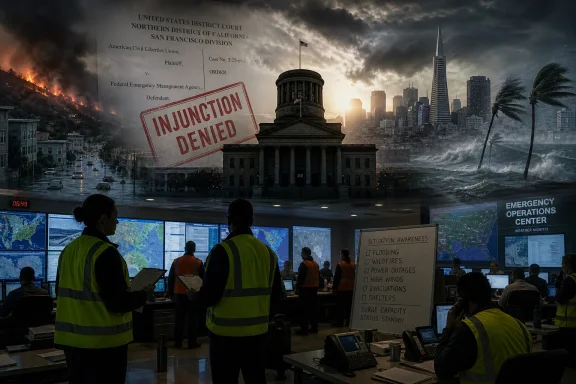 The Court Refused to Freeze a Threat That Had Started to Move
Judge Susan Illston’s order landed in the narrow procedural space where many public-sector workforce battles are won or lost. The unions wanted a preliminary injunction, the legal equivalent of telling FEMA to stop before the damage is done. Illston concluded that the record no longer supported that emergency remedy because the facts had shifted since the unions first asked for relief earlier in the year.That distinction matters. Courts do not issue preliminary injunctions merely because plaintiffs have a plausible case, or because an agency’s plans look disruptive, or because a policy smells like it was drafted in haste. They look for imminent harm, likelihood of success, and a balance of equities that justifies judicial intervention before the merits are fully decided.
The unions, led by the American Federation of Government Employees, argued that FEMA’s Cadre of On-Call Response and Recovery employees — CORE workers — were in danger of being eliminated as part of a broader push to restructure and shrink the federal workforce. FEMA countered that the picture had changed, including by rehiring some workers and by pointing to personnel and leadership changes since the earlier phase of the dispute.
Illston’s ruling therefore reads less like a sweeping endorsement of FEMA’s workforce strategy than a refusal to preserve an earlier snapshot of events. That is cold comfort to workers who see their positions as contingent on political winds and budgetary maneuvering. But it is also a reminder that emergency litigation depends on timing, and timing is often where the government has the advantage.
CORE Workers Are the Surge Capacity, Not the Spare Capacity
The phrase “temporary on-call responder” can make the workforce sound optional, as if these employees are a reserve pool that exists comfortably outside FEMA’s core mission. That framing is misleading. CORE employees are built into the agency’s disaster model precisely because disasters do not arrive on a tidy federal staffing calendar.FEMA’s permanent workforce cannot scale instantly to every wildfire complex, hurricane corridor, tornado outbreak, flood zone, and long-tail recovery mission. CORE workers help fill that gap. They are not merely clerical overflow; they are part of the machinery that turns a presidential disaster declaration into inspections, logistics, survivor assistance, grants administration, field coordination, and recovery support.
This is why the dispute has stakes beyond federal labor law. A private company can often cut temporary staff and accept slower service as a business risk. A disaster agency that cuts surge capacity is making a bet against volatility — and volatility has been winning.
The agency’s defenders will argue that a workforce model should not become untouchable simply because it has existed for years. That is fair. FEMA, like every large bureaucracy, can accumulate redundancies, bottlenecks, outdated roles, and layers of process that deserve scrutiny. But disaster response is one of the least forgiving places to discover, after the fact, that what looked like redundancy was actually resilience.
The Legal Fight Is Really About Who Gets to Redesign FEMA
The lawsuit sits inside a larger battle over the executive branch’s power to reorganize agencies through workforce cuts. The plaintiffs contend that FEMA’s staffing decisions are not merely routine management choices, but part of an unlawful effort to downsize or restructure the agency without following the legal constraints Congress put in place.That argument has special force at FEMA because Congress has repeatedly treated disaster management as a domain where structure matters. After Hurricane Katrina, lawmakers did not simply tell FEMA to do better; they rewrote parts of the agency’s legal framework to reinforce capability, coordination, and preparedness. The Post-Katrina reforms were born from the recognition that emergency management fails when authority is confused, staffing is thin, and planning is subordinated to improvisation.
The government’s position is equally familiar: agencies must be able to manage their own personnel, especially when budgets, priorities, and leadership change. No administration wants federal judges second-guessing every reduction in force, hiring freeze, or reorganization plan. If courts too readily convert workforce disputes into nationwide injunctions, executive agencies become harder to run.
Illston’s order does not resolve that constitutional and statutory argument. It simply says the unions did not carry the burden needed for immediate relief on the current record. The case may still proceed toward summary judgment, where the court can examine legality without the compressed urgency of an injunction fight.
That procedural posture is important because both sides will claim partial victory. FEMA can say the court declined to stop it. The unions can say the court did not bless the cuts. Both statements can be true, which is exactly why the next phase matters.
The Administration’s Workforce Strategy Keeps Colliding With Operational Reality
The FEMA dispute is part of a broader pattern: aggressive federal workforce reduction plans running into courts, statutory protections, and the messy fact that agencies are not interchangeable boxes on an org chart. Layoff plans that sound clean in a memo often become much harder to defend when tied to specific missions, specific workers, and specific legal constraints.FEMA is a particularly difficult test case for blunt-force downsizing. It is not an agency whose public output can be paused without immediate consequences. When disaster survivors are waiting for inspections, when state emergency managers need federal coordination, or when local governments are trying to rebuild destroyed infrastructure, staffing levels become visible in the most painful way possible.
That does not mean every FEMA job is beyond review. It does mean the administration must make a better argument than “temporary” or “on-call” if it wants to convince the public that cuts will not impair response. Temporary workers can perform permanent functions in a system designed around episodic demand.
The same lesson applies across government technology and operations. Sysadmins know this instinctively. A spare server, a redundant network path, an off-hours escalation rota, and a tested backup are all easy to describe as excess until the incident starts. FEMA’s CORE workforce is, in human form, a redundancy layer.
The Rehiring Argument Helped FEMA in Court but Creates Its Own Problem
FEMA’s claim that it had rehired many workers who were not reappointed earlier in the year appears to have weakened the unions’ request for emergency relief. If the threatened firings are not imminent, or if the agency has reversed some earlier decisions, a preliminary injunction becomes harder to justify. Courts are reluctant to freeze an agency based on a threat that has become less immediate.But the rehiring argument cuts both ways outside the courtroom. If workers were separated or left in limbo only to be brought back later, that suggests the initial staffing plan may have been unstable, improvised, or overtaken by operational need. In disaster management, churn itself is a cost.
Experienced responders carry institutional knowledge that cannot be instantly recreated by a hiring campaign. They know how FEMA systems behave under load, how field offices function, how state and local partners communicate, and where paper rules diverge from disaster-zone reality. If those workers spend months unsure whether they will have jobs, some will leave, and the agency may not get them back when the next emergency arrives.
This is the quiet damage of workforce turbulence. The government can sometimes reverse a layoff notice, reopen a hiring action, or tell a court that the harm is no longer imminent. But morale, trust, and retention do not reset as neatly as a docket entry.
Disaster Response Is Now a Workforce-Retention Problem
Emergency management has always been difficult work. It involves travel, long hours, chaotic environments, political pressure, and the emotional burden of dealing with communities that have just been hit by catastrophe. The bargain for many federal responders is not luxury; it is mission, stability, and the belief that the institution will be there when needed.That bargain becomes shakier when workers see their jobs treated as variables in a government-wide reduction campaign. Even if FEMA ultimately retains many CORE employees, the signal has already been sent. A role that requires readiness may not provide security.
The risk is not only that FEMA has too few people on paper. The risk is that the people it has become less willing or able to remain available. On-call systems depend on trust: trust that the agency will call, that the work will exist, that the bureaucracy will not strand workers between emergencies, and that leadership understands the difference between idle capacity and wasted capacity.
Private-sector technology teams learned a version of this lesson during the past decade’s boom-and-bust hiring cycles. Layoffs do not just remove headcount; they change how remaining employees behave. They document less generously, take fewer risks, look for exits, and become less likely to absorb institutional stress without protest.
FEMA cannot afford a workforce that is physically present but psychologically checked out. Disaster response requires people to lean into uncertainty. A government that makes their own employment uncertain should not be surprised if that readiness erodes.
The Public Will Judge the Cuts During the Next Disaster, Not the Next Hearing
The legal system will judge FEMA’s actions by administrative law, statutory authority, labor protections, and procedural records. The public will judge them by outcomes. If the next major disaster response appears slow, understaffed, or confused, the workforce cuts will become part of the political story whether or not they were technically lawful.That is the dangerous asymmetry for FEMA. A court victory can be narrow and procedural. A disaster failure is broad and visceral. No press release about reorganizing for efficiency will matter to a family waiting for help or a governor demanding federal support.
The agency therefore faces a communications problem as well as an operational one. If FEMA believes it can reduce or reshape the CORE workforce without degrading response, it needs to explain how. That explanation cannot be abstract. It should identify which functions are being preserved, how surge staffing will be maintained, and how field operations will be protected during overlapping disasters.
So far, the public debate has been dominated by litigation claims and workforce numbers. That is not enough. Disaster readiness is a systems problem, and systems fail at the interfaces: between headquarters and regions, between federal and state authorities, between IT platforms and field staff, between eligibility rules and real survivors.
Cutting people from that system may be possible. Pretending the cuts are only a human-resources matter is not.
Courts Are a Blunt Instrument for Managing Agency Capacity
The unions’ failure to win an injunction also illustrates the limits of litigation as a tool for preserving government capability. Courts can stop unlawful actions, require procedures, and enforce statutory boundaries. They are much less equipped to decide how many disaster responders a nation should keep ready.That question belongs partly to Congress, partly to agency leadership, and partly to voters. It is a policy judgment about risk tolerance. How much idle capacity should taxpayers fund so that the government can respond quickly when rare but catastrophic events occur?
Technology professionals understand this tradeoff as the economics of resilience. A system designed for average load is cheaper until peak load arrives. A system designed for peak load looks inefficient until the day it saves the business. FEMA exists because disaster demand is spiky, brutal, and geographically uneven.
The mistake is to treat low utilization during calm periods as proof of waste. In resilience engineering, unused capacity is not automatically inefficiency. Sometimes it is the product.
That does not absolve FEMA from proving that its staffing model is well designed. It does mean the burden of proof should not fall only on unions trying to stop cuts in court. The agency and the administration should have to show, in operational terms, that the new model can carry the load.
The WindowsForum Angle Is Infrastructure, Not Partisanship
This story may look, at first glance, like a federal labor dispute outside the usual orbit of Windows enthusiasts and IT pros. It is not. Disaster response today is inseparable from digital infrastructure, identity systems, cloud services, endpoint management, communications networks, geospatial tools, and data-sharing workflows.When FEMA scales up, it is not only deploying people with clipboards. It is scaling case-management systems, call centers, mobile devices, authentication, remote access, mapping platforms, document workflows, and intergovernmental data exchange. The responders in the field are the visible edge of a much larger operational stack.
Staffing cuts can stress that stack in ways that are familiar to anyone who has administered enterprise systems. Fewer trained users mean more errors. Fewer experienced coordinators mean more escalations. Less institutional knowledge means more reliance on brittle documentation. More churn means more onboarding, more access-control changes, and more room for security mistakes.
For state and local IT teams, FEMA capacity is not an abstraction. Disasters often require hurried coordination among emergency operations centers, public-safety networks, GIS teams, health systems, utilities, school districts, and cloud-hosted public portals. Federal staffing instability can ripple into those local environments.
This is why the ruling deserves attention from technologists even if the case itself is not about software. Modern emergency management is a socio-technical system. Remove enough experienced humans, and the technology does not compensate; it amplifies the gaps.
The Efficiency Argument Needs Evidence, Not Slogans
Every administration promises to make government more efficient. The phrase is so familiar that it often passes without scrutiny. But efficiency in disaster response cannot mean the same thing it means in a warehouse, a subscription business, or a social-media company.A disaster agency is not optimized solely for steady-state cost. It is optimized for readiness, coordination, and the ability to absorb shocks. Some of its value exists in the gap between what is happening today and what might happen tomorrow.
That makes efficiency harder to measure and easier to abuse. A spreadsheet can show salary savings immediately. It cannot easily show the cost of a delayed inspection, a slower grant approval, a missed coordination call, or a field office that has to relearn what departed workers already knew.
The administration may yet produce a credible case that FEMA can do more with fewer CORE workers, or with a different mix of permanent, temporary, contracted, and regional staff. But that case has to be operationally specific. It has to explain what capability is being retired, what capability is being replaced, and what risks are being accepted.
The court’s denial of an injunction should not be mistaken for that evidence. It is a legal development, not an after-action report from the future.
The Ruling Gives FEMA Room, but Not a Mandate
The immediate effect of Illston’s order is to give FEMA more room to act. The agency is not blocked by this preliminary injunction request from proceeding with its disputed workforce plans. That is a meaningful win for the government in a case that had become part of the wider legal resistance to federal layoffs.But room to act is not the same as a mandate to cut deeply. FEMA still operates under statutory obligations, congressional oversight, public scrutiny, and the unforgiving calendar of disaster season. If it moves too aggressively and performance suffers, the legal win will look pyrrhic.
The ruling also leaves the unions with strategic choices. They can continue pressing the merits, build a stronger record around actual or imminent harms, and use discovery and declarations to test FEMA’s claims about rehiring and operational continuity. The fight shifts from emergency prevention to proof.
That may ultimately be a better terrain for the public. Injunction fights compress complex policy questions into urgent legal standards. A fuller record could expose whether the agency’s workforce decisions are disciplined restructuring, political downsizing, or something messier in between.
Still, time is not neutral. If workers leave, programs reorganize, and disaster operations adapt around vacancies, a later ruling may not fully restore what was lost. Institutional capacity is easier to dismantle than rebuild.
The Concrete Meaning of a Procedural Loss
The most important lesson from Friday’s order is that legal process and operational readiness move at different speeds. FEMA may have won breathing room in court, but the country still needs confidence that the agency can breathe under pressure.- The court denied emergency relief because the unions did not show that CORE workers faced immediate firings on the current record.
- The ruling does not decide whether FEMA’s broader workforce actions are lawful or wise.
- CORE employees matter because they provide surge capacity for disasters that exceed ordinary staffing levels.
- FEMA’s rehiring of some workers may have helped its legal argument while also underscoring the instability of the staffing plan.
- The practical risk is that uncertainty drives away experienced responders before the courts or Congress settle the legality of the cuts.
- The next major disaster will test FEMA’s staffing choices more harshly than any preliminary injunction hearing can.
References
- Primary source: Bloomberg Law News
Published: 2026-06-27T00:50:14.540610
Loading…
news.bloomberglaw.com - Related coverage: bloomberg.com
Loading…
www.bloomberg.com - Related coverage: federalnewsnetwork.com
Loading…
federalnewsnetwork.com - Related coverage: notus.org
Loading…
www.notus.org - Related coverage: cbsnews.com
Loading…
www.cbsnews.com - Related coverage: fedscoop.com
Loading…
fedscoop.com
- Related coverage: news.bloombergtax.com
Loading…
news.bloombergtax.com - Related coverage: axios.com
Loading…
www.axios.com - Related coverage: scotusblog.com
Loading…
www.scotusblog.com - Related coverage: thedailybeast.com
Loading…
www.thedailybeast.com - Related coverage: cases.justia.com
Loading…
cases.justia.com