

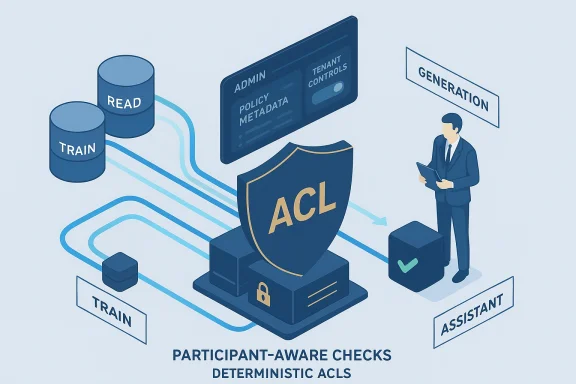
Microsoft Research’s new FineACL work reframes an obvious-but-neglected problem: when enterprise LLMs are trained on or retrieve from sensitive internal data, access control must be enforced deterministically across every stage of the pipeline — including fine-tuning and RAG — or confidential information will leak. The paper argues that probabilistic mitigations (sanitizers, filters, and differential-privacy-style noise) are necessary but insufficient, and describes a participant‑aware, access-control-first architecture that Microsoft has operationalized inside Copilot Tuning to prevent unauthorized disclosures.
Background
Large language models (LLMs) are now standard tools inside enterprises: summarizing mail, drafting legal text, triaging tickets and powering agentic automations. Many organizations fine-tune or tune models on internal knowledge to improve relevance and reduce hallucination. At the same time, Retrieval‑Augmented Generation (RAG) and semantic search let models fetch real documents at inference time to ground answers in tenant data. Those two realities — model tuning plus retrieval — multiply risk: a tuned model’s parameters may encode private facts, while a RAG pipeline can surface documents the requesting user shouldn’t see. The FineACL project exposes this combined threat and offers a design that treats every content item used for training or retrieval as subject to the same access policy checks a human would require.Why this matters now
- Enterprises increasingly run multi‑user LLM services and agent fleets across departments, meaning a single model instance may serve users with wildly different permissions.
- RAG systems intentionally bring external documents into the model’s prompt context, creating an egress surface for sensitive content.
- Administrators expect familiar access control semantics (group membership, role-based permissions, classification labels) to hold in LLM workflows, but existing pipelines often break or bypass those semantics.
What FineACL proposes (high-level)
FineACL promotes a simple principle: any content used in training, retrieval, or generation must be explicitly authorized for all participants in the interaction. Concretely, the project advances these practices:- Participant‑aware checks: Training examples, retrieval candidates, and any context that may influence model outputs are annotated and checked against the full set of principals participating in a session (requestor, assistant, and any agents). Access is denied unless authorization holds for every participant.
- Deterministic enforcement: Instead of relying on probabilistic filtering or post‑hoc output sanitization, FineACL inserts deterministic access-control checks at all touchpoints where content can enter a model’s learning or reasoning loop.
- End‑to‑end policy propagation: Access metadata travels with content — vectors, embeddings, and training shards are labeled so downstream components can enforce the same restrictions.
- Operational integration: The Microsoft team reports deploying these controls in Copilot Tuning so that tuned models inherit explicit model-level permissions and the training pipeline excludes documents a security boundary does not permit.
The technical surface: where leaks happen and how FineACL blocks them
Two main leakage vectors
- Fine‑tuned parameter leakage — content from the training set becomes recoverable from the model weights (membership inference, memorization, or adversarial extraction attacks).
- RAG/external retrieval leakage — the model retrieves or cites documents at inference; if retrieval ignores the requester’s permissions, it can return restricted content in the generated response.
During fine‑tuning (training-time)
- Training data is annotated with access predicates (who can read/use this data).
- FineACL enforces that a model trained on those data items may only be used by sessions where every participant is authorized according to those predicates.
- Practically, Copilot Tuning enforces model-level access controls after tuning: administrators control which security groups or roles may use the resulting model, and training excludes files outside those scopes. Microsoft’s documentation explicitly warns that changing source-resource permissions does not automatically update model permissions — administrators must update model ACLs after reclassification or permission changes. This underscores the need for clear lifecycle controls for models that have been tuned on sensitive content.
At retrieval time (RAG)
- Retrieval candidates are filtered by access policy before inclusion in the prompt context.
- Crucially, access decisions at inference are participant-aware: a candidate is eligible only if it’s authorized for all principals involved in the conversation that could see or act on the retrieved artifact.
- FineACL recommends attaching access metadata to index entries (e.g., to vector stores or search documents) so the retriever can perform fast, correct filtering without requiring reauthorization calls per document. This design reduces latency while making filtering deterministic.
Why determinism matters
Probabilistic defenses (token scrubbing, output filtering, or differential privacy) can reduce risk but never guarantee that a motivated adversary will fail. By contrast, policy‑based deterministic checks eliminate the ambiguity: if a piece of content is not authorized, it never participates in training or retrieval. The FineACL paper demonstrates how this shift reduces attack surface for extraction techniques that exploit model generalization and RAG context.Deployment and operational reality: Copilot Tuning and admin guardrails
Microsoft says FineACL concepts are implemented in Copilot Tuning and Copilot’s broader governance stack, where tenant administrators get explicit controls over who can fine‑tune models, which data sources may be included, and who can call the tuned models. Key operational facts to note:- Model access is a tenant‑admin-controlled artifact: after tuning, a model’s accessibility is controlled via security groups and the Microsoft 365 admin center. Admins can review, update, or delete tuned models.
- Training-phase isolation: Copilot Tuning operates in a tenant‑isolated environment; training does not send customer data to external services in Microsoft’s described flow. This is an important contractual and compliance guarantee for regulated industries.
- Document-level exclusion and suggestions: Copilot Tuning excludes files not authorized for the chosen security groups and will suggest appropriate security groups to maximize the model’s authorized knowledge base. This feature shows an engineering effort to reconcile utility and strict permissioning.
Attack demonstrations and empirical findings
FineACL’s authors document attacks that exploit misapplied or missing ACLs where adversaries recover sensitive training examples or coerce RAG pipelines into exposing protected documents. The key empirical observations:- Extraction attacks on tuned models: adversaries can craft prompts or use membership inference techniques to coax a tuned model into revealing fragments or entire items from its training set when the trained model lacks participant-aware enforcement.
- RAG-based exfiltration: when retrieval does not filter by requester authorization, a model can include or summarize documents the requester should not see; attackers can shape queries to maximize the chances such documents become context and thus appear in generated outputs.
- Common defenses fail in practice: the paper shows that sanitization, output filters, and even probabilistic privacy mechanisms do not robustly prevent these leakages; only access-control enforcement at training and retrieval guarantees pt.com]
Strengths and practical benefits
- Security-first semantics: FineACL restores familiar enterprise guarantees — if a user cannot open a file in SharePoint, they should not get it through an LLM either. This minimises legal and compliance risk.
- Deterministic prevention: moving ACL enforcement into the training and retrieval surfaces provides a stronger security posture than filters or sanitizers can achieve.
- Operational integration: implementation in Copilot Tuning demonstrates feasibility at scale and shows how enterprises can get policy + tooling in the loop, not just theory.
- Auditability and governance: FineACL’s model includes provenance and policy metadata that support auditing, compliance reporting, and lifecycle reviews — critical for regulated workloads. File- and model-level metadata used by Copilot and Agent 365 make governance tractable in real deployments.
Risks, tradeoffs and open challenges
No security solution is free. FineACL’s approach introduces operational complexity and leaves unresolved problems:1. Model drift, revocation and retraining
A tuned model encodes knowledge in weights. If a tenant later retracts permissions or wants to “forget” data, real remediation can require retraining or rebuilding the model — a costly process. Microsoft’s guidance explicitly calls this out: changing source file ACLs does not modify existing tuned models automatically, so explicit model ACL updates or retraining workflows are required. That lifecycle burden is non‑trivial for large organizations.2. Policy correctness and ACL misconfiguration
FineACL’s guarantees depend on correct ACL metadata. Misconfiguration, overly permissive defaults, or incomplete labeling will still permit leakage. The research also highlights extraction attacks that exploit these human errors; the solution shifts the security boundary but does not eliminate operator risk. Effective governance practices (regular access reviews, automation to prevent "Everyone" labels, and internal audits) remain mandatory.3. Performance and scalability tradeoffs
Per-request participant-aware checks and metadata-aware retrieval add operational cost and complexity. Indexing vectors with ACLs and enforcing multi-principal checks must be optimized for latency-sensitive scenarios (chat, real-time agents). The paper and the product documentation suggest performance engineering (ACL-annotated indices, cached policy decisions) but this adds development and operational overhead.4. Multi‑model routing and third‑party providers
Copilot and enterprise stacks increasingly support multi‑model routing (tenant may route tasks to third‑party models). When retrieval or tuning involves external models or services, policy enforcement must be contractual and technical; otherwise, data may leave enterprise boundaries. FineACL assumes control of the training and retrieval surfaces — that guarantee weakens when third‑party routing endor notes caution organizations to gate model routing in regulated environments.5. Usability and utility gap
Strict ACL enforcement may reduce the model’s helpfulness if too many items are excluded from training a balancing act: over‑restrict and you lose utility; under‑restrict and you risk leakage. Policies must be risk‑tiered so low‑risk productivity tasks enjoy relaxed controls while high‑risk workflows require human‑in‑the‑loop verification. Enterprise playbooks from Microsoft partners emphasize risk-tiered rollouts and CoE governance for that reason.Practical checklist for IT and security teams (adoption playbook)
- Inventory and classify data sources that will feed tuning and RAG (SharePoint, OneDrive, mailboxes, Dataverse). Apply sensitivity labels and Exact Data Match where possible.
- Define tenant model governance:
- Who can start a fine‑tuning project?
- Which security groups are model authors and model consumers?
- How are model ACLs updated when source permissions change?
- Indexing and metadata:
- Attach ACL metadata to vector-store entries and embeddings.
- Ensure retrieval components perform a fast ACL filter before ranking.
- Pilot design:
- Start with low‑risk pilots (meeting summarization, formatting tasks).
- Measure accuracy, hallucination rates, and policy enforcement effectiveness.
- Human‑in‑the‑loop for high‑risk outputs:
- Require sign‑off for legal, finance, and regulatory generation tasks.
- Use conservative “suggest only” modes before granting writeback or autocommit privileges.
- Monitoring and incident response:
- Route Copilot telemetry to SIEM/XDR, keep prompt/response logs tied to user IDs and model versions.
- Maintain a model‑revocation and recovery playbook (revoke model access, deindex embeddings, retrain if required).
- Contractual guardrails:
- If using third‑party models, require contractual restrictions about data usage, retention, and deletion. Verify that model routing complies with your data residency and DPA requirements.
How FineACL fits in the broader research landscape
FineACL’s policy-first stance aligns with a growing consensus in academia and industry: access control must be enforced at the point where data becomes usable by models. Complementary research takes different technical approaches:- Permissioned LLMs (PermLLM) formalizposes mechanisms to superimpose access constraints over fine-tuned models, introducing evaluation metrics to measure leakage and access advantage experimentally. This work validates the problem and provides alternative mechanism design.
- Activation-space steering offers training-free or lightweight-at-inference techniques that steer model activations away from unauthorized classes — useful when retraining is expensive. These approaches can complement ACL metadata by reducing reliance on full retraining to remove sensitive patterns.
Recommendations for CISOs and platform owners
- Treat model artifacts as first‑class assets in access reviews: models must have owners, access policies, and retirement paths just like databases or file shares.
- Gate fine‑tuning to approved teams and require an authorisation checklist before allowing dataset ingestion.
- Enforce participant‑aware retrieval checks: integrate ACL metadata into your vector stores and retrieval layers so RAG pipelines can filter deterministically.
- Require explicit contractual and technical guarantees for any third‑party model routing or MCP connectors — ensure DPA and residency clauses are clear before enabling those paths.
- Operationalize red‑teaming and adversarial testing that includes prompt‑injection and ACL‑misconfiguration scenarios. These tests should be part of any model or agent promotion pipeline.
Open questions and research directions
- Fine‑grained revocation: how can we provably “forget” specific training items without wholesale retraining? Incremental unlearning remains nascent and often expensive.
- Policy expressiveness: enterprise ACLs are often complex (time-bound access, contextual conditions). How can policy languages scale to capture these semantics and be enforced efficiently in vector stores and retrievers?
- Inter‑tenant and third‑party composition: when multi‑tenant or cross-organizational models are involved, who is accountable and how are policies negotiated/translated?
- Usability vs. safety tradeoffs: what automated policy-relaxation heuristics can recoup lost utility without undermining determinism?
- Formal verification and continuous assurance: can we build provable attestations that a given tuned model and its indices do not expose content outside declared ACLs? Academic metrics like access advantage are a start, but operational attestations are needed.
Conclusion
FineACL crystallizes a simple but powerful truth for enterprise AI: access control must be enforced where data is used, not patched afterwards. By building participant‑aware, deterministic enforcement into fine‑tuning and RAG pipelines, Microsoft’s work offers a practical path to reduce a category of extraction attacks that probabilistic defenses cannot fully fix. The tradeoffs are real — operational complexity, revocation difficulty and performance overhead — but for regulated or highly sensitive environments the safety and compliance gains are decisive.Enterprises adopting Copilot Tuning or any tuning+RAG architecture should accept that model governance is now an identity-and‑policy problem as much as it is a machine‑learning problem. Policies must be auditable, indexing must be metadata‑rich, and model lifecycles must include revocation and revalidation plans. As the research community advances complementary techniques (activation steering, permissioned LLM formalisms), these solutions will likely converge into a layered architecture: deterministic policy enforcement at the edges, mitigation‑level steering in the middle, and auditing + red‑team verification as the continuous control loop.
FineACL’s message is unambiguous: if your organization cares about keeping sensitive training and retrieval data from leaking through LLMs, you cannot rely on filters and hope — you must make access control the first and non‑negotiable rule of your model lifecycle.
Source: Microsoft FineACL - Microsoft Research
