

Finland’s small-business sector is moving from curiosity to practical use of artificial intelligence, with recent reporting claiming a dramatic year‑on‑year jump in adoption among SMEs — a shift that promises productivity gains but also raises urgent questions about skills, governance, and data security for the country’s most resource-constrained firms. The story is especially marked by strong uptake among younger entrepreneurs and firms in the Helsinki region, and by widespread use in expert services such as consulting, IT, and marketing — areas that translate language and creative tasks into immediate business value. The topline numbers behind these claims come from an Entrepreneur Gallup reported in the Finnish press; however, some headline figures in that coverage could not be located in an independent public release and should be treated with caution.
However, the scale of the recent jump reported in the press demands careful scrutiny. Different surveys and reporting waves give different snapshots; headline percentages should be validated against primary survey releases and method notes before being treated as definitive. More troubling than headline variance is the persistent skills and governance gap: without focused training, simple verification practices and enterprise‑grade tooling for sensitive data, many SMEs risk converting promising pilots into risky production patterns.
Practical, low‑cost interventions — short pilots, one‑page policies, vendor partnerships for secure endpoints, and role‑tailored micro‑learning — can convert the initial buzz into durable competitive advantage. If Finnish SMEs pair these practical steps with clearer public reporting and continued support from partners such as Elisa and trade bodies, the country can indeed capitalise on its early lead. But the path from experimentation to responsible, enterprise‑grade adoption will require deliberate investment in people, processes and privacy — not just reliance on the novelty of generative AI.
Source: Helsinki Times https://www.helsinkitimes.fi/business/28200-ai-use-grows-fast-in-finnish-small-businesses.html
 Background
Why Finland matters in the AI adoption debate
Finland punches above its weight in digital infrastructure, education, and public‑private initiatives supporting AI experimentation. National and regional programs — including industry partnerships, university compute resources, and SME‑targeted learning modules — have created fertile ground for small businesses to trial AI tools. These same structures explain why sector analyses repeatedly find Finland among the more active European adopters of language‑centric AI use cases (translation, summarisation, content generation). At the same time, multiple surveys show a persistent gap between awareness and routine use: consumer and workplace studies indicate many Finns recognise AI conceptually, but adoption into day‑to‑day workflows remains uneven. That nuance matters: adoption headlines can mask the difference between occasional experimentation and fully integrated, governed deployments that yield lasting productivity improvements.The data sources under discussion
The recent press coverage summarises findings from the Entrepreneur Gallup — a recurring survey run by Verian on behalf of the Federation of Finnish Enterprises (Suomen Yrittäjät) and partners — and highlights collaboration with telecom/IT provider Elisa, which runs SME training modules tied to the initiative. The Gallup is a rolling barometer of SME sentiment and practice; previous editions have tracked growth intentions, skills shortages, and early AI experiments. That context is important when interpreting short‑term swings in reported AI use. Crucially: recent reporting claims that 57 percent of SMEs now use AI (19 percent regularly, 38 percent occasionally), up from 38 percent a year earlier. Those are substantial changes if confirmed, but the exact numerical breakdowns and the original survey dataset or press release were not found in public federation archives at the time of reporting — a gap that necessitates cautious interpretation and follow‑up with the survey sponsor for verification. Independent coverage and federation pages document AI surveys with different timing and sample sizes, underscoring the risk of conflating separate polls.What the recent coverage reports (summary of the claims)
- The Entrepreneur Gallup reportedly found 57% of Finnish SMEs using AI: 19% on a regular basis and 38% occasionally. The same coverage says the share was 38% a year earlier, implying rapid growth. The reported sample for this particular wave was 1,175 SME representatives surveyed between 1–8 October 2025. These figures — if accurate — indicate a steep acceleration in adoption among smaller firms. The underlying article also highlights that usage concentrated in the capital region and among younger business owners, and that adoption is highest in consulting, IT and marketing. The coverage credits tools such as ChatGPT and Microsoft Copilot as most popular for these use cases.
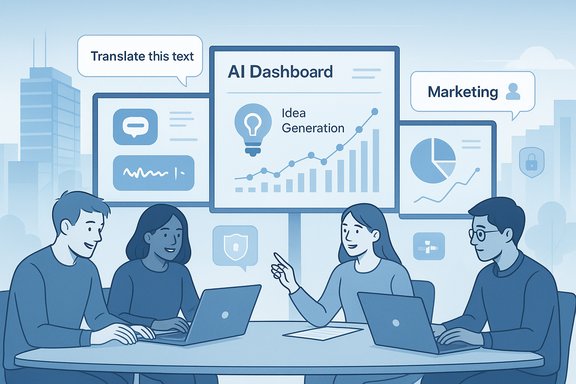
- Reported top use cases include translation, idea generation, communication, marketing, and product development. The share of companies using AI for idea generation was said to have risen materially (reported as 47 percent in the coverage), reflecting creative and exploratory adoption rather than only transactional automation. Many business owners told the survey that AI helped refine thinking and speed up creative tasks.
- Benefits reported by users centred on operational efficiency, time savings, and growth. In the coverage, 62% of AI users said they had experienced clear benefits — a finding said to be strongest in expert services and with younger entrepreneurs. At the same time, skills gaps (43%) and data security concerns (32%) appeared as the principal barriers to wider or more confident uptake. Free consumer tools were cited as an easy entry path but insufficient for secure, professional use, prompting calls for enterprise solutions like Microsoft Copilot.
Verification and what independent sources show
Cross‑checking the headline adoption numbers
- The Federation of Finnish Enterprises maintains a public presence that includes survey reporting; earlier 2025 waves of the Entrepreneur Gallup and related Employment Surveys are documented online with different sample sizes and distributions of AI use (for example, a June 2025 employment survey reported lower routine‑use figures and a different set of percentiles). This demonstrates variability across survey instruments and timing and flags that a direct confirmation of the October figures should be sought from the federation or the polling firm Verian for precision.
- Multiple industry and regional reports corroborate the direction of change — that AI adoption in Finnish firms is increasing, especially for language and productivity tasks — but they do not all report the same magnitudes. Studies by private vendors and sector groups show rapid upticks in interest and isolated high‑growth segments (e.g., service firms using LLMs for drafting and translation), while national surveys sometimes show lower routine daily use rates. This mixed evidence supports the broad claim of accelerating adoption but underlines the need to distinguish between experimentation and regular, governed use.
Independent corroboration on tools and use cases
- Reports from industry and training partners confirm that ChatGPT‑style interfaces and Copilot integrations are top of mind for SMEs because they map directly to common pain points: drafting, summarising, translating and ideation. Microsoft’s Copilot family and similar copilots embedded in productivity apps have been widely discussed and implemented in pilots across SMEs and larger organisations, which is consistent with the claims that Copilot is popular among business users.
- Telecom and enterprise providers like Elisa have active SME programmes that pair practical training with vendor tools and events — supporting the coverage’s point that vendor partnerships are being used to push practical, localised AI upskilling (including Finnish‑language processing improvements). That confirms there is a policy and training layer supporting SME adoption.
Critical analysis — strengths, opportunities, and immediate risks
Strengths and clear opportunities
- Rapid productivity wins: For small teams, tools that reduce time spent on drafting customer replies, marketing copy, translations and ideation can free scarce time for revenue‑generating activities. When correctly pipelined into everyday workflows, these gains compound quickly. Evidence from multiple vendor and sector studies confirms material time savings in drafting, summarisation and basic data tasks.
- Lower friction through integration: Copilot‑style assistants embedded directly into familiar apps (Word, Outlook, Excel, Teams) lower the activation energy for adoption. SMEs with existing Microsoft 365 subscriptions can get near‑term value without heavy integration budgets. This reduces vendor switching cost and helps adoption translate into measurable productivity changes.
- Localized language improvements: As Finnish‑language support improves, the entry barriers for local businesses shrink. Vendors and training partners increasingly deliver Finnish‑language examples, prompt templates, and playbooks, which makes the technology more directly useful for Finnish SMEs. Elisa and Suomen Yrittäjät training initiatives reinforce this practical capability building.
Risks and blind spots
- Survey variability and confirmation bias: Different surveys, different question frames and different sampling windows produce divergent headline percentages. Jumping from 38% to 57% in a single year — if true — would be among the fastest SME adoption curves recorded; but without a primary data release or harmonised methodology the headline may overstate the depth of routine use. Public reporting should distinguish “have ever used” vs “use regularly” vs “use in business‑critical workflows.” The published record shows mixed measures across waves, highlighting the need for transparency in methodology.
- Skills and governance gaps: The single biggest barrier to productive scaling is skills — SMEs consistently report a lack of training and confidence. Without role‑specific learning and on‑the‑job practice (promptcraft, verification practices, simple test suites), businesses risk low‑quality outputs, compliance errors, or productivity regressions that undercut the expected gains. Upskilling demand remains high, particularly in marketing and personal productivity use cases.
- Data security and leakage: Free consumer tools offer easy entry but often lack enterprise-grade privacy, SLAs or contractual guarantees about model training and data residency. For SMEs handling customer PII, financial data or proprietary IP, this is a real and present risk. The coverage’s emphasis on enterprise‑grade tools (e.g., Microsoft Copilot with business controls) is apt: secure, audited endpoints and contract terms reduce exposure. However, cost and complexity can be barriers, leaving a risky gap between experimentation and safe production use.
- Overreliance and complacency: When business owners accept AI outputs without adequate human review, errors, hallucinations or inappropriate tone can create reputational and legal risk. This is particularly salient in expert services (legal, accounting, regulated advice), where erroneous outputs can have outsized consequences if not validated. Evidence from sector case studies and Microsoft Copilot pilots repeatedly highlight the centrality of human verification.
Sector focus: where AI is taking hold in Finnish SMEs
Expert services (consulting, IT, marketing)
- These sectors see the most concentrated value today because they rely heavily on language, creative ideation and information synthesis — tasks LLMs are especially good at accelerating. Use cases include client proposals, draft reports, marketing content, translation/localisation, and internal research syntheses. The net effect is the compression of ideation and drafting cycles.
Customer service and internal communications
- Chatbot prototypes, auto‑responses, and meeting summarisation are accelerating. SMEs can triage routine customer enquiries with AI and reserve human time for complex or revenue‑sensitive interactions. Internal communication gains come from automated minutes, summary briefs and faster onboarding documentation. The reported plan among many SMEs to expand AI usage in customer service aligns with broader industry practice.
Product development and R&D light
- Smaller firms increasingly use AI for early‑stage product ideation, competitive analysis and producing minimal viable documentation. Where R&D budgets exist, retrieval‑augmented generation (RAG) workflows and specialised LLMs can accelerate prototype cycles — but they require technical integration and governance.
Practical playbook for SME owners (prioritised, sequential steps)
- Start with a short inventory
- Catalog existing subscriptions, data locations (where customer data lives), and current manual tasks that consume the most time.
- Identify low‑risk, high‑value pilot tasks (email templates, social posts, meeting summaries).
- Choose a one‑month pilot and measure baseline
- Define simple KPIs: time saved per task, number of human edits needed, error rate, customer satisfaction.
- Run the AI in parallel with the old process and log results for comparison.
- Use enterprise endpoints for sensitive data
- Where customer data or contracts are involved, prefer tools with business contracts and data‑governance features. Consumer tools are fine for practice but not for production‑level data.
- Build a light governance sheet
- One page with rules: which data can be pasted into which tools, approval workflows for client‑facing outputs, and a single owner responsible for verification. This reduces accidental leakage and clarifies responsibilities.
- Invest in short, role‑specific training
- Targeted modules on prompt design, verification, and task selection deliver far more value than generic “AI awareness” sessions. Partner programmes and vendor micro‑learning are effective for SMEs with limited training budgets.
- Scale only after proof
- If the pilot shows net benefits after adjusting for human verification costs, standardise templates, add simple monitoring, and roll out with clear SOPs.
Policy and ecosystem implications
- National and regional training initiatives matter: Finland’s ecosystem — universities, innovation hubs and telecom partners — plays a decisive role in lowering the cost of training and access to safer, localised tools. Public‑private programmes that combine technical help with governance templates will accelerate safe adoption.
- SME access to enterprise‑grade tools: Affordability of secure, business‑focused AI endpoints is a policy and market problem. Telco and platform partnerships that bundle secure AI with connectivity and support can be a pragmatic route for smaller firms. Elisa’s partnership work and the Yrittäjät & Tekoäly training modules are examples of that model.
- Measurement nuance in public reporting: National stakeholders and trade bodies should publish methodology details alongside headline adoption rates. Policymakers need consistent metrics to design effective interventions — for example differentiating “ever‑used”, “used in the past month”, and “used in revenue‑critical workflows.” The public record shows these measures are not always harmonised between waves.
What to watch next (signals of durable adoption)
- Movement from pilot to policy inside SMEs: more formal SOPs for AI outputs, designated AI champions and regular training schedules.
- Uptake of enterprise Copilot licences or vendor contracts for data protection — a sign firms are moving from sandbox to production.
- Growth in role‑specific micro‑learning adoption and vendor partnerships with local language support — these accelerate practical value creation.
- Public release of harmonised survey data (detailed methodology and raw shares by question) from federation or polling firms that would allow researchers to reconcile seemingly divergent headline figures. Until such releases are available, treat single‑wave leaps cautiously.
Conclusion
The narrative emerging from recent coverage — that Finnish SMEs are rapidly adopting AI, driven by younger owners and concentrated in the capital’s expert services — aligns with the country’s broader strengths: strong digital infrastructure, localised training partnerships, and early access to productivity copilots. These factors create real opportunity for small firms to reclaim time and scale tasks that previously required larger teams.However, the scale of the recent jump reported in the press demands careful scrutiny. Different surveys and reporting waves give different snapshots; headline percentages should be validated against primary survey releases and method notes before being treated as definitive. More troubling than headline variance is the persistent skills and governance gap: without focused training, simple verification practices and enterprise‑grade tooling for sensitive data, many SMEs risk converting promising pilots into risky production patterns.
Practical, low‑cost interventions — short pilots, one‑page policies, vendor partnerships for secure endpoints, and role‑tailored micro‑learning — can convert the initial buzz into durable competitive advantage. If Finnish SMEs pair these practical steps with clearer public reporting and continued support from partners such as Elisa and trade bodies, the country can indeed capitalise on its early lead. But the path from experimentation to responsible, enterprise‑grade adoption will require deliberate investment in people, processes and privacy — not just reliance on the novelty of generative AI.
Source: Helsinki Times https://www.helsinkitimes.fi/business/28200-ai-use-grows-fast-in-finnish-small-businesses.html
