

February’s FinTech headlines read like a briefing from the future: entrenched incumbents doubling down on generative AI, big players wiring payments directly into AI assistants, digital banks securing European licences, and stablecoins getting a second act as institutional settlement rails. These developments—detailed in FinTech Magazine’s February roundup—aren’t isolated press notes; they form an interlocking narrative about who controls the rails of money and intelligence as commerce shifts from “ask” to “act.”
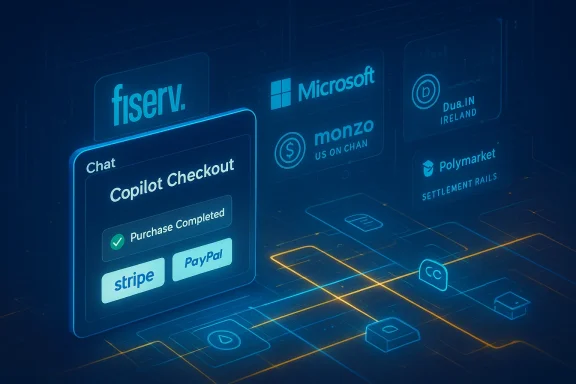
The fintech sector entered 2026 with one motif louder than any other: agentic AI—systems that don’t just advise, they take action. Microsoft’s Copilot platform moved from being a research showcase to a commerce surface where users can discover, compare and purchase without leaving a chat. Payment and platform vendors raced to be the plumbing inside those conversations, while banks and payroll platforms leaned on AI partnerships to streamline operations and productisation. FinTech Magazine’s monthly curation captures this pivot: enterprise AI deployments (notably Fiserv’s expanded Microsoft tie-up), in-chat commerce powered by Stripe and PayPal, Monzo’s EU licence, and Circle’s native-USDC settlement partnership with Polymarket are the leading edges of the trend.
Why this matters now:
Implications:
(Reporting aggregated from FinTech Magazine’s February roundup and corroborated through vendor announcements and trade coverage regarding Fiserv’s Microsoft expansion, Microsoft’s Copilot Checkout and payment partner integrations, Monzo’s EU banking licence, Circle’s native USDC partnership with Polymarket, and Paychex’s combined scale following recent acquisitions.)
Source: FinTech Magazine The Month in FinTech: February
 Background / Overview
The fintech sector entered 2026 with one motif louder than any other: agentic AI—systems that don’t just advise, they take action. Microsoft’s Copilot platform moved from being a research showcase to a commerce surface where users can discover, compare and purchase without leaving a chat. Payment and platform vendors raced to be the plumbing inside those conversations, while banks and payroll platforms leaned on AI partnerships to streamline operations and productisation. FinTech Magazine’s monthly curation captures this pivot: enterprise AI deployments (notably Fiserv’s expanded Microsoft tie-up), in-chat commerce powered by Stripe and PayPal, Monzo’s EU licence, and Circle’s native-USDC settlement partnership with Polymarket are the leading edges of the trend. Why this matters now:
- The user journey is collapsing: intent, discovery, and transaction are converging inside conversational surfaces.
- Platform control equates to data control: companies that own the in-chat experience gain first-party signals and payment flows.
- Regulatory and operational complexity scales quickly when agentic systems execute financial actions on behalf of users.
AI in FinTech: Fiserv’s strategic deepening with Microsoft
What happened
Fiserv announced a broad expansion of its collaboration with Microsoft, including deployment of Microsoft 365 Copilot across its workforce and deeper use of Microsoft’s Azure-based Foundry platform to build, deploy and manage AI applications. The company framed the move as a step toward “agentic” capabilities—shifting from automation to AI agents that can perform multistep tasks across platforms. Fiserv has also already been using GitHub Copilot at scale for engineering productivity and reported heavy token usage in Foundry during its experiments.Why it’s significant
- Scale of operational change: rolling Copilot into an enterprise the size of Fiserv touches client servicing, developer toolchains, fraud detection, and merchant-facing products. That’s a practical acceleration of AI from “pilot” to “production.”
- Platform lock-in risk: deep integration with Microsoft’s stack (Copilot + Foundry + Azure) increases efficiency but concentrates critical systems with a single cloud/AI vendor.
- Product implications: embedding generative agents in payments and banking workflows enables faster decisioning (e.g., authorization routing, merchant analytics), but also raises governance questions when agents take autonomous actions on money-moving systems.
Verified claims and caveats
- Fiserv disclosed that it will deploy Microsoft 365 Copilot and expand use of Microsoft Foundry—this is a company announcement and corroborated by multiple industry outlets.
- Operational metrics (for example, the amount of tokens processed in Foundry) are company-reported and should be treated as corporate disclosures rather than independently audited figures. Where claims about token volumes or performance thresholds appear in press materials, readers should expect these to be accurate representations of company telemetry but not independently verified.
Agentic commerce: Copilot Checkout, Stripe and PayPal embed payments into chat
The new buying surface
Microsoft launched Copilot Checkout, which allows shoppers to complete purchases natively inside a Copilot conversation. Payment partners for the initial rollouts include PayPal, Stripe and Shopify integrations—meaning when Copilot recommends or surfaces a product, the assistant can present a branded checkout inside the chat and accept payment without redirecting users to a merchant site. Shopify merchants are automatically enrolled absent an opt-out; other merchants may onboard via PayPal or Stripe connections.How payments actually work in-chat
- Microsoft’s integration with Stripe enables the chat to populate a checkout; Stripe then connects to the seller using agentic commerce primitives and, where applicable, issues shared payment tokens to avoid exposing buyer credentials directly to merchants.
- PayPal is similarly positioned to power branded checkout paths and guest payments inside the Copilot experience.
- Microsoft positions merchants as the merchant-of-record and emphasizes open protocols like the Agentic Commerce Protocol (ACP) to standardize interactions.
Implications and opportunities
- UX friction drops dramatically: moving from discovery straight to a transaction inside a chat removes multiple clicks, pages and interruptions that typically cause cart abandonment.
- Smaller merchants benefit from simplified multi-platform exposure—Shopify’s auto-enrolment could put millions of merchants within reach of in-chat buyers instantly.
- For payment providers, powering frictionless shopping in AI agents is a new vertical for authorization, risk, and tokenisation services; Stripe’s and PayPal’s roles extend beyond settlement to fraud signals and token exchange.
Risks and unanswered questions
- Data & privacy: when a purchase is completed inside an AI assistant, which party stores the conversation transcript, product selections, and post-sale communications? The ownership and retention policies will matter for customer service, dispute resolution and regulatory compliance.
- Automatic merchant enrolment: Shopify’s auto-enrolment (with opt-out) raises consent and discovery concerns for merchants who may be enrolled without explicit marketing due diligence.
- Anti-fraud & KYC: agentic checkouts will require robust, real-time risk decisions that balance user experience with liability—who bears fraud losses if an agent misinterprets identity or intent?
Digital banking moves: Monzo’s EU licence and passporting
The headline
Monzo secured a full European banking licence via the Central Bank of Ireland and the European Central Bank, a regulatory milestone that allows the UK challenger bank to operate within EU markets (starting in Ireland) and to passport services across the bloc. Monzo set up its European headquarters in Dublin and opened a waitlist for Irish customers following the approval.Why it matters
- Strategic hub: Ireland’s regulatory environment and English-speaking tech workforce make it a natural EU base for UK fintechs seeking post‑Brexit access to the single market.
- Revenue paths open: with EU deposit-taking powers, Monzo can now pursue lending, mortgages, and deposit-based monetisation across the eurozone, not just feature-led banking services.
- Competitive dynamics: other challengers and incumbent banks will need to respond as digital-first providers cement cross-border operations.
Trade-offs and regulatory visibility
- Local supervision: being licensed in Ireland brings Monzo under CBI oversight and ECB macro‑prudential supervision—this imposes compliance, capital, and reporting demands that will shape product launch cadence.
- Reputation & operational risk: Monzo has faced scrutiny on payment reversals and customer outcomes; expanding into new consumer bases means reputational risk scales alongside customer counts. Recent reporting on Monzo’s handling of fraud and refunds highlights why operational controls will be key as it scales into Europe.
Stablecoins moving into institutional rails: Circle + Polymarket
What was announced
Circle and prediction market platform Polymarket agreed to transition Polymarket’s settlement from bridged USDC (USDC.e on Polygon) to native USDC issued by Circle’s regulated affiliates. The migration is designed to reduce bridge risk, improve capital efficiency, and provide 1:1 redeemable dollar settlement as trading volumes and institutional interest grow.Why this is consequential
- Eliminates bridge risk: bridged assets introduce counterparty and smart-contract risks that are mitigated when settlement occurs with native, fully redeemable stablecoins.
- Institutional readiness: native USDC aligns Polymarket’s settlement mechanics with institutional expectations for redeemability and regulatory clarity—important where larger capital and custodians might participate.
- A blueprint for niche markets: prediction markets are an early case study for how onchain marketplaces can adopt regulated settlement rails without re‑architecting core trading logic.
Caveats and compliance
- Regulatory scrutiny: as stablecoins edge closer to institutional plumbing, they attract regulator focus on custody, reserve attestations, and AML/KYC—platforms and issuers must maintain transparent, audit-ready practices.
- Operational migration: moving tens of millions (or more) of user balances across token types and chains is non-trivial; clear migration timelines and rollback plans are operational necessities.
Payroll and HCM consolidation: Paychex scale and market footprint
Paychex’s acquisition of Paycor reshaped HCM market dynamics: the combined entity reports serving roughly 800,000 clients and processing payroll for approximately 1 in 11 U.S. private-sector employees. That scale confers a huge first-party dataset advantage for building payroll, benefits and HR AI services. The corporate narrative emphasises the enlarged customer base, expanded product set and richer compliance/advisory capabilities post-merger.Implications:
- Data moat: processing compensation for a large share of the workforce yields statistical advantages for models that predict wage patterns, benefits needs, and fraud anomalies.
- Regulatory & fiduciary duty: payroll providers operate as critical intermediaries for tax remittance and benefits administration—AI-driven automation must coexist with stringent auditability and fail-safe controls.
- Consolidation risk: market consolidation raises concentration concerns for employers who depend on a single HCM provider for payroll, benefits, and compliance across jurisdictions.
Cross-cutting analysis: strengths, systemic risks, and the near-term roadmap
Strengths & positive outcomes
- Improved user experience: in-chat checkout and embedded agents convert discovery to commerce faster than traditional flows, lowering abandonment and increasing merchant conversion rates.
- Operational efficiency: enterprise deployments of Copilot and Foundry promise productivity gains across underwriting, customer service and developer throughput.
- Infrastructure hardening for crypto markets: moves from bridged to native stablecoins reduce technical fragility and align onchain markets with conventional settlement standards.
Systemic and operational risks
- Vendor concentration: large swathes of fintech functionality—AI agents, developer tooling, identity and payments—are trending toward a small set of cloud and OS-level vendors. That increases single‑point-of-failure risk and systemic attack surface for regulators and risk officers to manage. Examples include deep Fiserv–Microsoft ties and Microsoft’s central role in Copilot Checkout.
- Data governance & audit trails: agentic actions create complex provenance chains. Who is accountable when an AI agent initiates a settlement or signs a contract? Firms must add deterministic logging, prompt & decision auditing, approvals, and human-in-the-loop controls to satisfy regulators and counterparties.
- Consumer & merchant consent friction: auto-enrolment and embedded checkout speed onboarding but can raise consent, fee transparency, and contract‑formation questions—particularly across jurisdictions with stricter consumer protection regimes.
- Fraud & dispute complexity: in-chat purchases blur the lines of merchant-of-record responsibility and platform facilitation. Payment providers and issuers must coordinate fraud-loss allocation rules and dispute pathways for endpoints (agent, platform, merchant, acquirer).
Regulatory lens
- Sandbox-to-scale risk: regulators have limited experience with agentic AI executing financial transactions. Supervised sandboxes and iterative certification regimes—from central banks, payments authorities and consumer protection agencies—will be essential to move from experimental to production usage safely.
- Stablecoin scrutiny: as Circle integrates native USDC into larger onchain venues, expect closer examination from payment regulators and banking supervisors regarding reserve management and settlement guarantees.
Practical guidance for fintech leaders and technologists
If you’re a CTO, product leader, or risk officer navigating the agentic commerce era, prioritize the following actions:- Map agentic touchpoints: inventory where AI agents can initiate transactions or change account state. Ensure each path has explicit guardrails.
- Implement deterministic logging: capture prompts, model inputs, model versions, decision outputs and human approvals as a single audit trail.
- Define loss allocation: pre-negotiate and document who bears liability for fraud, mis-execution or misclassification in agentic flows (platform vs merchant vs acquirer).
- Harden onboarding controls: for merchant auto-enrolment models, supply an opt-in audit and an obvious opt-out path; provide a merchant console to view and control Copilot-enabled listings.
- Stress-test migration plans: for token migrations (e.g., bridged → native stablecoin), run predictable migration windows with reconciliation checks, consumer notices and rollback plans.
Notable strengths and critical caveats in this month’s stories
- Strength: real-world production posture. Many announcements in February moved beyond “lab” to “rollout” (Copilot Checkout live in the U.S., Fiserv enterprise rollouts), signaling genuine production intent rather than marketing-only pilots. This materially shortens the window in which governance frameworks must be implemented.
- Strength: interoperability via standards. Microsoft and Stripe’s use of open primitives like the Agentic Commerce Protocol can reduce custom integrations and help merchants reach multiple agentic surfaces without bespoke engineering. Standardisation is a clear enabling factor here.
- Risk: concentration of control. Embedding commerce into a single assistant multiplies the value—and the risk—of controlling that surface. Firms must weigh efficiency gains against resilience and competition concerns.
- Caveat on numbers: several press releases and corporate announcements contain operational metrics (token counts, volumes, customer figures). These are legitimate company disclosures but should be treated as company-reported—useful for trend analysis but requiring independent verification for audit or regulatory purposes. For example, Fiserv’s token metrics and Paychex’s “1 in 11” stat are reported by the companies and repeated across trade press.
What to watch next (short list)
- Regulatory guidance on agentic AI in financial services: look for formal supervisory statements or sandbox frameworks from major regulators.
- Merchant adoption rates beyond early partners: whether Shopify’s auto-enrolment produces durable revenue lift for small merchants.
- Fraud and dispute patterns in in-chat commerce: early dispute resolutions will reveal whether agentic checkout reduces or shifts fraud losses.
- Further native stablecoin integrations: more platforms may shift from bridged assets to native USDC or other regulated stablecoins—watch liquidity and redemption dynamics.
Conclusion
February’s fintech headlines were less a list of disconnected releases and more a composite signal: the industry’s migration toward agentic commerce is real, payments are being re-embedded into conversational AI, and established firms are treating generative AI as a production priority rather than a speculative experiment. These changes promise smoother experiences and operational gains, but they also concentrate control of money-moving flows and surface new governance, liability and regulatory challenges. For practitioners, the imperative is clear: embrace the productivity of AI, but design for auditability, clarity of accountability, and systemic resilience from day one.(Reporting aggregated from FinTech Magazine’s February roundup and corroborated through vendor announcements and trade coverage regarding Fiserv’s Microsoft expansion, Microsoft’s Copilot Checkout and payment partner integrations, Monzo’s EU banking licence, Circle’s native USDC partnership with Polymarket, and Paychex’s combined scale following recent acquisitions.)
Source: FinTech Magazine The Month in FinTech: February
